How To Become An Affiliate Marketer In 2026 (Step By Step)


Affiliate marketing is one of the most searched side-income topics online right now – and for good reason. You recommend products, someone buys, you earn a commission. No inventory, no customer service, no upfront costs if you start smart.
But most guides skip the honest part: it takes real effort, the right structure, and usually 60–90 days before you see consistent money coming in.
Quick Answer: To become an affiliate marketer, pick a niche, join an affiliate program (Amazon, ShareASale, or a direct brand deal), create content that attracts buyers, and place your tracked links where your audience already spends time. Free methods like blogging and social media are the best starting point if budget is tight.
This guide covers every step in plain terms – from choosing your first program to scaling toward a real income – including how to start affiliate marketing for free, which affiliate products to sell, and what Amazon affiliation actually looks like in practice.

What is affiliate marketing and why does it still work in 2026?
Affiliate marketing is a performance-based model where you earn a commission for driving a sale, lead, or click to another company’s product. You get a unique tracking link, share it through content or ads, and get paid when someone converts. The merchant handles everything else – product creation, fulfilment, customer support.
It works because it aligns incentives perfectly. Brands only pay when results happen, which means the barrier to entry for affiliates is low and the ceiling is high for those who build real audiences.
Global affiliate marketing spend crossed $15 billion in 2023 and has been growing at roughly 10% per year, driven by the continued shift toward content-led commerce and creator-driven discovery.
The model also works across almost every niche – finance, fitness, software, fashion, home goods, education. Wherever people research purchases online, there is an affiliate opportunity. That breadth is what makes it one of the most accessible ways to monetise knowledge or a platform you already have.
In 2026, the strongest affiliates are not just link-droppers. They build trust first and sell second. That shift toward authenticity has actually made the model more sustainable, not less – audiences are more receptive to genuine recommendations than to banner ads, and search engines reward content that demonstrates real expertise.
How much can you realistically earn as an affiliate marketer?
Earnings vary enormously depending on your niche, traffic source, and the commission structure of the programs you join. Here is a realistic breakdown by effort level:
The middle band – $300 to $1,500 per month – is where most part-time affiliates realistically land after 6–12 months of consistent effort. The top figures are real but represent a small percentage of practitioners who have built large audiences and email lists over several years.
One note on ceiling figures: The $10,000+ per month cases you see shared online typically took 2–4 years to build and involve multiple traffic sources, an email list of 10,000+ subscribers, and usually a team. Plan your first 90 days around learning and building, not around income.
How to become an affiliate marketer step by step
The process is straightforward but the execution is where most beginners stumble. Work through these steps in order rather than jumping to promotion before your foundation is in place.
Step 1: Choose a niche you can own
Your niche determines your audience, your competition level, and your earning ceiling. The best niche sits at the intersection of something you understand well and something people actively spend money on.
Broad niches like “health” or “tech” are dominated by authority sites with years of content and thousands of backlinks. As a beginner, narrowing down gives you a real shot at ranking and building trust.
High-commission niches worth considering
Software and SaaS tools typically pay 20–40% recurring commissions. Finance products (credit cards, investing platforms) pay $50–$200 per lead. Health and wellness supplements pay 15–30% per sale.
Home improvement and appliances are strong for Amazon affiliation due to high average order values. Pet products consistently convert well because spending in that category is emotionally driven and less price-sensitive.
Why this works in 2026: Google’s Helpful Content updates have made thin affiliate sites harder to rank. Picking a niche you genuinely understand means you can write with the depth and specificity that both readers and search engines now reward.
Step 2: Pick the right affiliate programs
Once you have a niche, you need programs that match your audience’s buying behaviour. There are three main categories: large marketplace programs, niche-specific brand programs, and affiliate networks that aggregate hundreds of offers.
Amazon affiliation – the Amazon Associates program
Amazon Associates is the most common starting point for new affiliates and for good reason. The trust factor is unmatched – most online shoppers already have an Amazon account and are comfortable buying there.
The conversion rate on Amazon affiliate links tends to be higher than on direct brand sites simply because checkout friction is lower.
The trade-off is commission rates. Amazon pays between 1% and 10% depending on category, which means you need meaningful traffic volume to generate serious income. Home, garden, and tools sit at 3–8%.
Electronics are notoriously low at 1–2.5%. The sweet spot for Amazon affiliation is mid-to-high-ticket items in categories like home improvement, outdoor equipment, or kitchen appliances, where a $300 average order value still produces a useful commission even at 4%.
Important note: Amazon Associates has a 24-hour cookie window, one of the shortest in the industry. If a visitor clicks your link and buys three days later, you earn nothing.
Factor this into your content strategy – review content and “best of” comparison articles convert better than general informational posts because they target buyers already close to a decision.
ShareASale and CJ Affiliate
ShareASale and Commission Junction (CJ) are affiliate networks hosting thousands of merchant programs across every niche.
Commission rates on networks like these are typically higher than Amazon – 10–30% is common for physical products, and digital products often pay 40–50%. Cookie windows are also longer, usually 30–90 days.
The downside is that trust and conversion rates vary by merchant, and some programs have high payout thresholds or slow payment schedules.
Direct brand affiliate programs
Many brands run their own affiliate programs outside of networks, accessible through a simple “affiliate program” link in their footer. These often pay the highest commissions because there is no network middleman.
Software companies, course platforms, and subscription services tend to offer 20–50% recurring commissions, meaning you earn every month a referred customer stays subscribed.
Finding these requires more research but the payout is worth it once you have an audience with buying intent.
Step 3: Choose your content platform
Your content platform is where you place affiliate links and attract the audience that will click them. Each platform has a different traffic ceiling, effort requirement, and link placement flexibility.
A blog or niche website
A self-hosted WordPress blog remains the highest-ceiling platform for affiliate marketers. You own the traffic, the content, and the audience relationship. SEO-driven blogs compound over time – articles you write today can generate clicks and commissions years from now.
The downside is the timeline: expect 6–12 months before organic traffic becomes meaningful.
Using a free platform like WordPress.com or a free Blogger site lets you start affiliate marketing for free, though a self-hosted domain (roughly $10–$15/year) adds credibility and avoids platform restrictions on affiliate links.
YouTube
YouTube is the second-largest search engine in the world and one of the best affiliate channels available. Product reviews, tutorials, and comparison videos all carry affiliate links in the description.
YouTube’s algorithm also surfaces older content to new viewers, giving your videos a long earning tail. The barrier is production comfort – you need to be willing to appear on camera or invest in good screen recording and audio equipment.
Social media and short-form video
TikTok, Instagram Reels, and Pinterest can drive fast initial traffic, especially in visual niches like fashion, beauty, home decor, and fitness. The limitation is link placement – most short-form platforms restrict clickable links to your bio or a link-in-bio tool.
Conversion rates tend to be lower than search-intent traffic from Google or YouTube because viewers are in discovery mode, not purchase mode.
Step 4: Create content that converts
The content types that generate the most affiliate revenue are not the most popular – they are the most purchase-intent-driven.
“Best [product category] under $100”, “[Product A] vs [Product B]”, and “Is [Product] worth it?” outperform general informational articles every time because the reader is already in buying mode.
Structure matters as much as topic selection. A converting affiliate article gives a clear recommendation early, explains the reasoning with specific detail, addresses the main objections, and makes it easy to click through.
Burying your affiliate link at the bottom of a 3,000-word article that hedges every claim is not a content strategy – it is a missed opportunity.
For how to start affiliate marketing for free, a combination of free blog hosting, free keyword research tools (Google Search Console, Ubersuggest free tier, AnswerThePublic), and organic social distribution is a completely workable starting stack.
Add a domain and basic hosting when your first commissions arrive.
Step 5: Build your email list from day one
The affiliates who reach $5,000–$10,000 per month almost universally have an email list. An email list is an audience you own – platform algorithm changes and de-indexing events cannot take it away.
A list of 5,000 engaged subscribers who trust your recommendations can generate $1,000–$3,000 per promotional email send, depending on niche and offer quality.
Free email tools like Mailchimp (up to 500 subscribers free) or Brevo (300 emails/day free) let you start building your list before you have any budget.
Offer a free resource relevant to your niche – a checklist, a comparison guide, a short email course – in exchange for an email address. Even adding 10–20 subscribers per week compounds significantly over 12 months.
The best affiliate products to sell in 2026
Not all affiliate products are equal. The best affiliate products to sell combine strong conversion rates, meaningful commission values, and audiences that are actively searching for solutions rather than passively browsing.
Digital products and software
Software tools, online courses, and digital subscriptions are the highest-margin affiliate category. Commission rates of 30–50% are standard, and many SaaS tools pay recurring monthly commissions for the lifetime of the customer.
A single referred customer on a $99/month tool at 30% commission earns you $29.70 every month they stay subscribed. Ten customers like that is nearly $300 in monthly recurring revenue from one product.
Earning potential: $500–$5,000/month with a focused content strategy targeting software buyers in a specific industry vertical.
High-ticket physical products
High-ticket items – furniture, exercise equipment, photography gear, outdoor and camping equipment – generate useful commissions even at modest percentage rates. A 4% Amazon commission on a $1,200 treadmill sale is $48 from one click.
You do not need enormous traffic volume when average commission values are this high. Content strategies for high-ticket affiliate products centre on detailed review articles, comparison guides, and buyer’s guides targeting people already researching specific models.
Recurring subscription products
Subscription boxes, streaming services, software, and membership communities all offer the potential for recurring commissions. Promoting products where customers stay subscribed for 12+ months on average means your commission compounds each month without additional effort.
Look for programs with low churn rates – subscription businesses that customers actively love and recommend tend to retain customers far longer than services people use passively.
Finance and insurance products
Finance affiliate products pay some of the highest flat-rate commissions available – $50 to $200 per approved lead is common for credit cards, loan products, and investment platforms.
The audience targeting must be precise and the content must be genuinely helpful and accurate, but the payout per conversion means you do not need huge traffic volume to generate meaningful income.
Finance content also tends to have high search intent, which makes it well-suited to SEO-driven blogs.
How to start affiliate marketing for free
Starting without a budget is entirely possible and in some ways preferable – it forces you to focus on content quality and audience trust rather than paid traffic shortcuts that are easy to get wrong.
The free affiliate marketing stack that works in 2026 looks like this: a free blog on WordPress.com or Medium for long-form content, a Pinterest or TikTok account for visual distribution, a free email tool for list-building, and affiliate programs with no application fee (Amazon Associates, ShareASale, and most direct brand programs are all free to join).
Google Search Console is free and tells you exactly which search queries your content is appearing for.
The only genuine cost of starting for free is time. Budget at least 10 hours per week for 3–4 months before expecting any meaningful affiliate income.
That timeline is realistic – not pessimistic – and knowing it upfront keeps you from quitting during the slow early phase when most beginners abandon their efforts.
Important: Always disclose affiliate relationships clearly. The FTC requires it in the US, and the ASA requires it in the UK.
A simple “this post contains affiliate links – if you buy through them I may earn a commission at no extra cost to you” covers the requirement and, done honestly, rarely affects conversion rates.
Legal and ethical considerations every affiliate marketer needs to know
The affiliate marketing space has a long history of grey-area tactics that damage trust, attract regulatory attention, and ultimately hurt everyone in the ecosystem. Knowing what to avoid is as important as knowing what to do.
What to avoid absolutely
Do not cloak or disguise affiliate links in ways that prevent readers from understanding they are affiliate links. Do not write fake reviews for products you have not used or do not genuinely recommend.
Do not create comparison articles designed to steer readers toward a lower-quality product that pays a higher commission.
Do not use paid search ads that violate a merchant’s terms – most programs prohibit bidding on their brand name directly.
Cookie stuffing – dropping affiliate tracking cookies on users without a genuine click – is explicitly illegal in many jurisdictions and will get you banned from every reputable affiliate program immediately. The same applies to using bots or click farms to generate fake conversions.
What to do instead
Only promote products you would genuinely recommend to a friend. If you have not used something personally, say so and explain your research methodology. Update reviews regularly when products change.
Be honest about the limitations of products alongside their strengths – readers trust reviewers who acknowledge flaws far more than those who are uniformly positive about everything.
Key principle: Your audience’s trust is your most valuable business asset – protecting it is always more profitable than maximising short-term commission revenue.
Final thoughts: Which affiliate approach suits you?
Affiliate marketing is not a single path – it is a framework that adapts to different skills, schedules, and ambitions. Here is a quick breakdown by reader profile to help you choose your starting point.
Complete beginner
Start with Amazon Associates and a free WordPress.com blog in a niche you already know well. Write 10 comparison or review articles before worrying about promotion. Focus entirely on content quality in the first 60 days. Join ShareASale after your first 5 articles so you have alternative programs ready as your content grows.
Intermediate / part-time
If you already have a blog, social following, or email list – even a small one – shift your focus toward higher-commission programs and recurring products.
Audit your existing content for missed link placement opportunities. Add an email opt-in if you do not have one. Aim to diversify beyond Amazon affiliation within the next 90 days to reduce exposure to their commission rate changes.
Advanced / full-time goal
If your goal is $5,000+ per month within 12 months, affiliate marketing alone is a slow route. The affiliates who reach that level fastest combine content-driven affiliate income with their own product sales – either physical products through a dropshipping store or digital products.
Owning your product means you keep 100% of the margin rather than 5–30%. Affiliate content then becomes a feeder for your own store rather than your only income source.
Anyone ready to move faster
If the 6–12 month runway of affiliate marketing feels too long, ecommerce through a ready-built dropshipping store offers a parallel income stream that you can launch this week rather than next year. The two models complement each other well – your affiliate content drives organic traffic, and your store captures the buyers in that traffic who prefer to purchase directly.
AliDropship: Your complete all-in-one solution for starting dropshipping in 2026
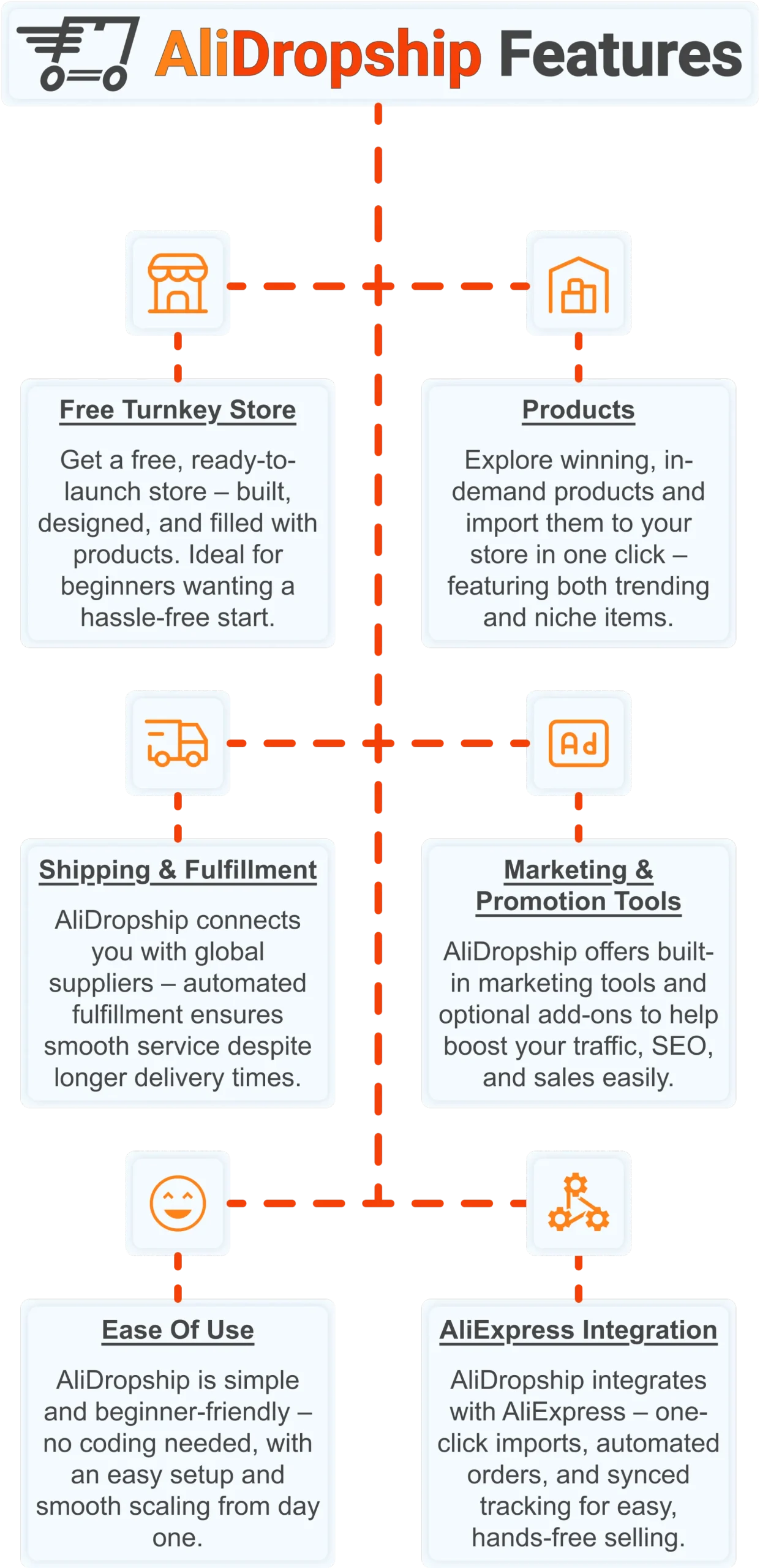
If you want the simplest possible way to start dropshipping – especially if you are brand new – AliDropship remains one of the most beginner-friendly tools available in 2026. It brings together store creation, product imports, automation, and marketing into a single streamlined system designed to help you launch quickly and grow confidently.
Free turnkey store 🛍️
Get a free turnkey store – built, designed, and filled with products. Ideal for beginners wanting a hassle-free start, the store comes fully optimized to attract customers right away, saving you time on setup.
Plus, it includes professional design elements to give your business a polished, trustworthy look from day one. This ready-made foundation makes it easy to move seamlessly into product selection.
Products 📦
Once your store is set up, you can explore winning, in-demand products and import them in one click – featuring both trending and niche items. This wide selection lets you cater to diverse customer interests and test what works best.
Regular updates ensure you always have fresh products, keeping your store competitive and relevant. With great products in place, smooth shipping becomes the next essential step.
Shipping & fulfillment 🚚
AliDropship connects you with global suppliers, and automated fulfillment ensures seamless order processing despite international delivery times. Customers receive real-time tracking updates, which builds confidence and trust in your store. Once shipping is handled reliably, you can focus on promoting your store and attracting traffic.
Marketing & promotion tools 📣
To maximize sales, AliDropship offers built-in marketing tools and optional add-ons that help boost traffic, SEO, and conversions. From email campaigns and discounts to social media integration, these tools empower you to reach and retain customers without needing prior marketing experience.
With promotion strategies in place, managing your business becomes simpler and more efficient.
Ease of use 👌
AliDropship is beginner-friendly – no coding needed, with an intuitive dashboard that guides you through every step. Easy setup and smooth scaling let you expand your store without stress.
As your business grows, adding new features, products, and marketing campaigns remains hassle-free, giving you more time to focus on sales.
AliExpress integration 🛒
Finally, AliDropship integrates seamlessly with AliExpress, enabling one-click imports, automated orders, and synced tracking. Your inventory stays up-to-date with the latest products and prices, while automated order processing frees you from manual tasks.
Combined with the turnkey setup, reliable shipping, and built-in marketing tools, this integration ensures your dropshipping business is fully equipped for growth and success.
Learning how to become an affiliate marketer is a great first step – but adding a ready-built ecommerce store turns that knowledge into a real business with no waiting period. Claim your free AliDropship store today and start selling alongside your affiliate content.
How to become an affiliate marketer with no experience?
How to start affiliate marketing for free?
Starting affiliate marketing for free requires only three things: a free content platform, a free affiliate program, and consistent effort. WordPress.com, Medium, and Pinterest all allow affiliate links and cost nothing to use. Google Search Console is free and shows you which search queries your content is appearing for, which guides your next article topics. Free tools like Ubersuggest and AnswerThePublic help identify low-competition keywords worth targeting. The only real investment is time.
How does Amazon affiliation work for beginners?
Amazon Associates is free to join and gives you access to affiliate links for millions of products. When a visitor clicks your link and buys within 24 hours, you earn a commission ranging from 1 to 10 percent depending on the product category. Home, garden, and outdoor categories tend to pay 3 to 8 percent, while electronics pay as little as 1 to 2.5 percent. The 24-hour cookie window is short compared to other programs, so review and comparison content targeting buyers close to a purchase decision converts best.
What are the best affiliate products to sell in 2026?
The best affiliate products to sell combine strong commission rates with high buyer intent. Software and SaaS tools typically pay 20 to 40 percent recurring commissions, making them the highest-value category for long-term income. High-ticket physical products like fitness equipment, furniture, and outdoor gear generate useful commissions even at modest percentage rates due to high average order values. Finance products such as credit cards and investment platforms pay 50 to 200 dollars per approved lead. Digital courses and subscriptions also convert well because buyers are often highly motivated.
How long does it take to earn money from affiliate marketing?
Most part-time affiliates start seeing their first small commissions within 60 to 90 days of consistent content publishing. Meaningful monthly income in the range of 300 to 1,500 dollars typically takes 6 to 12 months of regular effort. Full-time income above 3,000 dollars per month usually requires 12 to 24 months of building an audience, email list, and content library. These timelines assume at least 10 hours of focused work per week – results scale directly with consistency and content quality.