Ecommerce Marketing Strategies That Actually Work In 2026

Most ecommerce stores do not fail because of bad products. They fail because nobody sees them. You can have the cleanest store, competitive pricing, and a solid product lineup – and still make zero sales if your marketing for ecommerce is scattered or nonexistent. The good news is that the strategies that move the needle are not secret. They are just underused.
Quick Answer: The most effective ecommerce marketing strategies in 2026 combine a clear unique selling proposition, consistent brand building, platform-specific content (especially Instagram marketing), email automation, and SEO – applied together rather than in isolation.
This guide breaks down every major strategy, how much effort each requires, what kind of results to realistically expect, and exactly how to get started – whether you are brand new or ready to scale.
Before diving into individual tactics, it helps to understand why most ecommerce marketing fails. The answer is almost always the same: store owners copy what big brands do without the budget or audience those brands already have. The strategies below are designed for real businesses at early and mid-growth stages – not Fortune 500 marketing departments.

What are ecommerce marketing strategies?
Ecommerce marketing strategies are the deliberate actions you take to attract visitors to your store, convert them into buyers, and keep them coming back. Unlike traditional retail marketing, ecommerce marketing operates across multiple digital channels simultaneously – search engines, social platforms, email inboxes, and paid ad networks – all of which need to work together to produce consistent revenue.
In 2026, the landscape has shifted in a few important ways. Organic reach on most social platforms has declined, ad costs have risen, and consumers have become significantly better at ignoring generic promotional content.
That means the stores that grow are the ones that invest in brand building, not just traffic generation. A recognizable brand with a clear unique selling proposition will outperform a generic store with a bigger ad budget almost every time.
Marketing for ecommerce also covers the full customer lifecycle – from the moment someone first hears about your store to the point where they become a repeat buyer who recommends you to others. Most beginners focus only on acquisition (getting new customers) and ignore retention entirely. That is a costly mistake, since returning customers typically convert at two to four times the rate of first-time visitors.
How much can you realistically earn from ecommerce in 2026?
Earnings vary significantly depending on niche, effort level, and which marketing strategies you prioritize. The table below gives a realistic overview of what different approaches typically produce at different stages.
These figures represent realistic ranges for stores that are actively implementing each strategy – not passive setups. The highest earners in each row typically combine that channel with at least one other.
One note on these figures: Reaching the upper end of any range typically takes 60–90 days of consistent effort and requires a store that is properly set up, niche-focused, and backed by a clear unique selling proposition. Full-time effort – meaning 4 to 6 hours per day dedicated to marketing – is what separates stores that stall at $30/day from those that break $200/day.
The core ecommerce marketing strategies that actually drive growth
There is no single magic channel. Stores that grow consistently use a layered approach – owned channels like email and SEO for stability, social channels like Instagram for discovery, and paid channels for speed when budget allows. Here is how each major strategy works in practice.
Building a unique selling proposition first
Every other marketing strategy in this article depends on this one. Your unique selling proposition (USP) is the specific reason a customer should buy from your store rather than a competitor. Without it, your ads feel generic, your social content blends in, and your email subject lines get ignored.
How to define your USP
Start by asking three questions: Who is your ideal customer? What problem does your product solve for them specifically? And why can they not get the same thing – at the same quality, price, or experience level – somewhere else? Your USP lives at the intersection of those three answers.
A strong USP is not “we sell quality products at great prices.” That is what every store claims. A strong USP sounds more like “premium minimalist home office accessories for remote workers who hate clutter” or “eco-friendly pet supplies with carbon-neutral shipping.” It is specific, it speaks to an identity, and it immediately filters out people who are not your customer – which is actually a strength, not a weakness.
Why this works in 2026: Consumer trust is at a low. Shoppers are more skeptical of generic stores than ever. A clearly articulated USP signals that a real person built this store for a specific purpose – which converts better than a broad product catalog ever will.
Brand building for long-term ecommerce growth
Brand building is the strategy most beginners skip because it feels slow. It is also the strategy that compounds the most over time. A recognizable brand means lower ad costs (because people search for you directly), higher conversion rates (because trust is already established), and better word-of-mouth (because customers remember you).
Visual identity
Your store name, logo, color palette, and typography should be consistent across every touchpoint – your website, your social profiles, your email templates, and your packaging inserts if you use them. Inconsistency signals amateur operation, and it quietly kills conversion rates. Pick two to three brand colors, stick with them, and apply them everywhere.
Brand voice
Your brand voice is how your store sounds when it communicates – in product descriptions, social captions, email subject lines, and customer service replies. Decide early whether your brand is playful or serious, expert or approachable, minimal or detailed. Then write every piece of copy through that filter. Customers notice when a brand sounds like a different person in every channel, even if they cannot articulate why it bothers them.
Social proof and community
Brand building accelerates dramatically when real customers start validating your store publicly. Encourage reviews after every purchase. Repost user-generated content. Feature customer stories. Even a handful of authentic five-star reviews on your product pages can increase conversion rates by 15–30% compared to pages with no social proof at all.
Earning potential: Brand-built stores typically achieve 20–40% higher average order values than unbranded stores in the same niche, because customers trust them enough to buy more per transaction.
Instagram marketing for ecommerce stores
Instagram remains one of the highest-converting social platforms for ecommerce in 2026 – particularly for visual niches like fashion, home decor, beauty, fitness, and food. The platform has over two billion monthly active users, and its shopping features have matured significantly, allowing customers to go from discovery to purchase without ever leaving the app.
Content formats that drive ecommerce sales on Instagram
Reels are the primary discovery engine on Instagram right now. Short-form video content (15–30 seconds) showing your product in use, solving a real problem, or delivering a satisfying visual moment consistently outperforms static image posts for reach. Aim for three to five Reels per week if Instagram marketing is a core channel for your store.
Stories are for retention – keeping your existing followers engaged and driving repeat traffic. Use Stories for flash sales, behind-the-scenes content, polls, and limited-time offers. They convert particularly well for existing audiences who already trust your brand.
Instagram Shopping setup
If you are not using Instagram Shopping tags on your posts, you are leaving money on the table. Once your product catalog is linked, you can tag items directly in feed posts, Reels, and Stories – turning organic content into shoppable moments. Setup requires a Facebook Business account and a connected product catalog, which most ecommerce platforms support natively.
Micro-influencer partnerships on Instagram
Mega-influencers with millions of followers are expensive and often deliver poor ROI for ecommerce stores. Micro-influencers – accounts with 5,000 to 80,000 followers in a specific niche – typically have far higher engagement rates and more trusting audiences.
A single authentic post from a micro-influencer in your niche can drive 50–300 direct visits and meaningful sales spikes, often for a product gifting arrangement rather than a cash fee.
SEO and content marketing
Search engine optimization is the slowest ecommerce marketing strategy to start working and the most durable once it does. A product page or blog post that ranks on page one of Google can drive free, high-intent traffic for years – without ongoing ad spend. For stores in evergreen niches (home, fitness, pets, lifestyle), SEO is often the highest-ROI channel at the 12-month mark.
On-page SEO for product pages
Every product page should target a specific keyword that reflects how real shoppers search. Use that keyword in the page title, the first 100 words of the product description, at least one image alt tag, and the URL slug. Avoid keyword stuffing – one naturally placed keyword per paragraph is plenty. Focus more on writing descriptions that actually help the customer make a decision.
Blog content for organic discovery
A store blog is not just filler content. When done correctly, it drives top-of-funnel traffic from people who are researching before they buy. A fitness accessories store, for example, could rank for “best resistance bands for beginners” and capture buyers who are not yet searching for a specific brand. Aim for one to two long-form posts per week (1,000+ words) in the early stages of building organic traffic.
Email marketing and list building
Email remains the highest-ROI channel in ecommerce marketing – consistently generating $36–$42 for every $1 spent across the industry. The reason is simple: your email list is an owned asset. Unlike social media followers or paid ad audiences, nobody can take it away from you, and reaching it costs nothing beyond your email platform subscription.
List building tactics that work
A discount popup offering 10–15% off a first order is still the most effective list-building tool for new stores. Exit-intent popups – which appear when a visitor moves to close the tab – capture people who were about to leave and convert a meaningful percentage into subscribers. Giveaways, lead magnets (a free guide related to your niche), and post-purchase sign-up incentives all compound your list growth over time.
Automated email sequences every store needs
The three non-negotiable automations are: a welcome sequence (3–5 emails introducing your brand and best products), an abandoned cart sequence (2–3 emails sent within 24 hours of cart abandonment), and a post-purchase sequence (thank you, review request, and a cross-sell recommendation). These three sequences alone, set up once, will typically recover 5–15% of otherwise lost revenue on autopilot.
Paid advertising: when and how to use it
Paid ads – primarily Meta (Facebook and Instagram) and Google Shopping – are the fastest way to drive traffic to a new store. They are also the fastest way to lose money if the store is not ready. Before running a single paid ad, make sure your store has a clear USP, compelling product pages, a functional checkout, and at least a handful of reviews.
Starting with Meta ads
For most ecommerce stores, Meta ads are the right starting point. The targeting options are unmatched, the creative formats (video, carousel, collection) suit product-based businesses well, and the learning algorithm is strong enough that even modest budgets ($20–$50/day) can produce usable data within a week.
Start with one ad set targeting a broad but relevant interest audience, run three to five creative variants, and let the algorithm identify the winner before scaling.
Google Shopping for high-intent buyers
Google Shopping ads appear at the top of search results when someone types a product-specific query – meaning the buyer intent is much higher than on social platforms. The trade-off is that Google Shopping requires a well-structured product feed, accurate pricing, and clean product titles to compete effectively.
For stores with strong SEO foundations, Google Shopping is a natural paid complement that captures buyers already actively searching for what you sell.
Legal and ethical considerations in ecommerce marketing
As ecommerce has grown, so has regulatory scrutiny around marketing practices. Staying on the right side of these rules is not just ethically correct – it protects your store from platform bans, payment processor issues, and legal liability.
Key principle: Honest marketing that accurately represents your product, delivery times, and return policy will always outperform deceptive tactics – because it builds the repeat customer base that sustains a real business.
What to avoid absolutely: fake reviews (against both platform terms and FTC guidelines), misleading “limited time” countdown timers that reset on refresh, undisclosed influencer partnerships (the FTC requires clear #ad or #sponsored disclosure), and exaggerated income or result claims in your marketing copy.
These tactics may produce short-term spikes but routinely result in account terminations, chargebacks, and reputational damage that is very hard to recover from.
What to do instead: collect genuine reviews through post-purchase email sequences, create real urgency through actual inventory limits or time-specific sales, clearly disclose all influencer partnerships, and make product claims that are specific and verifiable. A store built on honest marketing compounds in value – a store built on shortcuts gets reset to zero.
How to choose the right ecommerce marketing strategy for your situation
Not every strategy makes sense at every stage. The right combination depends on your budget, your available time, and how far along your store already is.
Complete beginner
If you are starting from scratch with a limited budget, focus on three things in order: nail your unique selling proposition, set up your core email automations (welcome sequence and abandoned cart), and start posting consistently on one social platform – Instagram marketing is the strongest starting point for most product niches.
Do not touch paid ads until you have made at least 10–20 organic sales and understand what messaging your audience responds to.
Intermediate – part-time seller
If you are already making sales but growth has plateaued, the highest-leverage move is usually SEO and content marketing. Organic search traffic compounds over time and dramatically reduces your dependence on paid channels. Layer in micro-influencer outreach and expand your email sequences to include post-purchase upsells and win-back campaigns for lapsed customers.
Advanced – full-time ecommerce goal
At this stage, you need all channels working together: SEO for organic stability, email for retention and margin, Instagram marketing for brand visibility and discovery, and paid ads for scalable growth.
The shift at this level is from doing everything yourself to building systems – templated content workflows, automated email sequences, and data-driven ad optimization. Stores at this stage that are running all channels consistently typically see $150–$500+/day in revenue within 6–12 months of serious commitment.
Regardless of your stage, the single most important thing you can do right now is make sure your store is set up correctly before investing heavily in any marketing channel. A leaky store – slow load times, unclear product descriptions, a confusing checkout – will waste every dollar and hour you put into driving traffic to it.
AliDropship: Your complete all-in-one solution for starting dropshipping in 2026
If you want the simplest possible way to start dropshipping – especially if you are brand new – AliDropship remains one of the most beginner-friendly tools available in 2026. It brings together store creation, product imports, automation, and marketing into a single streamlined system designed to help you launch quickly and grow confidently.
Free turnkey store 🛍️
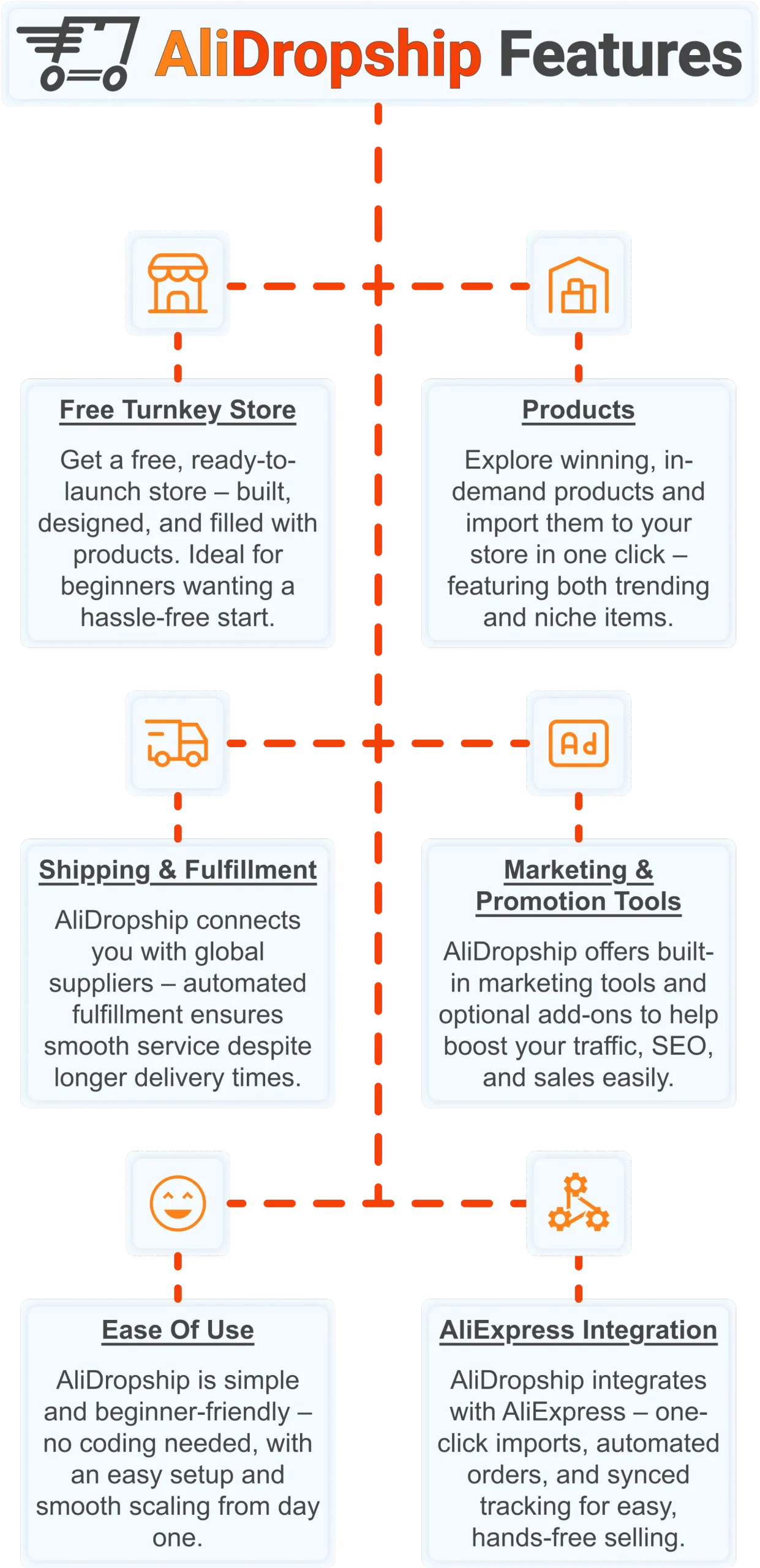
Get a free turnkey store – built, designed, and filled with products. Ideal for beginners wanting a hassle-free start, the store comes fully optimized to attract customers right away, saving you time on setup. Plus, it includes professional design elements to give your business a polished, trustworthy look from day one. This ready-made foundation makes it easy to move seamlessly into product selection.
Products 📦
Once your store is set up, you can explore winning, in-demand products and import them in one click – featuring both trending and niche items. This wide selection lets you cater to diverse customer interests and test what works best. Regular updates ensure you always have fresh products, keeping your store competitive and relevant. With great products in place, smooth shipping becomes the next essential step.
Shipping & fulfillment 🚚
AliDropship connects you with global suppliers, and automated fulfillment ensures seamless order processing despite international delivery times. Customers receive real-time tracking updates, which builds confidence and trust in your store. Once shipping is handled reliably, you can focus on promoting your store and attracting traffic.
Marketing & promotion tools 📣
To maximize sales, AliDropship offers built-in marketing tools and optional add-ons that help boost traffic, SEO, and conversions. From email campaigns and discounts to social media integration, these tools empower you to reach and retain customers without needing prior marketing experience. With promotion strategies in place, managing your business becomes simpler and more efficient.
Ease of use 👌
AliDropship is beginner-friendly – no coding needed, with an intuitive dashboard that guides you through every step. Easy setup and smooth scaling let you expand your store without stress. As your business grows, adding new features, products, and marketing campaigns remains hassle-free, giving you more time to focus on sales.
AliExpress integration 🛒
Finally, AliDropship integrates seamlessly with AliExpress, enabling one-click imports, automated orders, and synced tracking. Your inventory stays up-to-date with the latest products and prices, while automated order processing frees you from manual tasks. Combined with the turnkey setup, reliable shipping, and built-in marketing tools, this integration ensures your dropshipping business is fully equipped for growth and success.
Every ecommerce marketing strategy in this guide works best when it is pointing traffic to a store that is already built and ready to convert. Get your free turnkey store from AliDropship and start putting these strategies to work today.
What are the most effective ecommerce marketing strategies in 2026?
How important is a unique selling proposition for ecommerce marketing?
A unique selling proposition is one of the most important foundations for any ecommerce marketing effort. Without a clear reason for a customer to choose your store over a competitor, your ads become generic, your content blends in, and your conversion rates suffer. Research shows that stores with a clearly defined unique selling proposition typically achieve 20 to 40 percent higher average order values than unbranded stores in the same niche. Defining your USP before investing in any marketing channel saves significant time and budget.
How does Instagram marketing work for ecommerce stores?
Instagram marketing works for ecommerce by combining short-form video content, shoppable posts, and influencer partnerships to drive discovery and direct sales. Reels are currently the strongest discovery format on the platform, reaching new audiences without requiring ad spend. Instagram Shopping allows you to tag products directly in posts and Stories, turning organic content into purchase opportunities. Micro-influencers with 5,000 to 80,000 followers in a specific niche often deliver better return on investment than larger accounts due to their higher audience trust and engagement rates.
How much can a beginner realistically earn with ecommerce marketing?
A beginner implementing consistent ecommerce marketing strategies can realistically earn between 30 and 80 dollars per day within 60 to 90 days of focused effort. This assumes a properly set up store, a defined niche, regular content output on at least one social platform, and functional email automations including a welcome sequence and abandoned cart recovery. Full-time effort of 4 to 6 hours per day significantly accelerates results compared to a casual part-time approach. Reaching 150 dollars per day or more typically requires 4 to 6 months of layered multi-channel marketing.
What is the best marketing for ecommerce stores on a low budget?
The best low-budget marketing for ecommerce combines three free or near-free channels: organic Instagram marketing, email list building with a discount popup, and SEO-optimized product pages and blog content. Instagram Reels cost nothing to produce and can reach thousands of potential buyers in a relevant niche. A simple email welcome sequence and abandoned cart recovery can be set up on most platforms for under 20 dollars per month. These three channels together provide a sustainable foundation that does not require paid ad spend to generate early sales.