

Voice Commerce

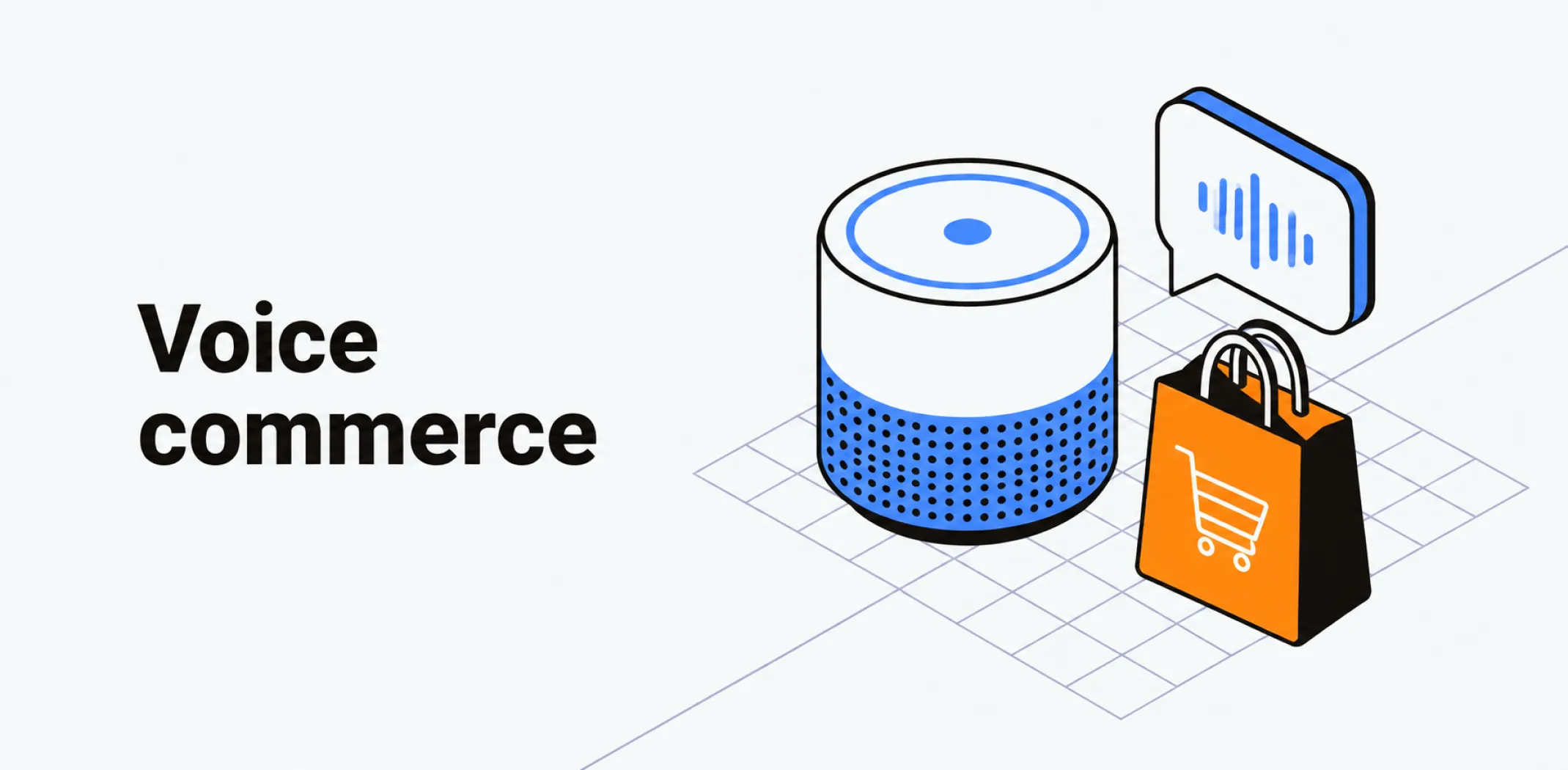
Voice commerce is a form of online shopping in which customers use spoken commands to voice assistants or smart speakers to search for, order, and pay for products, rather than typing or clicking through a website or app.
Voice commerce, sometimes called v-commerce, relies on natural language processing to convert spoken requests into completed transactions on devices such as smart speakers, smartphones, and connected car systems. It differs from conversational commerce, which covers a broader range of interactions including text-based chat, by relying specifically on audio input and output rather than typed messages.
A chatbot can serve as the software layer behind a voice commerce interaction, but voice commerce also functions through built-in assistants that were not designed around a conversational chat interface. It is most common for repeat purchases, quick reorders, and simple transactions where the product and preferences are already known to the system.
How voice commerce works
- The customer issues a spoken request to a voice-enabled device, such as asking to reorder a product or find an item.
- The device’s speech recognition software converts the spoken audio into text.
- Natural language processing software interprets the intent behind the request.
- The system matches the interpreted intent to a specific product, order, or account action.
- The device asks the customer to confirm the purchase, usually through a short spoken prompt.
- Payment is processed automatically using a payment method already linked to the customer’s account.
- The device provides audio confirmation once the order is placed.
Example
A customer asks a smart speaker to reorder coffee pods after running low. The device recognizes the request based on a previous purchase linked to the account, states the product name, quantity, and price out loud, and places the order once the customer verbally confirms it. No screen, app, or manual search is involved at any point in the transaction.
Key characteristics
- Hands-free interaction: Customers complete searches and purchases without touching a screen or keyboard.
- Device dependency: The experience requires a smart speaker, voice-enabled smartphone assistant, or similar hardware.
- Reliance on purchase history: Repeat orders and saved payment details make voice-only checkout practical for known products.
- Limited browsing: Voice interfaces suit quick reorders better than comparing multiple products, since there is no visual catalogue to scan.
Related terms
- Conversational commerce – shopping conducted through chat or messaging interfaces, of which voice commerce is one form.
- Chatbot – automated software that can power the interface behind a voice commerce interaction.
- Personalization – the practice of tailoring recommendations, which voice assistants rely on to narrow ambiguous spoken requests.
- Recommendation engine – the system that can suggest a product when a spoken request does not name an exact item.
Frequently asked questions
Does voice commerce require a smart speaker?
No. While smart speakers are common, voice commerce also works through smartphone assistants, smart TVs, and connected car systems that support voice-activated shopping.
Is voice commerce secure for payments?
Most voice commerce platforms use stored, pre-authorized payment methods and often add voice recognition or PIN confirmation for higher-value purchases to reduce the risk of unauthorized orders.
Which products sell best through voice commerce?
Simple, familiar, low-consideration items such as household staples, groceries, and repeat purchases tend to sell best, since customers already know what they want and do not need to browse options.
AliDropship: An all-in-one platform for starting an online business in 2026
AliDropship is an online business platform that gives customers a ready-made store, a digital products catalogue, and built-in, one-click advertising within a single system. Founded in 2015 and based in Irvine, California, it has helped launch more than 1,500,000 stores and holds a 4.7-star rating on Trustpilot. It is built for people with no prior experience and no technical skills.
🆓 Free 14-day trial
New users get full platform access for 14 days, including a ready-made store, hosting, a domain, an SSL certificate, and access to the digital products catalogue. The trial also includes a $40 ad coupon to test the advertising system. Order fees apply only when a sale is made.
📦 Digital products
Customers choose from AliDropship’s catalogue of digital products – guides, courses, checklists, tools, and AI-powered toolkits – and keep up to 70% of every sale. Delivery is instant and automated, so there is no inventory, shipping, or manual fulfillment involved.
📣 One-click advertising
AliDropship includes built-in advertising that customers can turn on for as little as $10 a day. The system handles targeting, creatives, and optimization, and many customers see their first orders the same day they launch ads.
👌 Ease of use
AliDropship requires no coding or marketing experience. The store, products, and ads are managed from a single dashboard that works on a phone as well as a desktop, and a personal growth manager is available to help by chat.
💳 Monthly plan
After the trial, continued access is $39 a month, covering the store, the digital products catalogue, and ongoing support. There is no long-term contract, and the plan can be cancelled at any time.
What is voice commerce?
How does voice commerce work for online stores?
Is voice commerce growing in ecommerce?
What devices support voice commerce?
What are the limitations of voice commerce?
Are you ready to become an owner
of a profitable online business?
Free Dropshipping Guide