

Personalization

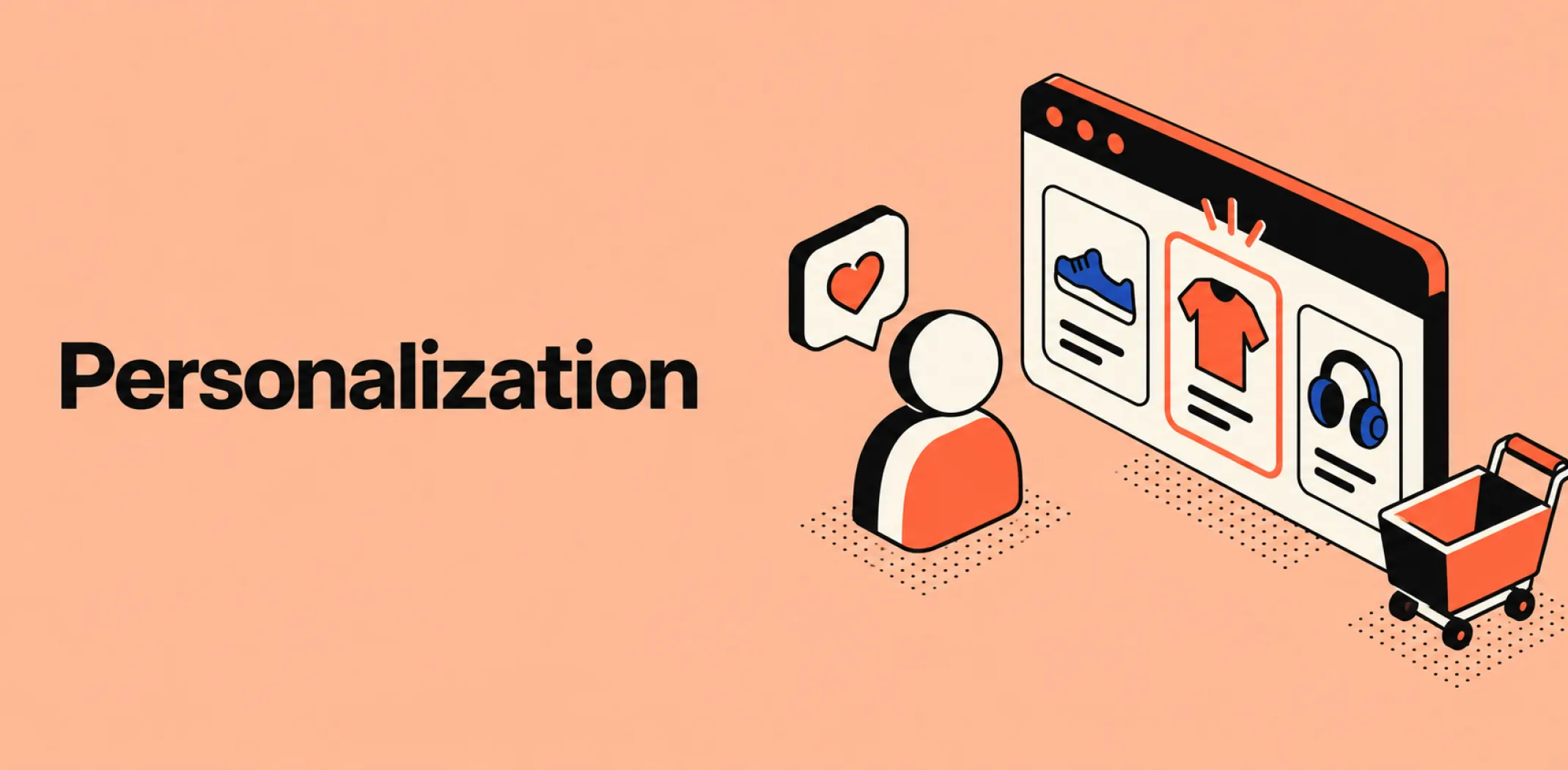
Personalization is the practice of tailoring content, offers, or product suggestions to an individual shopper based on their data, so that each visitor sees a version of the store shaped by their own behavior rather than a single generic experience.
Personalization draws on data such as browsing history, location, past purchases, and on-site behavior, often processed through a recommendation engine or similar machine learning system. It is a broader concept than any single tool, since it can apply to product suggestions, homepage layout, email content, pricing, and even the tone of a chatbot.
Personalization sits within the wider category of AI-powered ecommerce, though simpler forms can also be rule-based, such as showing a returning visitor’s last-viewed products.
Example
A shopper who previously browsed hiking boots on an outdoor gear store returns to the site a week later. Instead of the default homepage, the store shows a banner featuring hiking boots on sale, along with a “recently viewed” section further down the page. The store also sends a follow-up email a few days later highlighting a matching pair of hiking socks, based on the same browsing data.
Key characteristics
- Data-driven: The experience shown to a shopper is shaped by their own browsing, location, or purchase data.
- Applies across channels: Personalization can appear on-site, in email, in ads, and within chat interactions.
- Ranges from simple to advanced: Basic personalization uses fixed rules, while advanced systems rely on predictive models.
- Requires ongoing data collection: The quality of personalization typically depends on how much recent shopper data is available.
Related terms
- Recommendation engine – a common tool used to power product-level personalization.
- Machine learning in ecommerce – the technology behind more advanced, predictive personalization.
- Chatbot – a tool that can apply personalization within a conversational interface.
- AI-powered ecommerce – the broader use of artificial intelligence across store operations, including personalization.
Frequently asked questions
Does personalization require a large amount of customer data?
More data generally improves accuracy, but basic personalization can work with just a single browsing session or location.
Is personalization the same as targeted advertising?
No, targeted advertising decides which ads a person sees, while personalization changes the on-site or in-app experience itself.
Can personalization be turned off by a store owner?
Yes, most personalization tools and platform features can be disabled or adjusted through store settings.
AliDropship: An all-in-one platform for starting an online business in 2026
AliDropship is an online business platform that gives customers a ready-made store, a digital products catalogue, and built-in, one-click advertising within a single system. Founded in 2015 and based in Irvine, California, it has helped launch more than 1,500,000 stores and holds a 4.7-star rating on Trustpilot. It is built for people with no prior experience and no technical skills.
🆓 Free 14-day trial
New users get full platform access for 14 days, including a ready-made store, hosting, a domain, an SSL certificate, and access to the digital products catalogue. The trial also includes a $40 ad coupon to test the advertising system. Order fees apply only when a sale is made.
📦 Digital products
Customers choose from AliDropship’s catalogue of digital products – guides, courses, checklists, tools, and AI-powered toolkits – and keep up to 70% of every sale. Delivery is instant and automated, so there is no inventory, shipping, or manual fulfillment involved.
📣 One-click advertising
AliDropship includes built-in advertising that customers can turn on for as little as $10 a day. The system handles targeting, creatives, and optimization, and many customers see their first orders the same day they launch ads.
👌 Ease of use
AliDropship requires no coding or marketing experience. The store, products, and ads are managed from a single dashboard that works on a phone as well as a desktop, and a personal growth manager is available to help by chat.
💳 Monthly plan
After the trial, continued access is $39 a month, covering the store, the digital products catalogue, and ongoing support. There is no long-term contract, and the plan can be cancelled at any time.
How does personalization improve conversion rates?
What types of data are used for personalization?
Is personalization expensive to set up for a small store?
Does personalization raise privacy concerns?
What is the difference between personalization and segmentation?
Are you ready to become an owner
of a profitable online business?
Free Dropshipping Guide