


Standard Shipping

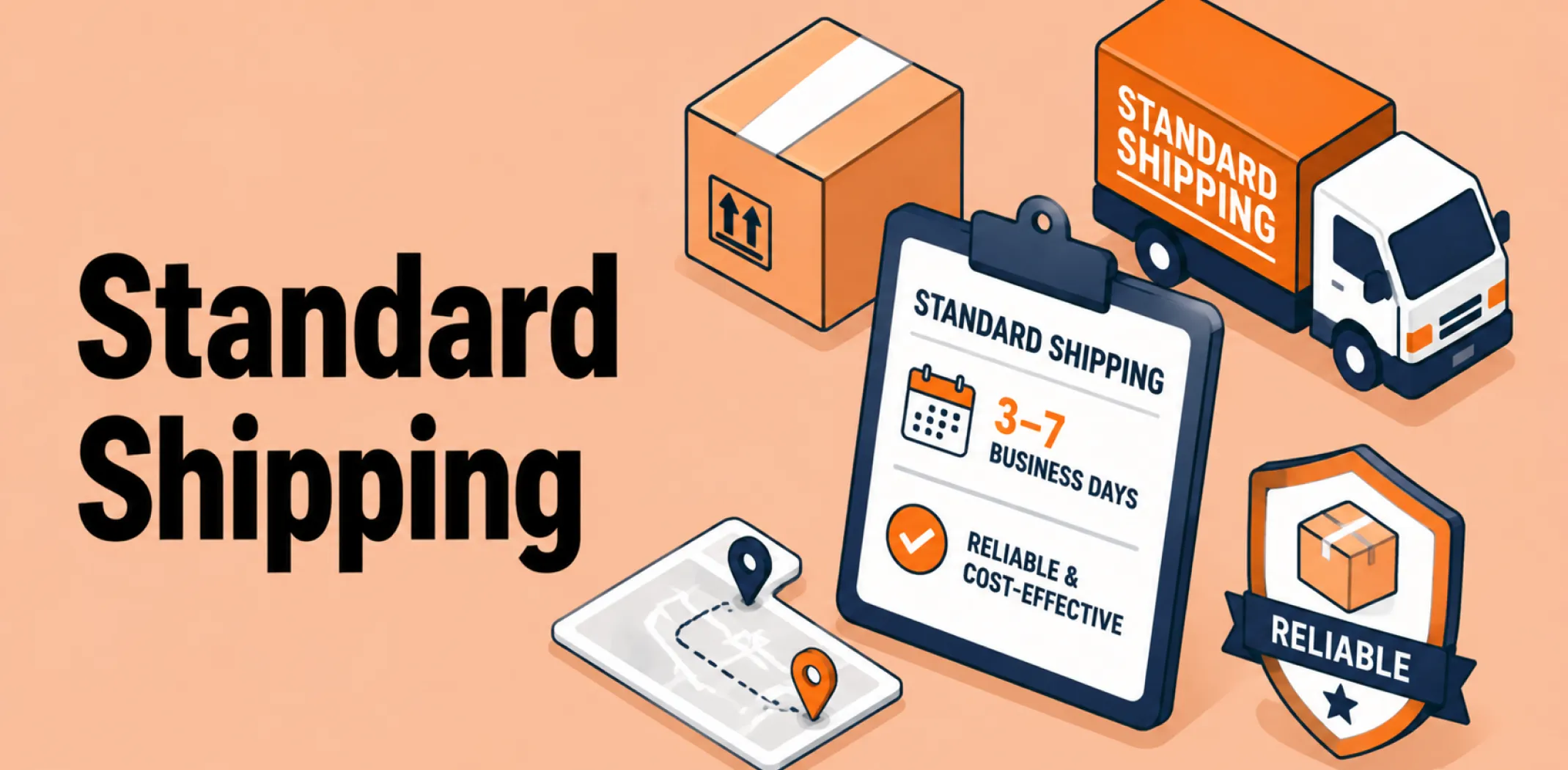
Standard shipping is the default, non-priority delivery method used by most ecommerce stores and online marketplaces, offering customers a lower-cost fulfillment option in exchange for longer estimated delivery windows compared to express or expedited alternatives.
Standard shipping operates through established carrier networks – including national postal services and major logistics providers – using economy routing and consolidated transport rather than dedicated or next-day lanes.
Because parcels move alongside other freight and are processed in batches rather than on priority schedules, transit times are longer but carrier costs are lower, which allows merchants to offer shipping at reduced rates or absorb the cost as free shipping on qualifying orders.
In dropshipping, standard shipping is the default method offered by most suppliers, particularly those based in overseas manufacturing hubs. Cross-border standard shipping can involve multiple carrier handoffs between an origin country postal service and a destination country network, with transit times varying by route, customs processing speed, and seasonal volume.
Merchants must set accurate delivery expectations at checkout to avoid disputes, returns, or negative reviews driven by shipping time rather than product quality.
How it works
- Order placed: A customer completes a purchase at checkout and selects standard shipping, or it is applied automatically as the default fulfillment method.
- Order passed to supplier or warehouse: The merchant or supplier receives the order and prepares the item for dispatch, typically within one to three business days depending on the fulfillment model.
- Carrier collection: The parcel is collected or dropped off at a carrier facility. For cross-border shipments, the origin country postal service or logistics partner accepts the item and logs it into their tracking system.
- Transit and routing: The parcel moves through carrier sorting facilities and transport legs. Economy routing means it may be consolidated with other parcels and routed via the most cost-efficient path rather than the fastest.
- Customs clearance (international): For cross-border shipments, the parcel passes through customs inspection at the destination country. Clearance time varies and is outside the carrier’s or merchant’s control.
- Last-mile delivery: The destination country carrier or postal service takes over and delivers the parcel to the customer’s address. A tracking update is generated at each handoff point.
- Delivery confirmation: The customer receives the parcel. Depending on carrier and value, a signature may or may not be required. The order fulfillment cycle is complete.
Example
A customer orders a phone case from a dropshipping store. The merchant uses a supplier based in China who ships via a standard cross-border service. The supplier dispatches the parcel within two days of the order. The item travels from the origin facility to an international sorting hub, boards a consolidated freight shipment, clears customs at the destination, and is handed to the national postal carrier for last-mile delivery. Total transit time is 12 days. The customer paid $1.99 for standard shipping at checkout; the merchant paid $2.80 to the supplier for the same service, absorbing the $0.81 difference to keep the storefront price competitive.
Key characteristics
- Lower cost than express: Standard shipping rates are significantly lower than expedited or priority alternatives, making them the default choice for price-sensitive buyers and high-volume merchants managing margin.
- Longer transit windows: Delivery timelines range from a few days for domestic shipments to several weeks for cross-border routes, depending on origin, destination, and carrier network.
- Carrier network dependency: Parcels move through shared infrastructure rather than dedicated lanes, meaning transit times can be affected by volume surges, weather, or carrier capacity constraints outside the merchant’s control.
- Tracking availability varies: Domestic standard shipments typically include full end-to-end tracking. International standard shipments may show limited tracking events once the parcel crosses borders and changes carrier networks.
- Customs exposure on international routes: Cross-border standard shipments pass through customs, introducing a variable delay that neither the merchant nor the carrier can predict or control.
Related terms
- Order fulfillment – the end-to-end process of picking, packing, and dispatching an order, of which standard shipping is the final delivery stage.
- Supplier – the manufacturer or distributor responsible for dispatching goods via standard or other shipping methods on behalf of the merchant.
- Warehousing – the storage of inventory prior to dispatch, relevant when a merchant holds stock rather than relying on direct supplier fulfillment.
- Overhead costs – the operational expenses a merchant must account for, including the difference between shipping charged to the customer and the actual carrier cost.
Frequently asked questions
How long does standard shipping take?
Domestic standard shipping typically takes 3 to 7 business days depending on origin, destination, and carrier. International standard shipping varies more widely: shipments from Asia to North America or Europe commonly take 10 to 20 business days, with additional time possible during peak periods or if customs processing is delayed.
What is the difference between standard shipping and express shipping?
Standard shipping uses economy routing through shared carrier networks, resulting in lower cost and longer transit times. Express shipping uses priority or dedicated lanes with committed delivery windows, typically 1 to 3 business days, at a significantly higher cost per parcel. Merchants offering both options allow customers to choose based on urgency and price sensitivity.
Is standard shipping tracked?
Domestic standard shipments almost always include tracking. International standard shipments usually include tracking at the origin end but may show limited updates once the parcel transfers to a destination country carrier network. Full end-to-end tracking on international routes is more reliably available with premium or registered postal services than with basic economy options.
Can standard shipping be offered for free?
Yes. Many merchants absorb standard shipping costs and offer it as free shipping on all orders or above a minimum order value threshold. This is a common conversion strategy: research consistently shows that free shipping reduces cart abandonment.
The shipping cost is typically factored into the product price or accepted as a cost of customer acquisition. For context on how shipping fits into overall business costs, see the is dropshipping profitable guide.
AliDropship: An all-in-one platform for starting dropshipping in 2026
AliDropship is a dropshipping platform that covers store creation, product imports, order automation, and marketing within a single system. It is designed for users with no prior ecommerce experience, though it also supports scaling for more established stores.
🛍️ Free turnkey store
New users receive a free pre-built store – set up, designed, and stocked with products. The store includes a ready-to-use product catalogue and a standard storefront design. It also comes with hosting, a domain, SSL, and payment systems already set up and included.
📦 Products
The platform provides access to a product catalogue covering both trending and niche items, with one-click import to your store. The catalogue is updated regularly to reflect current market availability. Products can be browsed, filtered, and added without leaving the platform.
🚚 Shipping & fulfillment
AliDropship provides access to a vast catalogue of products from global suppliers and handles order fulfillment automatically once a purchase is made. Customers receive tracking information directly, and orders are processed without manual intervention from the store owner.
📣 Marketing & promotion tools
The platform includes built-in marketing tools covering email campaigns, discount management, SEO settings, and social media integration. These are available within the dashboard and do not require third-party subscriptions for basic use.
👌 Ease of use
AliDropship requires no coding knowledge. The dashboard contains all the necessary tools for managing your store, products, and orders in one place. Additional features and products can be added as the store grows without rebuilding the existing setup.
How long does standard shipping take?
What is the difference between standard shipping and express shipping?
Is standard shipping tracked?
Can standard shipping be offered for free?
Are you ready to become an owner
of a profitable online business?
Free Dropshipping Guide