

Reverse Logistics

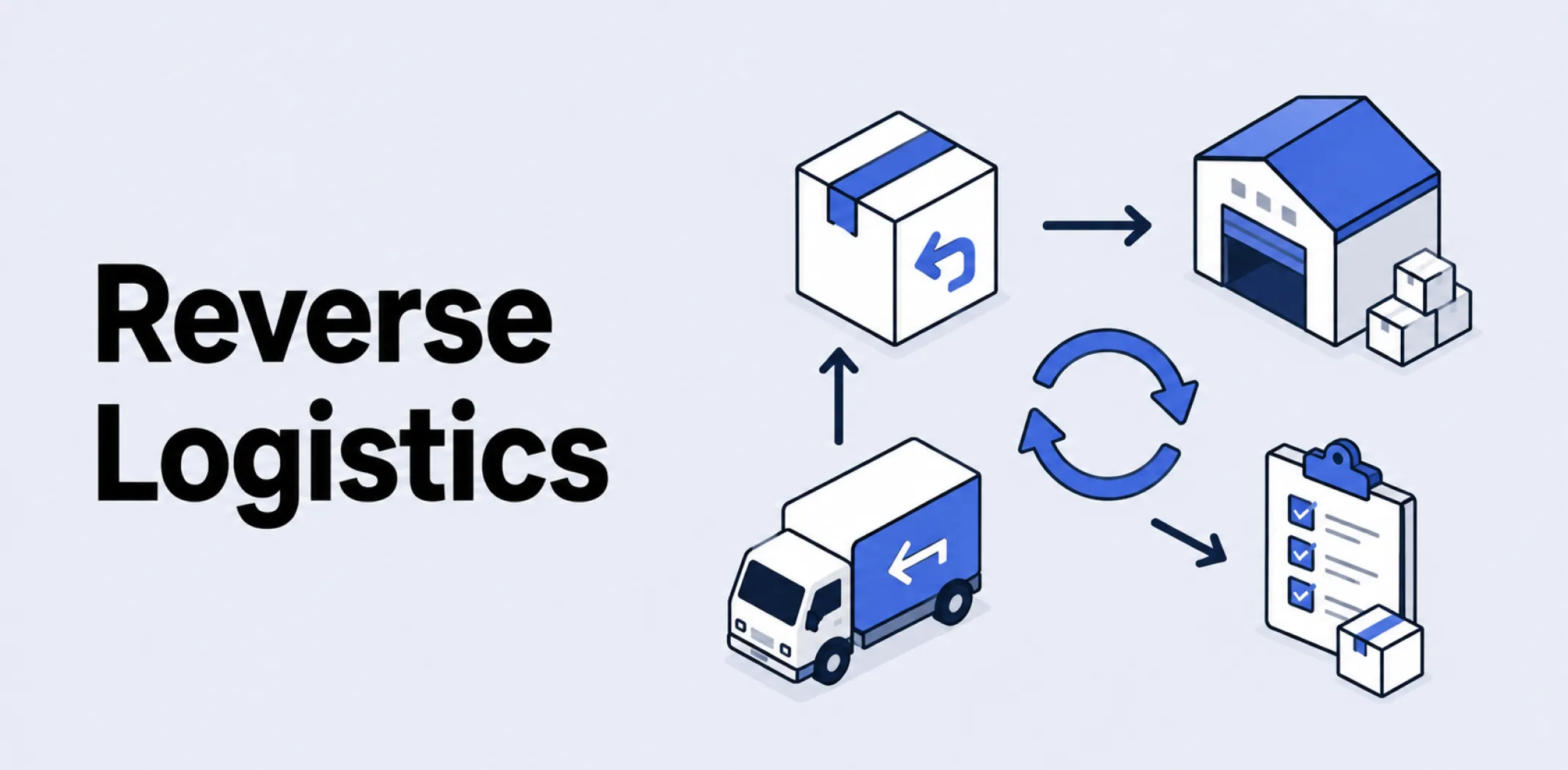
Reverse logistics is the set of processes that move goods backward through the supply chain – from the customer back to the merchant, supplier, warehouse, or disposal facility – after a sale has been completed.
Standard forward logistics moves goods from manufacturer to warehouse to merchant to customer. Reverse logistics operates in the opposite direction, managing what happens to products after they leave the customer’s hands. This includes customer-initiated returns, warranty claims, product recalls, unsold stock moving back from retailers to distributors, and end-of-life disposal or recycling.
In ecommerce, the most common driver of reverse logistics activity is the customer return: a purchased item travelling back through carrier networks to the merchant or supplier for assessment, resale, refurbishment, or disposal.
Reverse logistics is operationally more complex than forward logistics because each item in the reverse flow is in an unknown condition, arrives at unpredictable times, and requires individual assessment before a resolution can be applied. Forward logistics benefits from batching and predictability; reverse logistics deals in exceptions.
For ecommerce merchants and dropshippers, reverse logistics costs – including return carrier fees, assessment labor, refund processing, and inventory write-downs – form a significant component of total overhead costs that must be factored into pricing and margin planning.
How it works
- Return initiated by customer: A customer contacts the merchant to request a return, exchange, or warranty claim. The merchant reviews the reason against their return policy and approves or declines the request. If approved, a return authorization and shipping instructions are issued.
- Return label issued: The merchant or supplier generates a return shipping label and sends it to the customer, either pre-paid or requiring the customer to cover the cost depending on the return reason and merchant policy. Some merchants issue a return label linked to their carrier account; others ask customers to use their own carrier and submit for reimbursement.
- Customer dispatches item: The customer packs the item and drops it at the carrier collection point or arranges a pickup. The parcel enters the carrier network and begins travelling back toward the merchant or designated return address.
- Item received and assessed: The returned item arrives at the merchant warehouse, supplier facility, or dedicated returns processing center. Staff inspect the item against the stated return reason: is it damaged, unused, incomplete, or as described? The assessment determines which resolution path the item follows.
- Resolution applied: Based on assessment, the item is either restocked as sellable, marked for refurbishment, sent to liquidation, returned to the supplier for credit, or disposed of. The resolution triggers the corresponding customer outcome: refund issued, exchange dispatched, or store credit applied.
- Data captured and reported: The return is logged in the merchant system with reason, condition, resolution, and cost. Patterns in return data – recurring defects from a specific supplier, high return rates on a specific product – inform sourcing decisions and fulfillment process improvements.
Example
An ecommerce store selling home fitness equipment receives 12 returns in a single month for the same resistance band set, all citing snapped bands within two weeks of use. The merchant reviews the return log, confirms the pattern is isolated to one batch from one supplier, and initiates a recall conversation with the supplier. A pre-paid return label is issued to all 12 customers. Eight items arrive back in acceptable condition for a partial resale decision; four are disposed of as unusable. Refunds are issued for all 12 within three business days of return receipt. The supplier agrees to replace the defective batch at no cost. The merchant updates their supplier quality scorecard and increases the sampling rate on future incoming stock from that source. Total reverse logistics cost for the incident: carrier fees, assessment labor, two disposal write-downs, and four hours of customer service time.
Key characteristics
- Opposite direction to forward logistics: Where forward logistics moves goods predictably from source to customer in planned batches, reverse logistics handles individual items moving back in unplanned flows, requiring more per-unit processing effort.
- Condition uncertainty: Every item entering the reverse logistics flow arrives in an unknown state. Assessment on receipt is required before any downstream decision – restock, refurbish, liquidate, or dispose – can be made.
- Multiple resolution pathways: Unlike forward logistics which has one destination, reverse logistics routes items to different outcomes based on condition, product type, supplier agreement, and commercial viability of resale or refurbishment.
- Higher per-unit cost than forward logistics: The lack of batching, the assessment requirement, and the variable outcomes make each reverse logistics transaction more expensive to process than an equivalent forward shipment of the same item.
- Data value for supplier management: Reverse logistics data is a diagnostic signal: high return rates on specific products or from specific batches indicate quality or description issues that should feed back into supplier evaluation and sourcing decisions.
Related terms
- Supplier – the manufacturer or distributor to whom returned items may be sent for credit or replacement, and whose product quality directly determines reverse logistics volume.
- Order fulfillment – the forward logistics process whose failures – wrong items, damaged goods, incorrect quantities – generate a significant share of reverse logistics activity.
- Warehousing – the storage infrastructure used to receive, assess, and process returned items before resolution is applied.
- Overhead costs – the operational expenses that include all reverse logistics activity: carrier fees, assessment labor, refund payouts, and disposal or liquidation costs.
Frequently asked questions
What is the difference between reverse logistics and returns?
Returns are a subset of reverse logistics. A return is the specific act of a customer sending a purchased item back to a merchant.
Reverse logistics is the broader operational framework that manages all post-sale backward movement of goods – including returns, but also warranty claims, product recalls, unsold inventory moving back through the supply chain, and end-of-life disposal or recycling.
Every return involves reverse logistics, but not all reverse logistics activity involves a customer return.
How does reverse logistics work in dropshipping?
In dropshipping, the merchant typically does not hold inventory, so returned items cannot go to a merchant warehouse directly.
Common approaches include routing returns to the supplier for assessment and credit, directing returns to a third-party returns processing address, or issuing refunds without requiring physical return for low-value items where the reverse logistics cost exceeds the product value.
The merchant manages the customer communication and resolution regardless of which physical return path is used.
Why is reverse logistics more expensive than forward logistics?
Forward logistics ships known goods from a fixed origin to a defined destination in planned batches, enabling high route efficiency and low per-unit cost. Reverse logistics handles individual items of unknown condition, arriving unpredictably, each requiring manual assessment before a resolution path can be determined.
The absence of batching, the assessment labor, and the multiple possible downstream outcomes – restock, refurbish, liquidate, dispose – all increase the per-unit processing cost significantly above the equivalent forward shipment.
How can a dropshipping merchant reduce reverse logistics costs?
The most effective levers are reducing the volume of returns in the first place and streamlining the resolution process for those that occur. Return volume is reduced by sourcing from higher-quality suppliers, improving product descriptions and imagery to set accurate expectations, and choosing product categories with structurally lower return rates.
Resolution costs are reduced by establishing clear supplier agreements on defect responsibility, using pre-paid return labels negotiated at volume rates, and applying a refund-without-return approach for low-value items where the cost of processing the physical return exceeds its recovery value.
AliDropship: An all-in-one platform for starting dropshipping in 2026
AliDropship is a dropshipping platform that covers store creation, product imports, order automation, and marketing within a single system. It is designed for users with no prior ecommerce experience, though it also supports scaling for more established stores.
🛍️ Free turnkey store
New users receive a free pre-built store \u2013 set up, designed, and stocked with products. The store includes a ready-to-use product catalogue and a standard storefront design. It also comes with hosting, a domain, SSL, and payment systems already set up and included.
📦 Products
The platform provides access to a product catalogue covering both trending and niche items, with one-click import to your store. The catalogue is updated regularly to reflect current market availability. Products can be browsed, filtered, and added without leaving the platform.
🚚 Shipping & fulfillment
AliDropship provides access to a vast catalogue of products from global suppliers and handles order fulfillment automatically once a purchase is made. Customers receive tracking information directly, and orders are processed without manual intervention from the store owner.
📣 Marketing & promotion tools
The platform includes built-in marketing tools covering email campaigns, discount management, SEO settings, and social media integration. These are available within the dashboard and do not require third-party subscriptions for basic use.
👌 Ease of use
AliDropship requires no coding knowledge. The dashboard contains all the necessary tools for managing your store, products, and orders in one place. Additional features and products can be added as the store grows without rebuilding the existing setup.
What is the difference between reverse logistics and returns?
How does reverse logistics work in dropshipping?
Why is reverse logistics more expensive than forward logistics?
How can a dropshipping merchant reduce reverse logistics costs?
Are you ready to become an owner
of a profitable online business?
Free Dropshipping Guide