

Referral Marketing

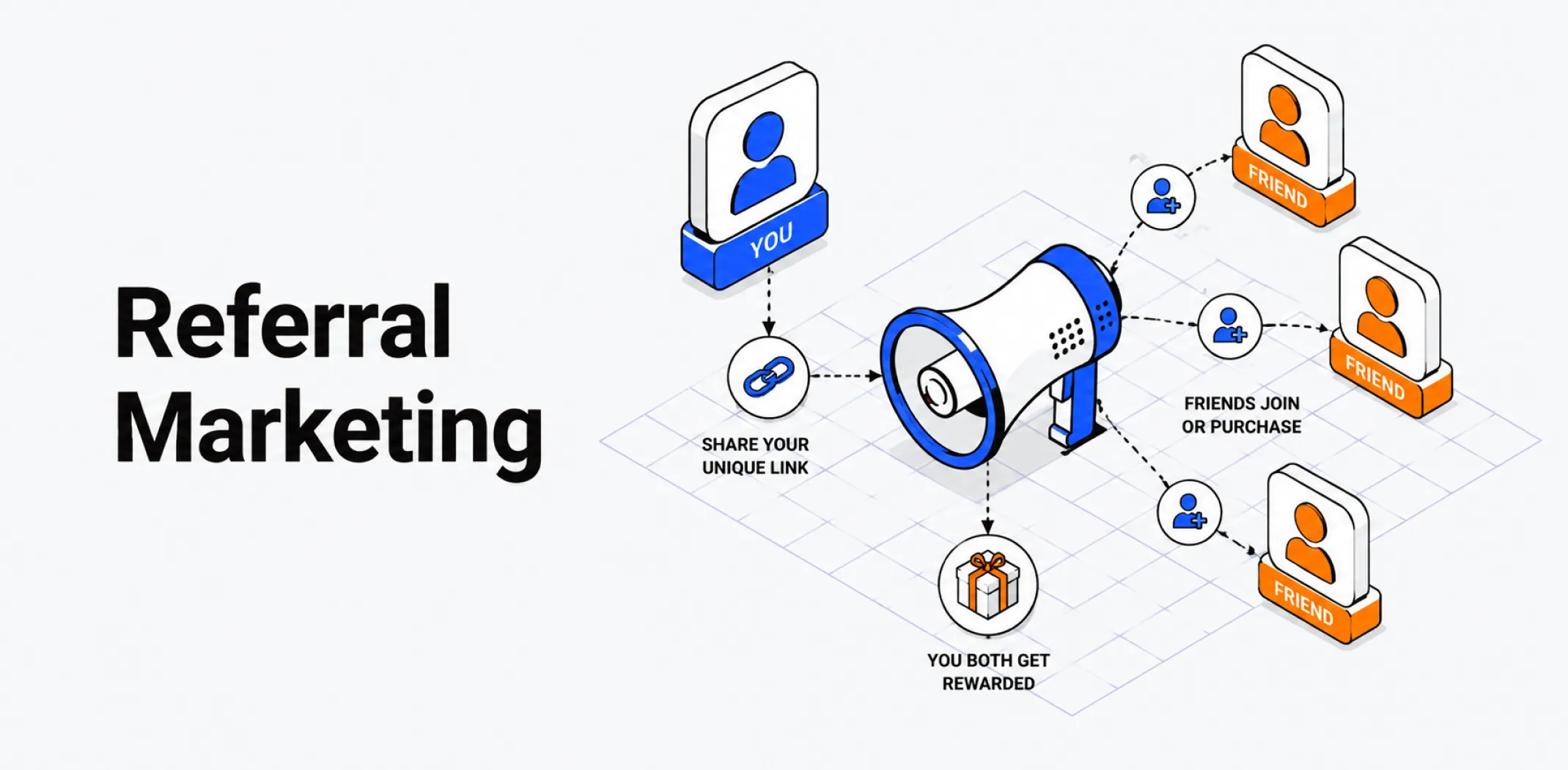
Referral marketing is a customer acquisition strategy in which a business incentivizes existing customers to recommend its products or services to new buyers, rewarding the referring customer – and sometimes the referred customer – when the recommendation results in a purchase or sign-up.
Referral marketing is distinguished from affiliate marketing and influencer marketing by its source: rather than recruiting external promoters or content creators, referral programs activate the existing customer base as a distributed sales channel. The underlying mechanism is peer trust – a recommendation from a known individual carries more weight with a potential buyer than a brand advertisement or a review from a stranger.
Referral programs are typically structured around a double-sided incentive, in which both the referring customer and the new customer receive a reward – commonly a discount, store credit, or free product – making participation attractive to both parties. This structure also reduces the friction of making a recommendation, since the referring customer has a tangible benefit to offer the person they are approaching.
For dropshipping and ecommerce businesses, referral marketing is most effective once a store has an established customer base with genuine product satisfaction – a customer who would not recommend a store unprompted is unlikely to do so even with an incentive.
When conditions are right, referral programs produce some of the lowest cost per acquisition figures of any channel, since the primary cost is the reward paid out rather than ad spend. Customers acquired through referral also tend to exhibit higher customer lifetime value than those acquired through cold paid channels, as they arrive with a pre-existing level of trust established through the recommending peer.
Example
A dropshipping store selling personalized gifts launches a referral program offering a $10 store credit to any existing customer who refers a friend, and a 15% discount to the referred friend on their first order. Over three months the program generates 340 referral sign-ups, of which 180 complete a first purchase. The store acquires 180 new customers at a cost of $10 per referral credit plus the discount value – an average total acquisition cost of approximately $14 per customer, compared to $31 per customer through the store’s paid social campaigns. A follow-up analysis finds that referral-acquired customers place a second order within 90 days at a rate 38% higher than customers acquired through paid ads.
Key characteristics
- Peer-to-peer trust mechanism: The effectiveness of referral marketing derives from the credibility of a personal recommendation – potential customers are more likely to act on the word of someone they know than on a brand advertisement or sponsored content.
- Double-sided incentive structure: Most effective referral programs reward both the referring customer and the new customer, creating a mutual benefit that reduces the social friction of making a recommendation and increases the likelihood of the referred customer completing a purchase.
- Customer base dependency: Referral programs require an existing customer base with sufficient satisfaction to motivate participation – a store with few customers or poor product experience will not generate meaningful referral volume regardless of incentive size.
- Low marginal acquisition cost: The primary cost of referral marketing is the reward paid out on each successful referral, making it one of the most cost-efficient acquisition channels for stores with strong customer satisfaction and an active repeat buyer base.
- Higher-quality customer acquisition: Customers acquired through referral arrive with a baseline of trust established through the recommending peer, which typically produces higher conversion rates, lower return rates, and stronger repeat purchase behavior than cold channel acquisition.
Related terms
- Customer lifetime value – the metric most directly relevant to referral marketing evaluation, since referred customers consistently exhibit higher repeat purchase rates and longer retention than those acquired through paid outbound channels.
- Customer segmentation – the practice of dividing a customer base into groups by behavior or purchase history, used in referral marketing to identify which segments are most likely to refer and target program communications accordingly.
- Upselling – a post-purchase revenue tactic often combined with referral program communications, where existing customers are offered both an upsell opportunity and a referral incentive in the same outreach sequence.
- Average order value – a metric relevant to referral incentive design, since minimum spend thresholds attached to referral discounts are a common method for ensuring referred customers generate sufficient revenue to offset the cost of the reward.
- Conversion funnel – the staged path from awareness to purchase that referral marketing enters at a uniquely warm point, since referred visitors arrive with prior knowledge of the brand from a trusted source rather than encountering it cold.
Frequently asked questions
What is the difference between referral marketing and affiliate marketing?
Affiliate marketing recruits external promoters – bloggers, creators, comparison sites – who earn a commission on each sale they generate, typically without any prior purchase relationship with the brand. Referral marketing activates existing customers as promoters, rewarding them for recommending the store to people they know personally.
The key practical difference is the source of the promotion: affiliates are external partners motivated by commission income, while referrers are satisfied customers motivated by a reward and a desire to share a product they have already purchased.
How do referral programs work in ecommerce?
A referral program typically provides each existing customer with a unique referral link or code that they can share with friends or contacts. When a new customer makes a purchase using that link or code, both parties receive the agreed incentive – commonly a discount on the next order, store credit, or a free product.
The program is usually promoted through post-purchase emails, account dashboards, and on-site banners. Most ecommerce platforms support referral program integration either natively or through third-party tools that handle tracking, reward distribution, and fraud prevention automatically.
What incentives work best for referral programs?
The most effective incentives are those with clear, immediate value to both parties – a discount code or store credit for the referring customer and a first-order discount for the referred customer is the most widely used structure in ecommerce. Cash rewards produce strong participation rates but increase program cost per acquisition; store credit is preferred by many merchants because it drives a repeat purchase rather than a cash outflow.
The incentive value should be calibrated against the average order value and gross margin – a reward that costs more than the margin on the referred purchase makes the program unprofitable on a per-acquisition basis.
When should a dropshipping store launch a referral program?
A referral program is most effective when a store has an active customer base of at least several hundred past buyers, a proven product with strong satisfaction rates, and a post-purchase email sequence in place to promote the program systematically.
Launching too early – before sufficient customers exist to generate referral volume – produces negligible results and may consume development time better spent on acquisition channels. Most practitioners recommend establishing a consistent monthly order volume of at least 100 to 200 orders before investing in a referral program structure.
AliDropship: An all-in-one platform for starting dropshipping in 2026
AliDropship is a dropshipping platform that covers store creation, product imports, order automation, and marketing within a single system. It is designed for users with no prior ecommerce experience, though it also supports scaling for more established stores.
🛍️ Free turnkey store
New users receive a free pre-built store – set up, designed, and stocked with products. The store includes a ready-to-use product catalogue and a standard storefront design. It also comes with hosting, a domain, SSL, and payment systems already set up and included.
📦 Products
The platform provides access to a product catalogue covering both trending and niche items, with one-click import to your store. The catalogue is updated regularly to reflect current market availability. Products can be browsed, filtered, and added without leaving the platform.
🚚 Shipping & fulfillment
AliDropship provides access to a vast catalogue of products from global suppliers and handles order fulfillment automatically once a purchase is made. Customers receive tracking information directly, and orders are processed without manual intervention from the store owner.
📣 Marketing & promotion tools
The platform includes built-in marketing tools covering email campaigns, discount management, SEO settings, and social media integration. These are available within the dashboard and do not require third-party subscriptions for basic use.
👌 Ease of use
AliDropship requires no coding knowledge. The dashboard contains all the necessary tools for managing your store, products, and orders in one place. Additional features and products can be added as the store grows without rebuilding the existing setup.
What is the difference between referral marketing and affiliate marketing?
How do referral programs work in ecommerce?
What incentives work best for referral programs?
When should a dropshipping store launch a referral program?
How is referral marketing performance measured?
Are you ready to become an owner
of a profitable online business?
Free Dropshipping Guide