

Purchase Funnel

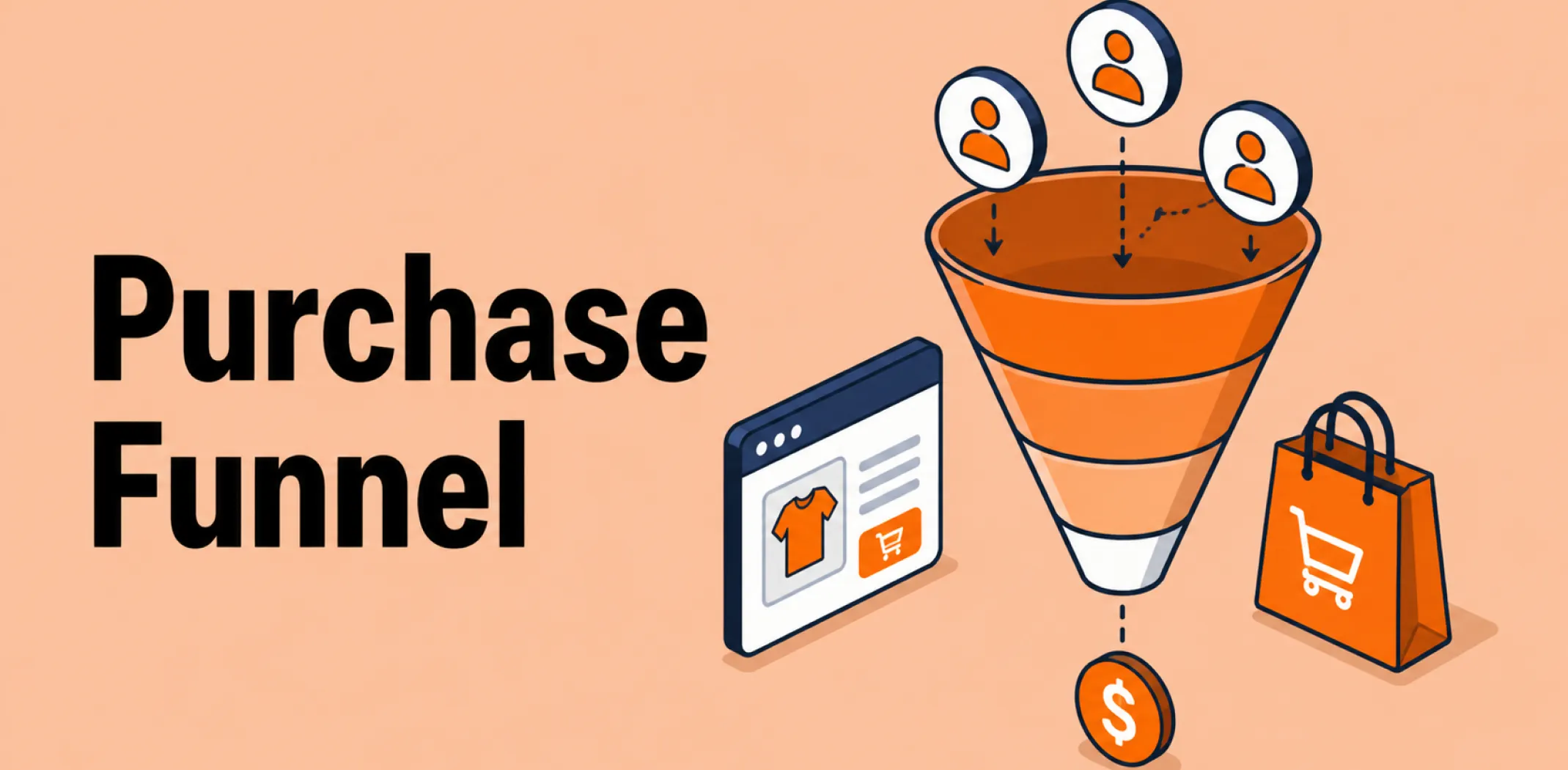
A purchase funnel is a conceptual model that represents the stages a potential customer moves through – from initial awareness of a product or store to the point of completing a purchase.
The model is typically divided into three broad stages: the top of the funnel (awareness), the middle of the funnel (consideration), and the bottom of the funnel (decision). Each stage represents a narrowing pool of potential buyers, which is why the model takes its characteristic shape.
A large number of people may become aware of a product, but a smaller proportion will evaluate it seriously, and a smaller proportion still will convert into paying customers.
In ecommerce contexts, the purchase funnel is used to diagnose where prospective buyers drop off, informing decisions about product advertising, landing page design, and pricing. It is closely related to the conversion funnel, which covers actions taken within a store rather than the broader buyer journey.
Key characteristics
- Stage-based structure: The funnel divides the buyer journey into discrete phases, allowing sellers to apply different strategies at each stage rather than treating all potential customers identically.
- Narrowing volume: Fewer people advance through each successive stage, so the ratio of awareness contacts to final conversions is always less than one.
- Diagnostic function: By measuring drop-off between stages, a seller can identify which part of the journey is underperforming and direct improvements accordingly.
- Channel dependency: Different marketing channels – paid search, social media, email – typically engage buyers at different funnel stages, requiring distinct messaging for each.
Example
A seller running a dropshipping store for home fitness equipment runs short video ads on social media, generating 40,000 impressions (awareness). Of those viewers, 3,200 click through to a landing page for a resistance band set (consideration). Of those, 95 complete the purchase (decision). The gap between 3,200 visitors and 95 buyers prompts the seller to examine checkout friction and pricing.
Related terms
- Conversion funnel – a closely related model focused on the on-site actions that move a visitor from landing page to completed order.
- Landing page – a standalone page designed to receive traffic at a specific funnel stage and guide visitors toward a defined action.
- Product advertising – the paid or organic promotion of a specific item, typically used to drive traffic into the top of the funnel.
- Customer lifetime value – a metric that quantifies the total revenue a buyer generates over time, relevant when the funnel is extended to include retention stages.
- Average order value – the mean spend per completed transaction, which affects the financial return of funnel optimization efforts.
- Upselling – a technique used at the bottom or post-purchase stage of the funnel to increase revenue from buyers who have already decided to buy.
Frequently asked questions
What are the main stages of a purchase funnel?
The three core stages are awareness (the buyer learns a product or store exists), consideration (the buyer evaluates the product), and decision (the buyer completes or abandons the purchase). Extended models add retention and advocacy stages to capture repeat-purchase and referral behavior.
How is a purchase funnel different from a conversion funnel?
A purchase funnel describes the full buyer journey, beginning before a visitor reaches a store – encompassing ad exposure, search discovery, and brand recall. A conversion funnel is narrower, covering only the on-site sequence from first visit to completed transaction. The purchase funnel contains the conversion funnel as one of its later stages.
Why do most visitors not reach the bottom of the funnel?
Drop-off occurs at every stage: low relevance at awareness, insufficient trust signals at consideration, and friction or price sensitivity at decision. Identifying the stage with the highest drop-off rate directs where optimization effort will have the most impact.
How can dropshipping sellers use the purchase funnel?
Sellers can map traffic sources, on-site behavior, and conversion data to each funnel stage. Top-of-funnel performance is measured through ad reach and click-through rates; middle-of-funnel through product page views and add-to-cart rates; bottom-of-funnel through checkout completion and cart abandonment rates. The ecommerce conversion funnel guide provides further detail on applying this framework in practice.
AliDropship: An all-in-one platform for starting dropshipping in 2026
AliDropship is a dropshipping platform that covers store creation, product imports, order automation, and marketing within a single system. It is designed for users with no prior ecommerce experience, though it also supports scaling for more established stores.
🛍️ Free turnkey store
New users receive a free pre-built store – set up, designed, and stocked with products. The store includes a ready-to-use product catalogue and a standard storefront design. It also comes with hosting, a domain, SSL, and payment systems already set up and included.
📦 Products
The platform provides access to a product catalogue covering both trending and niche items, with one-click import to your store. The catalogue is updated regularly to reflect current market availability. Products can be browsed, filtered, and added without leaving the platform.
🚚 Shipping & fulfillment
AliDropship provides access to a vast catalogue of products from global suppliers and handles order fulfillment automatically once a purchase is made. Customers receive tracking information directly, and orders are processed without manual intervention from the store owner.
📣 Marketing & promotion tools
The platform includes built-in marketing tools covering email campaigns, discount management, SEO settings, and social media integration. These are available within the dashboard and do not require third-party subscriptions for basic use.
👌 Ease of use
AliDropship requires no coding knowledge. The dashboard contains all the necessary tools for managing your store, products, and orders in one place. Additional features and products can be added as the store grows without rebuilding the existing setup.
What are the main stages of a purchase funnel?
How is a purchase funnel different from a conversion funnel?
Why do most visitors not reach the bottom of the funnel?
How can dropshipping sellers use the purchase funnel?
Are you ready to become an owner
of a profitable online business?
Free Dropshipping Guide