

Performance Marketing

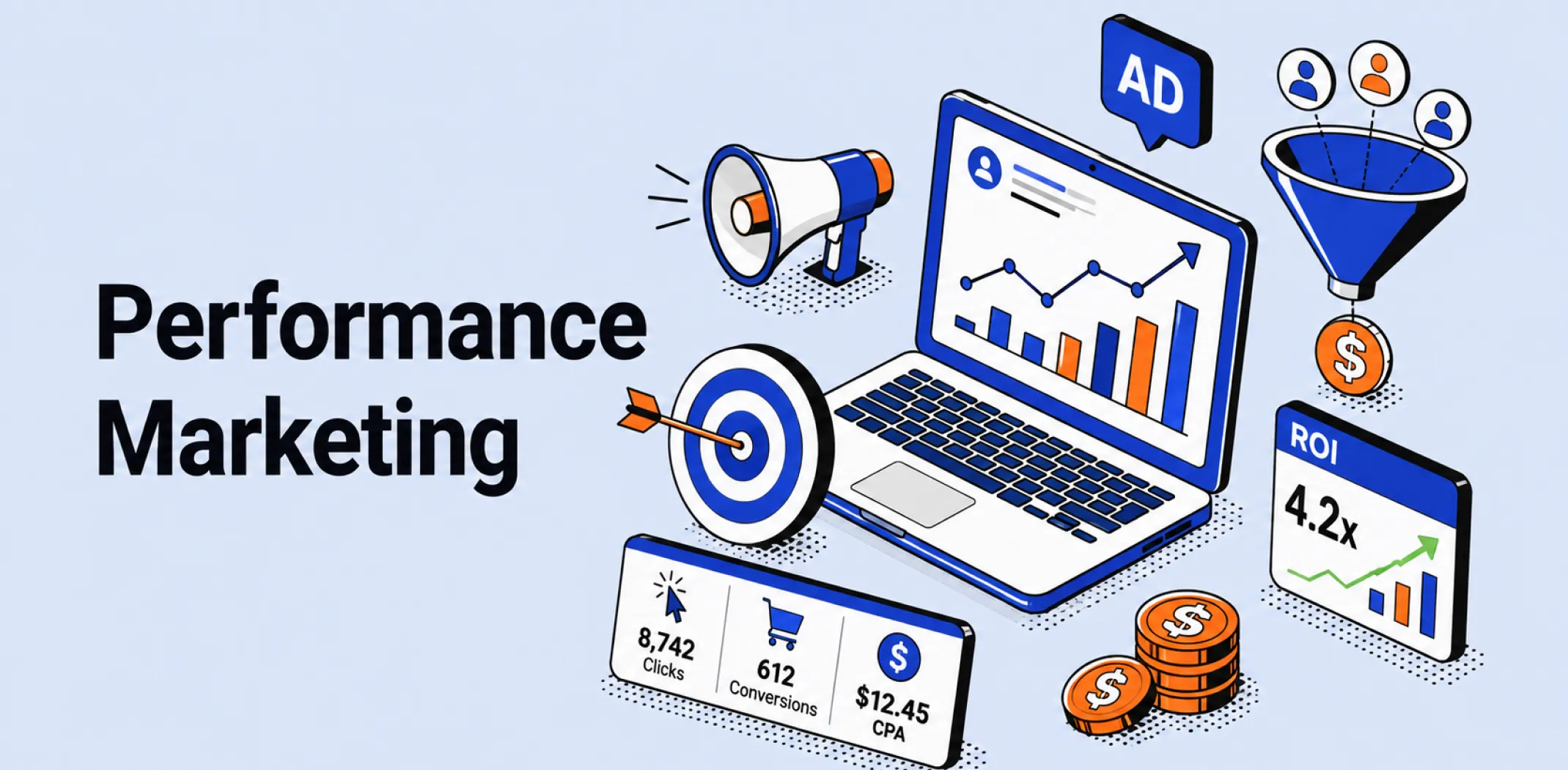
Performance marketing is a form of digital advertising in which the advertiser pays only when a specific, measurable action is completed — such as a click, lead submission, or sale — rather than paying a fixed fee for ad placement regardless of outcome.
Performance marketing sits within the broader category of product advertising and digital marketing, but is distinguished by its outcome-based payment structure.
Common performance marketing models include cost per click (CPC), where the advertiser pays each time a user clicks an ad; cost per acquisition (CPA), where payment is triggered only when a sale or sign-up is completed; and cost per lead (CPL), where payment occurs when a user submits their contact information.
This structure shifts financial risk from the advertiser to the publisher or platform, since no charge is incurred unless the target action occurs.
For dropshipping businesses, performance marketing is a natural fit because every cost is tied to a traceable outcome that can be compared directly against per-unit margin. A store running a CPA campaign knows exactly how much each sale costs to acquire, and can determine within days whether a channel is generating positive returns.
This is in contrast to brand awareness advertising, where spend precedes any measurable result by weeks or months. Performance marketing channels commonly used in ecommerce include Google Shopping, Meta ads with conversion objectives, and influencer partnerships structured around affiliate commissions rather than flat fees.
Example
A dropshipping store selling fitness accessories runs a Meta campaign optimized for purchase conversions, with a daily budget of $50. Over seven days the campaign generates 14 sales at a total ad cost of $350, producing a cost per acquisition of $25. Each unit sold carries a margin of $38 after supplier costs and fees. Since the $25 CPA is lower than the $38 margin, the campaign is profitable — a determination the store owner can make with precision because the payment model ties every dollar spent to a counted sale. The store owner scales the daily budget in response, using the same CPA benchmark to monitor whether efficiency holds at higher spend levels.
Key characteristics
- Outcome-based payment: Advertisers pay only when a predefined action — a click, lead, or sale — is completed, eliminating spend on impressions or placements that produce no measurable result.
- Trackable cost per result: Every performance marketing channel produces a cost-per-action figure that can be compared directly against revenue or margin, making return on ad spend calculable in real time.
- Multiple payment models: Performance marketing encompasses CPC, CPA, CPL, and revenue-share structures, each suited to different campaign objectives and business types.
- Risk transfer: Because payment is contingent on outcomes, a portion of the financial risk of advertising is transferred from the advertiser to the platform or publisher — the advertiser only pays when the platform delivers the agreed action.
- Scalability by performance: Campaigns that produce a positive return on ad spend can be scaled by increasing budget, while underperforming campaigns can be paused immediately without incurring sunk costs beyond what has already been spent.
Related terms
- Product advertising — a core application of performance marketing in ecommerce, where individual products are promoted through paid channels with the goal of driving direct purchase conversions.
- Conversion funnel — the staged path from awareness to purchase that performance marketing campaigns are designed to move users through, with different campaign types targeting different funnel stages.
- Return on investment — the profitability measure most directly applicable to performance marketing, calculated by comparing the revenue generated by a campaign against the total spend required to produce it.
- Customer lifetime value — the projected total revenue from a customer over time, used to set the maximum acceptable cost per acquisition in performance marketing campaigns.
- Landing page — the destination page to which performance marketing traffic is directed, whose conversion rate directly determines the efficiency and cost per acquisition of any campaign.
Frequently asked questions
What is the difference between performance marketing and brand marketing?
Performance marketing ties spend to measurable short-term actions — clicks, leads, or sales — and produces results that can be evaluated within days or weeks. Brand marketing focuses on building awareness, recognition, and long-term audience affinity, with results that are harder to attribute directly to spend and typically take months to materialize. Most ecommerce businesses prioritize performance marketing in early stages when capital is limited and direct return on spend must be demonstrated quickly.
What is cost per acquisition in performance marketing?
Cost per acquisition (CPA) is the total amount spent on a campaign divided by the number of completed purchases or target actions it generates. If a store spends $300 on ads and records 12 sales, the CPA is $25. CPA is the most directly relevant performance marketing metric for dropshipping stores because it can be compared against the per-unit margin to determine whether a channel is profitable on a per-sale basis.
Is affiliate marketing a form of performance marketing?
Yes — affiliate marketing is one of the most established performance marketing models, in which a publisher or content creator promotes a product and receives a commission only when a sale or lead is generated through their unique tracking link. Because payment is contingent on a completed action rather than on impressions or placements, it fits the defining structure of performance marketing. Many dropshipping stores use affiliate partnerships alongside paid social and search campaigns as a lower-risk channel for driving incremental sales.
How do dropshipping stores measure performance marketing success?
The primary metrics are cost per acquisition, return on ad spend, and — over longer periods — the ratio of CPA to customer lifetime value. A campaign is considered successful when the cost of acquiring each customer is sustainably lower than the margin generated by that customer’s purchase. Stores running multiple channels simultaneously track these figures per channel to identify which are producing positive returns and which should be paused or restructured.
AliDropship: An all-in-one platform for starting dropshipping in 2026
AliDropship is a dropshipping platform that covers store creation, product imports, order automation, and marketing within a single system. It is designed for users with no prior ecommerce experience, though it also supports scaling for more established stores.
🛍️ Free turnkey store
New users receive a free pre-built store – set up, designed, and stocked with products. The store includes a ready-to-use product catalogue and a standard storefront design. It also comes with hosting, a domain, SSL, and payment systems already set up and included.
📦 Products
The platform provides access to a product catalogue covering both trending and niche items, with one-click import to your store. The catalogue is updated regularly to reflect current market availability. Products can be browsed, filtered, and added without leaving the platform.
🚚 Shipping & fulfillment
AliDropship provides access to a vast catalogue of products from global suppliers and handles order fulfillment automatically once a purchase is made. Customers receive tracking information directly, and orders are processed without manual intervention from the store owner.
📣 Marketing & promotion tools
The platform includes built-in marketing tools covering email campaigns, discount management, SEO settings, and social media integration. These are available within the dashboard and do not require third-party subscriptions for basic use.
👌 Ease of use
AliDropship requires no coding knowledge. The dashboard contains all the necessary tools for managing your store, products, and orders in one place. Additional features and products can be added as the store grows without rebuilding the existing setup.
What is the difference between performance marketing and brand marketing?
What is cost per acquisition in performance marketing?
Is affiliate marketing a form of performance marketing?
How do dropshipping stores measure performance marketing success?
What are the most common performance marketing models?
Are you ready to become an owner
of a profitable online business?
Free Dropshipping Guide