

Organic Social

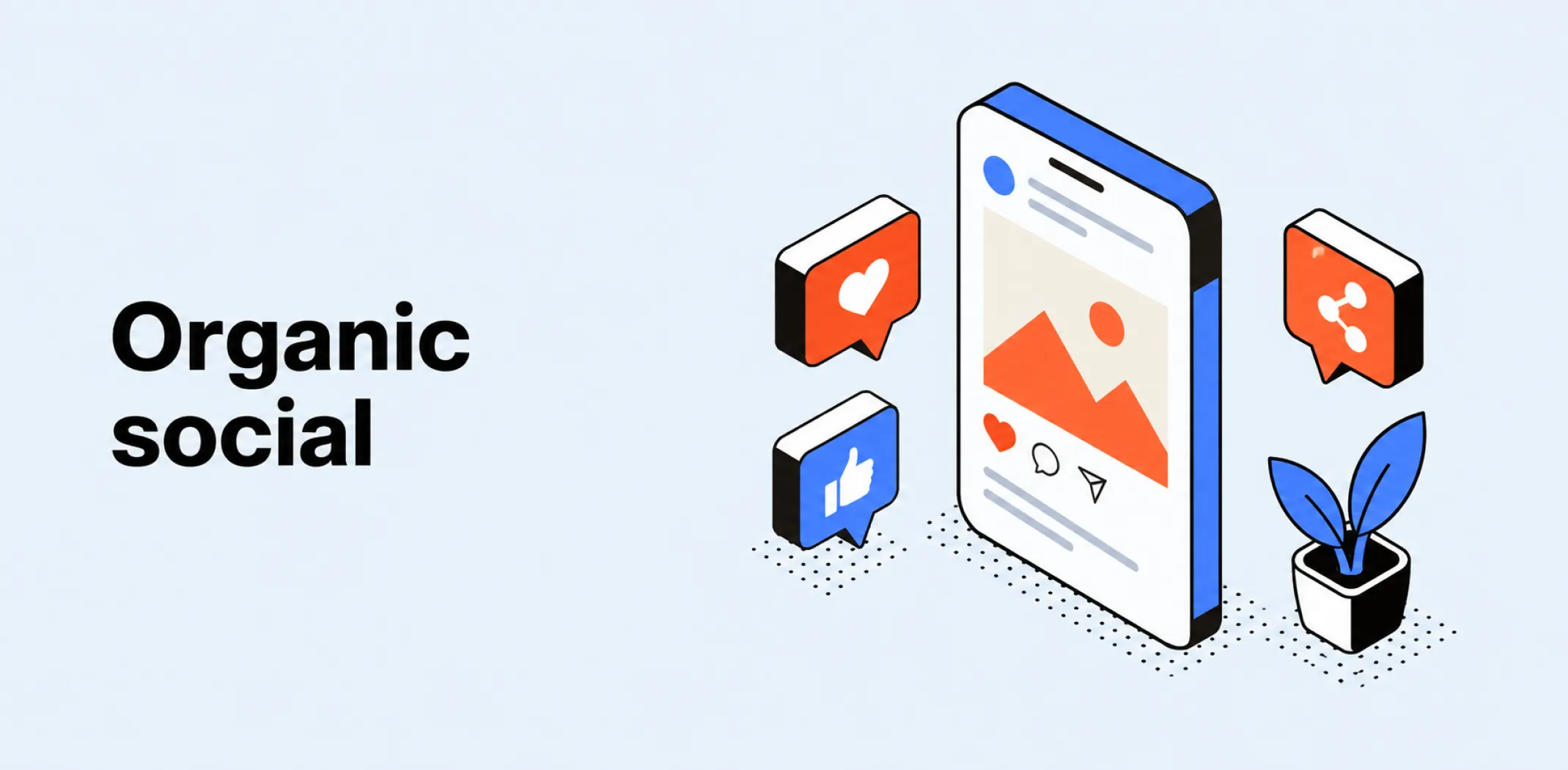
Organic social is unpaid content and activity published on social media platforms to reach and engage an audience without paying for promotion.
The term distinguishes content that appears in a platform’s feed through standard distribution – based on followers, engagement, and platform algorithms – from content that a business pays to place in front of a wider or more targeted audience.
Organic social typically includes posts, stories, videos, and comments published on a business or creator’s own account, with reach determined by factors such as posting frequency, content quality, and audience engagement rather than an advertising budget.
Organic social differs from paid social advertising primarily in cost and reach control: a business cannot guarantee how many people see an organic post, while paid placements offer targeting and predictable reach in exchange for a budget.
Organic activity often works alongside user-generated content and influencer partnerships, both of which can extend a brand’s reach without direct ad spend. Within ecommerce, strong organic social activity also builds social proof that supports paid campaigns run elsewhere.
Example
A dropshipping store posts three times a week on Instagram, sharing product photos, behind-the-scenes videos, and customer reviews without paying to boost any of the posts. Over several months, one video showcasing a kitchen gadget is shared widely by followers and reaches over 50,000 views through organic distribution alone, without any advertising spend behind it.
Key characteristics
- No direct media cost: Publishing organic social content does not require an advertising budget, though it still takes time and resources to produce.
- Algorithm-dependent reach: How many people see a post depends on platform algorithms that weigh factors such as engagement, recency, and content format.
- Builds long-term audience relationships: Consistent organic activity helps establish a brand’s voice and following independent of any single advertising campaign.
- Slower, less predictable results: Unlike paid campaigns, organic reach cannot be guaranteed or scaled on demand, and results build gradually over time.
Related terms
- User-generated content (UGC) – content created by customers or creators that brands often reshare as part of their organic social activity.
- Influencer – a creator whose organic posts about a brand can extend reach without a paid placement.
- Social proof – the trust signal generated when organic engagement, such as comments and shares, is visible to other viewers.
- Social commerce – the broader practice of selling through social platforms, which organic social activity can support alongside paid tactics.
- Shoppable post – a content format that can be published organically or promoted with paid budget.
Frequently asked questions
What is the difference between organic social and paid social?
Organic social relies on unpaid distribution through followers and platform algorithms, while paid social involves paying a platform to place content in front of a targeted audience. Many brands use both together, with paid budget often used to amplify strong organic content.
Does organic social still matter for ecommerce brands?
Yes. Organic social builds long-term audience relationships and trust that paid campaigns alone cannot replicate, and it often lowers the cost of paid advertising by supplying proven, high-performing content.
How is organic reach measured?
Organic reach is typically measured as the number of unique accounts that saw a post without paid promotion, alongside engagement metrics such as likes, comments, shares, and saves.
AliDropship: An all-in-one platform for starting an online business in 2026
AliDropship is an online business platform that gives customers a ready-made store, a digital products catalogue, and built-in, one-click advertising within a single system. Founded in 2015 and based in Irvine, California, it has helped launch more than 1,500,000 stores and holds a 4.7-star rating on Trustpilot. It is built for people with no prior experience and no technical skills.
🆓 Free 14-day trial
New users get full platform access for 14 days, including a ready-made store, hosting, a domain, an SSL certificate, and access to the digital products catalogue. The trial also includes a $40 ad coupon to test the advertising system. Order fees apply only when a sale is made.
📦 Digital products
Customers choose from AliDropship’s catalogue of digital products – guides, courses, checklists, tools, and AI-powered toolkits – and keep up to 70% of every sale. Delivery is instant and automated, so there is no inventory, shipping, or manual fulfillment involved.
📣 One-click advertising
AliDropship includes built-in advertising that customers can turn on for as little as $10 a day. The system handles targeting, creatives, and optimization, and many customers see their first orders the same day they launch ads.
👌 Ease of use
AliDropship requires no coding or marketing experience. The store, products, and ads are managed from a single dashboard that works on a phone as well as a desktop, and a personal growth manager is available to help by chat.
💳 Monthly plan
After the trial, continued access is $39 a month, covering the store, the digital products catalogue, and ongoing support. There is no long-term contract, and the plan can be cancelled at any time.
How much does organic social cost to run?
How often should a brand post on organic social to see results?
What content formats perform best on organic social?
Can organic social alone grow a dropshipping store?
How has organic social reach changed on major platforms?
Are you ready to become an owner
of a profitable online business?
Free Dropshipping Guide