

Last-Mile Delivery

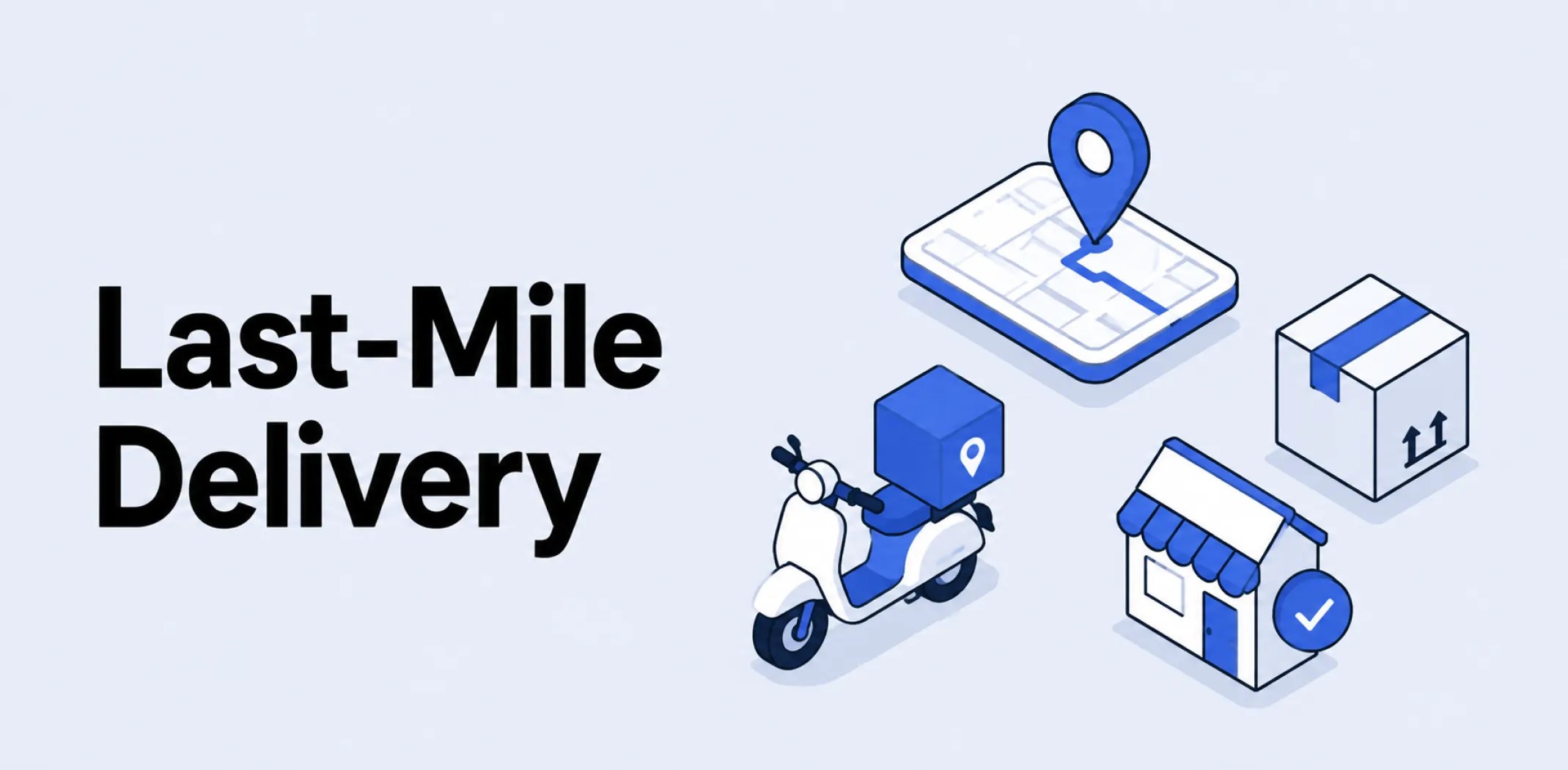
Last-mile delivery is the final stage of the shipping process, in which a parcel moves from a local carrier depot or sorting facility to the end customer’s delivery address, completing the order fulfillment chain.
The term originates in logistics and telecommunications, where it describes the most operationally complex and expensive portion of a network: the connection between a central hub and the individual endpoint.
In parcel shipping, the last mile is where the cumulative efficiency of long-haul freight – large volumes, optimized routes, consolidated loads – gives way to the inherent inefficiency of individual deliveries: one driver, one van, dozens of separate addresses, each requiring a stop, a scan, and often a second attempt.
Industry estimates consistently place last-mile delivery as the most expensive segment of the shipping chain, accounting for a substantial share of total logistics cost despite covering only the final portion of physical distance.
For ecommerce merchants and dropshippers, last-mile delivery is the stage most directly visible to the customer and most responsible for post-purchase satisfaction. Customers do not experience upstream logistics; they experience the moment the parcel arrives – or fails to. Delivery speed, accuracy, communication, and the handling condition of the parcel on arrival are all last-mile outcomes.
For stores operating with overseas suppliers, the last-mile carrier is typically a national postal service or regional courier in the customer’s country, and its performance is outside the merchant’s direct control.
How it works
- Parcel arrives at destination depot: After completing long-haul transit – whether domestic or cross-border – the parcel arrives at a local carrier depot or distribution center serving the delivery area. For international shipments, this follows customs clearance and carrier handoff from the origin network.
- Sortation and route assignment: The depot scans and sorts parcels by delivery zone. Route planning software or manual allocation assigns each parcel to a delivery run, grouping stops geographically to minimize driver travel time and fuel cost.
- Loading for delivery: Parcels are loaded onto a delivery vehicle – van, motorcycle, bicycle, or on-foot courier depending on the carrier, area density, and parcel size – in reverse delivery order so the first stop is accessible last.
- Delivery attempt: The driver or courier attempts delivery at the customer address. Success depends on whether someone is available to receive the parcel, whether access to the delivery point is possible, and whether a safe drop or neighbor delivery is permitted by the customer or carrier policy.
- Successful delivery or exception handling: If the customer is present or a safe location is agreed, the parcel is delivered and a proof-of-delivery scan or signature is captured. If delivery fails, the parcel returns to the depot and a second attempt, collection point hold, or return-to-sender process begins.
- Tracking update and confirmation: The carrier system logs the delivery outcome and triggers a notification to the customer – and in many cases, to the merchant via the order fulfillment platform. Failed attempts trigger a separate notification with redelivery or collection instructions.
Example
A customer orders a home decor item from a dropshipping store. The parcel travels from a supplier in Poland to a DHL regional hub in Germany, then to a local DHL depot serving the customer area in the Netherlands. The depot scans the parcel at 06:30 and the customer receives an automated notification with a one-hour delivery window. The driver attempts delivery at 11:15; the customer is not home. The driver leaves a card and the parcel is held at a nearby collection point. The customer collects it the following morning. Total last-mile time from depot arrival to customer receipt: 27 hours across two calendar days. The merchant receives a delivery-confirmed event from DHL, which closes the order automatically in the store dashboard.
Key characteristics
- Highest cost per unit in the shipping chain: Individual doorstep deliveries cannot be consolidated the way long-haul freight can, making last-mile the most expensive logistics segment relative to distance covered.
- Customer-facing outcome: Last-mile delivery is the only part of the shipping process the customer directly experiences, making its speed, accuracy, and communication quality primary drivers of post-purchase satisfaction.
- Failed delivery risk: A significant proportion of last-mile attempts fail on the first try due to absence of the recipient, access issues, or address inaccuracies, adding cost and delay for both carrier and merchant.
- Carrier dependency for merchants: Ecommerce merchants, particularly those using overseas suppliers, have no direct control over last-mile carrier performance and must rely on carrier service levels and tracking integrations to monitor outcomes.
- Urban and rural performance gap: Last-mile delivery is faster, cheaper, and more reliable in dense urban areas where stops are close together. Rural and remote addresses require longer routes, higher per-parcel cost, and often longer delivery windows.
Related terms
- Order fulfillment – the end-to-end process of dispatching and delivering a customer order, of which last-mile delivery is the final and most customer-visible stage.
- Supplier – the origin-country manufacturer or distributor that dispatches the parcel into the shipping chain leading to last-mile delivery.
- Warehousing – domestic inventory storage that positions stock closer to customers, shortening the distance and duration of the last-mile delivery leg.
- Overhead costs – the operational expenses that include last-mile carrier fees, which represent the most significant per-parcel cost in the fulfillment chain.
Frequently asked questions
Why is last-mile delivery the most expensive part of shipping?
Long-haul freight achieves efficiency through consolidation: large volumes of parcels share the same vehicle, route, and fuel cost. Last-mile delivery cannot be consolidated in the same way because each parcel has a different destination address.
A driver may make 80 to 120 individual stops in a day, each requiring a separate approach, stop, and scan. The labor, vehicle, and fuel cost per parcel is therefore much higher relative to the distance covered than any upstream shipping stage.
What happens if last-mile delivery fails?
If a delivery attempt fails – typically because no one is home or the address is inaccessible – the carrier usually makes one or two further attempts, holds the parcel at a local collection point for the customer to retrieve, or returns it to the sender if collection is not made within a set window.
The merchant is responsible for communicating options to the customer and, if the parcel is returned, for deciding whether to reship or refund. Unreported address errors are a common cause of failed last-mile delivery and result in avoidable cost for both carrier and merchant.
How does last-mile delivery affect customer satisfaction?
Last-mile delivery is the most direct point of contact between the fulfillment chain and the customer experience. Delivery speed, on-time accuracy, communication during the delivery window, and the condition of the parcel on arrival are all last-mile variables that directly drive review scores, repeat purchase rates, and refund or dispute volumes.
A product that arrives damaged or late creates a negative perception of the store regardless of product quality or checkout experience.
Can a dropshipping merchant control last-mile delivery?
Not directly. The last-mile carrier in the customer country is typically selected by the supplier or determined by the shipping method chosen at the time of dispatch.
Merchants can influence outcomes indirectly by choosing suppliers that use reliable carrier networks, offering tracked shipping services that give customers and merchants visibility into delivery status, using domestic warehousing through platforms such as Sellvia to access faster and more predictable last-mile carriers, and proactively communicating estimated delivery windows to customers at checkout and post-purchase.
AliDropship: An all-in-one platform for starting dropshipping in 2026
AliDropship is a dropshipping platform that covers store creation, product imports, order automation, and marketing within a single system. It is designed for users with no prior ecommerce experience, though it also supports scaling for more established stores.
🛍️ Free turnkey store
New users receive a free pre-built store – set up, designed, and stocked with products. The store includes a ready-to-use product catalogue and a standard storefront design. It also comes with hosting, a domain, SSL, and payment systems already set up and included.
📦 Products
The platform provides access to a product catalogue covering both trending and niche items, with one-click import to your store. The catalogue is updated regularly to reflect current market availability. Products can be browsed, filtered, and added without leaving the platform.
🚚 Shipping & fulfillment
AliDropship provides access to a vast catalogue of products from global suppliers and handles order fulfillment automatically once a purchase is made. Customers receive tracking information directly, and orders are processed without manual intervention from the store owner.
📣 Marketing & promotion tools
The platform includes built-in marketing tools covering email campaigns, discount management, SEO settings, and social media integration. These are available within the dashboard and do not require third-party subscriptions for basic use.
👌 Ease of use
AliDropship requires no coding knowledge. The dashboard contains all the necessary tools for managing your store, products, and orders in one place. Additional features and products can be added as the store grows without rebuilding the existing setup.
Why is last-mile delivery the most expensive part of shipping?
What happens if last-mile delivery fails?
How does last-mile delivery affect customer satisfaction?
Can a dropshipping merchant control last-mile delivery?
Are you ready to become an owner
of a profitable online business?
Free Dropshipping Guide