

Influencer Marketing

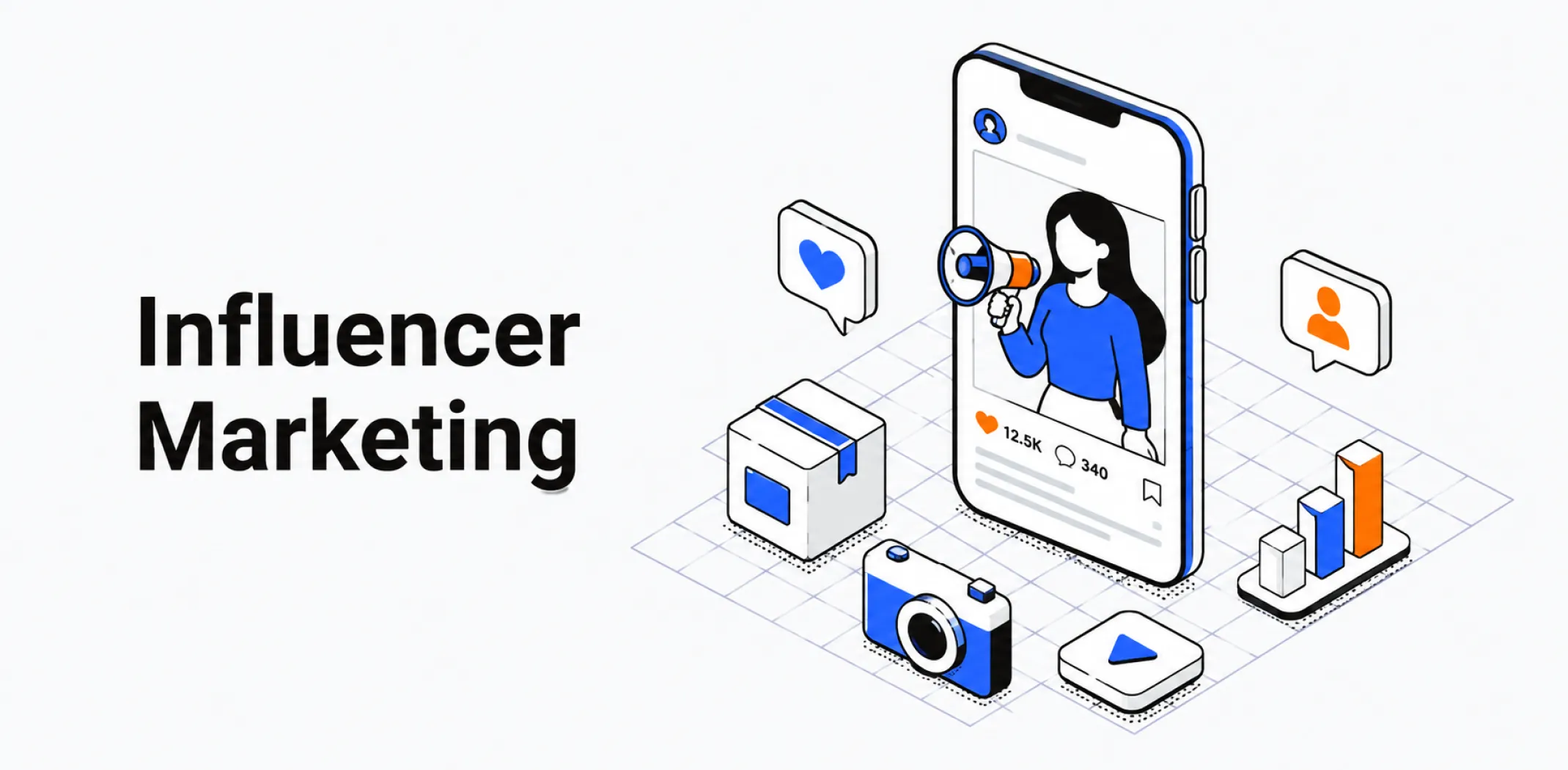
Influencer marketing is the practice of partnering with individuals who have established online audiences to promote products or services to those audiences, leveraging the trust and credibility the individual has built with their followers in place of direct brand advertising.
An influencer in this context is any content creator – on platforms such as Instagram, TikTok, YouTube, or Pinterest – whose audience actively engages with their content and whose recommendations carry persuasive weight. Influencer marketing differs from conventional advertising in that the promotional message is delivered through the influencer’s own voice and format, making it appear more organic than a standard paid ad.
Partnerships are structured in several ways: a flat fee paid for a post or video, a commission-based arrangement in which the influencer earns a percentage of each sale generated through a unique tracking link, a product gifting arrangement with no guaranteed post, or a hybrid of fee and commission.
The choice of structure affects both cost and risk – flat-fee arrangements guarantee delivery but not results, while commission-based models align incentives but require the influencer to believe in the product’s appeal to their audience.
For dropshipping and ecommerce businesses, influencer marketing sits at the intersection of outbound marketing – where it is used to drive immediate product awareness and sales through paid or gifted partnerships – and inbound marketing, where long-term ambassador relationships generate organic mentions and audience referrals over time.
It is particularly effective for visually driven product niches such as beauty, fashion, home decor, fitness, and pet accessories, where a product demonstration or lifestyle image from a trusted creator produces stronger purchase intent than a conventional display ad.
The measurability of influencer marketing varies by partnership structure: commission-based arrangements allow precise attribution through tracking links and discount codes, while flat-fee awareness posts are harder to tie directly to sales.
Example
A dropshipping store selling portable blenders identifies a TikTok creator with 180,000 followers in the health and fitness niche. The store sends the creator a free unit and agrees to pay a 15% commission on each sale generated through a unique discount code shared in the creator’s video. The video receives 420,000 views and generates 310 sales over two weeks, producing $4,650 in revenue at a commission cost of $697.50 – a cost per acquisition of $2.25, significantly below the store’s paid social benchmark of $8.40. The arrangement requires no upfront ad spend and the video continues generating views and occasional sales for months after the initial post.
Key characteristics
- Audience trust as the core mechanism: Influencer marketing derives its effectiveness from the relationship between the creator and their audience – followers are more likely to act on a recommendation from a person they follow than on a brand advertisement they encounter passively.
- Platform specificity: Different platforms suit different influencer marketing formats – TikTok and Instagram favour short-form video and image content, YouTube suits longer demonstrations and reviews, and Pinterest drives discovery in visually driven product categories.
- Tiered audience scale: Influencers are commonly categorised by follower count – nano (1,000–10,000), micro (10,000–100,000), macro (100,000–1,000,000), and mega (1,000,000+) – with engagement rates typically higher among smaller creators and reach greater among larger ones.
- Variable attribution: Commission-based and discount-code partnerships allow precise sales attribution, while flat-fee brand awareness content produces reach and engagement data that is harder to connect directly to revenue.
- Niche alignment dependency: The effectiveness of an influencer partnership depends heavily on how closely the creator’s audience matches the store’s target customer – a large but misaligned audience produces lower conversion rates than a smaller but highly relevant one.
Related terms
- Influencer – the individual content creator whose audience and credibility form the basis of an influencer marketing partnership, categorised by platform, niche, and follower count.
- Conversion funnel – the staged path from awareness to purchase that influencer marketing enters at the top, introducing a product to an audience that may not have encountered the brand through other channels.
- Customer lifetime value – a metric relevant to influencer marketing evaluation, since customers acquired through trusted creator recommendations may exhibit higher repeat purchase rates than those acquired through cold paid advertising.
- Product positioning – the way a product is framed relative to competitors and audience expectations, which influencer marketing reinforces through the context and lifestyle associations of the creator’s content.
- Niche market – the defined audience segment an influencer marketing strategy targets, with creator selection determined by how closely a creator’s follower base matches the store’s ideal customer profile.
Frequently asked questions
What is the difference between influencer marketing and affiliate marketing?
Affiliate marketing is a performance-based arrangement in which a promoter – who may or may not be a social media creator – earns a commission on each sale generated through a unique tracking link, with no guaranteed content format or delivery schedule.
Influencer marketing specifically involves content creators with established social audiences, and partnerships may be structured as flat fees, commissions, gifting arrangements, or a combination. All commission-based influencer partnerships are a form of affiliate marketing, but not all affiliate marketing involves influencers – affiliate programmes also include bloggers, comparison sites, and email publishers.
How do dropshipping stores find influencers to work with?
The most direct approach is to search relevant hashtags and keywords on the target platform – Instagram, TikTok, or YouTube – and identify creators whose content and audience align with the store’s product niche. Influencer discovery platforms and marketplaces automate this process and provide engagement rate data and audience demographics.
For stores with limited budgets, micro-influencers in the 10,000 to 100,000 follower range typically offer the most accessible entry point, with higher engagement rates relative to follower count and lower fees than macro or mega creators.
How is influencer marketing performance measured?
For commission-based or discount-code partnerships, performance is measured directly through sales attributed to the unique tracking link or code – producing a precise cost per acquisition and return on ad spend figure.
For flat-fee awareness partnerships, performance is typically measured through reach, impressions, engagement rate, and any observable lift in site traffic or sales during and after the campaign period. Commission-based structures are generally preferred by ecommerce stores for this reason, since they tie cost directly to revenue rather than to engagement metrics that may not translate to sales.
Are micro-influencers more effective than large influencers for dropshipping?
Not universally, but micro-influencers – those with between 10,000 and 100,000 followers – typically produce higher engagement rates and more targeted audience reach than larger creators, and charge significantly lower fees.
For dropshipping stores with limited marketing budgets, partnering with several micro-influencers in a specific niche often produces better results per dollar spent than a single macro or mega partnership. The optimal choice depends on the product, the niche, the platform, and whether the goal is broad awareness or direct conversion.
AliDropship: An all-in-one platform for starting dropshipping in 2026
AliDropship is a dropshipping platform that covers store creation, product imports, order automation, and marketing within a single system. It is designed for users with no prior ecommerce experience, though it also supports scaling for more established stores.
🛍️ Free turnkey store
New users receive a free pre-built store – set up, designed, and stocked with products. The store includes a ready-to-use product catalogue and a standard storefront design. It also comes with hosting, a domain, SSL, and payment systems already set up and included.
📦 Products
The platform provides access to a product catalogue covering both trending and niche items, with one-click import to your store. The catalogue is updated regularly to reflect current market availability. Products can be browsed, filtered, and added without leaving the platform.
🚚 Shipping & fulfillment
AliDropship provides access to a vast catalogue of products from global suppliers and handles order fulfillment automatically once a purchase is made. Customers receive tracking information directly, and orders are processed without manual intervention from the store owner.
📣 Marketing & promotion tools
The platform includes built-in marketing tools covering email campaigns, discount management, SEO settings, and social media integration. These are available within the dashboard and do not require third-party subscriptions for basic use.
👌 Ease of use
AliDropship requires no coding knowledge. The dashboard contains all the necessary tools for managing your store, products, and orders in one place. Additional features and products can be added as the store grows without rebuilding the existing setup.
What is the difference between influencer marketing and affiliate marketing?
How do dropshipping stores find influencers to work with?
How is influencer marketing performance measured?
Are micro-influencers more effective than large influencers for dropshipping?
How much does influencer marketing cost for a dropshipping store?
Are you ready to become an owner
of a profitable online business?
Free Dropshipping Guide