

Dynamic Pricing

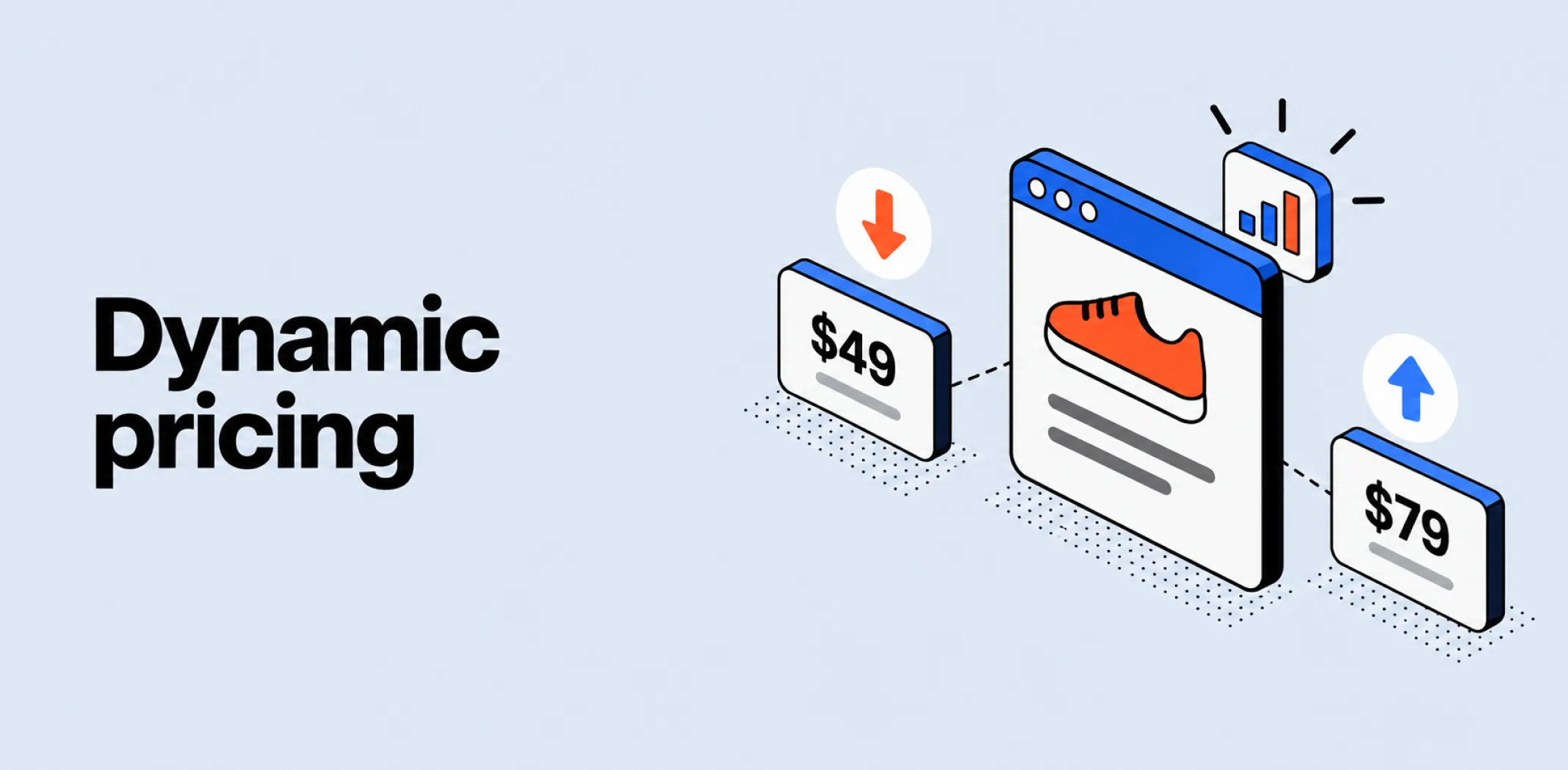
Dynamic pricing is the practice of adjusting a product’s price automatically in response to demand, competition, or inventory levels, rather than keeping the price fixed until a manual change is made.
Price changes can happen continuously throughout the day or on a set schedule, depending on the tool a store uses. Many dynamic pricing systems draw on the same machine learning techniques used for recommendation engines, though simpler versions follow fixed rules, such as raising a price when stock falls below a set threshold.
Dynamic pricing differs from a one-time seasonal sale in that it responds continuously to changing conditions rather than following a predetermined discount schedule.
How dynamic pricing works
- The system monitors factors such as competitor prices, current demand, and remaining inventory.
- A set of rules or a predictive model evaluates these factors against the product’s pricing strategy.
- The system calculates a new price based on this evaluation.
- The updated price is published on the storefront, replacing the previous price.
- The system continues monitoring conditions and repeats the process at set intervals or in real time.
Example
An online electronics store sells a portable speaker whose price normally sits at 45 dollars. When a competitor drops their price on the same speaker model, the store’s dynamic pricing tool detects the change and automatically lowers the price to stay competitive. Later, when inventory for that speaker runs low, the same system raises the price slightly to slow down remaining sales until new stock arrives.
Key characteristics
- Continuous or scheduled updates: Prices can change many times a day or on a fixed schedule, depending on the system.
- Multiple input factors: Common inputs include competitor pricing, demand signals, inventory levels, and time of day.
- Rule-based or predictive: Systems range from simple if-then pricing rules to models that forecast optimal price points.
- Requires monitoring: Store owners typically set boundaries, such as minimum and maximum prices, to prevent unwanted extremes.
Related terms
- Machine learning in ecommerce – the technology behind more advanced, predictive dynamic pricing.
- Recommendation engine – a related system that personalizes product suggestions rather than price.
- Personalization – a broader practice that can include showing different prices to different shopper segments.
- Dropshipping – a retail model where dynamic pricing is often used to account for fluctuating supplier costs.
Frequently asked questions
Is dynamic pricing legal?
Yes, adjusting prices based on demand or competition is legal in most regions, though pricing must still avoid discriminatory practices.
Do customers see different prices for the same product?
Sometimes, since some dynamic pricing systems display different prices to different shoppers based on location, device, or timing.
Can dynamic pricing be limited to certain products?
Yes, most tools allow a store owner to apply dynamic pricing to select products or categories rather than the entire catalogue.
AliDropship: An all-in-one platform for starting an online business in 2026
AliDropship is an online business platform that gives customers a ready-made store, a digital products catalogue, and built-in, one-click advertising within a single system. Founded in 2015 and based in Irvine, California, it has helped launch more than 1,500,000 stores and holds a 4.7-star rating on Trustpilot. It is built for people with no prior experience and no technical skills.
🆓 Free 14-day trial
New users get full platform access for 14 days, including a ready-made store, hosting, a domain, an SSL certificate, and access to the digital products catalogue. The trial also includes a $40 ad coupon to test the advertising system. Order fees apply only when a sale is made.
📦 Digital products
Customers choose from AliDropship’s catalogue of digital products – guides, courses, checklists, tools, and AI-powered toolkits – and keep up to 70% of every sale. Delivery is instant and automated, so there is no inventory, shipping, or manual fulfillment involved.
📣 One-click advertising
AliDropship includes built-in advertising that customers can turn on for as little as $10 a day. The system handles targeting, creatives, and optimization, and many customers see their first orders the same day they launch ads.
👌 Ease of use
AliDropship requires no coding or marketing experience. The store, products, and ads are managed from a single dashboard that works on a phone as well as a desktop, and a personal growth manager is available to help by chat.
💳 Monthly plan
After the trial, continued access is $39 a month, covering the store, the digital products catalogue, and ongoing support. There is no long-term contract, and the plan can be cancelled at any time.
How often do dynamic pricing systems change prices?
Does dynamic pricing require a large product catalogue?
Can dynamic pricing hurt customer trust?
What tools are used to set up dynamic pricing?
Is dynamic pricing the same as surge pricing?
Are you ready to become an owner
of a profitable online business?
Free Dropshipping Guide