

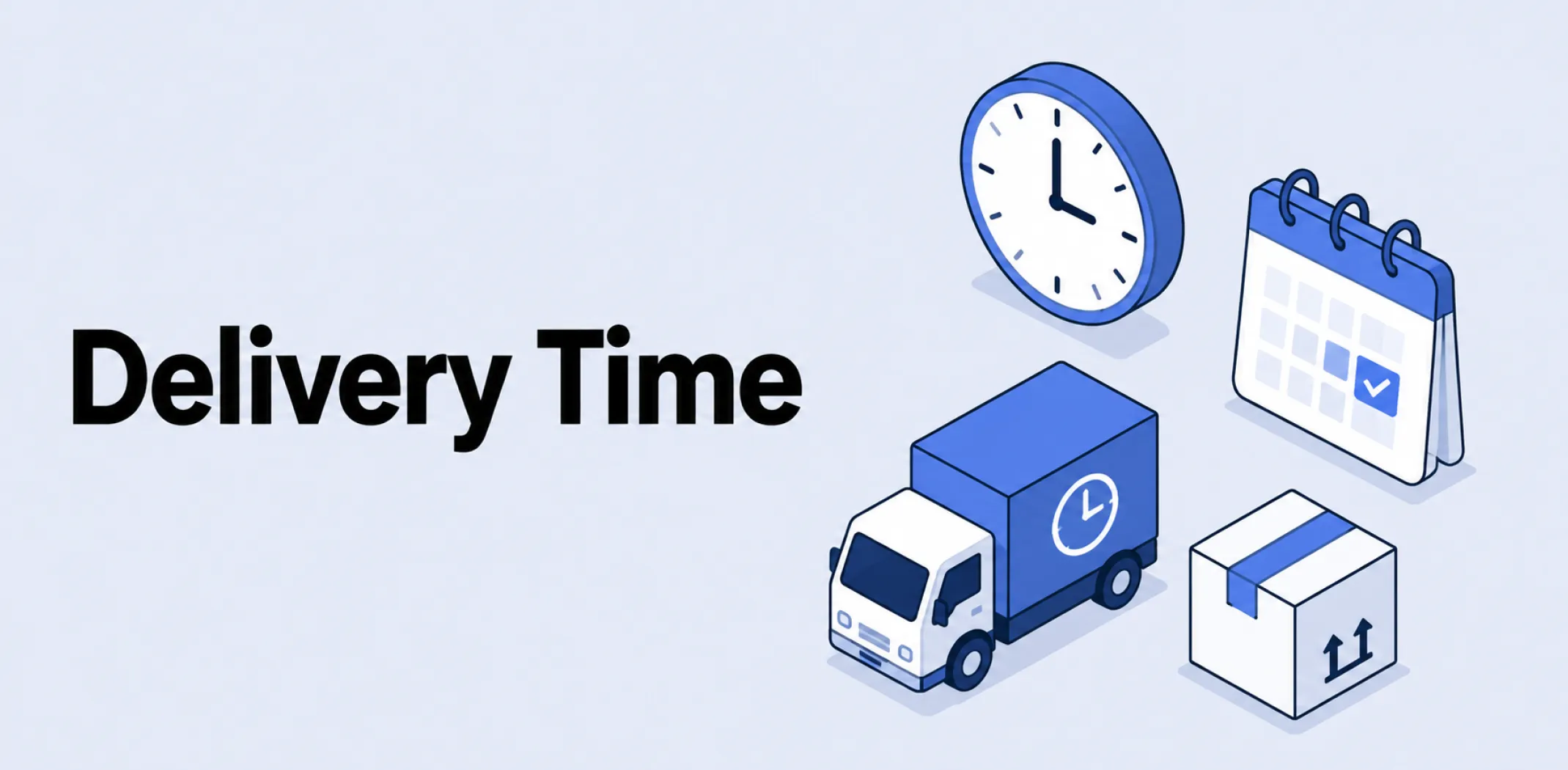
Delivery Time

Delivery time is the total elapsed time between a customer placing an order and receiving the parcel, encompassing every stage of the fulfillment process: order processing, dispatch, shipping transit, and last-mile delivery to the customer address.
Delivery time is not equivalent to shipping time, though the two terms are often used interchangeably. Shipping time refers specifically to the transit duration once a carrier takes possession of the parcel. Delivery time includes all preceding stages: the time taken by the merchant or supplier to process and dispatch the order before the carrier is involved.
In standard dropshipping with overseas suppliers, processing and dispatch can add one to five business days before shipping even begins, meaning the stated carrier transit time significantly understates what the customer actually experiences.
In ecommerce, delivery time is one of the most influential factors in purchasing decisions and post-purchase satisfaction. Customers compare delivery time estimates across competing stores at the point of purchase, and unmet delivery expectations are a primary driver of disputes, refund requests, and negative reviews.
Merchants are responsible for setting accurate estimates at checkout – accounting for all stages of the fulfillment chain, not just carrier transit – and for communicating proactively if delays occur. For dropshippers sourcing from overseas, managing the gap between customer delivery expectations and actual delivery time is a continuous operational challenge.
Example
A store advertises “ships in 1-3 business days” with a carrier transit time of 7-12 days. A customer orders on a Monday and expects to receive the parcel within roughly two weeks based on the storefront language. The supplier processes the order in three business days, the carrier collects on Thursday, and transit takes eleven days including a weekend. The parcel arrives on the third Monday after the order was placed – 15 calendar days in total. The customer expected closer to 14 days and rates the experience as acceptable. Had the store advertised only the carrier transit window without including processing time, the customer would have expected delivery by the end of the second week and filed a late-delivery complaint. Accurate delivery time framing avoids the dispute entirely.
Key characteristics
- Multi-stage composition: Delivery time is the sum of order processing time, dispatch time, carrier transit, customs clearance for international shipments, and last-mile delivery – not any single stage in isolation.
- Distinct from shipping time: Shipping time begins when the carrier collects the parcel. Delivery time begins at the moment the customer places the order. The gap between the two – processing and dispatch – can be substantial, particularly with overseas suppliers.
- Customer expectation driver: The delivery time estimate displayed at checkout directly sets customer expectations. Overpromising and underdelivering is a leading cause of disputes, chargebacks, and negative reviews regardless of product quality.
- Route and method dependency: Delivery time varies by shipping method chosen (standard vs express), origin and destination country pair, carrier performance, and whether customs clearance applies and how long it takes.
- Merchant vs carrier control: Merchants directly control only the processing and dispatch portion of delivery time. Carrier transit, customs clearance, and last-mile delivery are outside their operational control, making accurate estimation and proactive communication the primary levers available.
Related terms
- Order fulfillment – the complete process of picking, packing, dispatching, and delivering an order, all stages of which contribute to total delivery time.
- Supplier – the manufacturer or distributor whose processing and dispatch speed determines how quickly the shipping stage of delivery time begins.
- Warehousing – domestic inventory storage that eliminates overseas processing and international transit, significantly reducing total delivery time for the end customer.
- Conversion funnel – the path from product discovery to purchase, in which the delivery time estimate shown at checkout is a direct factor in whether a visitor converts.
Frequently asked questions
What is the difference between delivery time and shipping time?
Shipping time is the duration a carrier takes to transport a parcel from the dispatch point to the delivery address. Delivery time is the total time from order placement to customer receipt, which includes processing and dispatch before the carrier becomes involved.
For stores using overseas suppliers, processing and dispatch can add several business days on top of the carrier transit time, making delivery time meaningfully longer than shipping time alone.
What is a reasonable delivery time for a dropshipping store?
Customer expectations vary by market and product category, but ecommerce research consistently shows that most buyers expect delivery within 5 to 7 days for domestic orders and accept up to 14 to 21 days for international orders if informed clearly at checkout.
Stores using overseas suppliers and standard shipping often operate in the 10 to 20 business day range for international routes. Reducing delivery time through domestic warehousing or faster carrier services improves conversion rates and reduces dispute volumes.
How should delivery time be communicated to customers?
Delivery time should be stated clearly at the product page and checkout stages, covering the full range from order placement to expected delivery rather than carrier transit only. Using a range rather than a fixed date reduces the risk of a single-day miss creating a complaint.
Merchants should also set up automated order confirmation and dispatch emails with updated delivery estimates, and send a proactive message if any stage of the process is delayed beyond the stated window.
Does delivery time affect conversion rate?
Yes. Delivery time estimates are a direct factor in purchase decisions, particularly in competitive niches where multiple stores sell similar products. Shorter delivery times improve conversion at comparable price points. Inaccurate or missing delivery time information increases checkout abandonment.
Stores that display specific, credible delivery windows – rather than vague language such as “ships within a few days” – tend to convert better and generate fewer post-purchase disputes. For context on the broader purchase decision factors, see the conversion funnel wiki entry.
AliDropship: An all-in-one platform for starting dropshipping in 2026
AliDropship is a dropshipping platform that covers store creation, product imports, order automation, and marketing within a single system. It is designed for users with no prior ecommerce experience, though it also supports scaling for more established stores.
🛍️ Free turnkey store
New users receive a free pre-built store – set up, designed, and stocked with products. The store includes a ready-to-use product catalogue and a standard storefront design. It also comes with hosting, a domain, SSL, and payment systems already set up and included.
📦 Products
The platform provides access to a product catalogue covering both trending and niche items, with one-click import to your store. The catalogue is updated regularly to reflect current market availability. Products can be browsed, filtered, and added without leaving the platform.
🚚 Shipping & fulfillment
AliDropship provides access to a vast catalogue of products from global suppliers and handles order fulfillment automatically once a purchase is made. Customers receive tracking information directly, and orders are processed without manual intervention from the store owner.
📣 Marketing & promotion tools
The platform includes built-in marketing tools covering email campaigns, discount management, SEO settings, and social media integration. These are available within the dashboard and do not require third-party subscriptions for basic use.
👌 Ease of use
AliDropship requires no coding knowledge. The dashboard contains all the necessary tools for managing your store, products, and orders in one place. Additional features and products can be added as the store grows without rebuilding the existing setup.
What is the difference between delivery time and shipping time?
What is a reasonable delivery time for a dropshipping store?
How should delivery time be communicated to customers?
Does delivery time affect conversion rate?
Are you ready to become an owner
of a profitable online business?
Free Dropshipping Guide