

Customer Journey

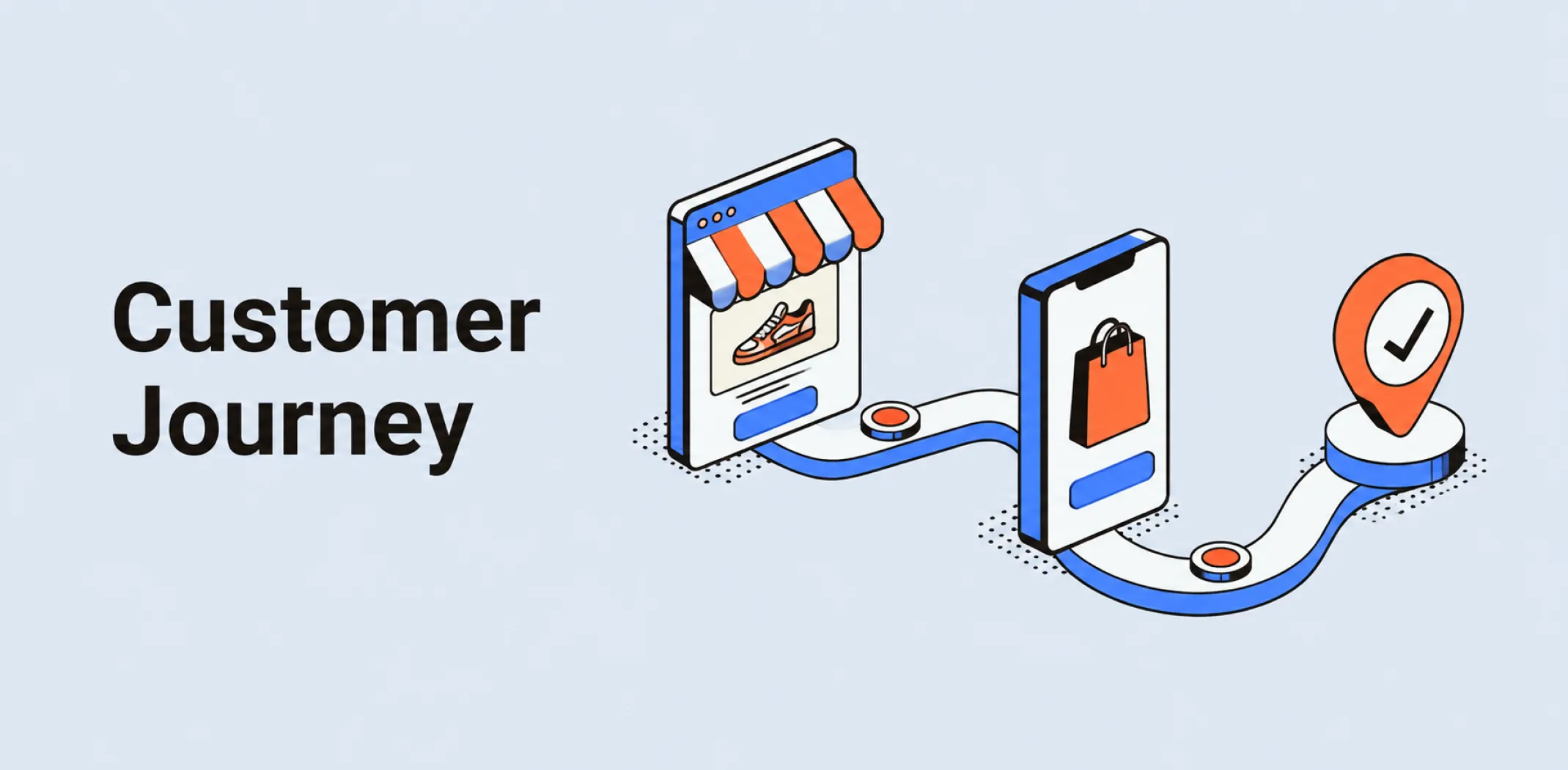
The customer journey is the sequence of stages a potential buyer moves through – from first becoming aware of a product or store to making a purchase and beyond – as mapped from the customer’s perspective rather than the seller’s.
The concept describes the full arc of a buyer’s experience, beginning before any commercial intent is formed and extending through post-purchase interactions such as reviews, returns, and repeat orders.
Unlike a conversion funnel, which models the seller’s view of how leads progress toward a transaction, the customer journey centres on the buyer’s mindset, motivations, and decision points at each stage. In ecommerce, understanding this arc helps store owners identify where potential customers disengage and what content or experience is needed to move them forward.
The journey is typically non-linear. A buyer may encounter a product through a social post, leave without purchasing, return via a search result days later, and convert only after reading reviews. Ecommerce marketing strategies that account for this behaviour address each stage with appropriate messaging rather than treating every visitor as ready to buy.
Example
A shopper sees a short-form video featuring a portable blender and visits the store out of curiosity. She does not purchase immediately but clicks through to a landing page and reads product details. Two days later, a retargeting ad reintroduces the product, and she returns to complete the purchase after reading customer reviews. A follow-up email arrives the next week with care instructions and a discount code for her next order. Each of these touchpoints is a distinct stage in her customer journey.
Key characteristics
- Stage-based progression: The journey is commonly divided into awareness, consideration, decision, purchase, and post-purchase – each requiring a different type of engagement from the seller.
- Multiple touchpoints: Buyers interact with a store through several channels – organic search, paid ads, social media, email, and on-site content – before converting.
- Customer-centric framing: The journey is mapped from the buyer’s perspective, focusing on their questions and needs at each stage rather than the seller’s sales objectives.
- Non-linear movement: Buyers frequently exit and re-enter the journey at different stages, making sequential channel strategies insufficient on their own.
- Post-purchase scope: The journey continues after a sale through delivery experience, support interactions, and re-engagement – factors that influence customer lifetime value.
Related terms
- Conversion funnel – a seller-side model tracking the stages through which visitors move toward completing a purchase.
- Customer lifetime value – the total revenue a store can expect from a single customer across all purchases over time.
- Customer segmentation – the practice of grouping buyers by shared characteristics to tailor messaging at different journey stages.
- Landing page – a focused page designed to receive visitors at a specific stage of the journey and prompt a defined action.
- Product advertising – paid and organic promotion used to introduce products to buyers at the awareness or consideration stage.
Frequently asked questions
What are the main stages of the customer journey?
The most widely used model includes five stages: awareness (the buyer first learns about a product or store), consideration (they evaluate options), decision (they choose to purchase), purchase (the transaction is completed), and post-purchase (delivery, support, and retention). Some frameworks extend this to include loyalty and advocacy as additional stages.
How does the customer journey differ from the sales funnel?
A sales funnel is built around the seller’s process of moving leads toward a conversion. The customer journey is built around the buyer’s experience – their questions, hesitations, and motivations at each stage. Both models describe the same progression but from opposite perspectives, and effective ecommerce stores use both together.
Why does the customer journey matter for dropshipping stores?
Dropshipping stores often compete on similar products at similar price points, making the buying experience itself a key differentiator. Mapping the customer journey helps store owners identify which stages are underserved – for example, a lack of social proof during consideration, or no post-purchase email sequence – and address those gaps to improve conversion rates and repeat purchases.
Can the customer journey be the same for every buyer?
No. Journey length, touchpoints, and decision factors vary by product category, price point, and buyer type. A low-cost impulse item may move from awareness to purchase in a single session, while a higher-priced product typically involves multiple visits and comparison across sources before a decision is made.
AliDropship: An all-in-one platform for starting dropshipping in 2026
AliDropship is a dropshipping platform that covers store creation, product imports, order automation, and marketing within a single system. It is designed for users with no prior ecommerce experience, though it also supports scaling for more established stores.
🛍️ Free turnkey store
New users receive a free pre-built store – set up, designed, and stocked with products. The store includes a ready-to-use product catalogue and a standard storefront design. It also comes with hosting, a domain, SSL, and payment systems already set up and included.
📦 Products
The platform provides access to a product catalogue covering both trending and niche items, with one-click import to your store. The catalogue is updated regularly to reflect current market availability. Products can be browsed, filtered, and added without leaving the platform.
🚚 Shipping & fulfillment
AliDropship provides access to a vast catalogue of products from global suppliers and handles order fulfillment automatically once a purchase is made. Customers receive tracking information directly, and orders are processed without manual intervention from the store owner.
📣 Marketing & promotion tools
The platform includes built-in marketing tools covering email campaigns, discount management, SEO settings, and social media integration. These are available within the dashboard and do not require third-party subscriptions for basic use.
👌 Ease of use
AliDropship requires no coding knowledge. The dashboard contains all the necessary tools for managing your store, products, and orders in one place. Additional features and products can be added as the store grows without rebuilding the existing setup.
What are the main stages of the customer journey?
How does the customer journey differ from the sales funnel?
Why does the customer journey matter for dropshipping stores?
Can the customer journey be the same for every buyer?
Are you ready to become an owner
of a profitable online business?
Free Dropshipping Guide