

Custom Audience

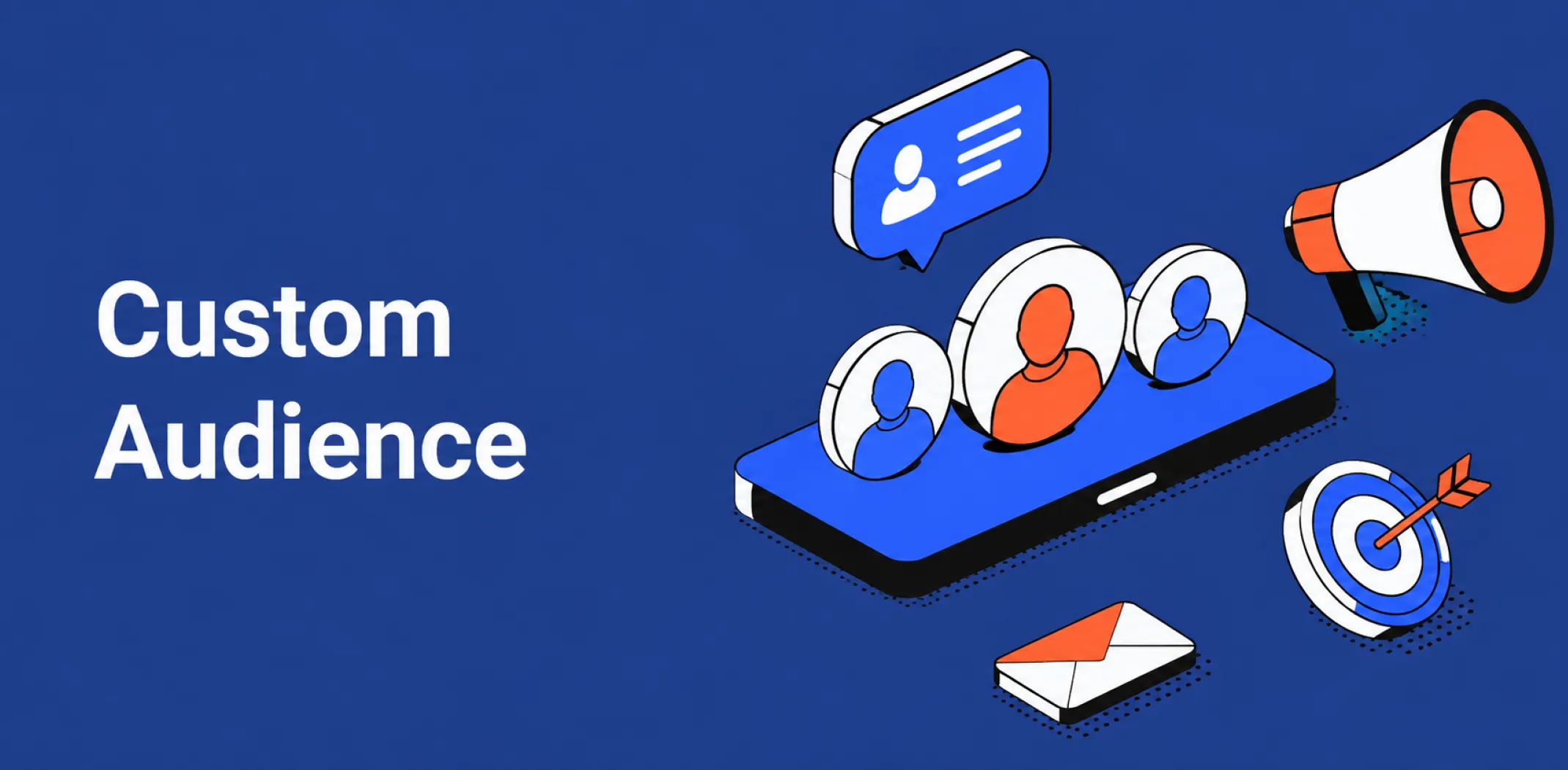
A custom audience is an advertising segment built from a merchant’s own first-party data – such as customer email lists, website visitor activity, or app usage – uploaded to an ad platform to target ads specifically at people who have already interacted with the business.
Custom audiences sit in contrast to interest-based or demographic targeting, which reaches people who have never interacted with the merchant but share traits the platform infers as relevant. A custom audience instead targets people the merchant already has a relationship with: past purchasers, cart abandoners, email subscribers, or visitors who viewed specific product pages.
Ad platforms such as Meta, Google, and TikTok allow merchants to upload customer data directly, or to install a tracking pixel that automatically builds an audience from website behaviour over time. Because the audience is built from real interaction history rather than inferred traits, custom audiences typically convert at a higher rate than cold, interest-based targeting.
In ecommerce and dropshipping, custom audiences are a core component of retargeting strategy. A merchant running paid product advertising campaigns can use a custom audience to re-engage visitors who viewed a product but did not purchase, target past buyers with complementary product recommendations, or exclude existing customers from acquisition campaigns to avoid wasting ad spend on people already converted.
Custom audiences are also frequently used as a seed to build lookalike audiences – new, cold audiences modelled on the characteristics of the custom audience – extending the reach of a targeting strategy beyond the merchant’s existing contact base.
Example
A dropshipping store sells a niche fitness accessory and installs a tracking pixel on its website. Over 60 days, the pixel builds a custom audience of 4,200 visitors who viewed the product page but did not complete a purchase. The merchant creates a retargeting campaign aimed specifically at this custom audience, showing an ad featuring a limited-time discount. The campaign achieves a 4.1% click-through rate and a 2.8% conversion rate – both significantly higher than the 0.6% conversion rate achieved on the original cold interest-based campaign that first drove traffic to the product page. The merchant also uploads a list of 1,800 past purchasers as a separate custom audience and excludes them from future acquisition campaigns, focusing ad spend on new visitor acquisition rather than re-targeting customers who have already bought.
Key characteristics
- Built from first-party data: Custom audiences are constructed from data the merchant already owns – customer lists, pixel-tracked website visitors, or app activity – rather than inferred interests or demographics provided by the ad platform.
- Higher relevance and conversion: Because the audience already has a relationship with the brand, ads shown to a custom audience typically achieve higher engagement and conversion rates than cold targeting aimed at new, unfamiliar audiences.
- Platform-specific implementation: Each ad platform – Meta, Google, TikTok, Pinterest – has its own method for building and uploading custom audiences, with varying minimum audience size requirements and data matching rates.
- Foundation for lookalike audiences: A custom audience can be used as a seed to generate a lookalike audience, allowing the merchant to reach new people who share characteristics with their existing customers or visitors.
- Privacy and consent dependency: Building custom audiences from customer data requires compliance with data privacy regulations such as GDPR and CCPA, including appropriate consent for using personal data in advertising.
Related terms
- Product advertising – the paid promotion activity in which custom audiences are most commonly applied to improve targeting precision and return on ad spend.
- Conversion funnel – the path from discovery to purchase, where custom audiences are used to re-engage visitors who dropped out at a specific funnel stage.
- Niche market – a focused customer segment whose existing purchasers or engaged visitors form a natural basis for building a high-relevance custom audience.
- Product positioning – the strategy informing what message or offer is shown to a custom audience based on their known relationship with the brand.
- Return on investment – the metric used to evaluate whether the cost of running campaigns targeted at a custom audience is justified by the resulting conversion lift.
Frequently asked questions
How do you build a custom audience?
Custom audiences are built either by uploading existing data such as a customer email list or phone number list directly to an ad platform, or by installing a tracking pixel on the store website that automatically records visitor behaviour and adds those visitors to an audience over a defined time window, commonly 30, 60, or 180 days.
Most ad platforms also support building a custom audience from app activity, video engagement, or page interaction for stores running content alongside product advertising.
What is the difference between a custom audience and a lookalike audience?
A custom audience is built directly from data the merchant already owns: actual past customers, subscribers, or website visitors. A lookalike audience is generated by the ad platform using a custom audience as a seed, then finding new people who share statistical similarities with that seed group.
A custom audience targets known people; a lookalike audience targets new people who resemble them, extending reach beyond the existing customer base.
Why do custom audiences convert better than cold targeting?
Custom audiences are made up of people who already have some relationship with the brand, whether through a past purchase, a website visit, or engagement with a previous ad. This prior familiarity means the audience requires less persuasion to convert compared to a cold audience seeing the brand for the first time.
Retargeting a custom audience that previously viewed a product but did not purchase typically achieves several times the conversion rate of the original campaign that drove the initial visit.
Are custom audiences relevant for small dropshipping stores?
Yes, though minimum audience size requirements vary by platform and feature. Smaller stores with limited site traffic may take longer to accumulate a custom audience large enough for some advanced features, such as lookalike audience generation, which typically requires a seed audience of at least a few hundred to a thousand matched users.
Even modest custom audiences built from cart abandoners or product page visitors can support effective retargeting campaigns at relatively low spend, making the tactic accessible to stores at most scales.
AliDropship: An all-in-one platform for starting dropshipping in 2026
AliDropship is a dropshipping platform that covers store creation, product imports, order automation, and marketing within a single system. It is designed for users with no prior ecommerce experience, though it also supports scaling for more established stores.
🛍️ Free turnkey store
New users receive a free pre-built store – set up, designed, and stocked with products. The store includes a ready-to-use product catalogue and a standard storefront design. It also comes with hosting, a domain, SSL, and payment systems already set up and included.
📦 Products
The platform provides access to a product catalogue covering both trending and niche items, with one-click import to your store. The catalogue is updated regularly to reflect current market availability. Products can be browsed, filtered, and added without leaving the platform.
🚚 Shipping & fulfillment
AliDropship provides access to a vast catalogue of products from global suppliers and handles order fulfillment automatically once a purchase is made. Customers receive tracking information directly, and orders are processed without manual intervention from the store owner.
📣 Marketing & promotion tools
The platform includes built-in marketing tools covering email campaigns, discount management, SEO settings, and social media integration. These are available within the dashboard and do not require third-party subscriptions for basic use.
👌 Ease of use
AliDropship requires no coding knowledge. The dashboard contains all the necessary tools for managing your store, products, and orders in one place. Additional features and products can be added as the store grows without rebuilding the existing setup.
How do you build a custom audience?
What is the difference between a custom audience and a lookalike audience?
Why do custom audiences convert better than cold targeting?
Are custom audiences relevant for small dropshipping stores?
Are you ready to become an owner
of a profitable online business?
Free Dropshipping Guide