

Adobe Commerce

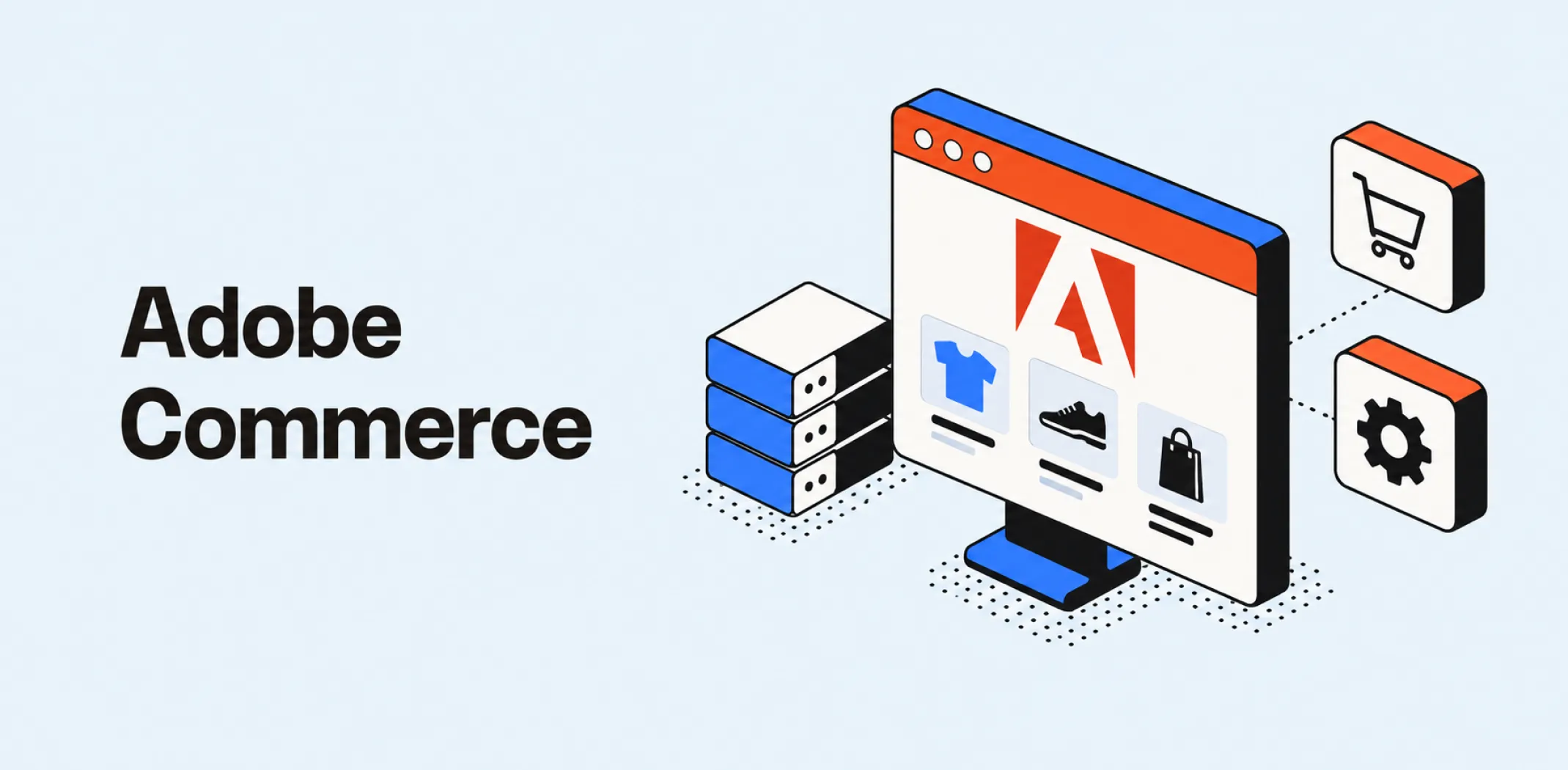
Adobe Commerce is the paid enterprise edition of the Magento ecommerce platform, built for mid-market and large businesses that need advanced personalization, native B2B functionality, and managed infrastructure beyond what the free, self-hosted Magento Open Source edition provides.
Adobe Commerce shares its underlying codebase with Magento Open Source but is licensed separately, with pricing based on a merchant’s gross merchandise value rather than a fixed published rate. As of 2026, annual license costs typically range from roughly $40,000 for smaller enterprise deployments up to $190,000 or more for large-scale cloud implementations, on top of hosting, development, and ongoing maintenance.
This positions the platform primarily for merchants generating several million dollars or more in annual revenue, since the licensing and implementation costs are generally considered prohibitive for smaller operations, which tend to be better served by platforms such as Shopify or BigCommerce.
The platform is available in several deployment models: a self-managed on-premise option, Adobe Commerce Cloud, which provides managed hosting on AWS or Azure with built-in scaling and security features, and Adobe Commerce as a Cloud Service, a fully managed multi-tenant SaaS option introduced in 2025 that automates infrastructure and updates in exchange for reduced low-level customization.
Across all deployment models, Adobe Commerce adds a defined set of enterprise features on top of the open-source core, including a native B2B suite, AI-powered merchandising and search, and advanced reporting tools not available in Magento Open Source.
Example
A manufacturer selling both to retail customers and wholesale accounts needs different pricing, catalogues, and approval workflows for each group from a single platform. They choose Adobe Commerce specifically for its native B2B suite, setting up company account hierarchies, shared catalogues, and quote negotiation for wholesale buyers, while retail customers shop through a separate, AI-personalized storefront on the same underlying instance.
Key characteristics
- Native B2B suite: Company account hierarchies, custom price books, requisition lists, quote negotiation, and purchase approval workflows are built into the platform rather than requiring third-party extensions.
- AI-powered merchandising: Built-in tools handle semantic search, personalized product recommendations, and automated category-page merchandising to improve conversion rates.
- Revenue-based licensing: Pricing is quote-based and tied to gross merchandise value rather than published flat-rate tiers, meaning costs scale with the size of the business.
- Multiple deployment options: Merchants can choose between self-managed on-premise hosting, the managed Adobe Commerce Cloud, or the fully managed Adobe Commerce as a Cloud Service, depending on how much infrastructure control they want to retain.
- Adobe ecosystem integration: Native connections to Adobe Experience Cloud products allow marketing, analytics, and commerce data to be unified across a single customer journey.
Related terms
- Magento – the broader platform and open-source edition that Adobe Commerce is built on top of, sharing the same underlying codebase.
- Ecommerce – the broader category of online commercial transactions that enterprise platforms such as Adobe Commerce are built to support.
- Wholesale – a pricing model natively supported through Adobe Commerce’s B2B suite, including company accounts and negotiated catalogue pricing.
- Payment gateway – the service that authorizes card transactions at checkout, integrated into Adobe Commerce through native and third-party connections.
- Order fulfillment – the process of processing and shipping a customer order, configurable within Adobe Commerce through native settings and logistics integrations.
Frequently asked questions
What is the difference between Adobe Commerce and Magento Open Source?
Magento Open Source is the free, self-hosted edition of the platform, while Adobe Commerce is the paid enterprise edition built on the same codebase. Adobe Commerce adds native B2B functionality, AI-powered merchandising, advanced reporting, and managed hosting options that are not available in the free edition.
How much does Adobe Commerce cost?
Adobe Commerce does not publish fixed pricing; costs are quoted individually based on a merchant’s gross merchandise value. As of 2026, typical annual license costs range from roughly $40,000 for smaller deployments to $190,000 or more for large-scale cloud implementations, before accounting for hosting, development, and implementation expenses.
Is Adobe Commerce suitable for small businesses?
Adobe Commerce is generally designed for mid-market and enterprise merchants, typically those generating several million dollars or more in annual revenue. Smaller businesses are usually better served by lower-cost hosted platforms, since Adobe Commerce’s licensing and implementation costs are considered prohibitive at smaller scale.
What deployment options does Adobe Commerce offer?
Adobe Commerce can be run on a self-managed on-premise installation, on Adobe Commerce Cloud with managed hosting on AWS or Azure, or through Adobe Commerce as a Cloud Service, a fully managed multi-tenant SaaS option introduced in 2025 that automates infrastructure and updates at the cost of some customization flexibility.
AliDropship: An all-in-one platform for starting dropshipping in 2026
AliDropship is a dropshipping platform that covers store creation, product imports, order automation, and marketing within a single system. It is designed for users with no prior ecommerce experience, though it also supports scaling for more established stores.
🛍️ Free turnkey store
New users receive a free pre-built store – set up, designed, and stocked with products. The store includes a ready-to-use product catalogue and a standard storefront design. It also comes with hosting, a domain, SSL, and payment systems already set up and included.
📦 Products
The platform provides access to a product catalogue covering both trending and niche items, with one-click import to your store. The catalogue is updated regularly to reflect current market availability. Products can be browsed, filtered, and added without leaving the platform.
🚚 Shipping & fulfillment
AliDropship provides access to a vast catalogue of products from global suppliers and handles order fulfillment automatically once a purchase is made. Customers receive tracking information directly, and orders are processed without manual intervention from the store owner.
📣 Marketing & promotion tools
The platform includes built-in marketing tools covering email campaigns, discount management, SEO settings, and social media integration. These are available within the dashboard and do not require third-party subscriptions for basic use.
👌 Ease of use
AliDropship requires no coding knowledge. The dashboard contains all the necessary tools for managing your store, products, and orders in one place. Additional features and products can be added as the store grows without rebuilding the existing setup.
What is the difference between Adobe Commerce and Magento Open Source?
How much does Adobe Commerce cost?
Is Adobe Commerce suitable for small businesses?
What deployment options does Adobe Commerce offer?
Are you ready to become an owner
of a profitable online business?
Free Dropshipping Guide