

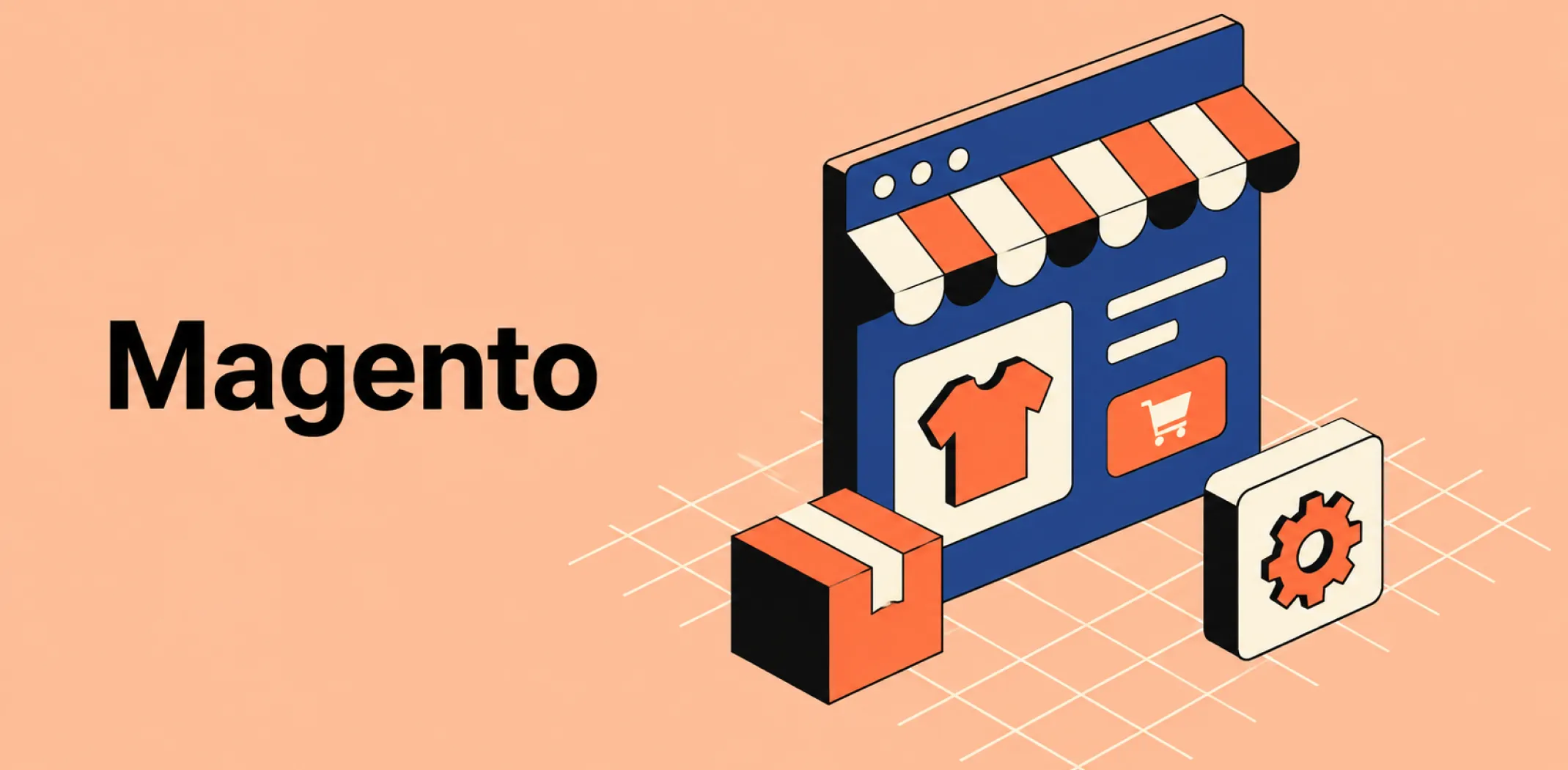
Magento

Magento is an open-source ecommerce platform built on PHP, originally designed to give merchants a more flexible and customizable alternative to the ecommerce software available in the mid-2000s. The platform now operates under the name Adobe Commerce following its acquisition by Adobe, though the original “Magento” name remains in common use, particularly for the free, self-hosted edition.
Magento was developed by Roy Rubin and Yoav Kutner through their company Varien, growing out of a web development consultancy that had previously worked with osCommerce, an earlier open-source platform. Finding the available service providers for osCommerce limited, the pair built an alternative from the ground up, releasing the first public beta in August 2007 and the first stable version in March 2008.
eBay acquired a 49% stake in 2010 before taking full ownership in 2011, and Magento was later spun off into an independent company backed by the investment firm Permira in 2015, the same year Magento 2.0 launched. Adobe completed its acquisition of Magento in June 2018 for $1.68 billion, subsequently rebranding the commercial edition as Adobe Commerce while keeping the free edition under the Magento Open Source name.
The platform exists today in two primary editions: Magento Open Source, a free, self-hosted version that requires merchants to manage their own hosting and security similar to WooCommerce, and Adobe Commerce, a paid enterprise edition priced on annual revenue that adds AI-driven personalization, advanced B2B tools, and tighter integration with Adobe’s broader marketing and analytics products.
In mid-2025, Adobe also introduced Adobe Commerce as a Cloud Service, a fully managed, multi-tenant version that handles infrastructure automatically, sitting alongside the existing self-managed cloud option.
Example
A wholesale distributor with thousands of SKUs and separate pricing for retail and trade customers needs a platform that can handle complex catalogue rules without forcing a rebuild as the business scales. They choose Magento Open Source, hire a development team to configure custom pricing tiers and multi-warehouse inventory, and host the store on their own infrastructure. As order volume grows, they evaluate upgrading to Adobe Commerce for native B2B account management and advanced reporting rather than continuing to build these features manually.
Key characteristics
- Open-source core: Magento Open Source remains free to download and self-host, with the underlying codebase shared across both the free and paid editions.
- Deep customizability: The platform’s modular architecture allows extensive customization of catalogue structure, pricing logic, and checkout flow, making it suited to merchants with requirements that exceed what hosted SaaS platforms support out of the box.
- Enterprise-oriented paid tier: Adobe Commerce adds AI-powered personalization, customer segmentation, multi-site management, and native B2B functionality such as quotes and company account hierarchies.
- Self-managed or cloud deployment: Merchants can host Magento Open Source themselves, run Adobe Commerce on a managed cloud infrastructure, or use Adobe Commerce as a Cloud Service for a fully managed, SaaS-style deployment.
- Developer-dependent setup: Unlike fully hosted platforms, Magento typically requires development expertise to install, configure, and maintain, particularly for the Open Source edition.
Related terms
- Ecommerce – the broader category of online commercial transactions that platforms such as Magento are built to support.
- WooCommerce – a self-hosted ecommerce plugin for WordPress, often compared to Magento Open Source as a lighter-weight self-hosted alternative for smaller merchants.
- Payment gateway – the service that authorizes card transactions at checkout, integrated into Magento through native and third-party extensions.
- Wholesale – a pricing model commonly supported through Adobe Commerce’s native B2B features, including company accounts and negotiated pricing.
- Order fulfillment – the process of processing and shipping a customer order, configurable within Magento through native settings and third-party logistics integrations.
Frequently asked questions
What is the difference between Magento and Adobe Commerce?
Magento Open Source is the free, self-hosted edition of the platform, while Adobe Commerce is the paid enterprise edition that adds AI-driven personalization, advanced B2B tools, and tighter integration with Adobe’s marketing and analytics products. Both share the same underlying codebase, but Adobe Commerce is priced based on the merchant’s annual revenue.
Is Magento free to use?
Magento Open Source is free to download and self-host, though merchants are responsible for hosting, security, and development costs. Adobe Commerce, the enterprise edition, requires a paid license priced according to annual revenue.
Is Magento suitable for small businesses?
Magento Open Source can technically be used by small businesses, but its setup and ongoing maintenance typically require development expertise that hosted platforms do not demand. Smaller merchants without dedicated technical resources often find platforms with built-in hosting and support easier to manage day to day.
What is Adobe Commerce as a Cloud Service?
Adobe Commerce as a Cloud Service, launched in mid-2025, is a fully managed, multi-tenant deployment option for Adobe Commerce. It handles infrastructure and updates automatically, trading some of the deep customization available in the self-managed cloud or Open Source editions for simpler, more automated maintenance.
AliDropship: An all-in-one platform for starting an online business in 2026
AliDropship is an online business platform that gives customers a ready-made store, a digital products catalogue, and built-in, one-click advertising within a single system. Founded in 2015 and based in Irvine, California, it has helped launch more than 1,500,000 stores and holds a 4.7-star rating on Trustpilot. It is built for people with no prior experience and no technical skills.
🆓 Free 14-day trial
New users get full platform access for 14 days, including a ready-made store, hosting, a domain, an SSL certificate, and access to the digital products catalogue. The trial also includes a $40 ad coupon to test the advertising system. Order fees apply only when a sale is made.
📦 Digital products
Customers choose from AliDropship’s catalogue of digital products – guides, courses, checklists, tools, and AI-powered toolkits – and keep up to 70% of every sale. Delivery is instant and automated, so there is no inventory, shipping, or manual fulfillment involved.
📣 One-click advertising
AliDropship includes built-in advertising that customers can turn on for as little as $10 a day. The system handles targeting, creatives, and optimization, and many customers see their first orders the same day they launch ads.
👌 Ease of use
AliDropship requires no coding or marketing experience. The store, products, and ads are managed from a single dashboard that works on a phone as well as a desktop, and a personal growth manager is available to help by chat.
💳 Monthly plan
After the trial, continued access is $39 a month, covering the store, the digital products catalogue, and ongoing support. There is no long-term contract, and the plan can be cancelled at any time.
What is the difference between Magento and Adobe Commerce?
Is Magento free to use?
Is Magento suitable for small businesses?
What is Adobe Commerce as a Cloud Service?
Are you ready to become an owner
of a profitable online business?
Free Dropshipping Guide