Dropshipping VS Affiliate Marketing Comparison: Which Earns More In 2026?

Two business models dominate the beginner ecommerce conversation in 2026 – and for good reason. Both dropshipping and affiliate marketing let you earn money online without manufacturing products or carrying inventory.
But they work very differently, they reward different skill sets, and they come with very different income ceilings. So which one is actually worth your time?
This guide introduces the dropshipping vs affiliate marketing comparison – what each involves, how much you can realistically earn, and which model makes more sense depending on where you are right now.
Quick Answer: Dropshipping gives you more control over revenue and scaling potential, with typical earnings of $50–$200/day once established. Affiliate marketing is lower effort to start but harder to scale beyond $1,000–$3,000/month without significant traffic. For most beginners in 2026, dropshipping offers a clearer path to full-time income.
Before we get into the detail, it helps to understand what each model actually is – not the hype version, but the practical, day-to-day reality of running one.
What is dropshipping vs affiliate marketing?
The dropshipping model works like this: you run an online store, a customer places an order, and a third-party supplier ships the product directly to them.
You never hold stock. You set your own prices, keep the margin between your cost and the sale price, and control the entire customer experience – from the storefront design to the post-purchase follow-up.
Affiliate marketing works differently. You promote someone else’s product using a unique tracking link.
When a visitor clicks your link and makes a purchase, you earn a commission – typically 3%–30% of the sale price depending on the niche and platform. You do not own the store, you do not set the price, and you have no relationship with the customer after the click.
Both models are legitimate. Both are low-cost to start. The key differences show up in how much control you have, how quickly earnings compound, and how vulnerable you are to things outside your control – like a brand changing its commission structure overnight.
One more important distinction: with dropshipping, you are building an asset – a store with a brand, a customer list, and repeat purchase potential.
With affiliate marketing, you are building traffic that funnels to someone else’s asset. That difference matters enormously over a 12–24 month horizon.
How much can you realistically earn?
Earnings in both models depend heavily on effort, consistency, and how well you choose your niche. But there are meaningful structural differences in the income ceilings and typical timelines that are worth understanding before you commit to either path.
Dropshipping has a higher ceiling and a faster feedback loop – you can test products, run ads, and see results within weeks.
Affiliate marketing builds more slowly because it depends on organic traffic compounding over time, but it requires less upfront operational management once content is live.
One note on the headline figures: “$1,000/day” in dropshipping is real but it reflects full-time effort, solid ad spend, and a well-tested product – not week-one results. For most people starting part-time, 60–90 days to your first $30–$80/day is a more grounded target.
The other thing to factor in is margin. A dropshipping sale of $40 might net you $12–$18 after product cost and shipping. An affiliate commission on a $40 sale at 10% nets you $4.
That gap compounds fast at scale. Affiliate marketing makes more sense when commissions are high (software, finance, or high-ticket products at 20%–50%) – but in commodity niches, dropshipping almost always wins on per-sale economics.
How the dropshipping model works in practice
Understanding the dropshipping model end-to-end helps you see exactly where the work goes – and where automation can take over.
Setting up your store
Choosing a niche
Your niche determines everything – product margins, audience size, ad costs, and competition. High-performing dropshipping niches in 2026 include home improvement, pet accessories, fitness gear, and specialty kitchen tools.
The goal is a niche specific enough to attract a defined buyer but broad enough to carry 30–100 products without running out of inventory options.
Research tools like Google Trends, AliExpress bestseller lists, and TikTok’s trending products tab all give you real demand signals. Avoid niches dominated by Amazon private label sellers unless you can compete on price or unique bundling.
Finding suppliers
AliExpress remains the most accessible starting point for dropshipping suppliers in 2026. Filters for “Top Seller” status, 4.7+ ratings, and order counts above 500 help you shortlist reliable options.
For faster shipping, US-based dropshipping suppliers through platforms like Spocket or AutoDS can reduce delivery times to 5–10 days, which matters significantly for customer satisfaction and return rates.
Automating fulfillment
The biggest operational advantage of modern dropshipping tools is automated order routing. When a customer buys, the order is sent to your supplier automatically – no manual copying of addresses, no chasing tracking numbers.
Platforms like AliDropship handle this natively, which is a major time saver once you are processing more than 10–15 orders per day.
Driving traffic to your store
Paid advertising
Facebook and TikTok ads are the fastest routes to sales in dropshipping. A typical testing budget is $20–$50/day across 3–5 product creatives. Expect to spend $200–$500 testing before you find a winning combination.
Once a product converts reliably, scaling ad spend is straightforward – and this is where dropshipping income can grow quickly.
Organic and SEO traffic
Long-tail SEO, Pinterest, and TikTok organic content are slower but free. A product-focused TikTok with good hook and clear benefit can generate hundreds of visits in 24 hours. Over time, organic content compounds in ways that paid ads never do – making it a smart secondary channel once your store is established.
How affiliate marketing works in practice
Understanding how affiliate marketing works from the ground up helps set accurate expectations – both for what it takes and what it pays.
The affiliate marketing basics
Joining an affiliate program
Most large retailers and software companies run affiliate programs. Amazon Associates, ShareASale, CJ Affiliate, and Impact are among the largest networks in 2026. You apply, get approved, and receive unique tracking links for any product you want to promote.
Commissions vary widely: Amazon pays 1%–10% depending on category, while software products on platforms like PartnerStack often pay 20%–40% recurring monthly commissions.
Creating content that converts
How affiliate marketing works in terms of traffic is almost entirely through content – blog posts, YouTube reviews, comparison articles, and email newsletters.
A well-ranked “best [product category]” article can generate passive commissions for years. The challenge is that ranking takes time: most affiliate sites take 6–18 months to generate meaningful organic traffic, depending on niche competition and content volume.
Earning potential: $100–$500/month in the first year for a consistent publisher; $1,000–$5,000/month is achievable after 12–18 months in a high-commission niche with strong SEO.
The commission dependency problem
One of the most underreported risks in affiliate marketing is commission volatility. Amazon slashed its affiliate rates in 2020 and wiped out thousands of publishers’ incomes overnight.
The same risk exists on any platform where you do not control the payout structure. If you build your entire income on one affiliate program and that program changes terms, you have no fallback. This is a structural weakness the dropshipping model does not share.
Where affiliate marketing genuinely wins
High-ticket and software niches
Affiliate marketing is most compelling in niches where commissions are high and products are expensive.
A single sale of a $2,000 online course at 40% commission earns you $800. A single software subscription at $99/month with 30% recurring commission earns you $29.70 every month that customer stays subscribed.
These are the niches where how affiliate marketing works translates into genuinely passive, scalable income – but they also require more sophisticated content and SEO skills to compete.
Low-maintenance content assets
A well-written affiliate review or comparison article, once ranked, requires almost no maintenance. This is a legitimate advantage over dropshipping, which requires ongoing product testing, ad management, and customer service.
For people with limited daily hours and strong writing skills, affiliate marketing can generate steady side income with minimal ongoing work.
Dropshipping vs affiliate marketing comparison
Here is a clear breakdown of how the two models compare across the factors that matter most to someone starting out in 2026.
Both models have genuine strengths. The right choice depends on how quickly you want results, how much control matters to you, and whether you prefer writing content or managing a storefront. For most people reading this in 2026, the dropshipping model wins on income speed and ceiling.
Legal and ethical considerations
Both models are fully legitimate when practiced honestly. But there are specific pitfalls in each that can get you into trouble – either with platforms, regulators, or your own audience.
Dropshipping ethics and compliance
The most common issue in dropshipping is misleading delivery time claims. If your supplier ships from China with a 15–25 day delivery window, your product listings must reflect that.
Advertising “fast shipping” without disclosing international delivery times violates FTC guidelines and leads to chargebacks and PayPal disputes. Always display accurate shipping estimates prominently on your product pages.
Key principle: Honest shipping disclosures protect your store reputation, reduce disputes, and build the long-term trust that drives repeat purchases.
Counterfeit products are an absolute line you should never cross. Selling branded items without authorization – even if they appear on AliExpress – exposes you to trademark infringement claims.
Stick to unbranded or white-label products in your store, particularly in fashion, electronics, and beauty categories where counterfeiting is common.
Affiliate marketing ethics and disclosure
The FTC requires affiliate marketers to disclose their relationship with brands whenever they earn a commission from a recommendation. This applies to blog posts, YouTube videos, social media posts, and email newsletters.
The disclosure must be clear and prominent – not buried in fine print or hidden in a generic disclaimer page.
Fake reviews are the biggest ethical trap in affiliate marketing. Reviewing products you have never used, or writing dishonestly positive reviews solely for commission, damages your audience trust and potentially violates platform terms on Amazon, Google, and major affiliate networks.
Write what you actually know, disclose what you earn, and your affiliate business will compound far more effectively over time.
Important note: Both models are cleaner and more profitable long-term when built on genuine value – honest product selection in dropshipping, honest recommendations in affiliate marketing.
Which model is right for you?
There’s no clear-cut winner in the dropshipping vs affiliate marketing comparison. It depends entirely on your current situation – your time, your skills, and your income goals.
Complete beginner
If you have never built an online business before, dropshipping with a turnkey store solution removes the biggest friction points – platform setup, product selection, and store design.
You can be live within a day and testing your first products within a week. Affiliate marketing is also accessible for beginners, but the 6–12 month SEO runway before meaningful income can be discouraging without visible early results.
Intermediate or part-time operator
If you already have some online income – from freelancing, content, or a side hustle – and you want to add a more scalable revenue stream, dropshipping adds a channel you control entirely.
The dropshipping model pairs well with existing social media audiences: if you already have followers, product recommendations via your own store earn significantly more than affiliate commissions on the same products.
Advanced or full-time goal
For anyone targeting $5,000+/month in 12–18 months, the dropshipping model scales more reliably. Paid ad scaling, product line expansion, and email list building compound into a business with real asset value – stores have been sold for 24–36x monthly profit multiples.
Affiliate marketing at this level is possible but requires either massive traffic (500,000+ monthly visitors) or a high-ticket niche with premium commissions.
The combination approach
Some experienced operators run both – an affiliate content site that drives warm traffic to their own dropshipping store. This hybrid captures both the low-maintenance income of affiliate content and the higher margins of owned ecommerce. It is a longer road to build, but a powerful one once both channels are running.
AliDropship: Your complete all-in-one solution for starting dropshipping in 2026
If you want the simplest possible way to start dropshipping – especially if you are brand new – AliDropship remains one of the most beginner-friendly tools available in 2026. It brings together store creation, product imports, automation, and marketing into a single streamlined system designed to help you launch quickly and grow confidently.
Free turnkey store 🛍️
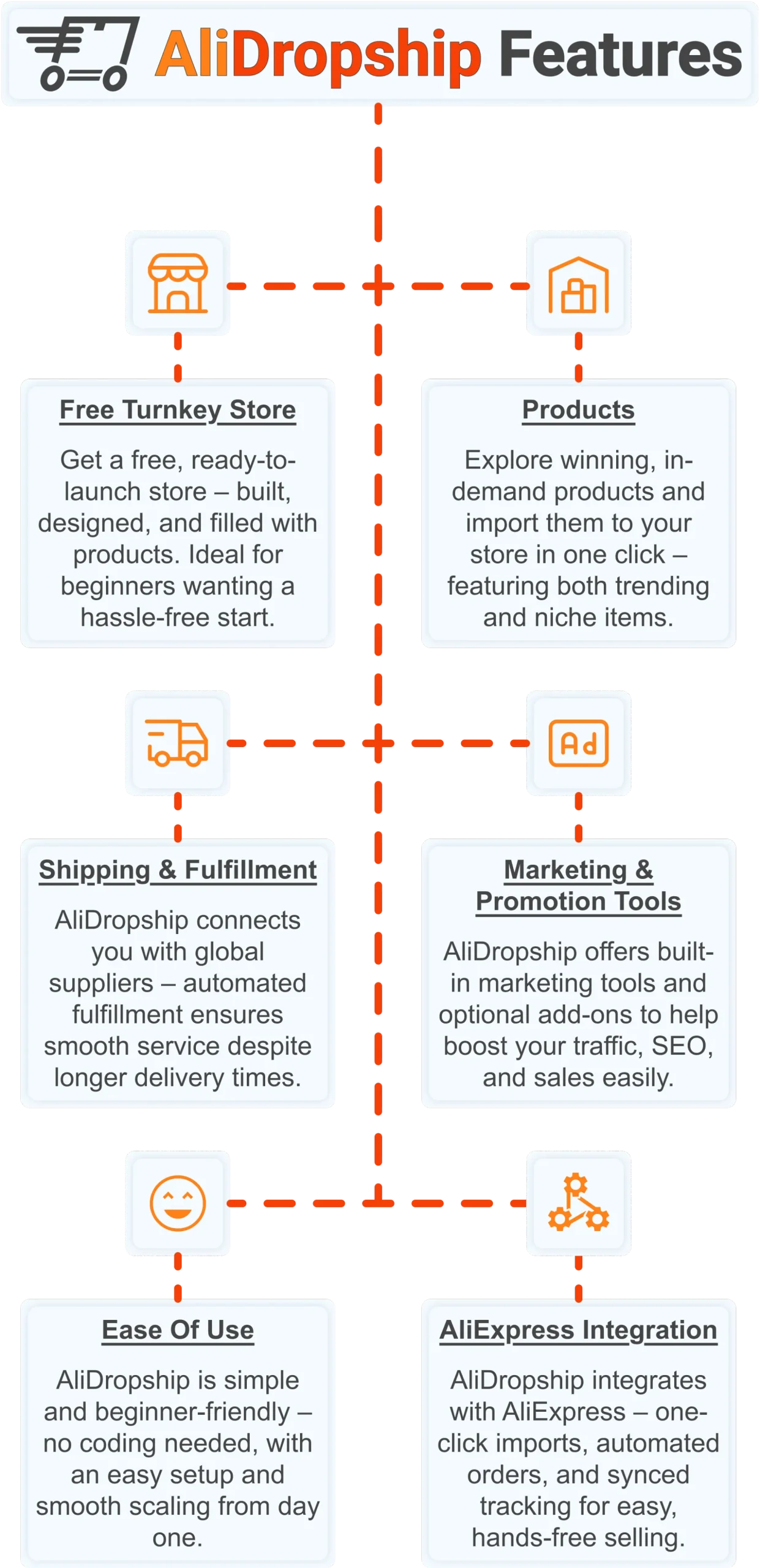
Get a free turnkey store – built, designed, and filled with products. Ideal for beginners wanting a hassle-free start, the store comes fully optimized to attract customers right away, saving you time on setup.
Plus, it includes professional design elements to give your business a polished, trustworthy look from day one. This ready-made foundation makes it easy to move seamlessly into product selection.
Products 📦
Once your store is set up, you can explore winning, in-demand products and import them in one click – featuring both trending and niche items. This wide selection lets you cater to diverse customer interests and test what works best.
Regular updates ensure you always have fresh products, keeping your store competitive and relevant. With great products in place, smooth shipping becomes the next essential step.
Shipping & fulfillment 🚚
AliDropship connects you with global suppliers, and automated fulfillment ensures seamless order processing despite international delivery times. Customers receive real-time tracking updates, which builds confidence and trust in your store. Once shipping is handled reliably, you can focus on promoting your store and attracting traffic.
Marketing & promotion tools 📣
To maximize sales, AliDropship offers built-in marketing tools and optional add-ons that help boost traffic, SEO, and conversions. From email campaigns and discounts to social media integration, these tools empower you to reach and retain customers without needing prior marketing experience. With promotion strategies in place, managing your business becomes simpler and more efficient.
Ease of use 👌
AliDropship is beginner-friendly – no coding needed, with an intuitive dashboard that guides you through every step. Easy setup and smooth scaling let you expand your store without stress. As your business grows, adding new features, products, and marketing campaigns remains hassle-free, giving you more time to focus on sales.
AliExpress integration 🛒
Finally, AliDropship integrates seamlessly with AliExpress, enabling one-click imports, automated orders, and synced tracking. Your inventory stays up-to-date with the latest products and prices, while automated order processing frees you from manual tasks.
Combined with the turnkey setup, reliable shipping, and built-in marketing tools, this integration ensures your dropshipping business is fully equipped for growth and success.
If you have been weighing dropshipping vs affiliate marketing and want the model with the higher income ceiling and full control over your earnings, the dropshipping path starts here. Get your free turnkey store from AliDropship and start building a business you actually own.
What is the main difference between dropshipping vs affiliate marketing?
How does affiliate marketing work for beginners?
Affiliate marketing works by joining a program through a network such as Amazon Associates, ShareASale, or Impact, then promoting products using a unique tracking link. When a visitor clicks your link and makes a purchase, you earn a commission. For beginners, the most accessible starting point is writing product review content on a blog or creating comparison videos on YouTube. Most beginners see their first commissions within 2 to 3 months, though building to 500 to 1000 dollars per month typically takes 6 to 12 months of consistent content publishing.
Which dropshipping model is best for someone with no experience?
The most beginner-friendly dropshipping model in 2026 is a turnkey store solution where the store is built, designed, and loaded with products for you. This removes the two biggest early barriers: technical setup and product selection. From there, the main task is driving traffic through TikTok organic content or small paid ad budgets of around 20 to 30 dollars per day. Most beginners with a ready-built store and consistent effort see their first sale within 1 to 3 weeks.
Can you do dropshipping and affiliate marketing at the same time?
Yes, and some experienced operators do exactly that. A common approach is building an affiliate content site around a niche and using it to drive warm traffic to your own dropshipping store in the same niche. The affiliate content generates passive income while also reducing your paid ad reliance. It requires more work to set up both channels simultaneously, but once running, the two models complement each other well. The main caution is not spreading yourself too thin in the early months.
How long does it take to make money with dropshipping vs affiliate marketing?
With dropshipping and consistent effort on paid ads, many beginners see their first sales within 1 to 3 weeks and reach 30 to 80 dollars per day within 60 to 90 days. Affiliate marketing takes longer because it depends on organic search traffic building up over time. Most affiliate publishers earn their first commission within 4 to 8 weeks but take 6 to 18 months to reach reliable monthly income. For speed to income, dropshipping is the faster path for most people starting in 2026.