AI Tools Are Changing The Way Dropshipping Businesses Run

Running a dropshipping store used to mean juggling a dozen tabs, manually tracking orders, guessing which products might sell, and answering customer emails one by one. In 2026, that picture has changed a lot. Dropshipping AI tools now handle most of the heavy lifting – from finding winning products to writing ad copy to managing returns – so you can focus on growing instead of grinding.
Quick Answer: Dropshipping AI refers to artificial intelligence tools and automations built into or integrated with ecommerce platforms that handle repetitive tasks like product research, pricing, customer support, and order management. Used correctly, they cut your workload significantly and help you scale without hiring a full team.
This guide breaks down exactly which AI tools are worth using, what they actually do for your store, and how to stack them together for a near-automated dropshipping operation.
Before we get into the tools themselves, it helps to understand what dropshipping AI actually means in practice – and why 2026 is the year more store owners are making it their default way of operating.
What is dropshipping AI?
Dropshipping AI is the application of artificial intelligence – machine learning models, natural language processing, and predictive algorithms – to the tasks that normally eat up a store owner’s time and attention. Instead of manually researching products, writing descriptions, setting prices, or responding to every support ticket, AI tools handle those workflows automatically or semi-automatically.
The term covers a wide range of tools. Some are built directly into platforms like AliDropship or Shopify. Others are standalone apps – think ChatGPT for copy, Tidio for customer chat, or Prisync for competitive pricing. What they all have in common is that they reduce the number of decisions you have to make yourself, and they act on data much faster than any human can.
In 2026, the barrier to using these tools is low. Most require no technical knowledge. You connect them to your store, set your preferences, and let them run. The real skill is knowing which tools to use and in which order – which is exactly what this guide covers.
Why this works in 2026: AI model capabilities have grown substantially since 2023, and integration with ecommerce platforms has matured. Tools that once required developer setup now plug in with a single click, making AI automation accessible to first-time store owners.
What can AI realistically do for your dropshipping store?
This is where a lot of store owners get the wrong idea. AI is not a magic button that builds a profitable store overnight. What it does is remove the bottlenecks that slow down growth and eat into your margin. Here is a realistic breakdown of what to expect across the main use cases.
Across all these use cases combined, a well-configured AI stack can save a solo store owner 15–35 hours per week. That is not a ceiling figure – heavy-volume stores with multiple product lines report even higher gains. But the realistic baseline for a store doing 30–80 orders per day is around 20 hours saved weekly once the tools are properly set up.
One note on setup time: Most AI tools require 1–3 weeks of configuration and fine-tuning before they run reliably. Do not expect zero-effort results from day one – expect zero-effort results from week four onward.
START FREE WITH AN AI INFLUENCER
AI tools for dropshipping: a full breakdown by task
The smartest approach to dropshipping AI is not to use every tool available – it is to cover each core workflow with one solid tool and let them work together. Here is how that looks in practice, broken down by task area.
Product research and trend detection
Finding products that actually sell is the first thing most dropshippers want AI to help with – and it is also one of the most mature use cases. AI-powered research tools analyze sales velocity, competitor listings, social media trends, and search volume to surface products with genuine demand before they hit saturation.
AliDropship’s built-in product recommendations
AliDropship uses a data-driven curation layer that surfaces trending products based on AliExpress sales data, niche demand signals, and historical performance. Rather than starting from scratch, you browse a curated shortlist of products that have demonstrated traction – and import them in one click. For beginners especially, this removes the guesswork that kills most early stores.
Earning potential: Stores that consistently import data-validated products report 2–3x higher conversion rates compared to stores built on manual browsing alone.
Exploding Topics and Google Trends (AI-assisted)
For trend detection beyond a single platform, Exploding Topics uses machine learning to identify topics gaining momentum weeks or months before they peak in mainstream search. Pairing it with Google Trends lets you validate whether a product has consistent demand or is just a short-lived spike. The combination is particularly useful for seasonal niches and emerging product categories.
Important note: Trend tools show you what people are searching for – not whether the product margin is viable. Always cross-reference trending products with supplier pricing before importing.
Minea and Sell The Trend
These platforms use AI to monitor what is performing across Facebook ads, TikTok, and Pinterest in real time. Sell The Trend’s NEXUS engine, for example, aggregates data from multiple sources to score products by momentum.
Minea focuses heavily on ad creative analysis – useful if you want to see which angles competitors are running before you test your own. Both tools cost $50–$100/month but can pay for themselves quickly if they help you avoid dead-end products.
AI copywriting for product pages and ads
Once you have your products, you need copy – and writing unique, SEO-optimized descriptions for dozens or hundreds of products manually is one of the biggest time sinks in dropshipping. AI writing tools have made this near-instant.
ChatGPT and Claude for product descriptions
With a well-structured prompt, ChatGPT or Claude can generate a full product description – including a headline, bullet benefits, and SEO paragraph – in under 30 seconds. The key is building a reusable prompt template that includes your brand voice, target keyword, and any specifics about the product. Store owners running 50+ SKUs report cutting their copywriting time by 80–90% using this approach.
A basic prompt structure that works well: “Write a product description for [product name] targeting [keyword]. Tone: conversational. Include a headline, 4 key benefits, and a closing sentence. Max 150 words.”
Jasper and Copy.ai for ad creatives
Jasper and Copy.ai are built specifically for marketing copy – Facebook ad headlines, Google ad descriptions, email subject lines, and landing page hooks. Both have ecommerce-specific templates that let you input a product name and target audience and receive multiple copy variations in seconds. Jasper starts at around $39/month; Copy.ai has a usable free tier for lower-volume needs.
Why this works in 2026: Ad platforms now reward creative variety – running multiple copy variations against each other (A/B testing) is the fastest way to find your highest-converting angle, and AI makes generating those variations nearly free.
Dynamic pricing and margin management
Pricing is one of the most underrated levers in dropshipping, and it is one where AI delivers a clear, measurable advantage. Manual pricing means you set a number and forget it. AI pricing means your margins adjust automatically based on supplier costs, competitor pricing, and demand signals.
Prisync
Prisync is a competitive pricing tool that tracks competitor prices across thousands of products and lets you set rules – for example, “always price 5% below the cheapest competitor” or “match the market median.”
It updates automatically, so if a competitor drops their price overnight, your store responds without you touching anything. Plans start at around $59/month, which is worth it for stores carrying more than 50 products.
AliDropship’s automated pricing rules
AliDropship includes built-in markup rules that automatically calculate your retail price based on supplier cost. You set percentage-based or fixed-amount markups per product category, and every imported product is priced instantly – no manual calculation required. Combined with supplier price sync, your margins stay protected even when AliExpress costs fluctuate.
AI-powered customer support
Customer support is where many solo dropshippers hit their first wall. Once orders start coming in, so do the questions – “Where is my order?”, “Can I return this?”, “Is this the right size?” – and each one takes time. AI chatbots handle the majority of these interactions without any human input.
Tidio
Tidio is one of the most widely used AI chat tools for ecommerce. Its Lyro AI bot is trained on your store’s FAQ content and can handle order status checks, return policy questions, and product queries automatically. In testing across ecommerce stores, Lyro resolves around 70% of incoming support conversations without escalation. The free plan covers up to 50 AI conversations per month; paid plans start at $29/month and scale with volume.
Gorgias
Gorgias is a step up from Tidio – a full helpdesk platform with AI that integrates directly with your order management system. It can pull live order data, issue refunds automatically based on rules you define, and tag tickets by category so nothing falls through the cracks. It is better suited to stores doing 50+ orders per day where support volume justifies the $10/month base cost and per-ticket pricing.
ChatGPT-powered custom bots
For more control, some store owners build custom GPT assistants via OpenAI’s API, trained specifically on their product catalog and policies. This requires slightly more setup but gives you full control over the tone, scope, and escalation logic. Costs are typically well under $20/month at normal ecommerce support volumes.
AI for marketing automation and email
Getting traffic is one thing. Converting it and bringing customers back is another. AI marketing tools handle the campaigns, segmentation, and timing that drive repeat revenue – without you manually scheduling every email or ad.
Klaviyo
Klaviyo is the go-to email and SMS platform for ecommerce stores, and its AI features are genuinely useful. It predicts which customers are likely to purchase again, segments your list automatically, and optimizes send times based on individual open patterns.
Abandoned cart flows, post-purchase sequences, and win-back campaigns run without you touching them after initial setup. The free plan covers up to 500 contacts, which is enough to get started.
AdCreative.ai
AdCreative.ai generates ad banners and creative assets using AI – you input your product image, brand colors, and headline, and it produces multiple ad variations optimized for Facebook, Instagram, and Google. For dropshippers who are not designers, this removes one of the biggest barriers to running paid traffic. Plans start at around $21/month for up to 10 ad creatives per month.
Order management and fulfillment automation
The operational side of dropshipping – processing orders, updating tracking, handling supplier communication – is exactly the kind of repetitive, rules-based work that AI and automation handle best.
AliDropship’s automated order fulfillment
AliDropship automates the entire order processing loop. When a customer places an order, the system automatically sends it to your AliExpress supplier, processes payment, and syncs tracking information back to your store – all without manual input. Customers receive tracking updates automatically. For store owners processing 20–100 orders per day, this alone is worth the price of the platform.
AutoDS
AutoDS is a dropshipping automation platform that handles supplier monitoring, price and stock updates, and order fulfillment across multiple suppliers and sales channels simultaneously. It uses AI to monitor supplier price changes and automatically adjust your listings to protect your margins. Plans start at around $26.90/month, and it integrates with AliExpress, Amazon, Walmart, and others.
How to build your AI dropshipping stack
The most common mistake people make with dropshipping AI is trying to use every tool at once. You end up with overlapping subscriptions, conflicting automations, and a lot of time spent managing tools instead of running your store. A better approach is to build your stack in layers – starting with the highest-impact tools and adding complexity only when your volume justifies it.
At the launch stage, your total AI tool cost can be near zero – AliDropship’s built-in automation handles fulfillment and pricing, and free tiers of ChatGPT and Tidio cover copy and basic chat. The paid tools only make sense once your volume creates enough recurring tasks to justify their cost.
GET YOUR AI INFLUENCER + STORE
What to avoid when using AI for dropshipping
AI tools are powerful, but they come with real risks if you use them carelessly. Here are the pitfalls that trip up the most store owners – and how to avoid them.
Publishing AI copy without review
AI-generated product descriptions are a starting point, not a finished product. Raw outputs often contain generic phrasing, inaccurate specifications, or brand voice inconsistencies that hurt both SEO and trust. Always review AI copy before it goes live. A 60-second read and light edit is all it usually takes.
Over-automating customer support
AI chatbots handle routine questions well, but they fail badly on complex or emotionally charged situations – a lost package, a damaged item, an angry repeat customer. Set clear escalation rules so that any conversation the bot cannot resolve confidently routes to a human within a reasonable timeframe. Failing to do this is one of the fastest ways to generate negative reviews.
Relying on AI for supplier vetting
No AI tool currently replaces manual supplier vetting. Before importing products from any supplier, check their AliExpress rating (aim for 4.7 stars and above), read recent reviews, and order a test unit if the product is going to be a core SKU. AI can surface candidates – but the judgment call is still yours.
Key principle: AI handles volume and speed. You handle judgment and relationship-building. The two work best together, not as replacements for each other.
Ignoring platform terms of service
Some AI tools for ad automation or review generation operate in grey areas that violate platform terms – Meta, Google, and Trustpilot all have policies against certain types of automated activity. Stick to tools that are explicitly endorsed by or integrated with the platform you are using. The short-term gain from a grey-area tool is rarely worth the account suspension risk.
Who should use dropshipping AI tools – and how to start
Your ideal AI stack depends on where you are in your dropshipping journey. Here is a quick breakdown by experience level.
Complete beginner
Start with a platform like AliDropship that has AI-assisted product selection and automated fulfillment built in. Add ChatGPT for product descriptions and Tidio’s free tier for basic customer chat. Do not subscribe to anything else until you have your first 10 orders.
Focus on learning the fundamentals – product selection, basic marketing, understanding your customers – and let the built-in automation handle the operational side.
Intermediate – part-time store owner
Once you are hitting 20–50 orders per week, the time savings from paid AI tools start to justify their cost. Klaviyo for email automation and a paid Tidio plan for higher chat volume are the two highest-impact additions at this stage. If you are running paid ads, AdCreative.ai or Jasper will speed up your creative testing significantly.
Advanced – full-time scale goal
At 50+ orders per day, every manual touchpoint becomes a bottleneck. AutoDS for multi-supplier fulfillment, Gorgias for support, Prisync for pricing, and Klaviyo for retention form a solid full-automation stack. Expect to spend 200–400 dollars per month on tools at this level – but a store generating 5,000–15,000 dollars per month in revenue has more than enough margin to cover it.
The common thread across all three stages is this: AI tools work best when they are layered onto a solid store foundation. The store itself – its niche, its products, its branding – still determines whether customers buy. AI just makes running that store dramatically more efficient.
LAUNCH WITH YOUR AI INFLUENCER
AliDropship: Your complete all-in-one solution for starting dropshipping in 2026
If you want the simplest possible way to start dropshipping – especially if you’re brand new – AliDropship remains one of the most beginner-friendly tools available in 2026. It brings together store creation, product imports, automation, and marketing into a single streamlined system designed to help you launch quickly and grow confidently.
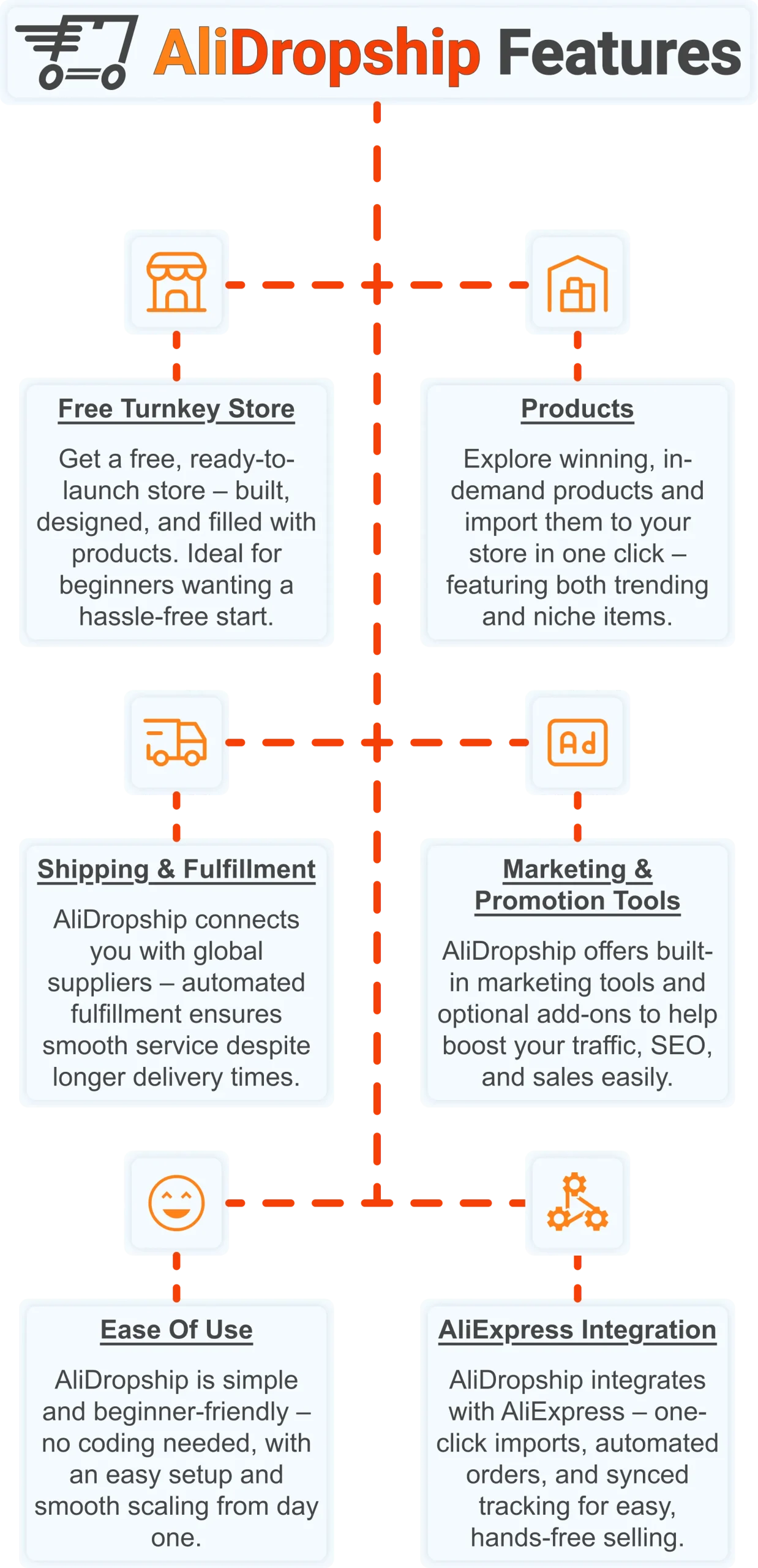
Free turnkey store 🛍️
Get a free turnkey store – built, designed, and filled with products. Ideal for beginners wanting a hassle-free start, the store comes fully optimized to attract customers right away, saving you time on setup. Plus, it includes professional design elements to give your business a polished, trustworthy look from day one. This ready-made foundation makes it easy to move seamlessly into product selection.
Products 📦
Once your store is set up, you can explore winning, in-demand products and import them in one click – featuring both trending and niche items. This wide selection lets you cater to diverse customer interests and test what works best. Regular updates ensure you always have fresh products, keeping your store competitive and relevant. With great products in place, smooth shipping becomes the next essential step.
Shipping & fulfillment 🚚
AliDropship connects you with global suppliers, and automated fulfillment ensures seamless order processing despite international delivery times. Customers receive real-time tracking updates, which builds confidence and trust in your store. Once shipping is handled reliably, you can focus on promoting your store and attracting traffic.
Marketing & promotion tools 📣
To maximize sales, AliDropship offers built-in marketing tools and optional add-ons that help boost traffic, SEO, and conversions. From email campaigns and discounts to social media integration, these tools empower you to reach and retain customers without needing prior marketing experience. With promotion strategies in place, managing your business becomes simpler and more efficient.
Ease of use 👌
AliDropship is beginner-friendly – no coding needed, with an intuitive dashboard that guides you through every step. Easy setup and smooth scaling let you expand your store without stress. As your business grows, adding new features, products, and marketing campaigns remains hassle-free, giving you more time to focus on sales.
AliExpress integration 🛒
Finally, AliDropship integrates seamlessly with AliExpress, enabling one-click imports, automated orders, and synced tracking. Your inventory stays up-to-date with the latest products and prices, while automated order processing frees you from manual tasks.
Combined with the turnkey setup, reliable shipping, and built-in marketing tools, this integration ensures your dropshipping business is fully equipped for growth and success.
If you are ready to put dropshipping AI to work, the fastest way to start is with an AI influencer and a store that already has the infrastructure in place. Get your free store and AI influencer team today and start building your automated ecommerce business.
What is dropshipping AI and how does it work?
What are the best AI tools for dropshipping in 2026?
Can AI fully automate a dropshipping business?
How does AI help with dropshipping product research?
Is dropshipping with AI profitable for beginners?