The New Way To Make Money Online In 2026 (Not What You Think)

What if your online store could turn into a $20K+ asset?
More entrepreneurs are building stores not just to earn a monthly income, but to sell them later for profit.
They grow traffic, increase sales, and list their store as an ecommerce business for sale.
This approach, known as store flipping, is gaining momentum.
And platforms like Sellvia Market make it possible.
What Is Sellvia Market
Sellvia Market is a platform where entrepreneurs can buy and sell ready ecommerce businesses.
If you’ve ever searched for an ecommerce business for sale, you already understand the idea behind marketplaces like this.

Instead of starting from scratch, buyers can purchase ready ecommerce websites that already have traffic, sales history, and proven profitability – in other words, businesses that are already working. This means no time wasted on promotion: you can buy and start earning right away.
On the other hand, you can list your ecommerce store and turn your profitable business into a serious payout.
This creates opportunities for two types of entrepreneurs:
- People who want to buy ecommerce business assets
- People who want to sell the ecommerce stores they built
For many beginners, buying a ready-made store is easier than learning how to start and build an ecommerce business from scratch.
How store flipping works
Store flipping is one of the fastest-growing ecommerce strategies.
The idea is simple:
- Build or acquire an online store
- Grow traffic and sales
- Improve design and automation
- Sell it as an ecommerce business
Some entrepreneurs build stores specifically for this. Others grow a store and later realize they can sell it for a profit.
Just like in real estate, the more optimized and stable the business is, the more valuable it becomes. Stores with proven traffic, sales, and automation are far more attractive to buyers than empty sites.
Sellvia Market structure
Sellvia Market is organized into two main sections: Buy and Sell.
You can also view your business value, explore the seller leaderboard, and see recently sold stores.
Each section is designed to help entrepreneurs find ecommerce stores for sale, list their own businesses, and track or improve their store’s value.
The Buy section lets you explore available ecommerce businesses for sale.
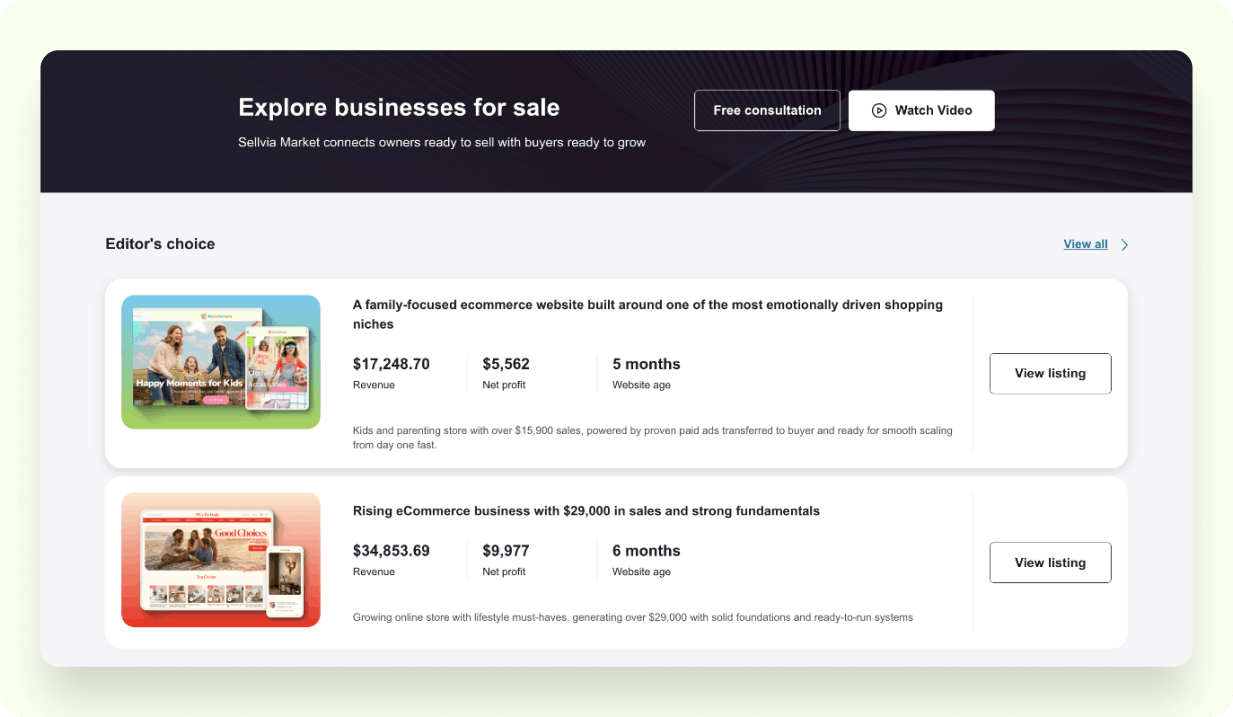
Each listing includes key details like niche, estimated value, traffic, sales, and automation, so you can quickly evaluate the opportunity.
Instead of spending weeks warming up your business, you can invest in an already operating store and start earning right away.
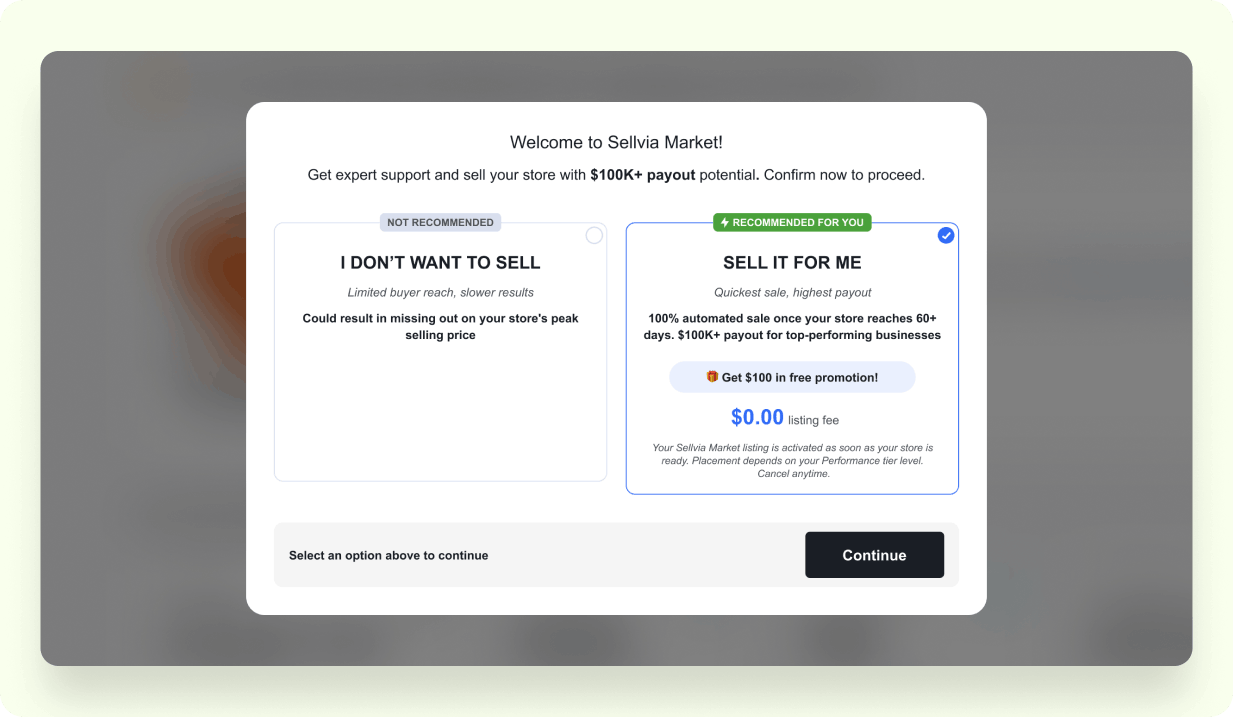
The Sell section is for entrepreneurs who want to list their ecommerce store for sale.
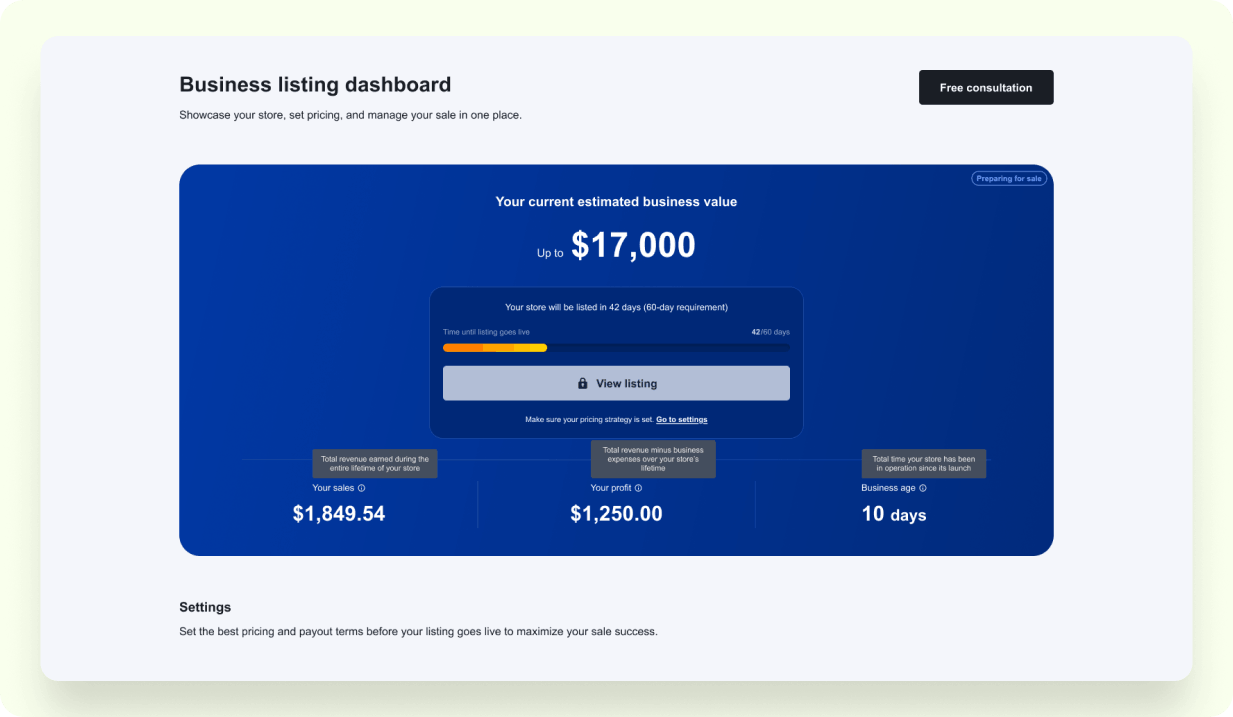
To qualify, the store needs to reach a certain level of maturity – it should be active long enough to show stable performance and build trust with buyers. At Sellvia, this point is set at 60 days.
This ensures the store reaches a level where it’s seen as trustworthy and has a stable flow of traffic, orders, and revenue – so buyers can evaluate it with confidence.
If the store hasn’t reached 60 days yet, it can be pre-approved and prepared for listing in advance. Once eligible, it goes live with key details like estimated value, sales, profit, and business age.
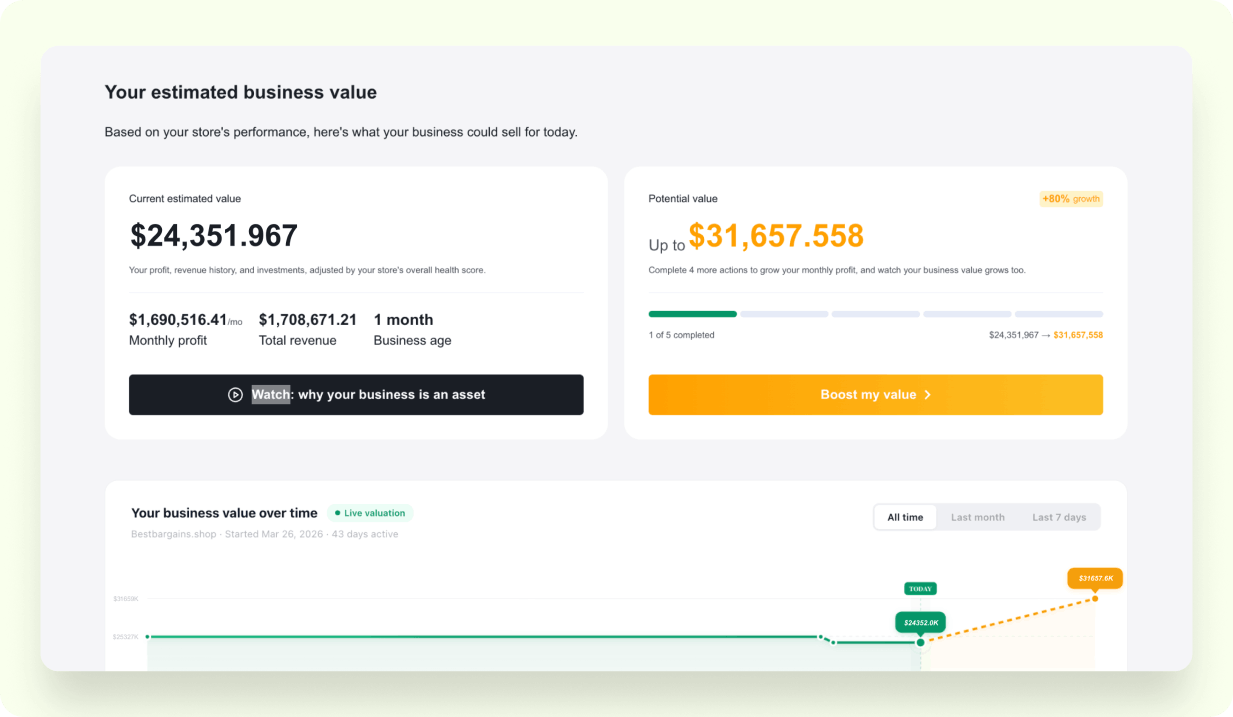
The My Valuation section shows your Estimated Business Value (EBV) – how much your store could be worth, and how to increase its value over time.
It’s based on key factors like traffic, sales, stability, automation, and store setup. As these improve, your store’s value grows.
This section helps you track how your performance directly impacts your potential selling price.
Success stories from Sellvia clients
Let’s dive into some real stories of Sellvia clients who have successfully built and sold their ecommerce stores. These entrepreneurs turned their online stores into valuable assets, and their journeys show how powerful store flipping can be.
Vikram: $18,500 in 8 Days
Vikram, an IT project manager, wanted to build something for himself – a business that he could eventually pass on to his children.
He chose to create a store around his personal interests in technology and productivity tools. Vikram used his experience to carefully set up the store, including advertising, SEO optimization, and automated fulfillment.
After six months, Vikram saw steady profits of around $1,100 per month. When he checked his store’s estimated value, he found it was $18,500. Vikram listed the store, and it sold in just 8 days.
The profits from the sale went into his son’s college fund, and Vikram started a second store, proving that store flipping can be a consistent part of his business plan.
Rachel: Selling three ecommerce stores
Rachel started her journey with a simple goal: to acquire an online store that would generate profit.
After buying a fashion store on Sellvia Market, she focused on boosting traffic by running paid ads. Over time, the store grew from $1K to a stable $4K in monthly sales.
Realizing that her store was a valuable asset – and that its value increased with consistent sales – Rachel decided to list it for sale on Sellvia Market.
The store sold quickly, and Rachel reinvested the profits to build two more stores, each with a strategic focus on growth. By the end, she had successfully flipped three stores.
Her story proves that with the right strategy and a focus on increasing store value, you can turn your ecommerce business into a profitable asset.
Kyle and Alyssa: $21,400 for a store built in two months
Kyle and Alyssa opened their first Sellvia store, featuring fashion, footwear, and sportswear. Within six months, the store became their main source of income, earning around $5,000 per month.
Their growth manager suggested they explore selling the store on Sellvia Market, but after evaluating the store’s performance, they decided to keep it.
Instead of selling their first store, they built a second ecommerce store in a new niche – brand fashion and digital style guides. They used the same strategy, including automated order processing and Sellvia’s ready-to-post promo videos. After just two months, they listed the new store for sale.
It sold in 9 days for $21,400, while their first store continued to generate income. Their experience showed how easy it is to build a second store for sale once you know what works.
These success stories show that Sellvia Market offers entrepreneurs a pathway to turn their stores into valuable assets. Whether you’re looking to buy a ready ecommerce business or sell your own, Sellvia Market makes it easier than ever to capitalize on the growing trend of store flipping.
Final thoughts
Ecommerce continues to evolve, and today, an online store is more than just a place to sell products – it can become a valuable digital asset.
Platforms like Sellvia Market make it easier for entrepreneurs to buy and sell ecommerce businesses. For buyers, this means getting access to stores that are already built and ready to generate profit. For sellers, it’s an opportunity to turn their hard work into real financial returns.
As the stories of Rachel, Vikram, and Kyle and Alyssa show, building a store with a clear strategy can lead to profitable results. The key is understanding how to grow a store’s value and when to list it for sale.
In today’s ecommerce landscape, creating a store is just the beginning. The ability to grow its value – and strategically decide when to sell – can make all the difference in turning your online business into a valuable asset.
Your online store can be more than just a source of monthly income – it can become a valuable asset. Check your business value today and see what your store could really be worth.
What is Sellvia Market?
What is store flipping?
Why do people buy ready ecommerce stores?
Can beginners buy a store on Sellvia Market?
What is Estimated Business Value (EBV)?
How can I increase the value of my store
How old does a store need to be before it can be listed?
Can I prepare my store for sale before 60 days?
How long does it usually take to sell a store?
Can I keep one store and sell another?
Is Sellvia Market only for Sellvia stores?