Best Time To Post On TikTok For Maximum Views

If you have posted on TikTok and watched your video get 200 views while a nearly identical one blew up to 50,000, timing is likely part of the reason. The best time to post on TikTok is not a myth – it is a real factor that affects how many people the algorithm shows your content to in the first hour after you publish. That initial push determines whether your video gets picked up by a wider audience or quietly fades into the feed.
Quick Answer: The best time to post on TikTok globally is between 6 am and 10 am and again between 7 pm and 11 pm in your audience’s local time zone, with Tuesday, Thursday, and Friday consistently delivering the highest engagement rates across most niches.
But the real answer is more nuanced than a single time slot. Your specific audience, your niche, and your content type all shift the optimal window. This guide breaks down the data, explains how the TikTok algorithm factors in your posting time, and gives you a practical TikTok posting schedule to follow – whether you are just starting out or already building a serious presence on the platform.
TikTok now has over 1.5 billion active monthly users globally, with the average user spending around 90 minutes on the app each day. That is an enormous pool of potential viewers – but only if the algorithm decides to surface your content when those users are actually scrolling. Getting your TikTok content strategy right means understanding not just what to post, but precisely when to post it.

What is the best time to post on TikTok?
The best time to post on TikTok refers to the windows during the day when your target audience is most actively scrolling and engaging with content on the platform. Because the TikTok algorithm prioritizes early engagement signals – views, likes, comments, shares, and especially video completion rate – posting when your audience is online increases the chances of triggering that initial push to a broader feed.
Research across multiple social media analytics platforms consistently points to a few recurring windows that work across most general consumer niches:
- Morning window: 6 am to 10 am (audience’s local time) – people checking their phones before and during their morning commute
- Lunch window: 12 pm to 2 pm – a shorter but reliable engagement spike during lunch breaks
- Evening window: 7 pm to 11 pm – the largest and most consistent window, when most users are relaxed and browsing after work or school
These windows hold reasonably well for most general consumer niches. However, TikTok for business accounts targeting professionals, parents, or older demographics may see different peak windows – which is exactly why the platform’s own analytics tool is your most accurate source of data, far more reliable than any generic published study.
One thing that does not change regardless of niche: posting in the middle of the night in your audience’s time zone is almost never optimal. The algorithm needs real, live reactions to amplify a video, and those are hard to come by at 3 am when your followers are asleep.
How much does posting time actually affect your TikTok reach?
Posting time is one factor in a larger system. TikTok’s algorithm uses a combination of signals to decide whether to push a video: watch time and completion rate, engagement rate (likes, comments, shares, saves), relevance to viewer interests, and whether the content was posted during a high-traffic window. Timing is not the whole equation, but it is a meaningful part of it – and one of the easiest variables to control.
To put it in perspective, here is how different TikTok content strategies compare in terms of effort required and the reach or engagement boost they can realistically deliver:
The data above reflects general patterns across accounts in consumer and ecommerce niches. Your actual results will vary based on content quality, niche saturation, and how well your video hooks the viewer in the first two seconds. Timing optimizes the conditions for success – it does not replace quality content.
One note on published timing data: Most “best times” studies average results across millions of accounts and use US Eastern Time as the default. They are a useful starting point, not a substitute for your own TikTok Analytics data once you have two or three weeks of posting history.
The good news is that getting your TikTok engagement strategy right does not require hours of extra work each week. Once you identify your peak window – usually a 1–2 hour slot that matches when your followers are most active – you can pre-schedule content and let the algorithm do the heavy lifting. The platform’s native scheduler makes this straightforward even without third-party tools.
Now let us get into the specific windows and how they break down by day, audience type, and content niche.
Best times to post on TikTok: a day-by-day breakdown
Different days of the week produce noticeably different engagement patterns on TikTok. Here is a breakdown based on aggregated data from social media analytics platforms, organized to help you build a practical weekly TikTok posting schedule you can start using this week.
Weekday peak times
Monday
Monday tends to be a slower day for TikTok engagement. Users are transitioning back into the work week, and scroll time is generally lower than midweek. That said, the evening window (7 pm–9 pm local time) still delivers solid reach for most niches. If you only have one post to schedule on Monday, aim for 7 pm–8 pm. The morning window (6 am–8 am) also performs reasonably well for motivational, fitness, or productivity content targeting an early-morning audience.
Earning potential: Monday posts see roughly 10–15% lower initial reach than Wednesday–Friday posts. Save your strongest videos for midweek unless your Analytics data suggests otherwise.
Tuesday and Wednesday
Tuesday and Wednesday consistently rank among the best days to post on TikTok. Midweek users are settled into their routines and browse during lunch breaks and in the evening with higher engagement intent than they show on Mondays. The strongest window across both days is 9 am–11 am and 7 pm–10 pm in the viewer’s local time zone. Wednesday in particular tends to produce the highest comment and share rates, which are the signals TikTok weights most heavily for algorithmic amplification.
Why this works in 2026: TikTok’s algorithm has shifted toward rewarding shares and saves more than raw likes – midweek content tends to generate more share activity as users send videos to friends and colleagues during their workday browsing.
Thursday and Friday
Thursday is arguably the single best day to post on TikTok for views, particularly in the 12 pm–3 pm and 7 pm–11 pm slots. Friday follows closely, with an extended evening window stretching toward midnight as users relax heading into the weekend. For ecommerce and product-focused TikTok content, Friday evening is especially effective – users are in a browsing and discovery mindset and are more likely to click through to a product or store link in your bio.
Earning potential: Thursday–Friday evening posts in consumer and ecommerce niches see 20–40% higher click-through rates on profile links compared to equivalent Monday posts.
Weekend and audience-specific timing
Saturday and Sunday
Weekends are high-volume days for TikTok usage overall, but engagement patterns shift. Users are on the app for longer sessions but with shorter attention spans – they are browsing casually rather than with strong intent. Saturday morning (9 am–11 am) and Sunday early afternoon (2 pm–4 pm) tend to be the sweet spots. For entertainment and lifestyle content, weekends perform well. For business-focused or high-intent content – tutorials, product reviews, dropshipping content – midweek consistently outperforms weekends in click-through and conversion metrics.
Time zones and global audiences
If your audience is concentrated in a single country, you only need to track one time zone. But many TikTok creators – particularly those in ecommerce or with international audiences – have followers distributed across multiple regions. In this case, target the time zone where the largest share of your followers lives. TikTok Analytics shows you a geographic breakdown under “Follower Activity” – check which country drives the most views and calibrate your TikTok posting schedule around that region’s peak hours.
Important: TikTok schedules posts based on the time zone of your device. If you are posting for a US audience from Europe, factor in that offset manually or use a third-party scheduling tool that lets you set a specific local delivery time.
Niche-specific timing adjustments
Not all niches follow the same pattern. Here is how peak posting windows shift across common content categories on TikTok:
- Fitness and wellness: 5 am–8 am and 5 pm–7 pm – before and after workouts
- Food and cooking: 12 pm–1 pm and 5 pm–7 pm – aligned with mealtimes
- Fashion and lifestyle: 7 pm–10 pm on weekdays and Saturday morning
- Business and ecommerce: 8 am–10 am and 12 pm–2 pm Tuesday through Thursday
- Entertainment and comedy: Evenings broadly, with weekends performing well
If your niche bridges two categories – for example, fitness products for a dropshipping store – test both relevant windows and let your analytics data tell you which one your specific audience responds to most strongly. You can usually identify a clear winner within three to four weeks of consistent posting.
Understanding when to post is only one piece of the picture. The TikTok algorithm’s broader mechanics also shape how far your content travels – and knowing those mechanics helps you make smarter decisions about both timing and content strategy.
How the TikTok algorithm decides who sees your content
Understanding the TikTok algorithm helps put posting time in its proper context. Timing affects your initial reach window – but the algorithm’s longer-term amplification depends on a different set of signals. Here is how TikTok’s recommendation system works and why your first hour after publishing matters so much.
When you publish a video, TikTok first shows it to a small test group of users. This initial batch typically includes people who already follow you plus a sample of users who have engaged with similar content recently. The algorithm then tracks how that test group responds – specifically:
- Completion rate: what percentage of viewers watch the video all the way through
- Re-watch rate: whether users watch the video more than once
- Engagement actions: likes, comments, shares, and saves (shares and saves carry the most weight)
- Negative signals: users who scroll past quickly or tap “not interested”
If the test group responds well, TikTok pushes the video to a larger pool. If that second wave engages, it pushes again. This cascading system is what allows some videos to reach millions even on small accounts – but it only triggers if the first hour or two of engagement is strong. A video published at 3 am reaches a small, unengaged test audience and never gets the signal boost it needs to amplify.
Why this works in 2026: TikTok has been placing more weight on longer-form content and higher-quality engagement signals. A 15-second video with a 95% completion rate now carries more algorithmic weight than a 60-second video with a 30% completion rate. Pair strong content with the right posting window and you double down on both.
Practical tips for building your TikTok posting schedule
Knowing the best time to post on TikTok for views is useful. Actually building a consistent schedule around that knowledge is what separates creators who compound their growth from those who post occasionally and wonder why nothing sticks. Here are five actionable tips for locking in a TikTok content strategy that works.
Use TikTok Analytics before anything else
If you have a TikTok Pro or Business account (free to switch in your profile settings), the Analytics tab shows you exactly when your followers are most active. Under “Followers” you will find an activity chart broken down by day and hour. This is far more accurate than any published study because it reflects your actual audience, not an average across millions of unrelated accounts. Check this chart after your first 14–21 days of posting and let it guide your schedule from that point forward.
Post consistently before optimizing for timing
Many creators waste weeks obsessing over the perfect posting window before they have enough content or follower history to generate useful data. If you are under 1,000 followers, focus first on posting at least 4–5 times per week in the general peak windows (morning and evening) and building your content quality. Timing optimization pays off much more when your account already has an engaged base to generate strong early signals.
Account for time zones when scheduling
This is one of the most common mistakes in TikTok marketing tips guides: they give you “best times” without specifying the time zone. Most aggregated studies use US Eastern Time (ET) as the default. If your audience is primarily in the UK, Australia, or another region, convert those windows to your viewers’ local time – not your own posting time. A scheduling tool like Later, Buffer, or TikTok’s own native scheduler lets you set the exact publication time in advance so you never have to be online at the moment of posting.
Test one variable at a time
If you change your posting time and your content topic simultaneously, you will not know which variable drove the change in performance. Pick a specific time slot, run 8–10 posts in that window, and track the average views and engagement rate. Then shift the window by one or two hours and repeat. This kind of systematic testing is how serious TikTok for business accounts identify their personal peak windows within 4–6 weeks – without guesswork.
Batch your content to stay consistent
Posting daily at a specific time is hard to sustain if you are filming and editing each video the same day. The solution is batching – filming 5–7 videos in a single session, editing them over the following two days, and scheduling them across the week using TikTok’s built-in scheduler or a third-party tool. This approach removes the daily pressure, keeps your TikTok engagement strategy airtight, and lets you be deliberate about your timing choices rather than posting reactively whenever a video happens to be ready.
Choosing the right TikTok posting strategy for your situation
Not everyone is building on TikTok for the same reason or starting from the same place. Here is how to think about your posting schedule based on where you are right now and what you are realistically trying to achieve in the next 60–90 days.
Complete beginner
If you are brand new to TikTok, do not overthink the timing in your first two weeks. Pick the general peak window for your niche (see the day-by-day breakdown above) and post at least 3–4 times per week. Your priority in the first 30 days is building content, finding your tone, and generating enough posting history for TikTok Analytics to give you useful data. Aim for 7 pm–9 pm on weekdays as your default starting window – it is a safe, broadly applicable slot that works for most niches without requiring any prior data.
Intermediate creator (part-time)
If you have been posting for 1–3 months and have 500–5,000 followers, you have enough data to start optimizing. Open TikTok Analytics, identify your top two or three performing videos, and check what time they were posted. Look for patterns. Then cross-reference with your Follower Activity chart. Build a weekly schedule with 1–2 daily posts targeting your two best windows. At this stage, TikTok engagement consistency matters more than any single post’s timing – the algorithm rewards accounts that publish regularly over those that post sporadically at theoretically optimal times.
Advanced creator or full-time goal
If you are posting daily or near-daily and have 10,000+ followers, your TikTok posting schedule should be built entirely around your own Analytics data. At scale, minor timing differences – even 30–60 minutes – can meaningfully affect how a video performs in its first two hours. Consider splitting your audience by geography and targeting your two largest regions with separate content or scheduling variations. Full-time creators using TikTok as part of a broader income strategy (brand deals, affiliate products, a dropshipping store) should also track how posting time affects link-in-bio click-through rates, not just in-app engagement metrics.
TikTok for ecommerce and business accounts
If you are using TikTok marketing tips to drive traffic to a product store or dropshipping business, the calculus shifts slightly. You are less focused on follower growth for its own sake and more focused on reaching high-intent buyers. For ecommerce TikTok accounts, Tuesday to Thursday, 10 am–12 pm and 8 pm–10 pm, consistently produce stronger click-through rates to external links than weekend posting. Pair this timing with TikTok Shopping features or a clear call to action in every video directing viewers to your bio link, and you compound both reach and conversion simultaneously.
Legal and ethical considerations on TikTok
As TikTok has grown, so has the ecosystem of shortcuts, grey-area tools, and outright scams targeting creators who want faster results. Here is what to avoid and what to do instead to build a sustainable presence that the algorithm actually rewards.
What to avoid absolutely
Buying followers or fake views is the most common mistake made by creators chasing faster growth. Services that sell TikTok followers or views deliver bot accounts that do not engage with your content. Because TikTok’s algorithm weights completion rate and real engagement over raw view counts, fake views actually hurt your performance – your engagement rate drops, and the algorithm starts showing your content to fewer real people. TikTok also periodically purges fake accounts, which can erase large portions of a purchased audience overnight.
Engagement pods – groups of creators who artificially inflate each other’s engagement by liking and commenting on demand – are a grey-area tactic that TikTok actively monitors. While not always against the letter of TikTok’s terms of service, they distort your analytics data and make it harder to identify genuinely performing content, undermining the very optimization process this guide is built around.
What to do instead
Sustainable TikTok growth comes from three things: strong content hooks in the first two seconds, consistent posting at peak times, and genuine community engagement – replying to comments, using the Stitch and Duet features with relevant content in your niche. These methods take 60–90 days to show compounding results, but they produce real, algorithm-friendly engagement that grows over time rather than collapsing when bot accounts get purged.
Key principle: If a TikTok growth service promises 10,000 followers in 48 hours for a fee, it is selling you something that will damage your account far more than help it.
Important: Always disclose paid partnerships and sponsored content as required by FTC guidelines if you are a US-based creator. TikTok’s Creator Marketplace includes built-in disclosure tools that make this straightforward and keeps you on the right side of both the platform’s policies and advertising regulations.
From TikTok views to real income: what comes next
Getting your TikTok posting schedule dialed in is a genuinely valuable skill – it maximizes the reach of every video you publish and helps the algorithm surface your content to the right people at the right time. But views alone do not pay the bills. Many TikTok creators at all follower levels find that converting their audience into consistent income requires a monetization layer beyond ad revenue or brand deals, both of which have significant eligibility barriers.
One of the most practical paths for TikTok creators in 2026 is pairing their content strategy with a dropshipping store. You are already building an audience and driving traffic – a product store gives that traffic somewhere valuable to go. And unlike waiting for TikTok’s monetization thresholds, which require 10,000 followers and specific geographic eligibility, a dropshipping business can start earning from day one regardless of your current follower count.
AliDropship: Your complete all-in-one solution for starting dropshipping in 2026
If you want the simplest possible way to start dropshipping – especially if you are brand new – AliDropship remains one of the most beginner-friendly tools available in 2026. It brings together store creation, product imports, automation, and marketing into a single streamlined system designed to help you launch quickly and grow confidently.
Free turnkey store 🛍️
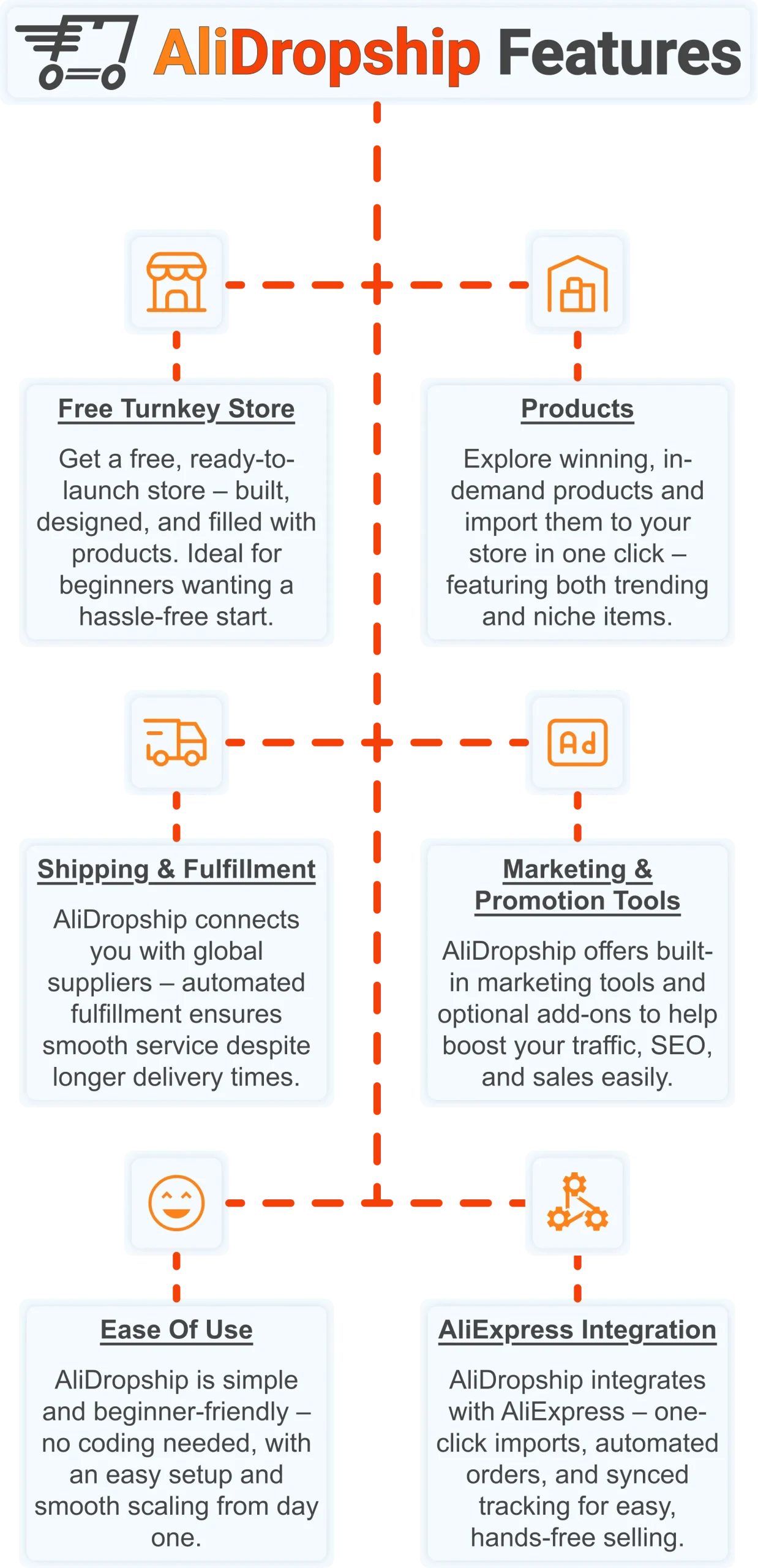
Get a free turnkey store – built, designed, and filled with products. Ideal for beginners wanting a hassle-free start, the store comes fully optimized to attract customers right away, saving you time on setup. Plus, it includes professional design elements to give your business a polished, trustworthy look from day one. This ready-made foundation makes it easy to move seamlessly into product selection.
Products 📦
Once your store is set up, you can explore winning, in-demand products and import them in one click – featuring both trending and niche items. This wide selection lets you cater to diverse customer interests and test what works best. Regular updates ensure you always have fresh products, keeping your store competitive and relevant. With great products in place, smooth shipping becomes the next essential step.
Shipping & fulfillment 🚚
AliDropship connects you with global suppliers, and automated fulfillment ensures seamless order processing despite international delivery times. Customers receive real-time tracking updates, which builds confidence and trust in your store. Once shipping is handled reliably, you can focus on promoting your store and attracting traffic.
Marketing & promotion tools 📣
To maximize sales, AliDropship offers built-in marketing tools and optional add-ons that help boost traffic, SEO, and conversions. From email campaigns and discounts to social media integration, these tools empower you to reach and retain customers without needing prior marketing experience. With promotion strategies in place, managing your business becomes simpler and more efficient.
Ease of use 👌
AliDropship is beginner-friendly – no coding needed, with an intuitive dashboard that guides you through every step. Easy setup and smooth scaling let you expand your store without stress. As your business grows, adding new features, products, and marketing campaigns remains hassle-free, giving you more time to focus on sales.
AliExpress integration 🛒
Finally, AliDropship integrates seamlessly with AliExpress, enabling one-click imports, automated orders, and synced tracking. Your inventory stays up-to-date with the latest products and prices, while automated order processing frees you from manual tasks. Combined with the turnkey setup, reliable shipping, and built-in marketing tools, this integration ensures your dropshipping business is fully equipped for growth and success.
If you are already putting in the work to master your TikTok posting schedule, pairing that effort with a dropshipping store is the most logical next step to turn your content reach into real income. Get your free turnkey store and start selling today.
What is the best time to post on TikTok for maximum views?
Does posting time really matter on TikTok?
What is the best TikTok posting schedule for beginners?
How do I find my personal best time to post on TikTok?
How often should I post on TikTok to grow my account?