Best Ecommerce Platform: Is It Shopify In 2026?

Shopify is mentioned everywhere when people search for the best ecommerce platform – and for good reason. But is it really the right choice for everyone starting an online store in 2026? The honest answer: it depends heavily on your budget, business model, and how much time you are willing to spend on setup before your first sale.
Quick Answer: Shopify is one of the most capable ecommerce platforms available in 2026, but it is not the best fit for every seller. Depending on your niche, budget, and goals, platforms like WooCommerce, BigCommerce, and AliDropship may offer better value – especially for dropshipping beginners who want to avoid monthly fees and technical friction from day one.
If you are trying to find the best ecommerce website builder for your first store – or you want a clear-eyed Shopify vs competitors breakdown before committing to a plan – this guide covers every major option. You will find what each platform does well, where it falls short, and which type of seller it is actually built for.
The ecommerce platform space in 2026 is more competitive than it has ever been. New entrants, lower barriers to entry, and increasingly purpose-built tools mean the best choice for a fashion brand looks completely different from the best choice for a first-year dropshipper. Getting this decision right from the start saves time, money, and a lot of painful store migrations later.

What is an ecommerce platform?
An ecommerce platform is the software system that powers an online store. It handles product listings, shopping cart functionality, payment processing, inventory tracking, and order management – all in one place. Think of it as the engine, storefront, and checkout counter of your online business running simultaneously behind every customer interaction.
In practical terms, the platform you choose determines how easy your store is to set up, how much it costs to run month to month, and how much you can scale it as your business grows. A hosted platform like Shopify manages all technical infrastructure on your behalf. A self-hosted platform like WooCommerce gives you full control but requires you to manage your own hosting, updates, and security independently.
The best online store builder for you comes down to three core variables: your starting budget, your technical comfort level, and your long-term business model. A dropshipping beginner testing their first niche has very different needs from an established brand managing thousands of SKUs. Both can find an excellent platform in 2026 – but they will almost certainly land on different answers.
Understanding the full cost of a platform – not just the headline monthly fee, but apps, themes, transaction charges, and hosting – is one of the most important steps before you commit. The platforms that look cheapest up front are not always the most affordable over a full year of selling.
How much can you realistically earn from an online store?
Ecommerce income varies significantly depending on your niche, traffic strategy, product margins, and how consistently you show up. That said, there are useful real-world benchmarks worth knowing before you choose your platform.
Most beginners who stay focused on a clear niche and market actively see their first sales within 30–60 days. Reaching a reliable $50–$150/day typically takes 3–6 months of consistent effort. Full-time income – around $3,000–$5,000/month – is achievable within 12 months for sellers who treat the business seriously rather than as a passive experiment.
These figures reflect real-world ranges reported by active sellers – not headline success stories from marketing material. Results depend heavily on niche selection, marketing spend, and how much time you invest each week. A seller running $500/month in paid ads may reach $300/day faster than someone relying on organic SEO alone, but the SEO-focused seller often builds a more sustainable income stream over the longer term.
One note on the ceiling figures: the top-end numbers above represent experienced operators with established traffic and proven product catalogues. For most new sellers in the first 3–6 months, a realistic target is $30–$80/day – and that is already a meaningful income stream worth building toward.
The platform you choose does not determine these outcomes on its own – but it does affect your starting costs, your setup timeline, and how quickly you can focus on selling rather than configuring. That is why the platform decision matters more than most new sellers realise at the start.
The top ecommerce platforms compared in 2026
There is no single best ecommerce platform for everyone – but there is almost certainly a best platform for you, based on your specific goals and situation. Below is a breakdown of every major option: what each one is built for, what it costs in practice, and who it suits best.
Hosted all-in-one platforms
These are the plug-and-play options. You sign up, choose a theme, add products, and start selling. The platform manages hosting, security, and software updates entirely – you never touch a server or worry about downtime. The trade-off is a monthly subscription fee and less flexibility over your backend code and data.
Shopify
Shopify is the most recognised name in the best ecommerce platform conversation – and it earns that reputation in several areas. It is fast to set up, has a clean and intuitive dashboard, and supports thousands of apps through its marketplace. Monthly plans start at $39 for Basic, scaling to $105/month for Shopify Standard and $399/month for Advanced.
Where Shopify genuinely shines is in its ecosystem breadth. The app store covers everything from abandoned cart recovery and email marketing to loyalty programmes and advanced analytics. It also handles multi-channel selling well, connecting your store to Instagram, TikTok Shop, and Amazon from a single dashboard.
The downsides are real. Transaction fees apply on every sale unless you use Shopify Payments, which is not available in all countries. The base themes are functional but generic – standing out typically means spending money on a premium theme or developer time. And the monthly cost stacks up fast once you add even a handful of paid apps. A realistic Shopify setup for a serious seller – including a premium theme, four to six apps, and email marketing integration – runs $150–$300/month before a dollar in advertising.
Earning potential: $100–$500/day with established traffic and a tested product range. Beginners should expect 60–90 days before seeing consistent daily sales.
BigCommerce
BigCommerce is the go-to choice for sellers who outgrow Shopify or want more built-in functionality without building an expensive app stack. It charges no transaction fees on any plan, offers stronger native SEO tools than Shopify out of the box, and includes multi-currency support as a standard feature. Plans start at $39/month and scale to $399/month for the Pro tier.
The trade-off is complexity. BigCommerce has a steeper learning curve than Shopify, and its theme marketplace is smaller. The platform is genuinely best suited to mid-size and scaling businesses – not the typical best ecommerce platform for beginners scenario. New sellers will likely find it overwhelming compared to Shopify or Wix before they hit the revenue levels that justify its feature depth.
Earning potential: $50–$400/day for established stores with consistent traffic. Scaling to $200+/day typically requires 6–12 months of catalogue development and audience building.
Wix eCommerce
Wix started as a website builder and has grown into a credible best online store builder option for small businesses and creators adding a product range to an existing site. Its drag-and-drop editor is the most visually intuitive on this list – no code required, generous free trial, and a wide library of templates that can be live in an afternoon.
The ceiling is lower than Shopify or BigCommerce. Wix eCommerce lacks the depth of inventory management, automation, and analytics tools that serious volume sellers need. It is the right answer for local businesses, creators selling a small curated range, or anyone where design simplicity matters more than scalability. Paid ecommerce plans start at $27/month.
Earning potential: $20–$150/day for well-optimised small stores. Best suited to niches with high margins and a focused product catalogue of under 100 SKUs.
Self-hosted platforms
Self-hosted platforms give you full ownership of your store, your data, and your codebase. You can customise virtually anything and avoid ongoing platform subscription fees. The trade-off is that you are responsible for your own hosting, updates, performance, and security – which adds both time and cost that hosted platforms absorb on your behalf.
WooCommerce
WooCommerce is a free WordPress plugin that transforms any WordPress site into a fully functional ecommerce store. It powers a significant share of all online stores globally, largely because the core plugin is free and the plugin ecosystem is vast. If you are comfortable with WordPress and want long-term cost efficiency, it is one of the most powerful ecommerce platform options available.
The real costs come in layers. You will need WordPress hosting ($10–$30/month for solid performance), a domain, an SSL certificate, and likely several paid plugins for subscriptions, advanced checkout, or in-depth analytics. A properly configured WooCommerce store can compete with any hosted alternative – but getting it there requires more initial effort than Shopify or Wix. There are no transaction fees beyond your payment gateway, which is a significant advantage at volume.
For SEO-focused sellers with some technical confidence, WooCommerce remains one of the best ecommerce website builders in terms of long-term value. You own the platform outright, and the SEO flexibility through WordPress and Yoast is difficult to match.
Earning potential: $50–$300/day for optimised stores with consistent SEO and email marketing. Timeline to consistent profitability is typically 3–9 months depending on niche competition.
Magento / Adobe Commerce
Magento – now rebranded as Adobe Commerce – is an enterprise-grade platform built for large retailers with dedicated development teams and complex inventory requirements. The open-source version is free to download but expensive to deploy properly: real-world development costs for a production-ready Magento store typically start at $5,000 and can reach $50,000+ depending on scope.
For anyone reading this as a first-time seller or small business owner, Magento is not the answer. It is included here for completeness and for readers who have seen it mentioned in best ecommerce platform comparison articles. If you are evaluating your first store, move on to the platforms below.
Dropshipping-specific platforms
If your model is dropshipping – selling products you do not hold in stock, fulfilled directly by a supplier on each order – then general-purpose platforms like Shopify or WooCommerce require additional apps or plugins to handle the specific workflows dropshipping demands. These platforms are built with that model in mind from the start.
AliDropship
AliDropship is one of the most complete dropshipping platforms available in 2026. It connects directly with AliExpress suppliers, handles one-click product imports, automates order fulfilment, and includes built-in marketing tools – all in one system designed specifically for the dropshipping model. It is available both as a standalone WordPress plugin and as a fully hosted turnkey store.
The turnkey store option is particularly compelling for beginners. AliDropship builds and delivers a fully configured store: professionally designed, stocked with products, and ready for you to start marketing. This removes the biggest time sink for new dropshippers – the technical setup phase that typically takes weeks on Shopify or WooCommerce before a store is actually ready to sell.
Unlike Shopify, there are no ongoing transaction fees and no monthly platform subscription once your store is running. Your main recurring costs are hosting and your marketing budget. That means more of every sale stays in your pocket from day one.
Earning potential: $30–$200/day for consistently managed stores with active marketing. Most new AliDropship users see their first sale within 30 days when they follow the platform guidance and start promoting immediately.
Why this works in 2026: AliExpress supplier networks have expanded significantly over the past two years, and demand for niche products with reliable fulfilment continues to grow. A well-positioned AliDropship store in a specific product niche can outperform a broad Shopify general store in profitability – even with lower overall traffic.
Spocket
Spocket is a dropshipping app that integrates with Shopify, WooCommerce, and BigCommerce rather than operating as a standalone store platform. Its focus is on US- and EU-based suppliers, which means faster shipping times than AliExpress-sourced alternatives – typically 2–7 business days for US customers versus 2–4 weeks from international fulfilment.
The trade-off is cost and margin. Spocket plans start at $39.99/month for full catalogue access, and product prices from domestic suppliers are higher than equivalent AliExpress products – meaning thinner margins per sale. It is a strong option if your audience is North American or European and fast delivery is a meaningful differentiator in your niche.
Earning potential: $30–$150/day with a focused niche and consistent traffic. Profit margins typically land in the 20–35% range per product, lower than AliExpress-sourced dropshipping at equivalent price points.
Shopify vs competitors: where does it actually lead?
Given how consistently Shopify appears in best ecommerce platform search results, it is worth being specific about where it genuinely leads the market and where its reputation has grown beyond its actual advantages.
Shopify wins on payment processing breadth. If you need to accept payments in 130+ currencies across every major card network, digital wallet, and buy-now-pay-later provider, Shopify is among the hardest to beat out of the box. Its hosted checkout is widely regarded as the highest-converting in the industry – a detail that matters enormously once you are running significant paid traffic.
Shopify also wins on brand legibility for B2B and wholesale use cases. Suppliers, potential stockists, and brand partners often interpret a Shopify storefront as a signal of legitimacy and operational readiness. For founders building brands that need to impress trade buyers, that perception has real commercial value.
Where Shopify loses ground is in total cost of ownership. A fully equipped Shopify store for a serious seller – a premium theme, four to six apps, an email platform, and analytics integrations – runs $150–$300/month before advertising. For a beginner testing a niche, that overhead is a serious disadvantage compared to a free ecommerce store option that includes comparable functionality at no monthly cost.
Important note: The question is not which platform is objectively best overall – it is which one fits your specific model. For brand-building and multi-channel retail, Shopify is excellent. For dropshipping beginners, AliDropship removes the setup friction and ongoing fee burden that Shopify is simply not designed to eliminate.
The best ecommerce platform comparison always ends at the same place: your model, your budget, and your timeline. Once those three things are clear, the right platform becomes obvious quickly.
Legal and ethical considerations for selling online
Whatever platform you choose, the way you run your store matters as much as the technology powering it. There are a handful of legal and ethical lines that new ecommerce sellers run into early – and getting on the wrong side of them can result in account suspensions, chargebacks, or legal liability that no platform can protect you from.
Key principle: Your store must represent what you sell accurately and transparently. Misleading product descriptions, fake reviews, hidden fees, and unrealistic shipping time claims are the fastest routes to platform bans and customer disputes.
On the product sourcing side, dropshippers need to verify that the products they list are not counterfeit or trademark-infringing. Selling branded goods through AliExpress suppliers without authorisation – even unknowingly – can result in DMCA takedowns and PayPal disputes. Stick to generic or clearly unbranded products, especially when starting out, and always read supplier listings carefully before importing.
Data privacy is another area worth taking seriously from the start. If you are selling to EU customers, GDPR applies regardless of where your store is based. This means a clear privacy policy, a compliant cookie banner, and a process for handling customer data deletion requests. Shopify, WooCommerce, and AliDropship all have GDPR compliance tools and documentation – use them.
On payment processing: chargebacks are a real cost in ecommerce, particularly for dropshipping stores with longer fulfilment times. Setting accurate shipping expectations upfront, sending tracking information promptly, and responding quickly to customer queries are the three most effective ways to keep your chargeback rate below the 1% threshold that payment processors flag.
What to avoid absolutely: fake reviews on your product pages, inflated “original” prices designed to make discounts look bigger than they are, and countdown timers that reset for every visitor. These tactics erode customer trust and, in many jurisdictions, are legally considered deceptive advertising.
How to choose the best ecommerce platform for you
The best ecommerce platform comparison is useful context – but at the end of the day, you need to make a call based on your actual situation. Here is how that decision maps across three common starting points.
Complete beginner
If you are starting your first online store in 2026 with limited technical experience and a modest initial budget, your priority should be minimising setup time and avoiding ongoing costs while you validate your niche. The worst outcome for a beginner is spending three weeks configuring a store and $200/month on subscriptions before knowing whether anyone will buy.
For this profile, a free turnkey ecommerce store through AliDropship removes both problems at once. The store arrives built, stocked, and ready to promote. You spend your early energy on finding customers – not configuring a checkout or debugging a theme. Wix eCommerce is a reasonable second option if you want more visual control over a small, design-led product range.
Intermediate seller or part-time entrepreneur
If you have already made some sales online, understand the basics of product sourcing, and are ready to invest more in a platform with greater depth, Shopify or WooCommerce are both strong choices. Shopify gives you speed, a polished checkout, and a vast app ecosystem. WooCommerce gives you ownership, SEO flexibility, and lower long-term costs once the setup investment is behind you.
At this level, the platform decision often comes down to how much you value owning your data and keeping your monthly overhead low versus how much you value convenience and ecosystem integration. There is no universally correct answer – both paths lead to the same destination with different trade-offs along the way.
Advanced seller with full-time income goals
If your goal is $5,000+/month within 12 months and you are willing to invest time and budget in the process, BigCommerce or a mature WooCommerce setup give you the depth and scalability those ambitions require. No transaction fees at volume, advanced native SEO, and full data ownership become meaningful advantages at this level.
For advanced dropshippers specifically, AliDropship scales well beyond the beginner stage – particularly with its marketing add-ons, upsell tools, and product catalogue management features. Many sellers who start with a turnkey store continue operating on the AliDropship stack through $10,000+/month in revenue without needing to migrate to a different platform.
Pro Tip: Whatever platform you choose, spend the first 30 days focused entirely on getting 10 sales – not on perfecting your theme or adding more products. Real sales data tells you more about your niche than any amount of pre-launch preparation.
AliDropship: Your complete all-in-one solution for starting dropshipping in 2026
If you want the simplest possible way to start dropshipping – especially if you’re brand new – AliDropship remains one of the most beginner-friendly tools available in 2026. It brings together store creation, product imports, automation, and marketing into a single streamlined system designed to help you launch quickly and grow confidently.
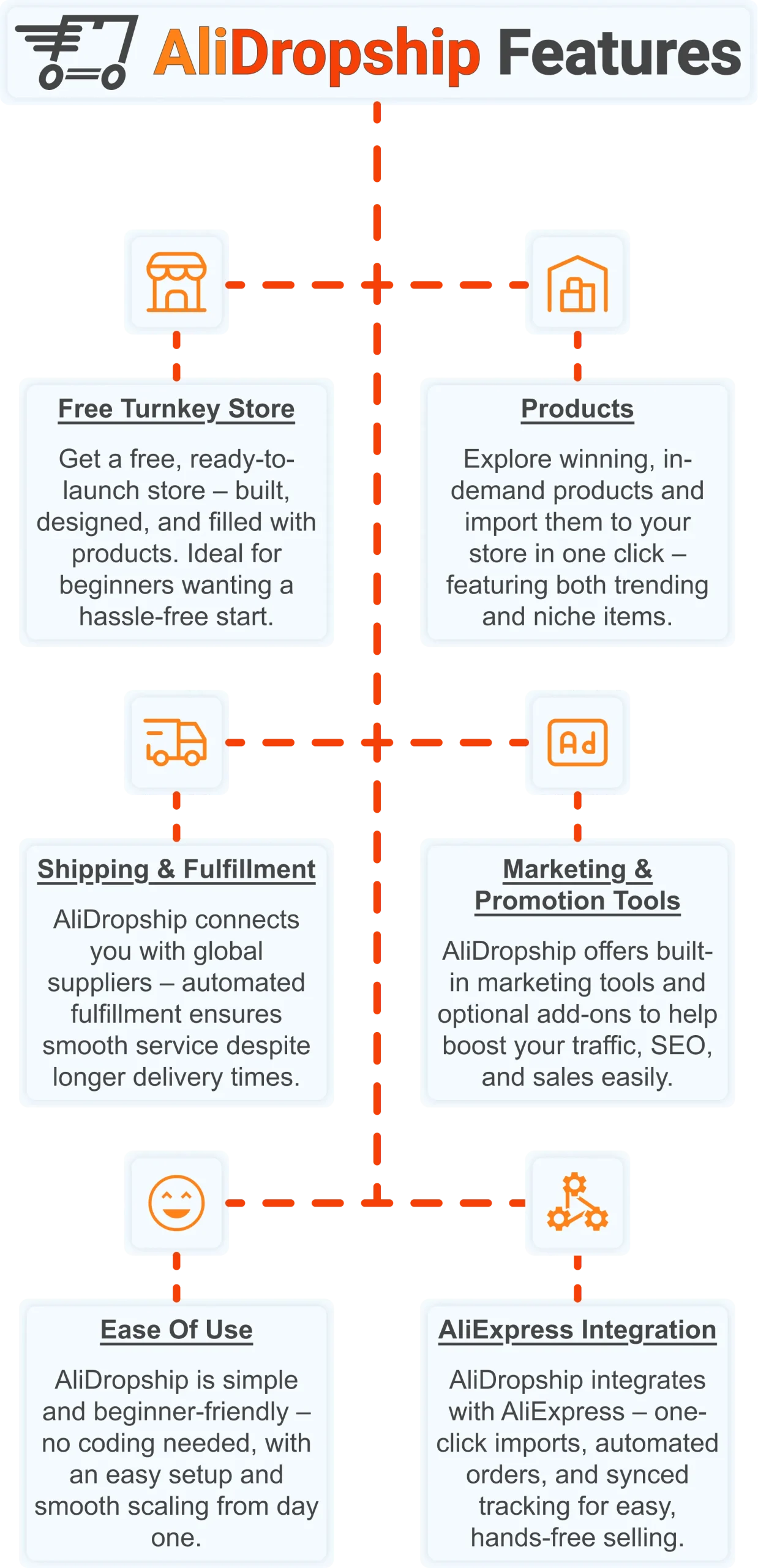
Free turnkey store 🛍️
Get a free turnkey store – built, designed, and filled with products. Ideal for beginners wanting a hassle-free start, the store comes fully optimized to attract customers right away, saving you time on setup. Plus, it includes professional design elements to give your business a polished, trustworthy look from day one. This ready-made foundation makes it easy to move seamlessly into product selection.
Products 📦
Once your store is set up, you can explore winning, in-demand products and import them in one click – featuring both trending and niche items. This wide selection lets you cater to diverse customer interests and test what works best. Regular updates ensure you always have fresh products, keeping your store competitive and relevant. With great products in place, smooth shipping becomes the next essential step.
Shipping & fulfillment 🚚
AliDropship connects you with global suppliers, and automated fulfillment ensures seamless order processing despite international delivery times. Customers receive real-time tracking updates, which builds confidence and trust in your store. Once shipping is handled reliably, you can focus on promoting your store and attracting traffic.
Marketing & promotion tools 📣
To maximize sales, AliDropship offers built-in marketing tools and optional add-ons that help boost traffic, SEO, and conversions. From email campaigns and discounts to social media integration, these tools empower you to reach and retain customers without needing prior marketing experience. With promotion strategies in place, managing your business becomes simpler and more efficient.
Ease of use 👌
AliDropship is beginner-friendly – no coding needed, with an intuitive dashboard that guides you through every step. Easy setup and smooth scaling let you expand your store without stress. As your business grows, adding new features, products, and marketing campaigns remains hassle-free, giving you more time to focus on sales.
AliExpress integration 🛒
Finally, AliDropship integrates seamlessly with AliExpress, enabling one-click imports, automated orders, and synced tracking. Your inventory stays up-to-date with the latest products and prices, while automated order processing frees you from manual tasks. Combined with the turnkey setup, reliable shipping, and built-in marketing tools, this integration ensures your dropshipping business is fully equipped for growth and success.
If you have been comparing ecommerce platforms trying to find the most beginner-friendly path to your first sale, AliDropship gives you the complete setup without the monthly overhead that holds most new sellers back. Get your free turnkey store today and start selling on a platform built for dropshipping from the ground up.
Is Shopify the best ecommerce platform for beginners?
What is the best free ecommerce store option in 2026?
How does Shopify compare to WooCommerce for dropshipping?
What are the best Shopify alternatives for dropshipping?
How long does it take to start earning from an ecommerce store?