AliDropship VS White-Label SaaS: Which Fits Beginners?

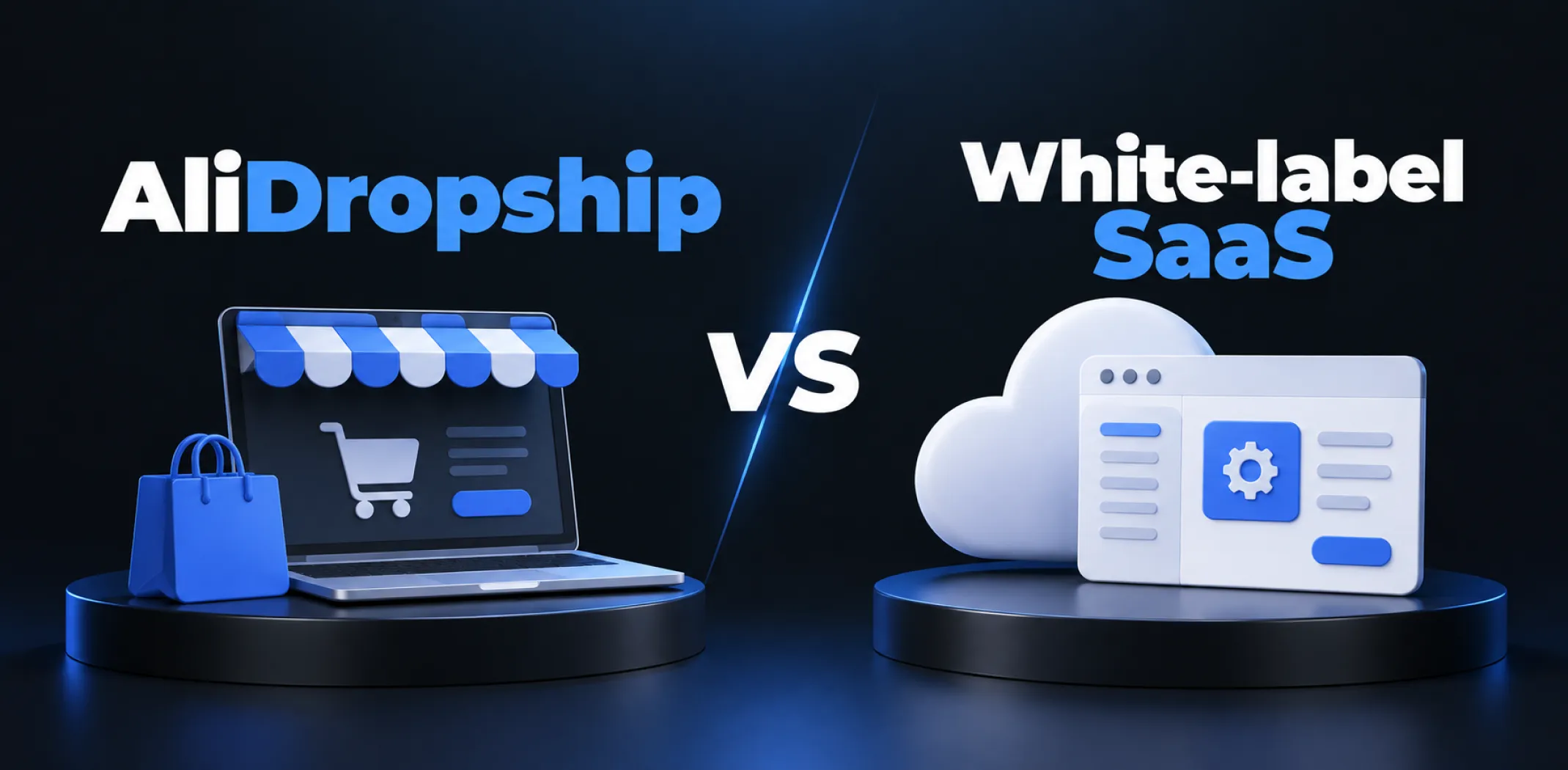
Comparing AliDropship vs white-label SaaS is really a comparison of two business models, not two similar products. One gives you a ready-made store that sells products to consumers. The other lets you rebrand a vendor software product and sell subscriptions to businesses. Both let you skip building the product yourself, but they ask very different things of you after that.
In 2026, the gap shows up first in price and in who your customers are. One widely used white-label platform, GoHighLevel, charges $497 a month for its reseller SaaS Mode, while AliDropship costs $39 a month after a 14-day free trial. This comparison covers where each model wins, what a first year costs, and which starting point fits you.
Key takeaways
- White-label SaaS means licensing a vendor product, rebranding it, and selling access to your own customers on a subscription.
- GoHighLevel, one widely used white-label platform, charges $497 a month for SaaS Mode, or $4,970 on annual billing.
- White-label resellers usually find their own clients, set their own prices, and handle first-line support.
- AliDropship costs $39 a month after a 14-day free trial and includes a ready-made store, loaded products, and a built-in ad system.
- The two models sell different things: white-label SaaS sells subscriptions to businesses, while AliDropship stores sell products to consumers.
The most useful way to compare them is to ask what you would actually do each week. A white-label reseller spends time finding business clients, onboarding them, and answering support questions. An AliDropship store owner spends time choosing products and managing ads for a store that is already built. With that in mind, here is how each model works, starting with white-label SaaS.
What is white-label SaaS and how does it work?
In 2026, white-label SaaS describes a model where you license finished software from a vendor, put your own brand on it, and sell access to your own customers. The vendor runs the infrastructure, updates, and core technology, while you set prices, find customers, and handle first-line questions. GoHighLevel and Vendasta are two examples built around this reseller model.
Reseller income comes from the spread between what you pay the vendor and what each client pays you, billed monthly. The reseller usually pays a flat platform fee however many clients it serves, plus usage charges that vendors meter separately. On GoHighLevel, the plan with SaaS Mode is Agency Pro at $497 a month, and texts, calls, email, and AI are billed on usage on top.
That makes white-label SaaS a B2B subscription business first. It rewards sales skills and an existing network, so it helps to look at where the model genuinely beats a product store.
Where does white-label SaaS win?
In 2026, a fair comparison has to start with what white-label SaaS does better, because several of its strengths are structural and a product store cannot copy them.
Those strengths come with trade-offs. Reseller guides commonly name provider dependency, reputational risk when the vendor has downtime, ongoing client support, and churn as the main risks, and all of them land on your brand rather than the vendor.
How does AliDropship compare to white-label SaaS?
In 2026, AliDropship is an ecommerce platform for people just starting an online business, built so dropshipping and digital product sales work with no experience and no tech skills. You get a fully built store with products already loaded and a built-in ad system, and you pay $39 a month after a 14-day free trial. The table below shows how that compares with a white-label SaaS reseller setup.
The table favors AliDropship on cost, setup, and customer acquisition, but it favors white-label SaaS on recurring revenue, and that last row matters. Store owners earn per sale, so each order is a separate win, while a subscription client keeps paying until they leave. Platform costs in the table use GoHighLevel as the white-label example, since it publishes its prices.
Year-1 cost breakdown: Which is actually cheaper?
As of 2026, the cost side of AliDropship vs white-label SaaS starts with platform fees, which differ by an order of magnitude. AliDropship costs $39 a month after the free trial, or $468 over 12 months. GoHighLevel Agency Pro costs $497 a month, or $5,964 over 12 months billed monthly and $4,970 on annual billing.
Platform fees are only part of the picture. AliDropship ads run $10 to $50 a day if you choose to use them, with a $40 coupon during the trial, so active promotion can add more than the subscription itself.
White-label resellers pay usage charges for texts, calls, and AI on top of the plan and must fund their own client acquisition. Pricing guides cite $97 to $297 a month per client, so covering the $497 plan takes between two and six paying clients before any usage costs.
What do real users say about white-label SaaS and AliDropship?
Based on 2026 reseller guides, white-label SaaS depends on finding clients and supporting them, while AliDropship is positioned for first-time store owners. The two composite examples below, one per model, reflect those patterns rather than any one real customer.
Which platform is right for you?
Based on 2026 pricing, match the model to your starting point rather than to the headline price. If you already sell to businesses, white-label SaaS has a head start, and if you are starting from zero, a ready-made store has fewer moving parts.
Best for agencies with clients
If you already serve business clients, white-label SaaS lets you add a recurring product to relationships you have built. The platform fee is a fixed cost, so each added client can improve your margin. You still own onboarding and support.
Best for beginners with no clients
If you have no clients, no audience, and no tech background, a ready-made store has fewer moving parts. AliDropship builds the store, loads products, and includes one-click ads, so you spend your time on choices rather than setup.
Best if you prefer selling products
If selling to consumers appeals more than selling to businesses, a product store matches that preference. Digital products deliver instantly, and physical items ship directly from suppliers, so you never handle a box.
Best for confident B2B sellers
If you enjoy sales calls, demos, and long client relationships, white-label SaaS rewards that skill. Subscription clients keep paying until they cancel, and you set your own pricing tiers. Expect real time on onboarding and support.
None of these profiles says one model is better in general. Each depends on what you already have: clients, cash for a higher monthly fee, and a preference for selling to businesses or to consumers. If the beginner profiles sound like you, the next option is aimed at you.
What factors should you consider before choosing?
As of 2026, five factors decide which model fits, and each one can be checked before you spend anything.
Who you want to sell to
White-label SaaS sells to businesses, which means conversations, demos, and contracts. AliDropship stores sell products to consumers through a storefront and ads. Choose the audience you can realistically reach, since pricing guides cite $97 to $297 a month per business client.
Your runway
A $497 monthly plan is a bigger fixed cost before your first client pays than a $39 plan. AliDropship ads are separate at $10 to $50 a day, so budget for them if you plan to promote the store.
Your sales and support skills
Resellers handle onboarding and first-line support, and vendor downtime reflects on their brand. Store owners still choose products and set an ad budget. Both GoHighLevel and AliDropship offer a 14-day trial, which is enough to test the workload.
Recurring versus per-sale income
A $297 client who stays 12 months pays $3,564, but subscriptions also carry churn when clients cancel. Store sales happen order by order, so each sale starts with a new buyer.
How much you depend on the platform
White-label resellers depend on vendor uptime, features, and pricing. AliDropship owners sell from its catalog, so you cannot add products of your own. Read the terms of either option before you commit.
If you are still undecided, run a small test of each. Both GoHighLevel and AliDropship offer a 14-day free trial, which is enough time to see whether you prefer configuring software for business clients or choosing products for a ready-made store. Count the hours the test takes, because time is the cost that neither price tag shows.
Whichever model you choose, price the full first year, not just the monthly fee. Add platform cost, usage or ad spend, and the time it takes to find your first customers. A realistic budget protects you better than a low headline price.
AliDropship and white-label SaaS are not direct substitutes, so the better question is which problem you want to solve first. The next section explains where AliDropship fits for readers starting from zero.
What is AliDropship, and who is it built for in 2026?
No experience? No problem. If you want the simplest way to start an online business in 2026, AliDropship is one of the most beginner-friendly platforms out there. It brings your store, your products, your fulfillment, and your marketing together in one place, so you can launch fast and grow with confidence.
Over 1,500,000 stores have already been built on AliDropship, and the platform has been featured by Forbes, Entrepreneur, Inc., NBC, Business, and Fox News.
AliDropship does not make you a software vendor and does not require business clients. It gives beginners a ready-made store with products loaded, so you sell to consumers instead of to businesses.
Starting any online business takes time and effort, and results depend on how much of both you put in. Ads cost money once the free coupon is used. The 14-day trial lets you look around before the monthly fee starts, and you can cancel anytime.
Back to the question behind this comparison: AliDropship vs white-label SaaS. White-label SaaS is the stronger fit if you already have business clients and want recurring revenue, and AliDropship is the lower-cost fit if you are starting from zero and prefer selling products to consumers. Neither removes the work of finding customers, so choose the work you are more willing to do.
Whichever you choose, test before you commit: use the free trial, count your hours, and compare current pricing on each vendor page, since prices and plans change. Readers who want a ready-made store to look at can start with the free store below and decide during the 14-day trial.
How does AliDropship compare to white-label SaaS?
Which is cheaper, AliDropship or white-label SaaS?
Is AliDropship better than white-label SaaS for beginners?
What does white-label SaaS do better than AliDropship?
Can I switch from white-label SaaS to AliDropship?