AliDropship VS Square: Features, Cost, And Who Wins

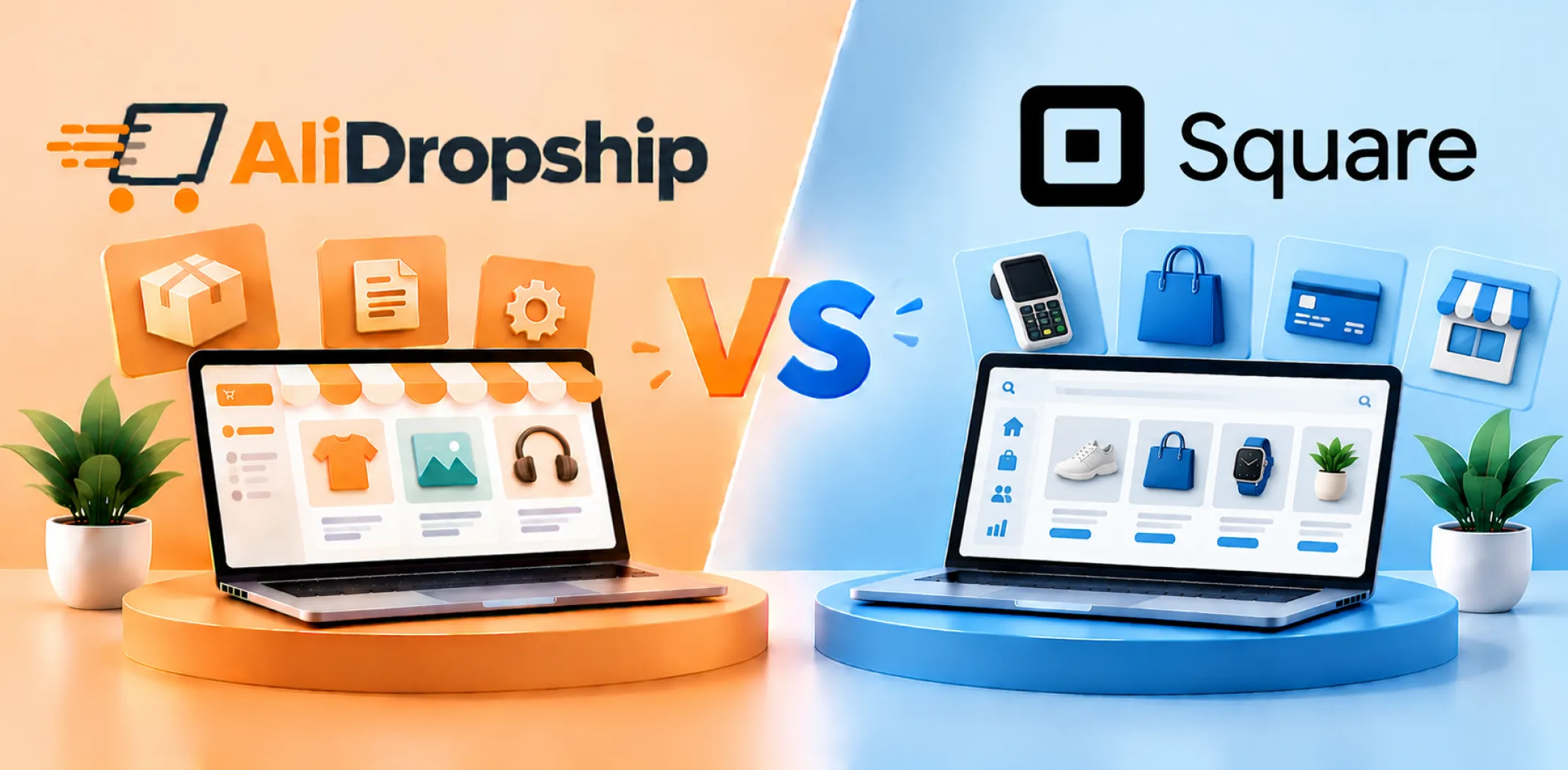
AliDropship vs Square is not a like-for-like comparison. In 2026, Square is mainly a payments and point-of-sale company that also offers a website builder, while AliDropship is an ecommerce platform that hands you a ready-made store with digital products already loaded. Which one fits you depends on one practical question: do you already have something to sell?
As of October 2026, Square sells three plans (Free, Plus at $49 per month, and Premium at $149 per month), and AliDropship charges $39 per month after a 14-day free trial. Those price tags look close at first glance, but they pay for very different things. This guide compares both on cost, features, user feedback, and fit, and it is upfront about the areas where Square is the better choice.
- Square is a payments and point-of-sale platform from Block, Inc. that launched in 2009 and reports more than 4 million businesses globally.
- Square Free costs $0 per month but charges 3.3% + 30¢ per online card payment, while Plus ($49 per month) and Premium ($149 per month) charge 2.9% + 30¢.
- Square Online does not supply products, so you create or source everything you sell and set up your own marketing.
- AliDropship costs $39 per month after a 14-day free trial and includes a built store, a digital product catalog, and a built-in ad system.
- Year-one subscription cost is $468 for AliDropship and $588 for Square Plus, and neither figure includes per-sale processing fees or advertising spend.
Below you will find a side-by-side table, a year-one cost breakdown, and a short guide to which platform suits which kind of seller. If you only want the short version, jump to the buyer profiles near the end of the article. The goal is to help you pick the platform that matches the work you actually want to do yourself, not to declare a universal winner.
What is Square and how does it work?
In 2026, Square is best known as a payments company. Jack Dorsey and Jim McKelvey launched it in 2009 after McKelvey lost a sale because he could not take a card payment, and the small card reader built to solve that problem grew into a much larger platform. The company was called Square, Inc. until December 2021, when it renamed itself Block, Inc.
Today Square covers point-of-sale software, card readers, invoicing, appointment booking, and banking tools, alongside Square Online, its website and online store builder. The online store reads from the same item library as your register, so inventory and orders stay in sync between a counter, a market stall, and a website. Square Online runs on website-builder technology from Weebly, which Square acquired in 2018.
Square makes money by charging a percentage plus a fixed fee on every card payment, by selling paid Plus and Premium plans, and by selling hardware. That model explains why a free plan exists at all: if you sell, Square earns on the processing. It also means the real cost of Square depends more on your sales volume than on the plan price.
Where does Square win over AliDropship?
As of October 2026, Square holds several real advantages, and they are worth stating plainly. The first is price of entry. Square Free has no monthly subscription, and you only pay processing fees when you take a payment. That is a genuine edge for anyone who wants to test an idea with no recurring cost, and AliDropship, with a 14-day free trial followed by $39 per month, cannot match a permanent $0 plan.
Square is also the stronger choice when you sell in person. Card readers, a point-of-sale app, invoicing, appointment booking, and banking tools all live in one account, and Square Online reads from the same item library, so a market stall and a website share one inventory. AliDropship is built around an online store, not a counter. If you run a bakery, a salon, or a pop-up shop, Square fits that job better.
A third advantage is freedom over what you sell. Square lets you list your own products, from handmade goods to event tickets, and it includes a digital item type as well. On AliDropship, every product comes from the AliDropship catalog, so you cannot add your own brand or inventory. Founders with an existing product line will find that restriction limiting.
The flip side is that Square assumes you already have something to sell. Square Online gives you a website builder and a payment system, but it does not supply products, run ads for you, or tell you what to sell. G2 reviewers also point to limited design flexibility and basic SEO tools, which matters if search traffic is your plan. For a first-time seller with no products, that leaves most of the hard work on your side.
How does AliDropship compare to Square?
In 2026, the clearest difference between the two is who does the work. With Square Online you choose a plan, build the site, decide what to sell, create or source the products, and set up your own marketing. With AliDropship, the store arrives built and stocked from a digital product catalog, and an ad system is included, so setup mostly comes down to signing up and choosing a daily budget.
AliDropship is a B2C platform founded in 2015 by Yaroslav Nevsky and Ilya Dolgikh and based in Irvine, California. It positions itself as an ecommerce platform for people just starting an online business, with no experience or technical skills required, and it reports more than 1,500,000 stores launched. Square reports more than 4 million businesses globally, so it is the larger company by reach.
Read the table as a map of trade-offs rather than a scorecard. Square gives you more freedom and a lower entry price, and it is the only option here that works at a physical counter. AliDropship gives you more done-for-you pieces, which matters most when the biggest obstacle is not knowing where to start. If your blocker is capital or foot traffic, Square wins. If your blocker is not having a store, products, or ads, AliDropship does.
Which is cheaper in year one, AliDropship or Square?
Based on pricing checked in October 2026, the subscription math is simple for AliDropship: $39 per month adds up to $468 over 12 months, and that price includes the store, the product catalog, and the ad system. Square has three tiers. Square Free costs $0, Plus costs $49 per month per location ($588 per year), and Premium costs $149 per month per location ($1,788 per year). Plus and Premium both include a 30-day free trial.
Those figures cover subscriptions only, so they hide the costs that usually decide the winner. On Square, you also pay per-payment fees: on one $20 online order, Square Free takes 96 cents while Plus and Premium take 88 cents.
If you want a custom domain, Square Online domains start around $19.95 per year, and you still need products to sell. On AliDropship, order processing fees apply when you make sales, and ads cost between $10 and $50 per day once you switch them on, with a $40 ad coupon included in the trial.
The fairest summary is this.
Square Free is cheaper if you already have products and can handle marketing yourself, because nothing recurring is due. AliDropship works out cheaper in practice if you would otherwise pay separately for a site, products, and ads, because those pieces arrive in the $39 plan. Premium at $1,788 per year targets larger operations, and its online card rate matches Plus, so its savings come from in-person payments and extra support.
What do real users say about Square and AliDropship?
Based on 2026 review data, the public picture of both platforms is fairly clear. Square holds a 4.0 out of 5 TrustScore on the US page of Trustpilot, based on more than 7,300 reviews. Positive reviews praise easy setup and quick access to funds.
The recurring complaint pattern involves account holds and deactivations: some merchants report frozen funds or closed accounts, and public replies from Square say holds can follow disputes, chargebacks, security concerns, or risk reviews. If one payment account carries all of your revenue, that pattern is worth knowing about.
AliDropship lists a 4.7★ average rating on Trustpilot. The two ratings come from different review volumes and different kinds of customers, so treat the gap as a data point rather than a verdict. Reviews of either platform are most useful when they come from sellers whose starting point resembles yours, which is why the examples below are built around two typical situations.
Both examples point to the same conclusion: neither platform is better in the abstract. The baker needed payments and a register more than a catalog, and the first-time seller needed a ready store more than a card reader. Matching the tool to your starting point matters more than any feature list, and that is the logic behind the buyer profiles in the next section.
Which platform is right for you?
In 2026, the simplest way to choose is to match each platform to a seller profile. The four profiles below cover the most common situations behind the AliDropship vs Square search, and each one names the platform that fits it best, including the two where Square comes out ahead.
Best for shops with a counter
Square suits any seller who takes payments in person, such as a cafe, salon, or market stall. The website extends a register you already use, and inventory stays in sync across both. Hardware and software come from one vendor.
Best for first-time online sellers
AliDropship fits beginners with no products and no technical skills. The store arrives built, the digital catalog is loaded, and the ad system is included, so setup stays short. It is built for online selling only.
Best for existing brands
Square is the better pick if you already make or source your own products. You control the catalog, pricing, and brand, and you can start on the free plan. AliDropship cannot match that freedom because its products come from its own catalog.
Best for hands-off promotion
AliDropship includes a built-in ad system where you pick a daily budget and the platform handles the setup behind the scenes. That suits sellers who do not want to learn ad tools. Square leans on email and text campaigns to existing customers.
If you are still unsure, ask one question: do you already have something to sell? A yes points to Square, and a no points toward a platform that supplies the store, the products, and the promotion. Starting small is reasonable either way, and both platforms let you test before committing to a paid plan, with Square Free at $0 and AliDropship on a 14-day trial.
What factors should you weigh before choosing?
As of 2026, five factors do most of the work in this decision. They apply whichever platform you lean toward, and they are worth checking against your own situation before you pay for anything.
Do you already have products?
Square Online assumes you do, and AliDropship supplies products from its own catalog. If you start with 0 products today, the first weeks on Square go into making or sourcing them, and that effort can outweigh any difference in monthly fees.
Where will your customers be?
Square is the stronger choice any time part of your revenue comes from in-person sales. An online-only idea does not need a card reader, which removes the main edge Square holds and makes the comparison closer.
How will you reach new buyers?
Square Marketing focuses on email and text campaigns to customers you already have, and Plus includes 500 text messages per month. G2 reviewers describe the SEO tools in Square Online as basic. AliDropship includes ads you can start at $10 per day, though no platform replaces a plan for reaching buyers.
How much payment risk can you carry?
Trustpilot reviews of Square include repeated reports of account holds and deactivations, and Square says holds can follow disputes, chargebacks, or risk reviews. If one account carries all your revenue, keep a backup bank account and payment option in mind.
What will year one really cost?
Add the subscription, per-sale fees, a domain, products, and ads before comparing. Subscription alone is $468 on AliDropship and $588 on Square Plus, and processing fees apply on both. Square domains start around $19.95 per year.
None of these factors is a dealbreaker on its own, and most sellers will find that two or three of them dominate their decision. A seller with existing products and local customers will usually land on Square. A seller starting from nothing, with no products and no marketing experience, will usually find that handing those pieces to a platform saves the most time in the first weeks.
What is AliDropship and why does it work for beginners in 2026?
No experience? No problem. If you want the simplest way to start an online business in 2026, AliDropship is one of the most beginner-friendly platforms out there. It brings your store, your products, your fulfillment, and your marketing together in one place, so you can launch fast and grow with confidence.
Over 1,500,000 stores have already been built on AliDropship, and the platform has been featured by Forbes, Entrepreneur, Inc., NBC, Business, and Fox News.
Before you decide, keep one limit in mind: AliDropship sells products from its own catalog, so it is a poor fit if your plan is to build a brand around items you make or source yourself. For everyone starting from scratch, the practical test is whether the trial gives you enough information to decide. Fourteen days is short, so plan to pick products and switch on ads early in the trial.
Square and AliDropship solve different problems, and the honest answer to AliDropship vs Square is that the right pick depends on your starting point. A baker with a register and a loyal local following has little reason to leave Square. Someone with no store, no products, and no marketing plan has a clearer path with a platform that supplies all three. Whichever way you lean, test the setup before paying for a full year.
Starting an online business takes real effort, and no platform removes that, so set your expectations accordingly. Results depend on the products you choose, the time you put in, and how well you reach buyers. Use the free options on both sides to compare the experience directly, then commit to the one that matches the work you actually want to do yourself.
How does AliDropship compare to Square?
Which is cheaper, AliDropship or Square?
Is AliDropship better than Square for beginners?
What does Square do better than AliDropship?
Can I switch from Square to AliDropship?