AliDropship VS Shopify VS BigCommerce: Which To Choose?

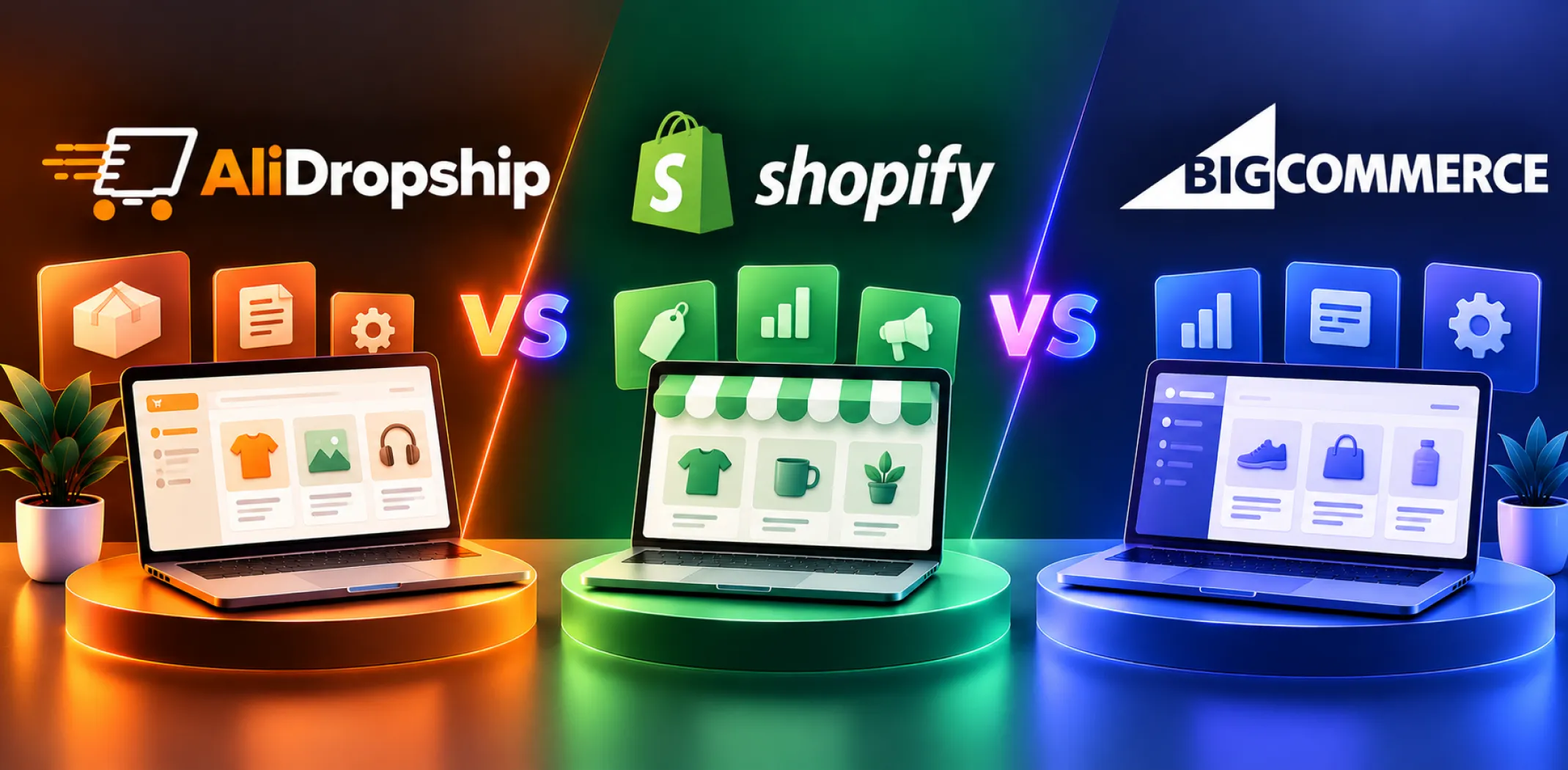
If you are comparing AliDropship vs Shopify vs BigCommerce in 2026, you will notice something odd: all three start at $39 per month on monthly billing. The similarity ends there. Shopify and BigCommerce are hosted platforms where you build the store, source the products, and set up your own marketing. AliDropship is an ecommerce platform that gives you a ready-made store, a product catalog, and a built-in ad system.
So which one fits you? If you have your own products, expect a large catalog, or want full control over design and tools, Shopify or BigCommerce gives you more room. If you are starting from zero with no experience and want a store that is ready to run, AliDropship is the stronger fit.
This guide covers what Shopify and BigCommerce do well, where AliDropship pulls ahead, what each costs over a full year, and how to choose. As of October 2026, the prices below reflect publicly listed plans, so confirm current rates on each site before you pay.
Before the detail, here are the facts worth keeping in mind. Each point is backed up with numbers or sources in the sections below, so you can skim this list now and come back to anything that needs more context. Where sources disagree, the article says so rather than picking a side.
- Shopify is a hosted ecommerce platform founded in 2006, with Basic at $39 per month on monthly billing, or $29 per month on annual billing.
- BigCommerce is a hosted ecommerce platform founded in 2009, with Core at $39 per month and plans tied to annual sales volume.
- AliDropship is an ecommerce platform that provides a built store, a product catalog, and a built-in ad system for $39 per month after a 14-day free trial.
- Shopify and BigCommerce let you sell your own products, while AliDropship products come from its catalog.
- In the AliDropship vs Shopify vs BigCommerce decision, the right choice depends on whether you want a store ready to run or a platform you build and grow yourself.
A matching price tag makes these three look interchangeable, and that is the trap. The $39 buys very different starting points.
On Shopify and BigCommerce it buys an empty platform: you choose a theme, add products, connect payments, and bring your own customers. On AliDropship it buys a store that is already built, with products loaded and an ad system included. The rest of this guide keeps those starting points apart so the numbers make sense.
What is Shopify and how does it work?
In 2026, Shopify is a hosted ecommerce platform founded in 2006 and headquartered in Ottawa, Canada. Hosting, security, and checkout come with the subscription, while you pick a theme, add products, and connect marketing. Basic costs $39 per month on monthly billing or $29 on annual billing, with Grow at $105, Advanced at $399, and Plus from $2,300.
New stores can currently start with a three-day free trial and then pay $1 per month for three months, though promotions change. Card payments through Shopify Payments cost 2.9% plus 30 cents on Basic, and using a third-party gateway adds an extra fee of about 2%.
The panel sticks to what public pricing pages and review sites report. G2 and Capterra show about 4.4 to 4.5 out of 5 for Shopify, while Trustpilot shows a far lower score around 1.3, partly because shoppers review individual stores there. Check the current numbers before relying on any one of them.
What is BigCommerce and how does it work?
As of October 2026, BigCommerce is a hosted ecommerce platform founded in Sydney in 2009 and now headquartered in Austin, Texas. Like Shopify, it provides hosting, security, and checkout, and it positions itself as having more features built in so merchants need fewer paid apps. It is aimed at growing and larger stores, including those with B2B needs.
BigCommerce renamed its plans on June 1, 2026: Standard became Core, Plus became Growth, Pro became Scale, and Enterprise became Performance. Core costs $39 per month, or $29 on annual billing, and covers up to $30,000 in trailing 12-month sales before the plan moves to Growth at $105 per month. Older articles still show the previous names and a $50,000 threshold, so check the current pricing page.
BigCommerce charges no platform fee on orders through its embedded payment providers, but since June 2026 orders through other gateways carry an Open Payment Provider Fee of 2% on Core, 1% on Growth, and 0.6% on Scale.
Review scores follow the same pattern as Shopify: G2 and Capterra sit around 4.2 to 4.3, while Trustpilot shows a much lower score near 1.2 to 1.3. For a fuller BigCommerce review, check the current plan terms on the official pricing page first.
Where do Shopify and BigCommerce win against AliDropship?
As of October 2026, Shopify and BigCommerce beat AliDropship on a point that matters to many sellers: you can sell your own products. Every AliDropship product comes from its catalog, so you cannot add your own. If you make something, source from your own supplier, or want to build a brand around a product line, both platforms give you the freedom AliDropship does not.
The main trade-off with Shopify is a bill that grows with success. Apps, a premium theme, and payment fees all add to the plan fee, and using a third-party payment gateway adds an extra charge of about 2% on Basic. One review also notes that a fully customizable checkout is reserved for the Plus tier.
Ease of launch is the main edge Shopify holds over BigCommerce. The setup flow is shorter, the theme and app marketplace is larger, and most guides and tutorials assume Shopify, so help is easy to find. For a seller who wants to build quickly without learning a long list of settings, that matters more than any single feature.
BigCommerce has its own trade-offs. Reviewers describe a steeper learning curve than Shopify, and since the June 2026 changes the sales thresholds are lower: a Core store that passes $30,000 in trailing 12-month sales moves to Growth at $105 per month. For a beginner with no sales yet that is a distant problem, but it matters for anyone planning fast growth.
Both platforms offer real advantages, and both come with work. Everything above assumes you will build the store, source or create the products, and set up your own marketing. That freedom is the right trade for a seller with a brand and a plan, and a heavy lift for someone starting from zero.
How does AliDropship compare to Shopify and BigCommerce?
In 2026, the cleanest way to compare AliDropship vs Shopify vs BigCommerce is by what the $39 actually buys. AliDropship was founded in 2015 and is based in Irvine, California.
It is an ecommerce platform for beginners: your store comes built, products are loaded from the AliDropship catalog, and a built-in ad system promotes the store for a daily budget you choose between $10 and $50. More than 1,500,000 stores have been launched on the platform.
Start with Shopify, since both plans cost $39 per month on monthly billing.
Shopify wins the row that matters to brand builders: you can sell anything. AliDropship wins the rows about what is done for you. The year-1 plan fee is identical on monthly billing, but Shopify Basic still needs a theme, products, apps, and an ad budget on top, while the AliDropship fee already covers the store, the catalog, and the ad system.
BigCommerce wins two rows: selling your own products and being built for high volume. Those rows matter if you already have a catalog or expect large sales. AliDropship wins the rows that decide whether a business can launch on day one, and the plan fees are again identical on monthly billing, so the real comparison is what each plan includes and what you must add yourself.
Which is cheaper over the first year: AliDropship, Shopify, or BigCommerce?
As of October 2026, the plan-fee math is unusually simple. AliDropship costs $39 per month after a 14-day free trial, or $468 over 12 months. Shopify Basic costs $39 per month on monthly billing, also $468, or $348 on annual billing. BigCommerce Core also costs $39 per month, or $29 on annual billing, so $468 or $348 as well. Here is a full year in the AliDropship vs Shopify vs BigCommerce cost comparison.
Three identical numbers hide three different starting points. Shopify and BigCommerce give you the platform, and you still pay for a theme if you want a premium look, for apps or extensions beyond the built-in tools, for products, and for your own ads. BigCommerce includes more native features, which can reduce app costs, while Shopify has the larger app store and the easier start.
Sales volume changes the picture later. BigCommerce moves a Core store above $30,000 in trailing 12-month sales to Growth at $105 per month, and both platforms charge extra on some third-party payment gateways, about 2% on entry plans. AliDropship ad spend of $10 to $50 per day is paid separately. For a beginner, the honest question is not which plan is cheapest. It is which setup gets a working store online with the least extra spending.
What do real users say about Shopify, BigCommerce, and AliDropship?
In 2026, public ratings for the two competitors follow the same split. Shopify scores about 4.4 out of 5 on G2 and 4.5 on Capterra from thousands of reviews, but its Trustpilot score is far lower, around 1.3. BigCommerce scores about 4.2 on G2 and 4.3 on Capterra, with a Trustpilot score near 1.2 to 1.3 in the listings reviewed.
Review sites measure different things. G2 and Capterra mostly capture merchants judging features, while Trustpilot also attracts shoppers and merchants with support or billing complaints. For Shopify, reviewers praise ease of launch and the app ecosystem, and criticize a bill that grows with apps and fees. For BigCommerce, reviewers praise built-in features and scalability, and criticize the learning curve and revenue-based pricing tiers.
AliDropship holds a 4.7 star average rating on Trustpilot, and it draws its own skepticism, usually from readers who expect a finished store to produce sales without further work. Results depend on product choice, ad budget, and the time you put in. The three examples below are composites built from common user profiles, not individual customers.
The three stories point to the same pattern. Shopify and BigCommerce reward sellers who bring their own products and are willing to build, while AliDropship removes setup work for sellers who are not. None of them replaces the effort of choosing products and testing marketing.
Which platform is right for you?
In 2026, the best choice comes down to four buyer profiles. Match your situation to the closest one below. Each tile names the platform that fits and gives one concrete number to anchor the decision.
You are starting from zero
AliDropship fits first-time sellers with no store, no products, and no technical background. The store arrives built, products are loaded, and ads are included, so you can open without design, coding, or sourcing.
You have your own products
Shopify fits sellers who make or source their own products and want the easiest hosted route. Hosting and checkout are included, and apps extend the store as the business grows.
You expect fast growth
BigCommerce fits sellers with larger catalogs or B2B needs who want more features built in. Plan tiers rise with sales, so growth raises the monthly fee.
You want ads handled for you
AliDropship fits sellers who do not want to learn ad setup. The built-in system promotes the store for a daily budget you choose, so a one-click start replaces hours of manual configuration.
If two profiles fit, the order of operations matters. Many sellers learn more from running a ready-made store for a few weeks than from planning a custom build for months. Nothing stops you from moving to Shopify or BigCommerce later if you outgrow a catalog-based store and want to sell your own products, and the first weeks of real traffic will tell you what you actually need.
What should you weigh before choosing between them?
As of 2026, five checks separate a good purchase from a regretted one. Work through them in order, because the first one usually settles the question on its own.
Your time and goal
Decide whether you want to build a store or open one that is ready. Building gives control and takes time, while a turnkey store gives speed and less control. Write down how many hours per week you can give to setup over the first month.
Total first-year cost
AliDropship, Shopify Basic, and BigCommerce Core all cost $468 a year on monthly billing, but only AliDropship includes a built store, products, and ads. Shopify and BigCommerce add themes, apps, products, and ad budget on top, and annual billing brings each to $348.
Sales thresholds and fees
BigCommerce ties plans to sales, with Core covering up to $30,000 in trailing 12-month sales before moving to Growth at $105 per month. Both Shopify and BigCommerce charge extra on some third-party payment gateways, about 2% on entry plans. AliDropship lists a flat $39 monthly plan.
Where your products come from
AliDropship products come from its catalog, so you cannot add your own. Shopify and BigCommerce let you sell anything, including your own brand, but you must source or create the products. Be clear about whether you need your own product line.
Learning curve and upkeep
Reviewers describe Shopify as easier for non-technical sellers and BigCommerce as more powerful with a steeper learning curve. Both handle hosting and security for you. AliDropship is built for beginners with no technical skills, with the trade-off that products come from its catalog.
None of these checks requires technical knowledge, only a few minutes with each pricing page and an honest look at your own situation. If your answers point toward your own products, a large catalog, or B2B selling, Shopify or BigCommerce is the sensible route, and the cost checks above still apply to both in full. Either way, you will decide better with those answers written down than with a feature list in front of you.
If you decided you need a ready-made store, the next section shows what AliDropship includes so you know exactly what you would be signing up for. If you decided you want to build your own, nothing in the section below changes that, and it is worth reading only as a point of comparison.
What is AliDropship and why does it suit beginners in 2026?
No experience? No problem. If you want the simplest way to start an online business in 2026, AliDropship is one of the most beginner-friendly platforms out there. It brings your store, your products, your fulfillment, and your marketing together in one place, so you can launch fast and grow with confidence.
Over 1,500,000 stores have already been built on AliDropship, and the platform has been featured by Forbes, Entrepreneur, Inc., NBC, Business, and Fox News.
To keep this comparison honest, AliDropship does not let you sell your own products, because every product comes from its catalog. If you already make or source your own products, expect a large catalog, or need B2B features, Shopify or BigCommerce is the better fit. AliDropship is not a like-for-like Shopify alternative or BigCommerce alternative for every seller. It is built for beginners who want a store that is ready to run.
The practical way to compare is to test. The trial gives full platform access for 14 days, the ad coupon covers a first campaign, and you can cancel anytime. After the trial the plan is $39 per month, the same fee as Shopify Basic or BigCommerce Core on monthly billing. The difference worth noting is what you get for it: only one of the three starts with a built store, loaded products, and ads included.
Whichever way you lean, the order of operations stays the same. Decide how much you want to build yourself, check the total first-year cost, and be clear about where your products will come from. Those three steps will tell you more than any AliDropship vs Shopify vs BigCommerce feature list, and they apply equally to all three platforms.
If you are ready to see what a finished store looks like, the free trial is the quickest way to find out. Take your time with the dashboard, load a few products, and compare the experience with the build-it-yourself platforms you have looked at, so the decision rests on what you saw rather than on any review, including this one. Then decide whether the $39 monthly plan makes sense for you.
How does AliDropship compare to Shopify and BigCommerce?
Which is cheaper: AliDropship vs Shopify vs BigCommerce?
Is AliDropship better than Shopify or BigCommerce for beginners?
What do Shopify and BigCommerce do better than AliDropship?
Can I switch from Shopify or BigCommerce to AliDropship?