AliDropship VS ShineOn: Store Or Personalized Jewelry POD?

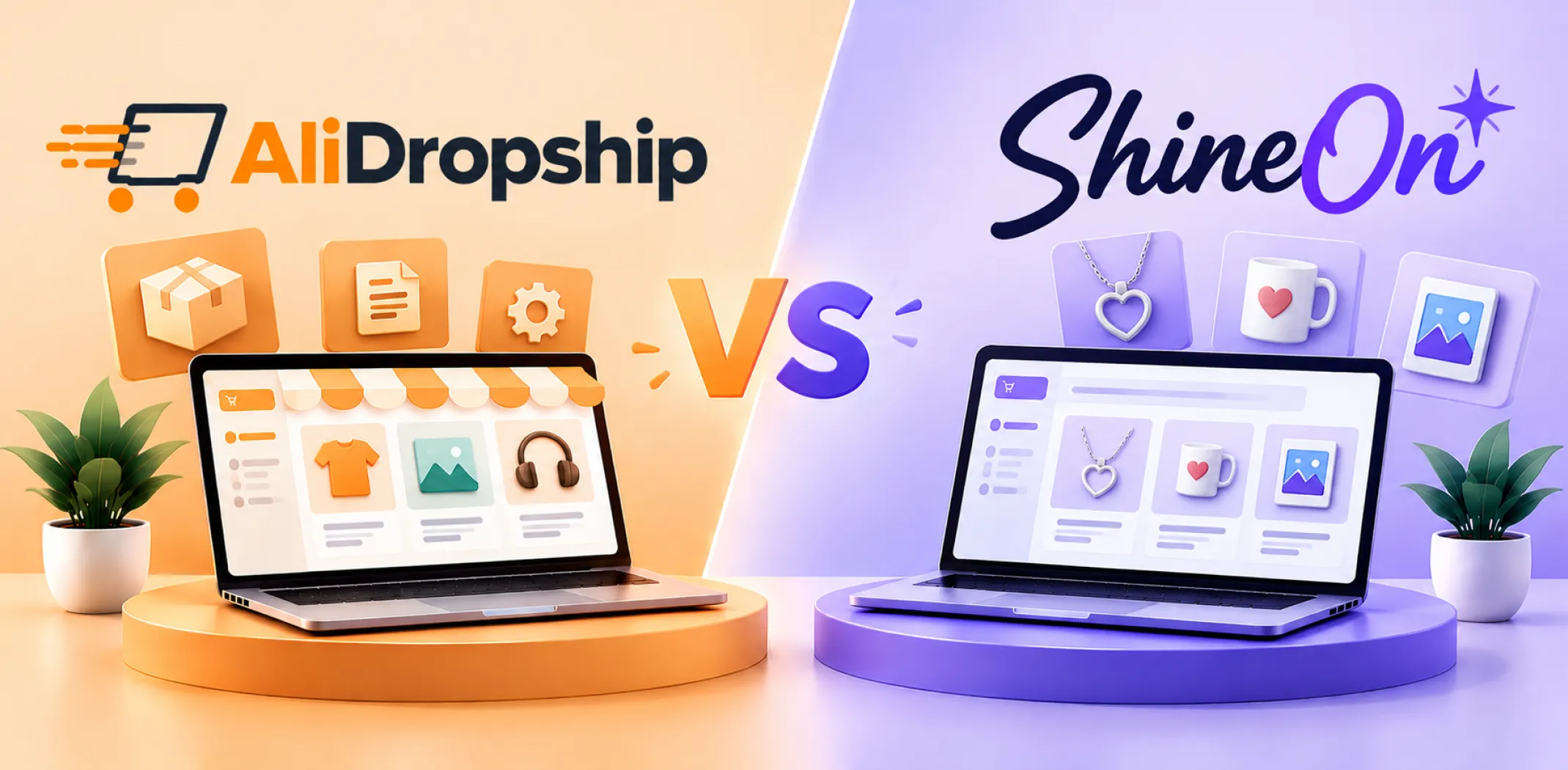
If you are comparing AliDropship vs ShineOn in 2026, you are comparing a store with a product supplier. ShineOn is a print-on-demand supplier, best known for personalized jewelry, that makes and ships custom items for sellers who run their own Shopify stores.
AliDropship is an ecommerce platform that gives you a ready-made store, a product catalog, and a built-in ad system. Both are no-inventory models, but they ask very different things of you.
So which one fits you? If you already run a Shopify store, or plan to, and want to sell personalized jewelry or gifts to a defined audience, ShineOn is built for that. If you are starting from zero and need a store to sell from, AliDropship is the stronger fit.
This guide covers what ShineOn does well, where AliDropship pulls ahead, what each costs over a full year, and how to choose. As of October 2026, the prices below reflect publicly listed plans, so confirm current rates on each site before you pay.
Before the detail, here are the facts worth keeping in mind. Each point is backed up with numbers or sources in the sections below, so you can skim this list now and come back to anything that needs more context. Where sources disagree, the article says so rather than picking a side.
- ShineOn is a print-on-demand supplier founded in 2016, best known for personalized jewelry, and it connects to a Shopify store you own rather than building one.
- ShineOn is free to install, with paid plans at $27, $77, and $87 per month that add per-unit discounts and extra features.
- ShineOn scores well on the Shopify App Store but much lower on Trustpilot, where reviewers report support and account-closure problems.
- AliDropship is an ecommerce platform that provides a built store, a product catalog, and a built-in ad system for $39 per month after a 14-day free trial.
- In the AliDropship vs ShineOn decision, the right choice depends on whether you want to sell personalized products on your own store or need a ready-made store.
A supplier makes and ships the product. It does not build the store, choose the niche, or find the buyers.
ShineOn does more than most suppliers to help, with free training, mockups, and a community, but the store, the audience, and the marketing remain yours. AliDropship starts from the opposite end, giving you the store, the products, and the ads first. The rest of this guide keeps those jobs apart so the numbers make sense, and it says plainly where ShineOn is the better value.
What is ShineOn and how does it work?
In 2026, ShineOn is a print-on-demand supplier founded in 2016 by Eric Toz, best known for personalized jewelry such as message-card necklaces. It also offers watches, apparel, blankets, and other custom items.
You connect it to a Shopify store, create a product with its mockup tools, and when a customer orders, ShineOn produces and ships the item, mainly from facilities in the United States and more recently the EU. Most orders are reported to be produced in about two to five business days.
ShineOn does not build a store or bring customers. It does offer free training, a community, and a library of mockups and creatives, which lowers the design and learning work compared with most print-on-demand suppliers. You still own the store, the niche, and the marketing.
The panel sticks to what the Shopify App Store, review sites, and independent reviews report. The Shopify listing shows about 4.6 out of 5 in some snapshots and 4.9 from more than 2,500 reviews in another, while Trustpilot shows roughly 2.7 to 3.0 from about 630 reviews, so check the live profiles before relying on any single number. For a fuller ShineOn review, read the current plan terms and base costs on its site first.
Where does ShineOn win against AliDropship?
As of October 2026, ShineOn beats AliDropship if you want to sell personalized products. AliDropship sells products from its own catalog and cannot add your custom designs, messages, or engraving, while ShineOn is built around exactly that: personalized jewelry, message cards, and gifts that carry a customer name or message. In a niche where the emotional value is high, that is a real edge.
It also wins on fast US production, a free plan, and support for new sellers. The free plan has no monthly fee, paid plans start at $27 per month and add per-unit discounts, and the training and community lower the learning curve. Reported margins on jewelry run around 20 to 30 percent for sellers who master the niche.
ShineOn has real limits as well. Reviewers say base costs are relatively high for jewelry, which keeps margins tight, and the per-unit discounts sit behind paid plans that cost $27 to $87 per month. Trustpilot reviewers also report support and account-closure problems, and a polarized score of about 2.7 to 3.0 shows that experiences differ widely.
Everything above assumes you already have a Shopify store, a niche, and a way to bring in customers. A supplier makes and ships the product, but it does not build the store or find the buyers, which is exactly what a beginner may not have yet.
How does AliDropship compare to ShineOn?
In 2026, the cleanest way to compare AliDropship vs ShineOn is by what each one actually provides. AliDropship was founded in 2015 and is based in Irvine, California.
It is an ecommerce platform for beginners: your store comes built, products are loaded from the AliDropship catalog, and a built-in ad system promotes the store for a daily budget you choose between $10 and $50. More than 1,500,000 stores have been launched on the platform.
Read the table with context. ShineOn wins three rows: personalized products, a free plan, and flexibility about where your store lives. Its year-1 fee can be far lower than AliDropship, so that row is not a loss for ShineOn. AliDropship wins the rows that measure whether a store and ads exist at all. The comparison is not like for like, because ShineOn is a supplier that still needs a Shopify store and your own marketing underneath it.
Which is cheaper over the first year: AliDropship or ShineOn?
As of October 2026, ShineOn pricing starts with a free plan on Shopify, and paid plans cost $27 per month ($260 billed yearly), $77 per month ($740 yearly), and $87 per month ($835 yearly).
They add per-unit discounts of up to about $1, $2, and $4, plus extras such as expedited shipping and priority support. Paid plans start with a 7-day free trial, and every order carries its own product and shipping cost. AliDropship costs $39 per month after a 14-day free trial. Here is a full year of plan fees in the AliDropship vs ShineOn cost comparison.
The free plan means the ShineOn subscription can cost nothing, which is cheaper than AliDropship. The catch is what it covers. You still need a Shopify store, which starts at $39 per month on monthly billing or $468 a year, plus product costs, an ad budget, and the time to design and test products. With Shopify Basic added, the first-year plan fees come to about $468 on the free ShineOn plan.
The AliDropship plan fee covers the store, the catalog, and the ad system, although your daily ad spend of $10 to $50 is paid separately. For a beginner, the honest comparison is not $468 against $0. It is a complete starting setup against a supplier that needs a store, a niche, and marketing on top.
What do real users say about ShineOn and AliDropship?
In 2026, ShineOn ratings depend on where you look. The Shopify App Store shows about 4.6 out of 5 in some snapshots and 4.9 from more than 2,500 reviews in another, and merchants praise product quality, fast US and EU fulfillment, support, and training. Trustpilot shows a much lower score, roughly 2.7 to 3.0 from about 630 reviews, with about two thirds of reviews at five stars and about one in six at one star.
The complaints cluster around support and accounts. Some reviewers describe difficulty closing or deleting an account, others report slow or unhelpful support, and several independent reviewers note that margins are tight because base costs are high. Sellers who stay with it tend to rate the training, the community, and the shipping speed highly.
AliDropship holds a 4.7 star average rating on Trustpilot, and it draws its own skepticism, usually from readers who expect a finished store to produce sales without further work. Results depend on product choice, ad budget, and the time you put in. The two examples below are composites built from common user profiles, not individual customers.
Both stories point to the same pattern. ShineOn rewards sellers who bring a niche, a message, and an audience, while AliDropship removes setup work for sellers who have none of those yet. Neither replaces the effort of choosing products and testing marketing.
Which platform is right for you?
In 2026, the best choice comes down to four buyer profiles. Match your situation to the closest one below. Each tile names the option that fits and gives one concrete number to anchor the decision.
You are starting from zero
AliDropship fits first-time sellers with no store, no products, and no design background. The store arrives built, products are loaded, and ads are included, so you can open without creating anything.
You have a niche and a message
ShineOn fits sellers who already run a Shopify store and want to sell personalized jewelry or gifts to a defined audience. Free training and mockups lower the learning curve.
You want ads handled for you
AliDropship fits sellers who do not want to learn ad setup. The built-in system promotes the store for a daily budget you choose, so a one-click start replaces hours of manual configuration.
You sell steady volume
ShineOn Side-Hustle and Empire Builder fit sellers with regular orders who want per-unit discounts and priority support. Savings grow with order volume.
If two profiles fit, the order of operations matters. Many sellers learn more from running a ready-made store for a few weeks than from designing products before the first sale. Nothing stops you from adding ShineOn to a Shopify store later if you find a niche worth personalizing, and the first weeks of real traffic will show what customers actually want.
What should you weigh before choosing between them?
As of 2026, five checks separate a good purchase from a regretted one. Work through them in order, because the first one usually settles the question on its own.
Whose products you sell
ShineOn prints personalized jewelry and gifts, so you choose the message, the design, and the niche. AliDropship sells products from its catalog, so there is no design work, but you cannot personalize or upload your own. Be clear about whether personalization is the reason customers will buy.
Total first-year cost
ShineOn Free has no subscription, and paid plans run from $260 to $835 a year on annual billing. AliDropship is $468 a year with the store, catalog, and ad system included. ShineOn also needs a Shopify store, product costs, and an ad budget on top.
Margins and base costs
Reviewers report that jewelry base costs are relatively high and that margins run around 20 to 30 percent. Order samples, calculate your margin after product cost, shipping, and ads, and test one product before building a range.
Marketing and customers
ShineOn offers training and creatives but does not bring buyers, so you must run your own marketing. AliDropship includes a built-in ad system with a daily budget between $10 and $50. A strong message with no traffic sells nothing.
Support and account terms
Shopify App Store reviewers praise ShineOn support, while Trustpilot reviewers report account-closure and support problems. AliDropship offers a 14-day free trial and lets you cancel anytime. Read the plan and cancellation terms before you commit to either.
None of these checks requires technical knowledge, only a few minutes with each pricing page and an honest look at what you already have. If your answers point toward an existing Shopify store and a niche that needs personalization, ShineOn is the sensible route, and the cost and margin checks above still apply to it in full. Either way, you will decide better with those answers written down than with a feature list in front of you.
If you decided you need a ready-made store, the next section shows what AliDropship includes so you know exactly what you would be signing up for. If you decided to sell personalized products, nothing in the section below changes that, and it is worth reading only as a point of comparison.
What is AliDropship and why does it suit beginners in 2026?
No experience? No problem. If you want the simplest way to start an online business in 2026, AliDropship is one of the most beginner-friendly platforms out there. It brings your store, your products, your fulfillment, and your marketing together in one place, so you can launch fast and grow with confidence.
Over 1,500,000 stores have already been built on AliDropship, and the platform has been featured by Forbes, Entrepreneur, Inc., NBC, Business, and Fox News.
To keep this comparison honest, AliDropship does not let you personalize products, add your own messages, or sell custom jewelry, because every product comes from its catalog. It is not a like-for-like ShineOn alternative, because it solves a different problem. If you want to build a brand around personalized jewelry or gifts, ShineOn is the better fit. AliDropship is built for beginners who want a store that is ready to run.
The practical way to compare is to test. The trial gives full platform access for 14 days, the ad coupon covers a first campaign, and you can cancel anytime. After the trial the plan is $39 per month, which is above the $27 ShineOn Starter plan and below its $77 Side-Hustle plan. The difference worth noting is what you get for it: only one of the two starts with a built store, loaded products, and ads included.
Whichever way you lean, the order of operations stays the same. Decide whether personalization is your edge, check the total first-year cost including per-order fees, and read the plan terms before entering card details. Those three steps will tell you more than any AliDropship vs ShineOn feature list, and they apply equally to both options.
If you are ready to see what a finished store looks like, the free trial is the quickest way to find out. Take your time with the dashboard, load a few products, and compare the experience with the print-on-demand options you have looked at, so the decision rests on what you saw rather than on any review, including this one. Then decide whether the $39 monthly plan makes sense for you.
How does AliDropship compare to ShineOn?
Which is cheaper: AliDropship or ShineOn?
Is AliDropship better than ShineOn for beginners?
What does ShineOn do better than AliDropship?
Can I switch from ShineOn to AliDropship?