AliDropship VS GoDaddy: Features, Cost, And Who Wins

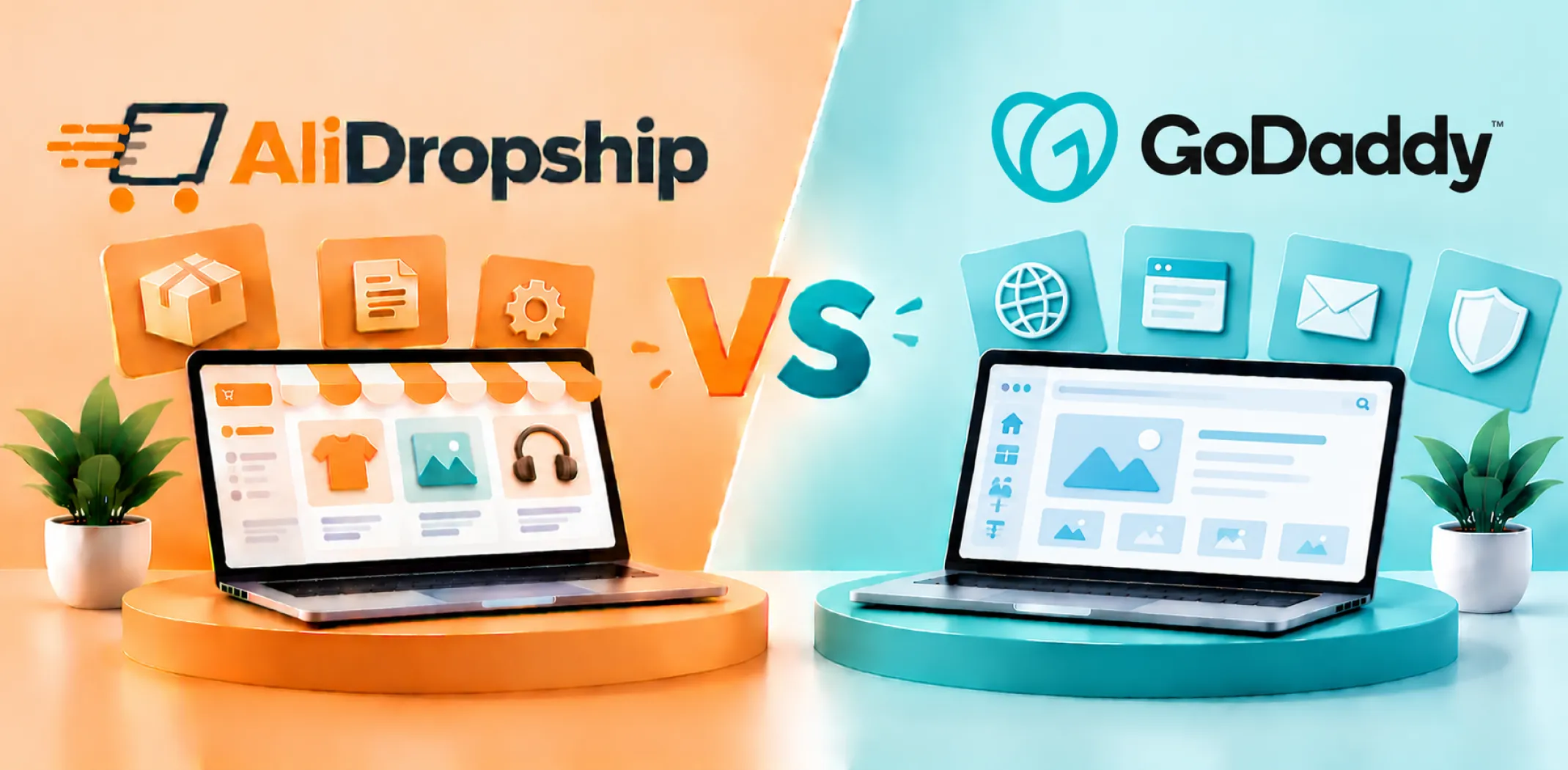
AliDropship vs GoDaddy is a comparison between a store that arrives stocked and a site builder from a domain company that expects you to bring the products.
In 2026, GoDaddy is one of the best-known domain registrars and web hosts, with a website builder and a Commerce plan, while AliDropship hands you a ready-made store with digital products already loaded. Which one fits you depends on one practical question: do you already have products of your own to sell?
As of October 2026, GoDaddy Commerce costs $20.99 per month on a one-year term, and AliDropship charges $39 per month after a 14-day free trial. GoDaddy is cheaper on that line, so this guide is upfront about when that holds, and it compares both on cost, features, user feedback, and fit.
- GoDaddy was founded in 1997, is based in Tempe, Arizona, is listed on the NYSE as GDDY, and is best known as a domain registrar and web host.
- GoDaddy Websites + Marketing Commerce costs $20.99 per month on a one-year term ($34.99 month to month) and adds unlimited products, a 0% online store transaction fee, and card processing at 2.7% + 30¢.
- GoDaddy promotes discounts of up to 53% on annual Commerce plans, so renewal prices and add-ons such as professional email are worth checking before checkout.
- AliDropship costs $39 per month after a 14-day free trial and includes a built store, a digital product catalog, and a built-in ad system.
- Year-one plan cost is $468 for AliDropship and about $252 for GoDaddy Commerce on an annual term, but GoDaddy does not supply products.
Below you will find a side-by-side table, a year-one cost breakdown, and a short guide to which platform suits which kind of seller. If you only want the short version, jump to the buyer profiles near the end of the article. The goal is to help you pick the platform that matches the work you actually want to do yourself, not to declare a universal winner.
What is GoDaddy and how does it work?
In 2026, GoDaddy is best known as a domain registrar and web host. Bob Parsons founded it in 1997 under the name Jomax Technologies, it is headquartered in Tempe, Arizona, and it trades on the NYSE under the ticker GDDY. Aman Bhutani has been CEO since 2019, and the company serves about 20 million customers, most of them small and micro businesses.
GoDaddy sells a website builder called Websites + Marketing, with Basic, Premium, and Commerce plans. Its Airo AI assistant can draft a site or store from a few prompts, and the Commerce plan lets you sell physical and digital products online and in person, though GoDaddy notes that Commerce is available in certain regions only. Payments run through GoDaddy Payments.
GoDaddy prices its products across separate lines for domains, hosting, website building, email, and security. For someone starting a store, that means the plan price is only part of the bill, and the store itself is a site builder with commerce added, not a store that arrives ready to sell.
Where does GoDaddy win over AliDropship?
As of October 2026, GoDaddy holds clear advantages for the right seller, and they are worth stating plainly. The first is price. GoDaddy Commerce costs $20.99 per month on a one-year term, well below the $39 per month AliDropship charges, and it includes unlimited products and a 0% online store transaction fee. AliDropship, with a 14-day free trial followed by $39 per month, cannot match that on plan price alone.
The second is the all-in-one bundle. Domain, hosting, email, and a site builder sit in one account, the AI assistant can draft a first version of your site, and Commerce includes email marketing with up to 100,000 sends per month. For a seller who already owns a domain with GoDaddy, keeping everything in one place is a real convenience.
A third advantage is selling beyond the website. GoDaddy offers point-of-sale hardware and payments for counter sales, social selling, and marketplace integrations with inventory sync, and you can list any product you make or source. On AliDropship, every product comes from the AliDropship catalog, so you cannot add your own brand or inventory. Founders with an existing product line will find that restriction limiting.
The flip side is that GoDaddy assumes you will build the store and supply the products. The AI assistant drafts a site, but you still add products, photos, and prices, and one Capterra reviewer describes the sites as fairly basic.
Pricing is promotional: GoDaddy advertises annual discounts of up to 53% on Commerce, one 2026 review says builder renewal pricing is not published, and reviewers report add-ons such as professional email appearing at checkout. GoDaddy Commerce also does not supply products or tell you what to sell.
How does AliDropship compare to GoDaddy?
In 2026, the clearest difference between the two is who supplies the products and the promotion. With GoDaddy you choose a plan, build the site with AI help, create or source your products, and bring your own customers. With AliDropship, the store arrives built and stocked from a digital product catalog, and an ad system is included, so setup mostly comes down to signing up and choosing a daily budget.
AliDropship is a B2C platform founded in 2015 by Yaroslav Nevsky and Ilya Dolgikh and based in Irvine, California. It positions itself as an ecommerce platform for people just starting an online business, with no experience or technical skills required, and it reports more than 1,500,000 stores launched. GoDaddy is the much larger company by customer count, built around domains and hosting first.
Read the table as a map of trade-offs rather than a scorecard. GoDaddy gives you a lower entry price, in-person selling tools, and freedom over what you sell. AliDropship gives you more done-for-you pieces, which matters most when the biggest obstacle is not knowing where to start. If your blocker is budget or selling in person, GoDaddy wins. If your blocker is not having products, a store design, or hands-off ads, AliDropship does.
Which is cheaper in year one, AliDropship or GoDaddy?
Based on pricing checked in October 2026, AliDropship is simple to price: $39 per month adds up to $468 over 12 months, and that includes the store, the product catalog, and the ad system. GoDaddy Commerce costs $20.99 per month on a one-year term ($251.88 per year), or $34.99 per month if paid month to month ($419.88 per year).
Those figures cover plans only, so they hide the costs that usually decide the winner. GoDaddy lists a 0% online store transaction fee but charges 2.7% + 30¢ for card processing, and domain renewals, professional email, and security are separate.
Vendr data suggests a typical small business using GoDaddy for domain, hosting, email, and SSL pays roughly $500 to $2,000 a year at introductory rates, and the total often rises at renewal. On AliDropship, order processing fees apply when you make sales, and ads cost between $10 and $50 per day once you switch them on, with a $40 ad coupon included in the trial.
The fairest summary is this. GoDaddy Commerce is cheaper than AliDropship by roughly $216 a year on plan price with an annual term, and that is a real advantage if you already have products and customers.
The gap shrinks once you add a domain, email, and renewal increases, and you still have to supply products and promotion. AliDropship works out cheaper in practice for a seller who would otherwise create products and pay for ads separately.
What do real users say about GoDaddy and AliDropship?
Based on 2026 review data, GoDaddy earns solid marks from the small sellers it targets. GoDaddy Website Builder holds 4.2 out of 5 on Capterra, based on about 1,380 reviews, with ease of use at 4.2, customer service at 4.2, and value for money at 4.1, and roughly 79 percent of reviews are positive. Reviewers praise templates, fast setup, and low cost compared with hiring a designer.
The recurring criticisms are basic-looking sites, a learning curve, and pricing surprises at renewal or from add-ons. AliDropship lists a 4.7★ average rating on Trustpilot. The two ratings come from different review sites, volumes, and kinds of customers, so treat the gap as a data point rather than a verdict.
Reviews of either platform are most useful when they come from sellers whose starting point resembles yours, which is why the examples below are built around two typical situations.
Both examples point to the same conclusion: neither platform is better in the abstract. The shop owner needed domain, site, and payments for products she already had, and the first-time seller needed a ready store more than a site builder. Matching the tool to your starting point matters more than any feature list, and that is the logic behind the buyer profiles in the next section.
Which platform is right for you?
In 2026, the simplest way to choose is to match each platform to a seller profile. The four profiles below cover the most common situations behind the AliDropship vs GoDaddy search, and each one names the platform that fits it best, including the two where GoDaddy comes out ahead.
Best for local shops with their own products
GoDaddy suits shops and small brands that sell online and in person. You get a site, payments, and email in one account, and Commerce covers unlimited products. Card processing runs through GoDaddy Payments.
Best for first-time online sellers
AliDropship fits beginners with no products and no technical skills. The store arrives built, the digital catalog is loaded, and the ad system is included, so setup stays short. It is built for online selling only.
Best for low-budget stores with products
GoDaddy is the better pick if you already have products and want the lowest monthly plan price. Commerce starts at $20.99 per month on a one-year term. AliDropship cannot match that freedom because its products come from its own catalog.
Best for hands-off promotion
AliDropship includes a built-in ad system where you pick a daily budget and the platform handles the setup behind the scenes. That suits sellers who do not want to learn ad tools. GoDaddy gives you tools, but you run the campaigns.
If you are still unsure, ask one question: do you already have something to sell? A yes points to GoDaddy, and a no points toward a platform that supplies the store, the products, and the promotion. Starting small is reasonable either way, since AliDropship offers a 14-day trial and GoDaddy offers plans billed monthly with no long commitment.
What factors should you weigh before choosing?
As of 2026, five factors do most of the work in this decision. They apply whichever platform you lean toward, and they are worth checking against your own situation before you pay for anything.
Do you already have products to sell?
GoDaddy lists products you make or source, and AliDropship supplies digital products from its own catalog. If you start with 0 products, a GoDaddy store has nothing to sell until you create them, and that effort can outweigh any difference in monthly fees.
Do you also sell in person?
GoDaddy offers point-of-sale hardware and payments for counter sales alongside the online store. AliDropship is built for online selling only, so a seller with 1 physical location has a clear reason to lean toward GoDaddy.
How will you reach buyers?
GoDaddy includes email marketing, with up to 100,000 sends a month on Commerce, and tools for Meta and Google ads that you manage. AliDropship includes an ad system you can start at $10 per day, though no platform replaces a plan for reaching buyers.
What happens at renewal?
GoDaddy advertises annual-plan discounts of up to 53%, and one 2026 review says website builder renewal pricing is not published. Check the renewal price and any add-ons in your cart before you commit. AliDropship lists $39 per month after the trial.
What will year one really cost?
Add plan fees, domain, email, payment processing, products, and promotion before comparing. GoDaddy Commerce costs about $252 on a one-year term against $468 for AliDropship, and processing fees apply on both.
None of these factors is a dealbreaker on its own, and most sellers will find that two or three of them dominate their decision. A seller with existing products, a physical location, and local customers will usually land on GoDaddy. A seller starting from nothing, with no products and no marketing experience, will usually find that handing those pieces to a platform saves the most time in the first weeks.
What is AliDropship and why does it work for beginners in 2026?
No experience? No problem. If you want the simplest way to start an online business in 2026, AliDropship is one of the most beginner-friendly platforms out there. It brings your store, your products, your fulfillment, and your marketing together in one place, so you can launch fast and grow with confidence.
Over 1,500,000 stores have already been built on AliDropship, and the platform has been featured by Forbes, Entrepreneur, Inc., NBC, Business, and Fox News.
Before you decide, keep one limit in mind: AliDropship sells products from its own catalog, so it is a poor fit if your plan is to build a brand around items you make or source yourself. For everyone starting from scratch, the practical test is whether the trial gives you enough information to decide. Fourteen days is short, so plan to pick products and switch on ads early in the trial.
GoDaddy and AliDropship solve different problems, and the honest answer to AliDropship vs GoDaddy is that the right pick depends on your starting point. A shop owner with products, a storefront, and local customers has little reason to leave GoDaddy.
Someone with no store, no products, and no marketing plan has a clearer path with a platform that supplies the store, the products, and the ads. Whichever way you lean, test the setup before paying for a full year.
Starting an online business takes real effort, and no platform removes that, so set your expectations accordingly. Results depend on the products you choose, the time you put in, and how well you reach buyers. Use the free trial and the monthly options on both sides to compare the experience directly, then commit to the one that matches the work you actually want to do yourself.
How does AliDropship compare to GoDaddy?
Which is cheaper, AliDropship or GoDaddy?
Is AliDropship better than GoDaddy for beginners?
What does GoDaddy do better than AliDropship?
Can I switch from GoDaddy to AliDropship?