AliDropship VS Blogging: Which Route Fits Beginners?

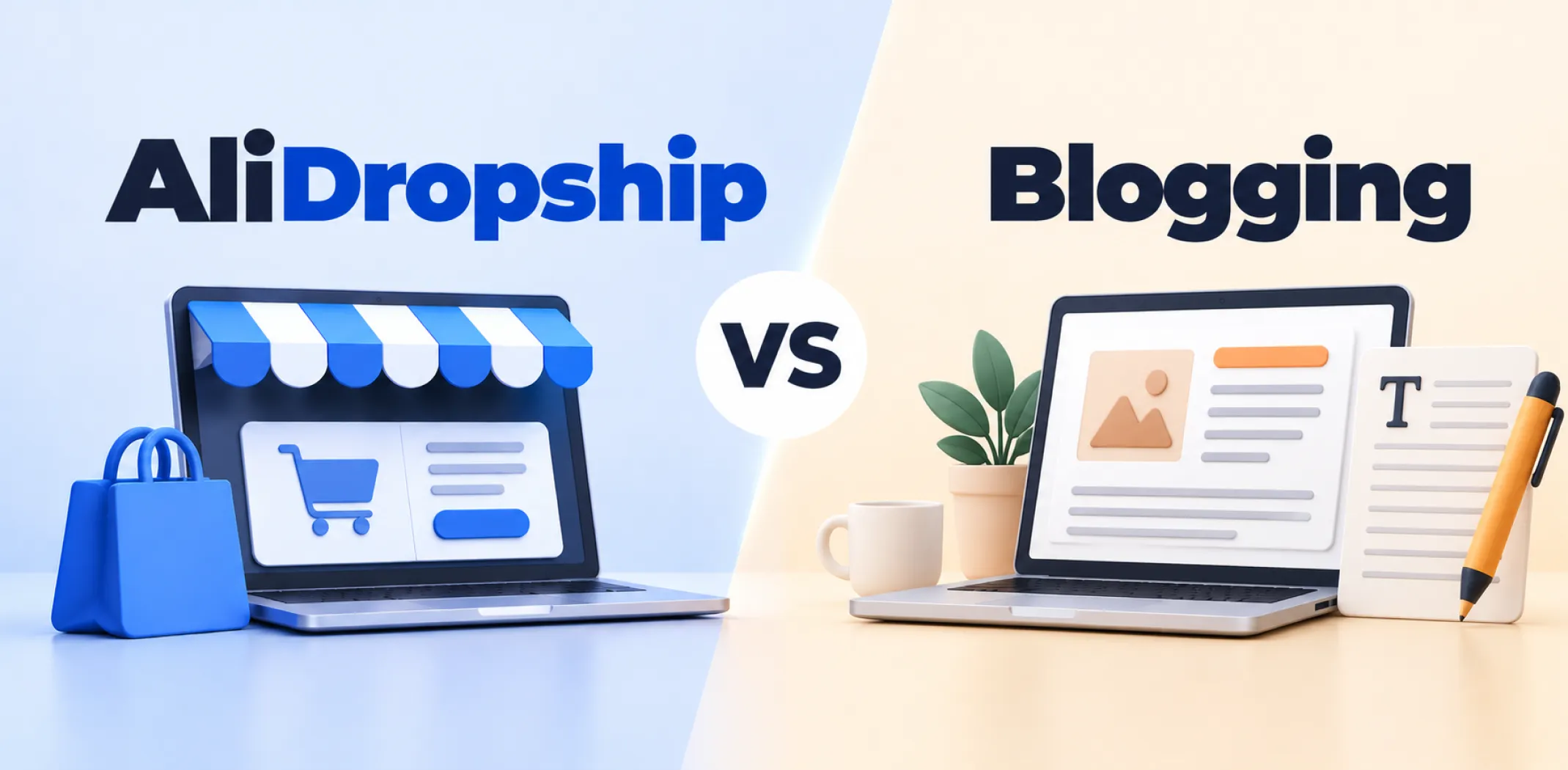
AliDropship vs blogging compares two ways to build an online business: opening a ready-made store that sells products, or publishing a content site that earns from traffic. A blog or SEO content site earns through display ads, affiliate links, sponsored posts, or products of its own, once search or social traffic arrives. Both can start cheaply, but they ask for very different amounts of time before the first dollar.
In 2026, the gap shows up in time. Ahrefs found that only 1.74% of newly published pages reached the top 10 in Google within a year, and Raptive, a large ad network, asks for 25,000 monthly pageviews before it places ads. AliDropship costs $39 a month after a 14-day free trial and starts with a store that is already built. This comparison covers where each route wins, what a first year costs, and which one fits you.
Key takeaways
- Blogging and content sites earn through display ads, affiliate links, sponsored posts, or your own products, and all of them depend on traffic.
- Ahrefs found that only 1.74% of newly published pages reached the top 10 within a year, and the average number-one page is about 5 years old.
- Raptive requires 25,000 monthly pageviews and a domain at least 6 months old, and it pays 75% of ad revenue to publishers.
- AliDropship costs $39 a month after a 14-day free trial and includes a ready-made store, loaded products, and a built-in ad system.
- Pew Research found people clicked a traditional result in 8% of Google visits with an AI summary, versus 15% without, so search traffic is less predictable.
The most useful way to compare them is to ask what you would be doing in your first six months. A blogger or content-site owner researches topics, writes and publishes articles, and waits for search engines to send readers. An AliDropship store owner chooses products and sets an ad budget for a store that already exists. Here is how blogging and SEO content sites work first, and then how the two compare.
What are blogging and SEO content sites and how do they work?
In 2026, a blog or SEO content site is a website that publishes articles meant to rank in search results and earn from the readers who arrive. Income usually comes from display ads served by an ad network, affiliate commissions on products you recommend, sponsored posts, or products you sell yourself.
Traffic is the gate to income. Raptive, for example, requires at least 25,000 monthly pageviews, a domain at least 6 months old, and 50% of traffic from five key English-speaking countries on sites under 100,000 pageviews, and it pays publishers 75% of ad revenue on a Net 45 schedule. Smaller sites can start with entry-level programs such as Google AdSense, which has no minimum traffic requirement.
That makes blogging a content business first and a revenue business second, so the next section looks at where it beats a ready-made store.
Where do blogging and content sites win?
In 2026, a fair comparison has to start with what content sites do better, because several of their strengths are structural and a catalog store cannot copy them.
Those strengths come with trade-offs. Most new pages do not reach page one within a year, premium ad networks set traffic minimums, and AI answers in search can reduce the clicks a ranking page receives. Pew Research found people clicked a traditional result in 8% of Google visits with an AI summary, compared with 15% without one, although Google disputes how that affects overall click volume.
How does AliDropship compare to blogging?
In 2026, AliDropship is an ecommerce platform for people just starting an online business, built so dropshipping and digital product sales work with no experience and no tech skills. You get a fully built store with products already loaded and a built-in ad system, and you pay $39 a month after a 14-day free trial. The table below shows how that compares with building a content site.
The table favors AliDropship on setup, finding customers, and the eligibility gate, but it favors content sites on cost and variety of income streams, and those rows matter. A content site is the cheaper business to hold, while an AliDropship store earns per sale from a catalog you do not control. The next section adds the time cost that neither price shows.
Year-1 cost breakdown: Which is actually cheaper?
As of 2026, the cost side of AliDropship vs blogging comes down to money versus time. A self-hosted WordPress blog typically costs $50 to $300 a year for a domain and hosting, while AliDropship costs $39 a month after the free trial, or $468 over 12 months.
Money is only part of the picture. A content site pays its real cost in hours: the average number-one result is about 5 years old, and ad networks such as Raptive want 25,000 monthly pageviews before they place ads. AliDropship ads run $10 to $50 a day if you choose to use them, with a $40 coupon during the trial, and store sales still depend on products and testing.
What do real users say about content sites and AliDropship?
Based on 2026 search data, content sites reward months of consistent publishing, while AliDropship is positioned for first-time store owners. The two composite examples below, one per route, reflect those patterns rather than any one real customer.
Which path is right for you?
Based on 2026 data, AliDropship vs blogging comes down to your starting point rather than the entry fee. If you enjoy writing and can publish for a year or more, a content site is worth the wait, and if you want a store running before any search traffic exists, a ready-made store has fewer moving parts.
Best for patient writers
If you enjoy researching and writing about a topic, a content site rewards that habit with ads, affiliate links, and sponsorships. The site costs little to run, and the articles are yours. Expect months of publishing before traffic and ad approvals arrive.
Best for beginners without time to wait
If you want a business running before search traffic exists, a ready-made store has fewer moving parts. AliDropship builds the store, loads products, and includes one-click ads, so you spend your time on choices instead of content.
Best if you prefer selling products
If selling products appeals more than writing articles, a catalog store matches that preference. Digital products deliver instantly, and physical items ship directly from suppliers, so you never handle a box.
Best for people with an audience
If you already have readers, an email list, or a social following, a content site can turn that attention into ad and affiliate income sooner. Without one, traffic starts from zero.
None of these profiles says one route is better in general. Each depends on what you already have: readers, comfort writing, and how long you can wait before income starts. If the beginner profiles sound like you, the next option is aimed at you.
What factors should you consider before choosing?
As of 2026, five factors decide AliDropship vs blogging for your situation, and each one can be checked before you spend anything.
How much time you can wait
Content sites rank slowly: only 1.74% of newly published pages reached the top 10 within a year in an Ahrefs sample. A store can open the day you sign up, though sales still depend on products and testing.
Whether you enjoy writing
A content site depends on publishing useful articles week after week. AliDropship stores sell from a catalog, so no article writing is required. Pick the work you can keep doing.
Cash you can commit
A self-hosted blog typically costs $50 to $300 a year, while AliDropship costs $39 a month after a 14-day trial, plus optional ads at $10 to $50 a day. Compare the cash you can spare with the months you can wait.
How reliable search traffic is
Pew Research found 8% of Google visits with an AI summary led to a click on a traditional result, versus 15% without one. Paid ads on an AliDropship store do not depend on rankings, though they cost money.
How much you depend on the platform
A content site depends on search engines and ad networks, whose rules and minimums change often. AliDropship owners sell from its catalog and cannot add products of their own. Read the terms of either option.
If you are still undecided, run a small test of each. A new blog can publish a handful of articles for the cost of a domain and hosting, and AliDropship offers a 14-day free trial that is long enough to look at a ready-made store. Count the hours each test takes, because time is the cost that neither price tag shows.
Whichever route you choose, price the full first year, not just the entry fee. Add platform cost, ad spend or writers, and the months it takes to reach your first customers or ad approval. A realistic timeline protects you better than a low headline price.
AliDropship and content sites are not direct substitutes, so the better question is which problem you want to solve first. The next section explains where AliDropship fits for readers starting from zero.
What is AliDropship, and who is it built for in 2026?
No experience? No problem. If you want the simplest way to start an online business in 2026, AliDropship is one of the most beginner-friendly platforms out there. It brings your store, your products, your fulfillment, and your marketing together in one place, so you can launch fast and grow with confidence.
Over 1,500,000 stores have already been built on AliDropship, and the platform has been featured by Forbes, Entrepreneur, Inc., NBC, Business, and Fox News.
AliDropship does not require rankings or articles. It gives beginners a ready-made store with products loaded, so you sell from a catalog instead of building a content site first. It also has limits worth stating plainly: you sell from its catalog and cannot add your own products, ads cost money once the free coupon is used, and results depend on the time and effort you put in.
Starting any online business takes time and effort, and neither route removes the work of finding customers. The 14-day trial lets you look around before the monthly fee starts, and you can cancel anytime. If a store is the route you want to test, you can do it without waiting on search rankings and without a large fixed fee.
Back to the question behind this comparison: AliDropship vs blogging. A content site is the stronger fit if you enjoy writing, can publish for a year or more, and want assets you own, while AliDropship is the faster-to-launch fit if you are starting from zero and prefer selling a ready-made catalog. Neither removes the work of finding customers, so choose the work you are more willing to do.
Whichever you choose, test before you commit: use the free trial, count your hours, and check current requirements on each platform, since ad network minimums, search results, and store plans change often. Readers who want a ready-made store to look at can start with the free store below and decide during the 14-day trial.
How does AliDropship compare to blogging and SEO content sites?
Which is cheaper, AliDropship or a blog?
Is AliDropship better than blogging for beginners?
What do blogging and content sites do better than AliDropship?
Can I switch from blogging to AliDropship?