AliDropship VS Big Cartel: Features, Cost, And Who Wins

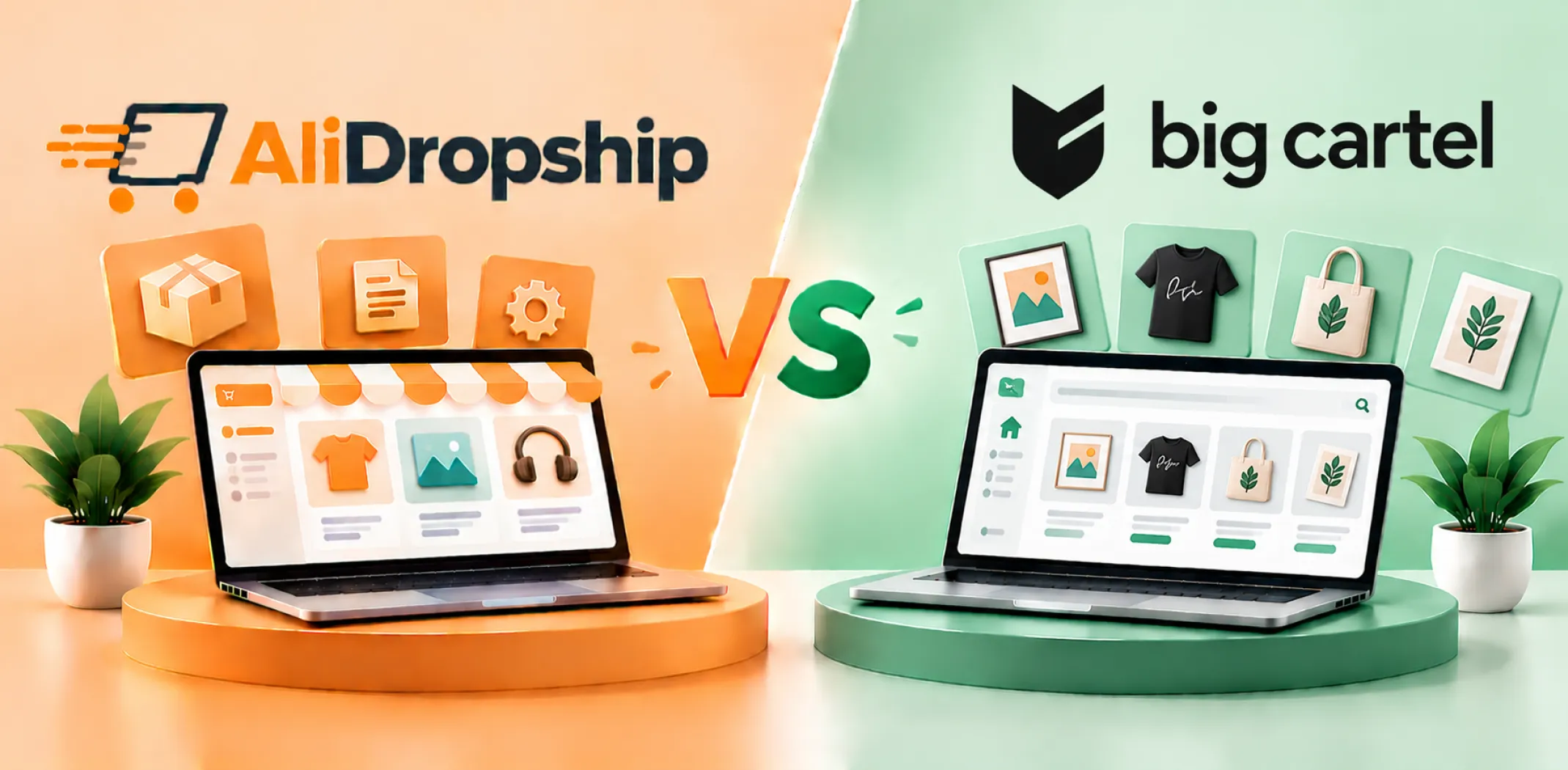
AliDropship vs Big Cartel is a comparison between a store that arrives stocked and a storefront for products you already have. In 2026, Big Cartel is a simple, low-cost platform built for artists and makers, while AliDropship hands you a ready-made store with digital products already loaded. Which one fits you depends on one practical question: do you already have something to sell?
As of October 2026, Big Cartel offers a free plan and paid plans at $15 and $30 per month, and AliDropship charges $39 per month after a 14-day free trial. Big Cartel is the cheaper of the two on plan fees, so this guide is upfront about when that matters, and it compares both on cost, features, user feedback, and fit.
- Big Cartel launched in 2005 in Salt Lake City and is built for artists, makers, and small brands selling their own products.
- Big Cartel plans cost $0 (Gold), $15 (Platinum), and $30 (Diamond) per month, with 20 percent off for annual billing on paid plans, and they cap products at 5, 50, and 500.
- Big Cartel says it never takes a cut of your sales, so you pay only your payment processor, typically 2.9% + 30¢ per US card payment through Stripe.
- AliDropship costs $39 per month after a 14-day free trial and includes a built store, a digital product catalog, and a built-in ad system.
- Year-one plan cost is $468 for AliDropship and $0 to $288 for Big Cartel, but Big Cartel does not supply products or promotion.
Below you will find a side-by-side table, a year-one cost breakdown, and a short guide to which platform suits which kind of seller. If you only want the short version, jump to the buyer profiles near the end of the article. The goal is to help you pick the platform that matches the work you actually want to do yourself, not to declare a universal winner.
What is Big Cartel and how does it work?
In 2026, Big Cartel is best known as a simple online store builder for artists, makers, and small brands. Matt Wigham, a musician and web developer, and Eric Turner launched it in Salt Lake City in 2005, and Wigham originally wanted a way to sell his own band merchandise online. The company is still based in Salt Lake City.
Big Cartel is a hosted service, so you sign up, pick a theme, add your products, and connect Stripe or PayPal to take payments. Plans are tiered by how many products you list: Gold is free, Platinum costs $15 per month, and Diamond costs $30 per month, with 20 percent off for annual billing on the two paid plans. Paid plans also include built-in digital product delivery, so you can sell downloadable files without a separate app.
Big Cartel says it never takes a cut of your sales on any plan. You pay your payment processor separately, typically 2.9% + 30¢ per US card payment through Stripe. That keeps the pricing predictable, but it also means Big Cartel is a place to sell products you already have. It gives you a storefront, not products or promotion.
Where does Big Cartel win over AliDropship?
As of October 2026, Big Cartel holds clear advantages for the right seller, and they are worth stating plainly. The first is price. Gold is free, and the paid plans cost $15 or $30 per month, or $12 and $24 per month when billed annually, well below the $39 per month AliDropship charges.
A seller with a handful of products can run a store for $0 to $144 a year in plan fees, and AliDropship, with a 14-day free trial followed by $39 per month, cannot match that.
Big Cartel also wins on freedom and simplicity for creators. You list your own artwork, merchandise, prints, or digital downloads, set your own prices, and keep your brand front and center, and paid plans include a theme code editor for HTML, CSS, and Liquid.
Because Big Cartel takes no commission, your per-sale costs are limited to payment processing. On AliDropship, every product comes from the AliDropship catalog, so you cannot add your own brand or inventory. Founders with an existing product line will find that restriction limiting.
A third advantage is focus. Big Cartel is built around independent artists, musicians, and makers, and its tools are deliberately uncluttered: product pages, orders, and basic promotion. Many sellers value that simplicity, and 2026 reviews describe it as one of the easier platforms to learn, with a clean dashboard and straightforward product management.
The flip side is that Big Cartel assumes you already have products and an audience. Plans are capped by product count, with 5 products on Gold, 50 on Platinum, and 500 on Diamond, so a growing catalog pushes you up a tier or off the platform.
Reviews in 2026 also describe the free plan as limited, with one photo per product and no custom domain, and some roundups call the platform too limited for ambitious merchants. It does not supply products, run ads for you, or tell you what to sell, so a first-time seller with nothing to list still has most of the work ahead.
How does AliDropship compare to Big Cartel?
In 2026, the clearest difference between the two is who supplies the products and the promotion. With Big Cartel you choose a plan, pick a theme, create or source your products, photograph them, and find your own customers. With AliDropship, the store arrives built and stocked from a digital product catalog, and an ad system is included, so setup mostly comes down to signing up and choosing a daily budget.
AliDropship is a B2C platform founded in 2015 by Yaroslav Nevsky and Ilya Dolgikh and based in Irvine, California. It positions itself as an ecommerce platform for people just starting an online business, with no experience or technical skills required, and it reports more than 1,500,000 stores launched. Big Cartel is the older and simpler tool, built for creators who sell their own work.
Read the table as a map of trade-offs rather than a scorecard. Big Cartel gives you a lower entry price, a permanent free plan, and full freedom over what you sell. AliDropship gives you more done-for-you pieces, which matters most when the biggest obstacle is not knowing where to start. If your blocker is budget or product freedom, Big Cartel wins. If your blocker is not having products, a store design, or ads, AliDropship does.
Which is cheaper in year one, AliDropship or Big Cartel?
Based on pricing checked in October 2026, AliDropship is simple to price: $39 per month adds up to $468 over 12 months, and that includes the store, the product catalog, and the ad system. Big Cartel is cheaper on plan fees at every tier. Gold costs $0, Platinum costs $15 per month ($144 per year on annual billing), and Diamond costs $30 per month ($288 per year on annual billing).
Those figures cover plans only, so they hide the costs that usually decide the winner. On Big Cartel, you pay your payment processor separately, typically 2.9% + 30¢ per US card payment through Stripe, and you still need products, photos, and a way to find customers. A custom domain requires a paid plan.
On AliDropship, order processing fees apply when you make sales, and ads cost between $10 and $50 per day once you switch them on, with a $40 ad coupon included in the trial.
The fairest summary is this. Big Cartel is cheaper on plan fees, often by hundreds of dollars a year, if you already have products and can bring your own customers, and that is a real advantage. AliDropship works out cheaper in practice only if you would otherwise pay separately for products and promotion, because those pieces arrive in the $39 plan. If you have no products to list, even a free Big Cartel store has nothing to sell.
What do real users say about Big Cartel and AliDropship?
Based on 2026 review data, Big Cartel earns good marks from the small sellers it targets. A September 2026 review roundup puts it at 4.2 out of 5 on both G2 and Capterra and 4.7 out of 5 on Trustpilot. Reviewers praise the simple dashboard, the free plan, and the lack of platform fees. Criticism centers on product limits, a limited free plan, and a ceiling on how far the platform can grow with an ambitious business.
AliDropship also lists a 4.7★ average rating on Trustpilot, so the star rating alone does not separate the two. What separates them is the starting point: Big Cartel reviewers are mostly sellers who already had something to sell. Treat any rating as a data point rather than a verdict, and look for reviews from sellers whose situation resembles yours, which is why the examples below are built around two typical situations.
Both examples point to the same conclusion: neither platform is better in the abstract. The illustrator needed a simple, low-cost home for work she had already made, and the first-time seller needed a ready store more than a blank storefront. Matching the tool to your starting point matters more than any feature list, and that is the logic behind the buyer profiles in the next section.
Which platform is right for you?
In 2026, the simplest way to choose is to match each platform to a seller profile. The four profiles below cover the most common situations behind the AliDropship vs Big Cartel search, and each one names the platform that fits it best, including the two where Big Cartel comes out ahead.
Best for artists with their own work
Big Cartel suits artists, musicians, and makers who already have products to list. You control the products, prices, and branding, plans start at $0, and there is no platform commission on sales.
Best for first-time online sellers
AliDropship fits beginners with no products and no technical skills. The store arrives built, the digital catalog is loaded, and the ad system is included, so setup stays short. It is built for online selling only.
Best for small catalogs and low budgets
Big Cartel is the better pick if you sell a small catalog and want the lowest monthly cost. Gold is free, and Platinum and Diamond cap at 50 and 500 products. AliDropship costs more per month because the catalog and ads are included.
Best for hands-off promotion
AliDropship includes a built-in ad system where you pick a daily budget and the platform handles the setup behind the scenes. That suits sellers who do not want to learn ad tools. Big Cartel does not include an ad system.
If you are still unsure, ask one question: do you already have something to sell? A yes points to Big Cartel, and a no points toward a platform that supplies the store, the products, and the promotion. Starting small is reasonable either way, since Big Cartel has a free plan and AliDropship offers a 14-day trial before you commit to a paid plan.
What factors should you weigh before choosing?
As of 2026, five factors do most of the work in this decision. They apply whichever platform you lean toward, and they are worth checking against your own situation before you pay for anything.
Do you already have products to sell?
Big Cartel lists products you make or source, and AliDropship supplies digital products from its own catalog. If you start with 0 products, a Big Cartel store has nothing to sell until you create them, and that effort can outweigh any difference in monthly fees.
How big will your catalog get?
Big Cartel caps plans at 5, 50, or 500 products, so catalog size drives your tier. AliDropship stores arrive stocked from its digital catalog. A shop with 60 products needs Diamond on Big Cartel at $30 per month.
How will you reach buyers?
Big Cartel does not include an ad system, and Diamond adds abandoned cart recovery and Zapier. AliDropship includes ads you can start at $10 per day, though no platform replaces a plan for reaching buyers.
How much design control do you want?
Paid Big Cartel plans include a theme code editor for HTML, CSS, and Liquid, which suits sellers who want to restyle their shop. AliDropship stores arrive designed and ready, so you edit less and launch faster.
What will year one really cost?
Add plan fees, payment processing, products, and promotion before comparing. Plan fees run $0 to $288 on Big Cartel with annual billing, against $468 for AliDropship, and processing fees apply on both.
None of these factors is a dealbreaker on its own, and most sellers will find that two or three of them dominate their decision. A seller with existing products, a small catalog, and an audience will usually land on Big Cartel. A seller starting from nothing, with no products and no marketing experience, will usually find that handing those pieces to a platform saves the most time in the first weeks.
What is AliDropship and why does it work for beginners in 2026?
No experience? No problem. If you want the simplest way to start an online business in 2026, AliDropship is one of the most beginner-friendly platforms out there. It brings your store, your products, your fulfillment, and your marketing together in one place, so you can launch fast and grow with confidence.
Over 1,500,000 stores have already been built on AliDropship, and the platform has been featured by Forbes, Entrepreneur, Inc., NBC, Business, and Fox News.
Before you decide, keep one limit in mind: AliDropship sells products from its own catalog, so it is a poor fit if your plan is to build a brand around items you make or source yourself. For everyone starting from scratch, the practical test is whether the trial gives you enough information to decide. Fourteen days is short, so plan to pick products and switch on ads early in the trial.
Big Cartel and AliDropship solve different problems, and the honest answer to AliDropship vs Big Cartel is that the right pick depends on your starting point. An artist with finished work and a loyal following has little reason to leave Big Cartel.
Someone with no store, no products, and no marketing plan has a clearer path with a platform that supplies the store, the products, and the ads. Whichever way you lean, test the setup before paying for a full year.
Starting an online business takes real effort, and no platform removes that, so set your expectations accordingly. Results depend on the products you choose, the time you put in, and how well you reach buyers. Use the free options on both sides to compare the experience directly, then commit to the one that matches the work you actually want to do yourself.
How does AliDropship compare to Big Cartel?
Which is cheaper, AliDropship or Big Cartel?
Is AliDropship better than Big Cartel for beginners?
What does Big Cartel do better than AliDropship?
Can I switch from Big Cartel to AliDropship?