AI Dropshipping In Ireland: Start And Get Paid In 2026

Yes, you can run an AI-powered dropshipping business from Ireland. PayPal is the payout provider that actually works here, with full support for receiving payments and withdrawing straight to an Irish bank account. Once your 14-day free trial ends, the real startup cost is close to €34 a month, the euro equivalent of the platform’s subscription, since domain, hosting, and your first batch of ad spend are already covered.
The harder question is not whether you can start, but how much of each sale the euro conversion actually leaves you with, and when Revenue expects you to register once you do.
Most guides to running an online business from Ireland are written around physical products: warehouses, An Post shipping rates, and customs paperwork for goods crossing the border. None of that applies here, since nothing physical ever touches Ireland.
Because the products are digital and delivery is instant, the real questions are narrower than usual: can you actually get paid, can you fund the ad accounts that bring in customers, and what does Revenue expect from you once sales start coming in.
Who your customers will be
Selling digital products means your customers are wherever your ads run, typically the United States, the United Kingdom, Canada, and Australia, not necessarily Ireland. Ireland’s own market size, payment habits, and ecommerce maturity do not limit this business.
For an Ireland-based seller specifically, this is the cleanest version of that overlap anywhere in this series. Ireland sits in the exact same timezone as the UK year round, not just close to it the way France, Switzerland, the Netherlands, and Sweden do, and it is roughly five hours ahead of the US East Coast.
English is the language you already work in, so there is no proficiency ranking to cite and nothing for the AI to compensate for on your behalf, unlike every other page in this series so far. The AI still writes the ad copy and product descriptions your customers see, but here that is a convenience rather than a language bridge.
Can you run AI dropshipping from Ireland?
Every part of the gate clears cleanly for Ireland, which is not true of every country in this series: payouts, ad funding, and business registration all work without the workarounds some markets need. Here is where things stand:
For other markets with an equally clean gate, see how the same numbers play out in the UK, the other English-speaking market with this same timezone overlap, and Germany, which shares the same EU-wide VAT threshold now that Ireland is on this list.
How you get paid in Ireland
PayPal is the payout provider that actually works here, and it works well. Ireland is one of the countries where PayPal offers full local integration: you can receive payments, withdraw directly to an Irish bank account, and use PayPal Business tools without the workarounds some countries in this series require. Withdrawals typically land within one business day.
The part that costs you money is the currency conversion, not the payout itself. If your AliDropship store runs in US dollars, which is standard, you receive each sale in dollars, and PayPal charges its standard cross-border commercial fee, roughly 4.5 percent plus a small fixed fee, before the euro conversion even comes into play.
Converting that balance to euros for an Irish bank withdrawal adds PayPal’s own conversion spread on top, typically around 4 percent above the mid-market rate. On a $39 digital product sale at a 60% margin, a seller in Ireland receives approximately €19 after payout and conversion fees, based on a rate of about €1 to $1.14.
Routing that same conversion through Wise instead of PayPal, at a spread closer to 0.5 percent, keeps a meaningfully larger share of each sale, since the receiving fee is unavoidable but the conversion spread is not.
There are no capital controls or withdrawal limits on this kind of income in Ireland, and you do not need a dedicated business bank account to receive PayPal withdrawals right away, though most Irish banks expect one fairly quickly once you register as self-employed, and it makes preparing your annual Form 11 return considerably easier.
How AI dropshipping works
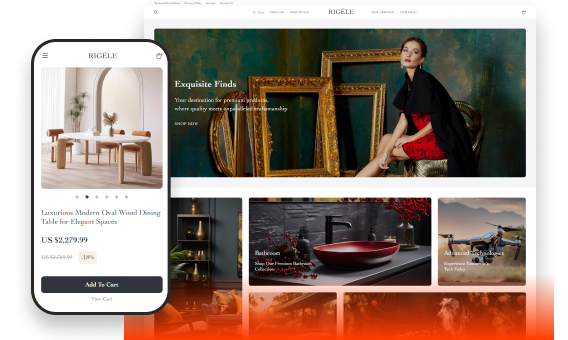
The mechanics are the same wherever you are based. AI configures your store and stocks it automatically from AliDropship’s catalog of digital products, guides, courses, checklists, and similar content suited to the US, UK, Canadian, and Australian audiences your ads will actually reach. None of that catalog fit depends on where you are selling from, so a Dublin-based seller draws from the same product set as a seller anywhere else.
AI also writes and runs your ad campaigns across Google, Instagram, TikTok, and Amazon, using your ad account regardless of which country issued it.
Since Meta, TikTok, and Google Ads all bill directly in euros from an Irish account, funding those campaigns works the same way it would from any other euro-zone market; the AI still handles the copy, creative, and ongoing optimization, which here simply means one less thing to do yourself rather than a genuine language gap being closed.
Because the products are digital, there is no shipping from Ireland, no customs, no stock, and no failed deliveries. Orders are fulfilled the moment they are placed, wherever the customer is. See how the full model works on the AI dropshipping hub page.
What it costs to start in Ireland
Here is the realistic first-month breakdown, converted at the current rate of about €1 to $1.14:
Tax and legal requirements in Ireland
This is general information, not tax advice, and Irish and EU rules can change, so confirm anything time-sensitive with an Irish accountant before you file.
Registering as a sole trader in Ireland means telling Revenue you are self-employed, using an online TR1 form through ROS or myAccount. It is free, and you are expected to do it within about 30 days of starting to trade, or once your net income passes €5,000, whichever applies to your situation.
You only need to register a separate business name with the Companies Registration Office if you trade under something other than your own name, which most sellers running a single AliDropship store will not need to do.
Income from a store like this is taxed as personal income under Ireland’s self-assessment system, filed annually on Form 11 by the end of October, or mid-November if you file and pay through ROS. The standard rate is 20 percent on the first €44,000 for a single filer and 40 percent above that, reduced by tax credits including the €2,000 Earned Income Credit available to the self-employed.
On top of income tax, you pay the Universal Social Charge on a sliding scale from 0.5 percent up to 8 percent, with self-employed income above €100,000 taxed at a combined 11 percent, plus Class S PRSI at a flat 4.1 percent.
Domestic Irish VAT only applies once your turnover passes €37,500 for a services-style activity like this one, or €75,000 for goods, and even then only on sales to Irish customers, which are not your target market here.
Because Ireland is an EU member, selling digital products to customers in other EU countries is covered by the same combined EU-wide threshold as Germany, France, the Netherlands, and Sweden: €10,000 a year across all those sales together, above which you register for the Union OSS scheme.
UK sales sit outside that system entirely and follow the nil-threshold rule that applies to every non-UK-established seller in this series: register for UK VAT from your first sale, not after some threshold. Sales to your actual core markets, the US, Canada, and Australia, trigger neither system.
For current rates, thresholds, and forms, see Revenue’s guide to registering for tax as a sole trader.
What AI does and does not solve for Ireland sellers
AI handles the parts that used to take the most time: store setup, product selection from the catalog, ad copy and creative, campaign optimization across platforms, product descriptions, and email. What it does not do is make three specific Ireland-based obligations disappear.
First, your annual Form 11 return, covering income tax, USC, and PRSI together, is yours to file, along with preliminary tax for the following year, even though nothing about the filing itself is automated by the platform.
Second, watching two separate VAT thresholds, the €10,000 EU-wide figure for other EU countries and the nil threshold for the UK, is a manual tracking job the AI does not do for you, and the UK side is easy to miss since it applies from the very first sale.
Third, PayPal and the ad platforms all run their own identity verification on an Ireland-registered account, ID document and proof of the bank account you are withdrawing to, and this can take a few days the first time even though it is only a one-time step.
None of these are logistics problems, since there is no inventory or shipping in this model at all; they are paperwork problems, and they are the real work an Ireland-based seller does once the store itself is running.
Getting started from Ireland
1. Start your free trial. Let the AI configure your store with digital products matched to US, UK, Canadian, and Australian buyers, the audiences that actually convert for this catalog.
2. Register with Revenue as self-employed. File the TR1 form through ROS within about 30 days of starting to trade, so your registration is in place well before your annual return is due.
3. Set up PayPal and watch your VAT thresholds. Verify your account with ID and Irish bank details, and register for the Union OSS and UK VAT schemes as soon as you expect sales in those markets, not after you cross the threshold.
None of these three steps takes more than an afternoon on its own, and Ireland is one of the simpler pages in this series to act on precisely because there is no language question and barely any timezone question sitting on top of the payout and tax mechanics.
Getting paid and getting compliant are mostly one-time setup tasks, not ongoing work, which leaves the AI to handle the part that actually repeats: writing, launching, and optimizing the ads that bring in customers every day your store is live.
Can I do AI dropshipping from Ireland?
How do I get paid as a dropshipper in Ireland?
Do I need to register a business in Ireland to sell digital products?
Do I pay tax on digital product sales in Ireland?
Can I sell to customers outside Ireland?


Recommended for You