Wix Vs Shopify Compared: The Full 2026 Breakdown

So you’re trying to choose between Wix and Shopify. Both platforms let you build an online store, both are beginner-friendly, and both have millions of users worldwide. But they are built for very different things – and picking the wrong one can cost you time, money, and momentum.
Quick Answer: Shopify is the stronger choice for serious ecommerce businesses that plan to scale. Wix works well for small stores, creative websites, and anyone who wants design flexibility at a lower monthly cost. The best platform for you depends on what you are actually building.
This guide breaks down the real differences between Wix and Shopify in 2026 – pricing, features, ease of use, SEO, and scalability – so you can make a clear decision and move forward.

What is the Wix vs Shopify debate really about?
On the surface, Wix and Shopify look like direct competitors. Both are hosted platforms, both require no coding to set up a store, and both charge a monthly subscription. But the similarity stops there.
Shopify launched in 2006 specifically to solve one problem: making it easy to sell products online. Every feature, every app in its marketplace, every update – all of it is focused on ecommerce. Today it powers over 5.6 million online stores globally, from solo sellers to publicly traded brands.
Wix also launched in 2006, but with a completely different goal. It was designed to let anyone build a beautiful website without coding. Ecommerce came later – Wix started seriously pushing into online selling around 2020. The platform now has more than 8.5 million live sites, most of which are business websites, portfolios, and blogs rather than dedicated stores.
That origin story matters. It shapes every tradeoff you will encounter when comparing the two platforms in 2026.
Wix vs Shopify pricing: what you actually pay
Pricing is usually the first thing people look at, and it is also the area where the gap between listed price and real cost is widest.
Wix ecommerce plans start at $29 per month (Core plan, billed annually), which gets you a basic online store. The Business plan sits at $36 per month and adds more storage, tax calculators, dropshipping support, and multi-currency. At the top end, the Business Elite plan runs $159 per month with priority support.
Shopify’s pricing starts at $29 per month for the Basic plan (billed annually). The mid-tier Shopify plan costs $79 per month, and Advanced runs $299 per month. Shopify also charges transaction fees of 2% on Basic if you do not use Shopify Payments – that adds up fast once you have real sales volume.
Here is a side-by-side look at entry-level and mid-tier costs:
At the entry level, the two platforms are priced identically. But mid-tier and above, Wix is noticeably cheaper – Shopify’s most expensive plan costs nearly double Wix’s equivalent. The difference is that Shopify’s higher tiers come with significantly more ecommerce infrastructure, reporting tools, and lower payment processing rates that often justify the extra cost for high-volume stores.
One note on listed prices: Both platforms offer promotional first-year discounts. Wix’s annual plan pricing can jump noticeably in year two once introductory rates expire, so factor that into any long-term comparison.
Ease of use: which platform is friendlier for beginners?
Both Wix and Shopify are designed for non-technical users, but they take opposite approaches to the setup experience.
Wix ease of use
Wix is built on a drag-and-drop editor that gives you pixel-level control over where every element sits on the page. You can move anything, resize anything, and customize the layout exactly as you picture it. The platform also includes an AI website builder that can generate a complete site from a short description, which makes getting started extremely fast.
The tradeoff is that this freedom comes with a catch: once you publish your store with a particular template, switching to a new one means rebuilding from scratch. Your template choice is permanent. That is a significant limitation if you want to refresh your brand down the line.
Shopify ease of use
Shopify keeps its editor and dashboard separate, which means you switch back and forth between the live preview and the backend settings as you build. New users sometimes find this approach slightly less intuitive at first. However, the separation actually becomes an advantage at scale – product management, orders, analytics, and marketing tools all live in a clean, well-organized dashboard.
Shopify also includes an AI assistant called Sidekick that can walk you through setup steps, suggest SEO settings, and answer operational questions across 20 languages. It is more ecommerce-focused than Wix’s equivalent.
Verdict on ease of use
For pure website building, Wix is the easier tool. For running an online store day-to-day, Shopify’s dashboard becomes more comfortable quickly. Beginners who want to get a basic site live fast will find Wix more forgiving. Beginners who specifically want to sell will find Shopify’s ecommerce workflow more logical once they get past the initial learning curve.
Ecommerce features: where the platforms truly separate
This is the core of the Wix vs Shopify comparison – and where the two platforms diverge most clearly.
Wix ecommerce features
Wix gives you everything you need to run a small online store: product listings, inventory management, order tracking, discount codes, abandoned cart recovery (on paid plans), and a buy-now-pay-later option. The Wix App Market has around 800 apps available, including some dropshipping integrations and marketing tools.
For a store with a modest product catalog and steady but not high-volume traffic, Wix covers the basics well. The friction appears when you start scaling – more products, more orders, more complex shipping rules, and more sales channels become harder to manage.
Shopify ecommerce features
Shopify was built exclusively for selling, and it shows. The platform supports unlimited products with advanced variant management, built-in abandoned cart recovery on all plans, multi-channel selling across Instagram, TikTok, Amazon, and eBay, and automated workflows through Shopify Flow. Its App Store has over 13,000 applications – most of them ecommerce-specific.
Shopify’s checkout is widely regarded as one of the most conversion-optimized in the industry. Stores handling thousands of orders per month, managing complex product catalogs, or selling across multiple channels will hit far fewer limitations on Shopify than on Wix.
Dropshipping support
Both platforms support dropshipping, but Shopify has a clear edge in depth and ecosystem. Shopify integrates natively with DSers (the official AliExpress app), Spocket, Zendrop, and dozens of other dropshipping suppliers. Wix’s Business plan includes dropshipping support via Modalyst, but the integration options are narrower and the automation less mature.
If dropshipping is your primary business model, Shopify gives you more room to work with.
Design and templates: creative freedom vs conversion focus
Design matters for conversions, and the two platforms take very different stances here.
Wix offers over 800 templates covering everything from restaurants and portfolios to online stores. Of those, around 156 are specifically for ecommerce. All templates are free, and Wix’s AI design tools let you generate and iterate on a site layout from a simple description. The drag-and-drop editor then lets you customize every element freely.
Shopify has around 1,050 themes available, with only 23 being free. Paid themes range from $100 to $500. However, all Shopify themes are built specifically for ecommerce conversion – they are optimized for product pages, checkout flows, and mobile performance. Unlike Wix, you can switch Shopify themes without losing your product data or store content.
For pure creative freedom, Wix wins. For themes that are purpose-built to drive sales and allow future flexibility, Shopify holds the advantage. A store that looks beautiful but converts poorly is not serving its purpose – keep that in mind when weighing design options.
SEO capabilities: which platform helps you rank?
Organic search traffic is one of the most valuable things an online store can build. Both platforms include SEO tools, but their depth differs.
Wix has invested heavily in SEO since 2020 and now offers a solid suite of tools: customizable meta titles and descriptions, canonical URLs, structured data, XML sitemaps, and a dedicated SEO Learning Hub with guided setup. For small stores targeting local or niche keywords, Wix’s SEO tools are more than adequate.
Shopify provides comparable on-page SEO controls, auto-generated sitemaps, and canonical tags. Its AI tool Shopify Magic can generate SEO keyword suggestions and meta descriptions automatically. The main SEO advantage Shopify holds is speed – Shopify stores are hosted on a fast, globally distributed infrastructure that contributes to strong Core Web Vitals scores, which are a ranking factor in Google’s algorithm.
Both platforms are SEO-capable. Wix offers slightly more guidance for beginners through its step-by-step SEO checklist. Shopify has a performance edge at scale, where page load speed across thousands of product pages becomes a meaningful ranking variable.
Wix vs Shopify for dropshipping and scalability
If you are building a business you want to grow – not just a side project – scalability should be near the top of your evaluation checklist.
Wix is well-suited for stores up to a few hundred products with moderate traffic. As catalog size increases toward 500–1,000 products, or as order volume climbs, Wix’s ecommerce infrastructure starts to show its limits. Fewer app integrations, simpler reporting, and less granular shipping and tax control mean more manual workarounds as complexity grows.
Shopify was designed to scale from the start. Its infrastructure handles millions of orders – Shopify stores processed over $235 billion in total revenue in 2023 alone. Whether you are at 10 products or 10,000, the core platform handles the load without requiring a platform migration. Over 13,000 apps mean that virtually any feature gap can be filled as your business demands it.
Why this works in 2026: Ecommerce competition is intensifying, and stores that outgrow their platform face costly, disruptive migrations. Choosing a scalable platform from the beginning avoids that problem entirely.
Pro Tip: If you are unsure about your long-term scale, start with Shopify’s Basic plan. The lower-tier price is the same as Wix’s entry plan, and you will not have to migrate later if your store takes off.
Which platform should you choose in 2026?
There is no single right answer to the Wix vs Shopify question – but there is a right answer for your specific situation. Here is how to think about it based on where you are starting from.
Complete beginners
If you want to build a website that also happens to sell a few products – an online portfolio with a small shop, a service business with a booking and product section, or a blog with a merchandise add-on – Wix is a strong, affordable choice. Its drag-and-drop editor and AI tools make it genuinely easy to get something live quickly, and the pricing is competitive at entry level.
Intermediate / part-time store owners
If ecommerce is your primary goal and you are building something you want to monetize within 60–90 days, Shopify is the better foundation. The slightly steeper initial setup is offset by a more logical selling workflow, better checkout performance, and access to a much larger ecosystem of dropshipping and marketing apps. For a store targeting $30–$80 per day in revenue within the first three months, Shopify gives you more tools to get there.
Advanced / full-time ecommerce goal
If you are planning to run a high-volume dropshipping operation, sell across multiple channels, manage a large product catalog, or eventually build a brand with serious revenue targets, Shopify is the clear choice. The platform’s infrastructure, automation tools, and reporting capabilities are simply not matched by Wix at that level of complexity. Full-time ecommerce operators consistently choose Shopify for this reason.
People who want to skip the platform debate entirely
Both Wix and Shopify require time, setup, and ongoing management. There is a third option worth knowing about: starting with a fully built, ready-to-launch dropshipping store that already has products, design, and automation in place. If your goal is income rather than platform mastery, that path is faster than either alternative.
AliDropship: your complete all-in-one solution for starting dropshipping in 2026
If you want the simplest possible way to start dropshipping – especially if you’re brand new – AliDropship remains one of the most beginner-friendly tools available in 2026. It brings together store creation, product imports, automation, and marketing into a single streamlined system designed to help you launch quickly and grow confidently.
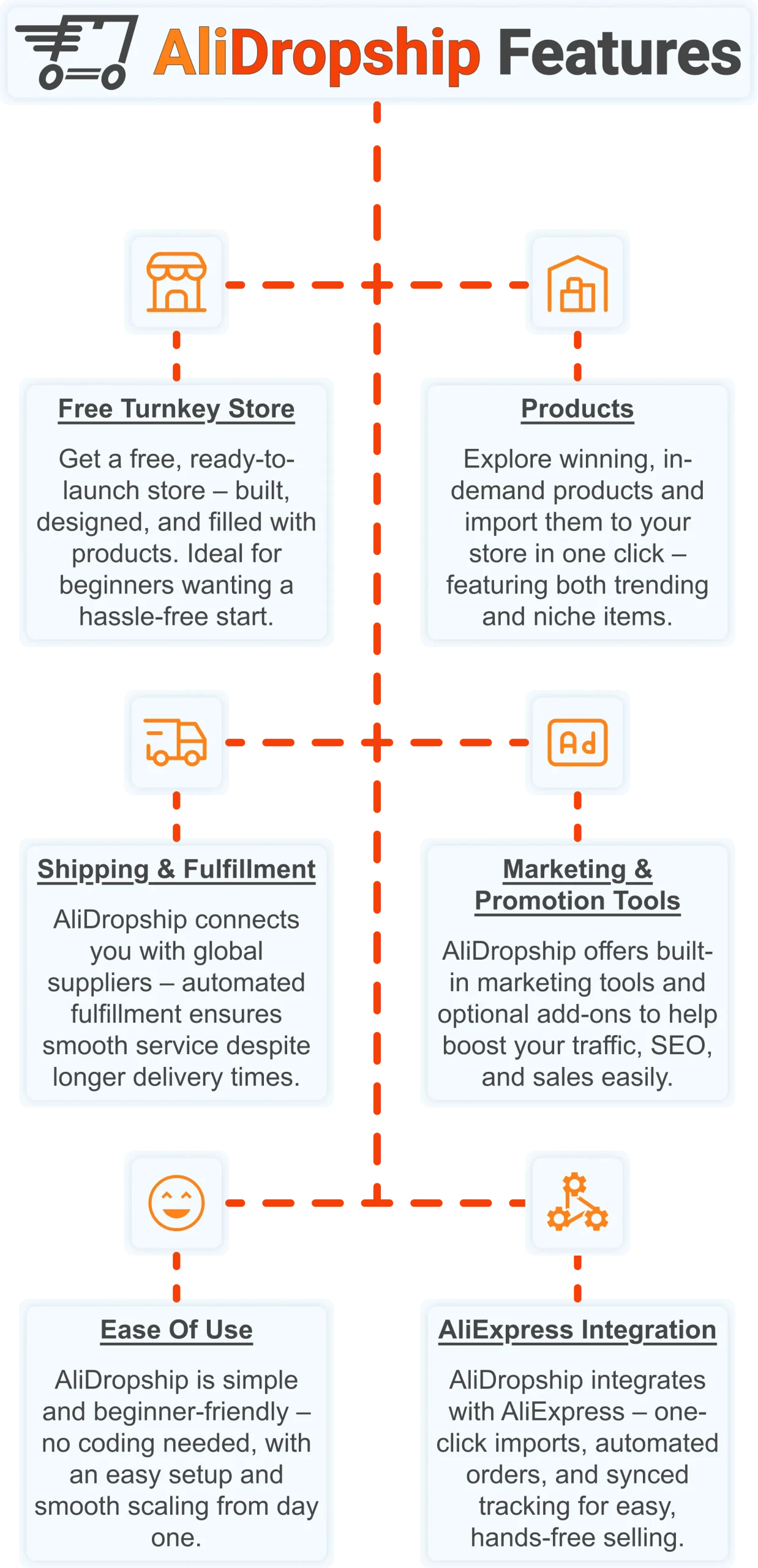
Free turnkey store 🛍️
Get a free turnkey store – built, designed, and filled with products. Ideal for beginners wanting a hassle-free start, the store comes fully optimized to attract customers right away, saving you time on setup. Plus, it includes professional design elements to give your business a polished, trustworthy look from day one. This ready-made foundation makes it easy to move seamlessly into product selection.
Products 📦
Once your store is set up, you can explore winning, in-demand products and import them in one click – featuring both trending and niche items. This wide selection lets you cater to diverse customer interests and test what works best. Regular updates ensure you always have fresh products, keeping your store competitive and relevant. With great products in place, smooth shipping becomes the next essential step.
Shipping & fulfillment 🚚
AliDropship connects you with global suppliers, and automated fulfillment ensures seamless order processing despite international delivery times. Customers receive real-time tracking updates, which builds confidence and trust in your store. Once shipping is handled reliably, you can focus on promoting your store and attracting traffic.
Marketing & promotion tools 📣
To maximize sales, AliDropship offers built-in marketing tools and optional add-ons that help boost traffic, SEO, and conversions. From email campaigns and discounts to social media integration, these tools empower you to reach and retain customers without needing prior marketing experience. With promotion strategies in place, managing your business becomes simpler and more efficient.
Ease of use 👌
AliDropship is beginner-friendly – no coding needed, with an intuitive dashboard that guides you through every step. Easy setup and smooth scaling let you expand your store without stress. As your business grows, adding new features, products, and marketing campaigns remains hassle-free, giving you more time to focus on sales.
AliExpress integration 🛒
Finally, AliDropship integrates seamlessly with AliExpress, enabling one-click imports, automated orders, and synced tracking. Your inventory stays up-to-date with the latest products and prices, while automated order processing frees you from manual tasks. Combined with the turnkey setup, reliable shipping, and built-in marketing tools, this integration ensures your dropshipping business is fully equipped for growth and success.
While Wix and Shopify both require you to build, configure, and stock your store from scratch, AliDropship hands you a complete, ready-to-run dropshipping business from day one. Claim your free turnkey store and start selling without the setup headache.
Wix vs Shopify: which is better for ecommerce?
Is Wix cheaper than Shopify for an online store?
Can you do dropshipping on Wix?
What is the main difference between Wix and Shopify?
Which platform is easier to use: Wix or Shopify?