Selling Products Online From Home: A Complete 2026 Guide

Over 26 million ecommerce stores are active worldwide right now – and a large share of them were started by people selling products online from home with no prior experience. If you have been wondering whether it is still possible to build real income from your living room in 2026, the answer is yes.
The landscape is more accessible than ever, but it also rewards those who pick the right model and stick with it long enough to see results.
Quick Answer: Selling products online from home works best through dropshipping, print-on-demand, or selling handmade and digital goods on established marketplaces. Beginners typically start seeing consistent revenue within 60–90 days of setting up their store and actively promoting it.
This guide breaks down every viable method, what each one realistically pays, how to get started without technical experience, and which approach fits your goals and schedule best.

What is selling products online from home?
Selling products online from home means running an ecommerce operation entirely from your own space – no office, no warehouse, and in many models, no physical stock. You source or create products (or skip that step entirely with dropshipping), list them through a store or marketplace, and handle orders and customer communication remotely.
In 2026, home-based selling is not a niche activity. It is a mainstream business model backed by a global infrastructure of suppliers, fulfillment partners, payment processors, and marketing tools designed specifically for solo and small-team operators. Whether you want to earn a few hundred dollars a month alongside your main job or build a full-time income, the model scales to match your ambition.
The key difference from traditional retail is that you do not need capital tied up in inventory. Models like dropshipping allow you to list and sell products before you ever purchase them – you only order from your supplier after a customer has already paid you.
How much can you realistically earn selling products online from home?
Earnings vary enormously depending on the method, the time you invest, and how quickly you find a product-market fit. Below is an honest comparison of the main approaches.
Dropshipping offers the highest ceiling for home-based sellers because it is not capped by production time or inventory. Print-on-demand and digital products work well as lower-effort supplementary streams. Reselling and handmade goods reward consistency but trade your time more directly for income.
One note on ceiling figures: The upper ranges above reflect sellers who are 6–12 months in, running paid ads or strong organic traffic, and treating their store as a real business. Beginners typically earn $30–$150/month in their first 60 days while still learning. Full-time results generally require full-time effort for at least 3–6 months before they become reliable.
That said, the path from zero to a consistent $1,000–$2,000 per month is well-documented and repeatable – especially for dropshipping, where you are not limited by what you can personally produce or source locally.
The best methods for selling products online from home in 2026
Each method below has a different entry point, income ceiling, and time requirement. Read through all of them before deciding – many home sellers run two complementary models at once.
Dropshipping: The most scalable home-based model
Dropshipping is the most popular method for selling products online from home because it removes the two biggest barriers: upfront stock costs and physical storage. You list products in your store, customers buy them, and your supplier ships directly to the buyer. You never touch the product.
How dropshipping works
You set up an online store (standalone or on a marketplace), import products from a supplier network like AliExpress, set your own retail prices above the supplier cost, and keep the margin. When an order comes in, your store or automation tool forwards the order to the supplier, who handles packing and shipping. Most platforms provide customer tracking automatically.
The business model means your main job is marketing and customer service – not logistics. That makes it genuinely runnable from a laptop at home with no warehouse, no packing tape, and no boxes stacked in your spare room.
How to get started with dropshipping
The fastest route is a ready-built dropshipping store with products already imported. This cuts weeks off the setup process. From there, your focus shifts immediately to product research – identifying items with strong demand, low competition, and healthy margins (typically 25–60%).
Home goods, pet accessories, fitness equipment, and niche hobby products consistently perform well in 2026.
Earning potential: $500–$5,000+/month within 3–9 months with consistent product testing and marketing.
Print-on-demand: Sell designs without holding inventory
Print-on-demand (POD) follows the same no-inventory logic as dropshipping but applies it to custom-designed products. You create artwork or text-based designs and upload them to platforms that print them on t-shirts, mugs, tote bags, phone cases, and hundreds of other items – only when a customer orders.
How to get started with print-on-demand
Platforms like Printful, Printify, and Redbubble integrate with your own store or let you sell through their marketplaces. The main skill required is design – but you do not need to be an illustrator. Tools like Canva make text-based and graphic designs accessible to complete beginners.
Niche targeting is critical: a “nurses who love cats” mug consistently outsells a generic “I love coffee” mug because the buyer feels seen.
Earning potential: $100–$1,500/month; higher for sellers who identify tight niches and produce consistent design volume.
Selling handmade goods: Turning a skill into income
If you already make something – candles, jewelry, ceramics, knitwear, soap, art prints – selling handmade goods online is one of the most direct paths to home income. Etsy remains the dominant marketplace for handmade products, with over 90 million active buyers as of 2024.
How to find buyers for handmade products
Etsy’s internal search is the main traffic source for most new sellers, so SEO within the platform matters enormously. Your product titles, tags, and descriptions need to match what buyers are actually typing. Beyond Etsy, Instagram and Pinterest are both highly effective for visual products – a well-shot product photo can drive organic discovery without any ad spend.
Earning potential: $200–$3,000/month depending on product type, price point, and production capacity. Physical creation time is the main ceiling.
Selling digital products from home
Digital products – PDFs, templates, courses, presets, ebooks, printables – are the closest thing to passive income in ecommerce. You create them once and sell them repeatedly with no production cost per unit and no shipping involved. Margins are close to 100% after platform fees.
What digital products sell well in 2026
Canva templates for social media and business use are consistently among the highest-selling digital product categories on Etsy. Resume and cover letter templates, meal planners, budget trackers, and educational printables for parents and teachers also convert strongly.
Courses and tutorial packages perform well on platforms like Gumroad and Teachable when backed by an audience, even a small one.
Why this works in 2026: Buyers increasingly prefer instant downloads over waiting for shipping – digital products convert faster and require zero fulfillment effort from the seller after the initial creation.
Reselling and retail arbitrage
Reselling means buying products at low prices – from clearance sales, charity shops, liquidation lots, or wholesalers – and listing them at a profit on platforms like eBay, Amazon, Facebook Marketplace, or Poshmark. It requires more active sourcing than other methods but has a low barrier to entry and near-zero startup cost if you already own sellable items.
How to source products for reselling
The most reliable sources for home resellers are: local charity shops and car boot sales for collectibles and branded clothing, online liquidation platforms like B-Stock and Direct Liquidation for bulk lots, and clearance sections at major retailers during seasonal changeovers.
Electronics, branded fashion, toys, and sports equipment are consistently strong categories on eBay and Facebook Marketplace.
Earning potential: $300–$2,500/month; scales with sourcing time and how quickly you can turn inventory.
How to choose the right platform for selling products online from home
Your platform choice shapes almost every aspect of your business – fees, traffic, branding control, and long-term scalability. The two main options are marketplaces and independent stores, and they suit different goals.
Marketplaces provide built-in traffic but charge fees on every sale and own the customer relationship. An independent store costs more effort to drive traffic to initially, but every customer you earn belongs to your brand – you can email them, retarget them, and build loyalty that no platform can take away.
For most people starting out with dropshipping, an independent store paired with social media and low-cost paid ads is the most reliable long-term model. Marketplaces are better for testing product ideas quickly before committing to a full store.
Tips for making more money selling products online from home
1. Validate before you scale
Do not spend money on ads until you have evidence that people want your product. Test organically first – post on Reddit communities related to your niche, share on TikTok or Instagram, or run a small $5–$10 daily ad test. If you cannot get a handful of sales organically or cheaply, scaling ad spend will not fix the underlying problem.
2. Focus on one niche, not everything
The most common beginner mistake is building a general store with hundreds of random products. Niche stores convert better because they speak directly to a specific buyer. A store dedicated entirely to hiking accessories will outperform a general outdoor gear store with the same products, because the branding feels intentional and relevant to the customer.
3. Treat product descriptions as your sales team
Most home sellers copy supplier descriptions directly – and it shows. Write your own copy that addresses the buyer’s specific problem, desire, or identity. Focus on outcomes (“keeps your hands dry during a workout”) rather than features (“moisture-wicking fabric”). Even a two-paragraph rewrite outperforms a generic supplier description in conversion rate.
4. Build your email list from day one
Email remains the highest-ROI marketing channel in ecommerce. A list of 500 engaged subscribers who have already bought from you or opted in is worth more than 5,000 cold social media followers. Use a pop-up offering a discount on first purchase to collect emails from store visitors, and send a simple weekly or bi-weekly update featuring new products or promotions.
5. Use social proof to overcome buyer hesitation
For a new store, trust is your biggest conversion barrier. Collect product reviews actively – follow up with customers via email after delivery and ask directly. Display real photos from customers on product pages wherever possible. Even 5–10 genuine reviews on a product page can meaningfully lift conversion rates for new visitors who have never heard of your store before.
Legal and ethical considerations when selling products online from home
Running a legitimate home-based ecommerce business is straightforward, but there are rules worth understanding before you scale – both to protect yourself and your customers.
Business registration and tax
In most countries, once your income from online selling crosses a threshold (varies by jurisdiction, but often around $600–$1,000 per year in the US), it is classified as taxable business income. Register as a sole trader or LLC depending on your location and consult a local accountant about your obligations. Most ecommerce platforms provide annual sales summaries that simplify this process.
Important: Platforms like eBay, Etsy, and PayPal are required in many countries to report seller earnings to tax authorities once you cross certain thresholds – so declaring income is not optional if you want to avoid penalties.
Product compliance and safety
If you are dropshipping physical goods, check that the products you sell meet the safety standards required in your target market. Electronics, children’s toys, and food-contact items face specific regulatory requirements in the EU, UK, and US.
Your supplier should be able to provide compliance documentation. Selling non-compliant products, even unknowingly, can result in marketplace bans or customer liability.
What to avoid absolutely
Fake reviews are among the fastest ways to get permanently banned from any major marketplace. Buying reviews, incentivising positive-only feedback, or creating fake buyer accounts violates every major platform’s terms of service and, in some jurisdictions, consumer protection law.
Counterfeit or branded goods are similarly off-limits. Listing products with designer logos or brand names you do not have authorisation to use can result in DMCA takedowns, legal action, and account termination. Stick to generic or white-label products from your supplier unless you have written permission from a brand to resell their goods.
Key principle: Sustainable ecommerce income comes from building genuine trust with buyers – every grey-area shortcut you take risks the entire business you are building.
How to choose your method: Recommendations by reader profile
Not every model suits every person. Here is how to think about your starting point.
Complete beginner with no technical background
Start with dropshipping using a ready-built store. You skip the product sourcing, store design, and setup entirely and go straight to the part that matters: finding a winning product and getting traffic. A free turnkey store with pre-loaded products removes the steepest part of the learning curve. Expect to spend your first 30 days learning, not earning – that is normal and expected.
Intermediate seller with some experience and budget
If you have already sold on Etsy or eBay and want to grow beyond marketplace limitations, an independent dropshipping store is your next move. You already understand buyer psychology and product research – an independent store gives you the branding control and margin structure to turn that knowledge into a scalable business.
Advanced / full-time income goal
For anyone targeting $3,000–$5,000+/month, the combination of a standalone dropshipping store, paid social ads (Meta or TikTok), and email marketing automation is the proven system. At this level, the business requires treating it like a job: daily ad monitoring, product testing cycles every 2–4 weeks, and building relationships with reliable suppliers. The ceiling is high, but it requires the commitment to match.
Side income alongside a full-time job
If you have 5–10 hours per week, digital products or a dropshipping store running largely on automation are your best fit. The passive income potential of digital products is real – but it takes an upfront investment of time in creation and SEO. A dropshipping store, once set up with automated order processing, can run with minimal daily input once you have identified a few winning products.
Ecommerce home businesses are continuing to grow in 2026 as more tools, platforms, and global supplier networks lower the barrier to entry. The opportunity is largest for people who start now, build systematically, and choose a model that suits their available time and goals.
AliDropship: Your complete all-in-one solution for starting dropshipping in 2026
If you want the simplest possible way to start dropshipping – especially if you’re brand new – AliDropship remains one of the most beginner-friendly tools available in 2026. It brings together store creation, product imports, automation, and marketing into a single streamlined system designed to help you launch quickly and grow confidently.
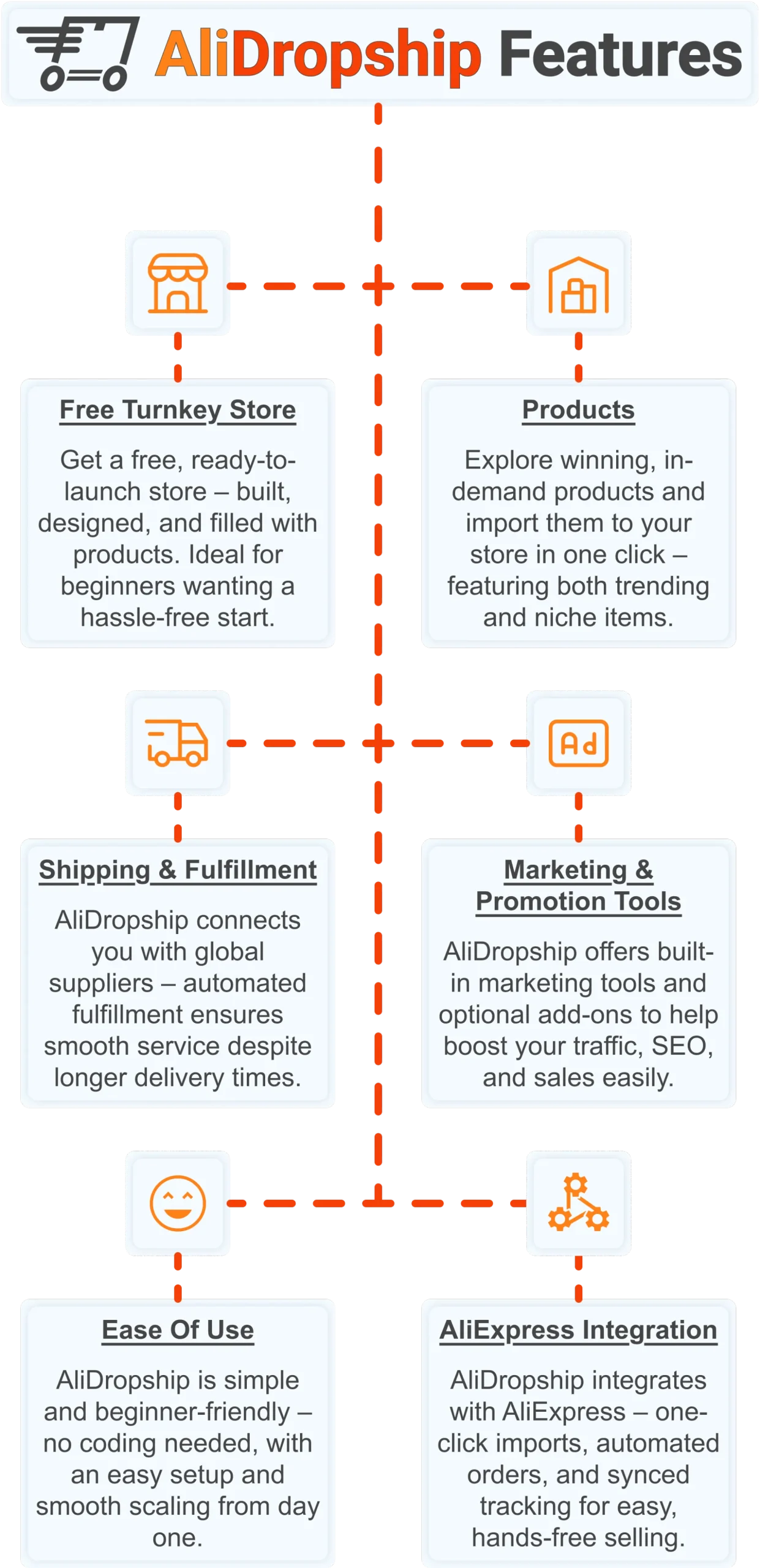
Free turnkey store 🛍️
Get a free turnkey store – built, designed, and filled with products. Ideal for beginners wanting a hassle-free start, the store comes fully optimized to attract customers right away, saving you time on setup. Plus, it includes professional design elements to give your business a polished, trustworthy look from day one. This ready-made foundation makes it easy to move seamlessly into product selection.
Products 📦
Once your store is set up, you can explore winning, in-demand products and import them in one click – featuring both trending and niche items. This wide selection lets you cater to diverse customer interests and test what works best. Regular updates ensure you always have fresh products, keeping your store competitive and relevant. With great products in place, smooth shipping becomes the next essential step.
Shipping & fulfillment 🚚
AliDropship connects you with global suppliers, and automated fulfillment ensures seamless order processing despite international delivery times. Customers receive real-time tracking updates, which builds confidence and trust in your store. Once shipping is handled reliably, you can focus on promoting your store and attracting traffic.
Marketing & promotion tools 📣
To maximize sales, AliDropship offers built-in marketing tools and optional add-ons that help boost traffic, SEO, and conversions. From email campaigns and discounts to social media integration, these tools empower you to reach and retain customers without needing prior marketing experience. With promotion strategies in place, managing your business becomes simpler and more efficient.
Ease of use 👌
AliDropship is beginner-friendly – no coding needed, with an intuitive dashboard that guides you through every step. Easy setup and smooth scaling let you expand your store without stress. As your business grows, adding new features, products, and marketing campaigns remains hassle-free, giving you more time to focus on sales.
AliExpress integration 🛒
Finally, AliDropship integrates seamlessly with AliExpress, enabling one-click imports, automated orders, and synced tracking. Your inventory stays up-to-date with the latest products and prices, while automated order processing frees you from manual tasks. Combined with the turnkey setup, reliable shipping, and built-in marketing tools, this integration ensures your dropshipping business is fully equipped for growth and success.
Selling products online from home has never been more accessible – and AliDropship gives you everything you need to start today, in one place. Get your free turnkey store and start building your home-based ecommerce business now.
What is the easiest way to start selling products online from home?
How much money do you need to start selling products online from home?
Startup costs depend heavily on the model. Dropshipping can be started with as little as 50 to 100 dollars for a domain and hosting if you use a free store offer. Print-on-demand has near-zero upfront cost since you only pay per item after a customer orders. Reselling requires some capital to purchase stock, typically 100 to 300 dollars to start. Digital products can be created for free using tools like Canva.
What products sell best online from home?
Home goods, pet accessories, fitness equipment, and niche hobby items consistently perform well for dropshipping in 2026. For handmade and Etsy sellers, personalised gifts, candles, and custom jewelry are strong categories. Digital products like Canva templates, planners, and resume templates sell steadily year-round. The key across all categories is finding a niche with real demand and less established competition.
Can you really make a full-time income selling products online from home?
Yes, but it requires treating it like a business rather than a side project. Most sellers who reach 2000 to 5000 dollars per month are 6 to 12 months in and running consistent marketing. Dropshipping offers the highest ceiling for home-based sellers because it is not capped by production time. Reaching full-time income typically takes 3 to 9 months of focused effort, depending on how quickly you identify winning products and scale your traffic.
What is the best platform for selling products online from home?
The best platform depends on your model. Etsy suits handmade goods and digital products well. eBay works best for reselling and collectibles. For dropshipping and long-term brand building, an independent ecommerce store gives you the most control – no marketplace fees, no rules about what you can list, and full ownership of your customer relationships. Most serious home sellers eventually move to or start with an independent store for this reason.