Private Label Dropshipping: What It Is And How To Start

Most people who look into dropshipping eventually ask the same question: “How do I stop competing on price with a hundred other stores selling the exact same thing?” Private label dropshipping is one of the best answers to that.
Instead of reselling generic products under someone else’s brand, you put your own label on them – and suddenly you have something that feels unique, commands higher prices, and builds a real customer base over time.
In 2026, private label dropshipping has become more accessible than ever. You do not need a warehouse, a manufacturer relationship, or thousands of dollars upfront to get started. With the right tools and a clear plan, even a complete beginner can launch a branded store and start seeing sales within 60–90 days.
Quick Answer: Private label dropshipping means sourcing generic products from a supplier, branding them with your own logo and packaging, and selling them through your online store – without holding any inventory yourself. It combines the low overhead of dropshipping with the higher margins and brand equity of a private label business.

What is private label dropshipping?
Private label dropshipping sits at the intersection of two popular business models. Dropshipping means you sell products without stocking them – your supplier ships directly to your customer. Private labeling means those products carry your brand name, your logo, and often your custom packaging instead of the manufacturer’s generic branding.
Put them together and you get a business where you design the brand experience, market the products, and handle customer relationships – while your supplier does all the physical work of storing, packing, and shipping.
It is a model that has grown significantly over the past few years as more suppliers have opened up to low-minimum branding arrangements, especially through platforms like AliExpress and dedicated private label networks.
The key difference between standard dropshipping and private label dropshipping is brand ownership. With standard dropshipping, your product is identical to what dozens of competitors are selling. With private label, your branding makes the product feel exclusive, even if the underlying item is similar. That distinction matters a lot when it comes to pricing power and customer loyalty.
Why this works in 2026: Consumers are increasingly brand-aware even when shopping at lower price points. A well-presented private label store with consistent branding converts significantly better than a generic storefront selling unbranded goods.
How much can you realistically earn with private label dropshipping?
Private label dropshipping tends to offer better margins than standard dropshipping, but it also requires more upfront effort. The earning potential depends heavily on which approach you take, how much time you put in, and how well you execute your branding and marketing. Here is a realistic breakdown based on common starting points:
The table above reflects realistic ranges – not guarantees. The basic tier is the most achievable starting point, while full private label income at the higher end requires consistent paid advertising, strong SEO, and a well-developed product line.
One note on the top figures: $300–$800/day represents what serious, full-time operators can achieve. Most people starting part-time will sit closer to $20–$80/day for the first few months. That is still a meaningful side income, and it scales as your brand builds recognition and repeat buyers.
The timeline also matters here. Unlike standard dropshipping where you can sometimes get sales in the first week, private label dropshipping involves a branding phase – designing assets, communicating with suppliers, and setting up your store properly. Budget 4–6 weeks before your first sale, and 3–6 months before you have a clear read on whether a product line is working.
Map your path from first sale to profit
Enter your startup investment, net profit per sale, monthly fixed costs, and expected monthly sales, and the calculator will display your monthly revenue and net contribution toward break-even, total sales needed, months to break-even, and an at-a-glance verdict on your startup’s trajectory.
| Under 3 mo | Fast — strong product economics, fast payback |
| 3–6 mo | Moderate — typical first product cycle for beginners |
| 6–12 mo | Slow — workable but little cushion for setbacks |
| 12+ mo | Concerning — reconsider price, sourcing, or audience |
| Never | Fixed costs exceed monthly profit — structural fix needed |
How private label dropshipping works: A step-by-step overview
The mechanics of private label dropshipping are straightforward once you break them down. Here is how the process works from start to first sale – and what you need to have in place at each stage.
Finding and vetting suppliers
Your supplier relationship is the foundation of your private label dropshipping business. You need a manufacturer or wholesaler who is willing to brand products with your logo and ship individual orders directly to your customers – sometimes called “white label” or “OEM” fulfillment.
AliExpress and AliExpress suppliers
AliExpress remains one of the most accessible starting points for private label dropshipping beginners. Many suppliers on the platform offer branding services for relatively low minimum order quantities. Look for listings that mention “custom logo,” “OEM accepted,” or “private label.”
Before committing, always order a sample – check product quality, packaging options, and shipping time to your target market. Suppliers with a Trustpilot-verified track record or strong review histories on AliExpress itself are always the safer choice.
Earning potential: $20–$60/day for a focused niche store with 5–10 branded SKUs at this tier.
Dedicated private label networks
Beyond AliExpress, platforms like Modalyst, Spocket, and Printful offer structured private label programs where the branding process is more formalized. Printful, for example, handles print-on-demand products – meaning you can create custom-branded apparel, accessories, and home goods with zero minimum order quantity.
These platforms often have higher per-unit costs than AliExpress, but the logistics are more reliable and the supplier vetting is handled for you.
Reaching out to manufacturers directly
For more advanced setups, sourcing directly from manufacturers via platforms like Alibaba (not AliExpress) gives you better pricing and more control over product customization. The minimum order quantities are typically higher, and the communication requires more back-and-forth – but the margins are significantly better.
This approach makes more sense once you have validated a product on AliExpress and want to scale.
Important: Always use Alibaba’s Trade Assurance program or escrow-style payments when working with new manufacturers. Never wire money directly to an unverified contact.
Building your brand identity
Your brand does not need to be elaborate, but it does need to be consistent. At minimum, you need a store name, a logo, a color palette, and a clear value proposition for your niche. Free tools like Canva handle logo design well for beginners. If you have a budget of $30–$100, platforms like 99designs or even Fiverr can deliver professional brand assets quickly.
Choose a niche that is specific enough to feel curated but broad enough to support a full product catalogue. “Pet accessories” is too broad. “Minimalist accessories for small dog owners” is a workable niche. The more clearly defined your audience, the easier it is to write product descriptions, run ads, and build a repeat customer base.
Setting up your online store
Your store is your brand’s home on the internet. The platform you choose matters – it affects your SEO, your payment options, your ability to automate order fulfillment, and your overall credibility. The main options most private label dropshippers use are WordPress with WooCommerce, Shopify, and dedicated dropshipping platforms like AliDropship.
For SEO-driven traffic – which is often the most sustainable long-term traffic source for private label dropshipping – WordPress-based stores tend to outperform closed platforms because you have full control over your content, metadata, and site structure. AliDropship is built on WordPress, which gives you that flexibility without requiring technical knowledge.
Product pages and descriptions
Generic supplier descriptions will hurt your conversion rate and your SEO. Rewrite every product description in your own voice, using language your target customer actually searches for. Highlight the branding and quality story – customers are choosing your brand, not just a commodity product. Include sizing guides, use-case scenarios, and genuine customer-focused language.
Marketing your private label store
Private label dropshipping has a built-in marketing advantage: you own a brand, which means you can build an audience around it. The most effective marketing channels for new stores in 2026 are organic social media (especially TikTok and Instagram Reels for visual products), SEO-driven blog content, and targeted paid ads on Meta or TikTok once you have a validated product.
Start with one channel and do it well before adding others. Many successful private label dropshippers spend their first three months exclusively on organic content – documenting the brand story, showing the product in use, and building an email list. Paid ads scale what is already working, so validate organically first.
Earning potential: Stores combining SEO content with a focused paid ads strategy can reach $100–$300/day in net profit within 6–9 months of consistent effort.
Private label dropshipping vs standard dropshipping: Key differences
Understanding where private label dropshipping sits relative to standard dropshipping helps you decide whether it is the right model for where you are right now.
Standard dropshipping is faster to launch but harder to differentiate. Private label dropshipping takes more upfront effort but builds something with real long-term value – a brand asset that is harder for competitors to copy.
Legal and ethical considerations for private label dropshipping
Private label dropshipping is a completely legitimate business model, but there are a few legal and ethical boundaries worth understanding clearly before you launch.
What to avoid absolutely
Do not brand products with logos, names, or imagery that resemble established trademarks. Even if the underlying product is generic, applying packaging that could be confused with a known brand creates serious legal exposure. This includes obvious cases like copying brand color schemes or wordmarks, but also subtler cases like using terms that are trademarked in specific product categories.
Avoid making unverifiable claims about your products – particularly in health, wellness, or supplement niches where regulatory frameworks (like the FDA in the US or MHRA in the UK) impose strict rules on what you can say on packaging and in advertising.
Important note: If you are selling branded products in the EU or UK, you are also required to comply with packaging and labeling regulations that go beyond what AliExpress suppliers typically provide by default. Build that compliance into your branding process from the start.
What to do instead
Conduct a basic trademark search before registering your brand name – the US Patent and Trademark Office (USPTO) and EUIPO both have free public search tools. When writing product claims, stick to what you can genuinely demonstrate or what the supplier can document. Work with suppliers who can provide safety certifications for your product category, especially if you are selling anything that goes on skin, in mouths, or near children.
Key principle: A sustainable private label dropshipping business is built on a genuine brand – not shortcuts that create legal or reputational risk down the line.
Which approach is right for you in 2026?
Private label dropshipping is not a one-size-fits-all model. The right entry point depends on where you are starting from and how much time and budget you can commit.
Complete beginner
If you are new to ecommerce entirely, start with a ready-made store and use it to understand the mechanics of dropshipping before adding the complexity of custom branding.
Platforms like AliDropship give you a fully functioning store with products already loaded – you can learn how to drive traffic, handle customer inquiries, and read your analytics before you start investing in private label branding. Think of this phase as paid education with the upside of real revenue.
Intermediate / part-time
If you already have a dropshipping store running and want to differentiate, private label dropshipping is your natural next step. Take your two or three best-selling products and approach your suppliers about branding options.
Start with logo placement on packaging – this is the easiest and cheapest entry point – and expand from there as margins improve. Most intermediate operators in this position reach $80–$150/day in profit within 4–6 months of adding private labeling to their existing store.
Advanced / full-time goal
If your goal is a full-time income from private label dropshipping – $300/day or more – you need to treat it like a real business from day one. That means a defined niche, a brand identity you have invested in, a content strategy that builds organic traffic over time, and a paid ads budget you can test systematically.
The most successful private label dropshippers at this level typically operate 2–3 focused stores rather than one large general store.
The ecommerce space is growing every year, and private label dropshipping is one of the models best positioned to benefit from that growth. Consumer trust in online shopping is higher than ever, and the tools available to independent store owners – from AI-assisted product research to automated fulfillment – make it easier than at any point in the past to compete with larger brands.
The window to build something meaningful is open right now.
AliDropship: Your complete all-in-one solution for starting dropshipping in 2026
If you want the simplest possible way to start dropshipping – especially if you’re brand new – AliDropship remains one of the most beginner-friendly tools available in 2026. It brings together store creation, product imports, automation, and marketing into a single streamlined system designed to help you launch quickly and grow confidently.
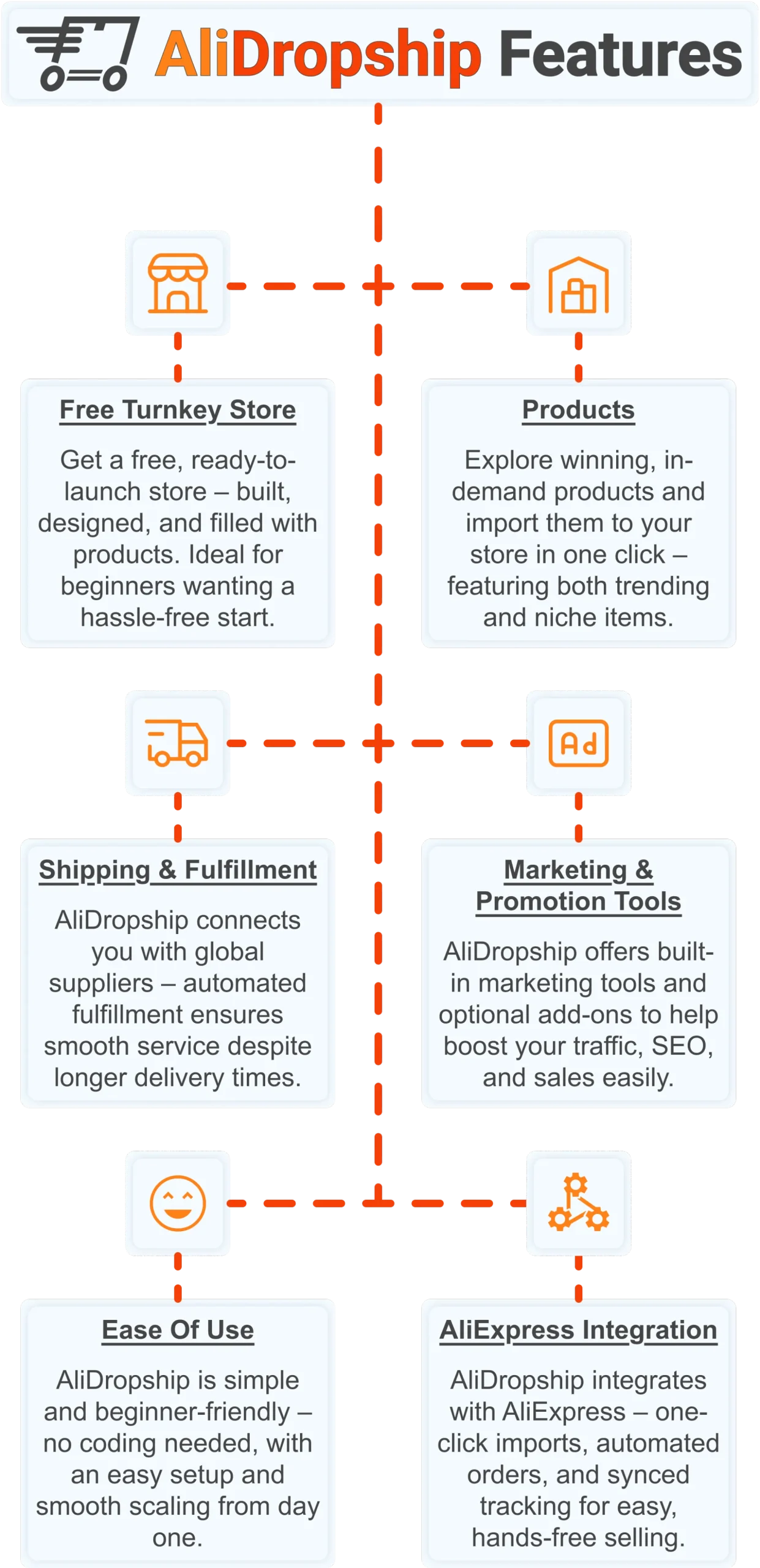
Free turnkey store 🛍️
Get a free turnkey store – built, designed, and filled with products. Ideal for beginners wanting a hassle-free start, the store comes fully optimized to attract customers right away, saving you time on setup. Plus, it includes professional design elements to give your business a polished, trustworthy look from day one. This ready-made foundation makes it easy to move seamlessly into product selection.
Products 📦
Once your store is set up, you can explore winning, in-demand products and import them in one click – featuring both trending and niche items. This wide selection lets you cater to diverse customer interests and test what works best. Regular updates ensure you always have fresh products, keeping your store competitive and relevant. With great products in place, smooth shipping becomes the next essential step.
Shipping & fulfillment 🚚
AliDropship connects you with global suppliers, and automated fulfillment ensures seamless order processing despite international delivery times. Customers receive real-time tracking updates, which builds confidence and trust in your store. Once shipping is handled reliably, you can focus on promoting your store and attracting traffic.
Marketing & promotion tools 📣
To maximize sales, AliDropship offers built-in marketing tools and optional add-ons that help boost traffic, SEO, and conversions. From email campaigns and discounts to social media integration, these tools empower you to reach and retain customers without needing prior marketing experience. With promotion strategies in place, managing your business becomes simpler and more efficient.
Ease of use 👌
AliDropship is beginner-friendly – no coding needed, with an intuitive dashboard that guides you through every step. Easy setup and smooth scaling let you expand your store without stress. As your business grows, adding new features, products, and marketing campaigns remains hassle-free, giving you more time to focus on sales.
AliExpress integration 🛒
Finally, AliDropship integrates seamlessly with AliExpress, enabling one-click imports, automated orders, and synced tracking. Your inventory stays up-to-date with the latest products and prices, while automated order processing frees you from manual tasks. Combined with the turnkey setup, reliable shipping, and built-in marketing tools, this integration ensures your dropshipping business is fully equipped for growth and success.
Private label dropshipping gives you the brand ownership and margin advantage that generic stores simply cannot match. Get your free turnkey store today and start building a brand that is truly yours.
What is private label dropshipping?
How much does it cost to start private label dropshipping?
Starting costs vary depending on how much branding work you invest in upfront. At the most basic level, you need a domain name (around 10 to 15 dollars per year), a store platform (AliDropship offers a free turnkey store option), and a small budget for product samples, typically 30 to 100 dollars. Logo design can be done free with tools like Canva or outsourced on Fiverr for 20 to 50 dollars. Most beginners start private label dropshipping for under 200 dollars total, not including any paid advertising budget.
Is private label dropshipping profitable in 2026?
Private label dropshipping is profitable in 2026, but results depend on niche selection, branding quality, and marketing consistency. Beginner stores using basic logo branding on AliExpress products typically earn 20 to 60 dollars per day within the first 60 to 90 days. Stores with stronger branding, SEO content, and a focused niche can reach 100 to 300 dollars per day within 6 to 9 months. The model tends to generate higher profit margins than standard dropshipping because branded products command better prices.
What products work best for private label dropshipping?
The best products for private label dropshipping are items that are widely available as generics but where branding adds perceived value. Popular categories include beauty and skincare products, pet accessories, fitness gear, kitchen tools, and eco-friendly home goods. Avoid heavily regulated categories like supplements or electronics until you are confident about compliance requirements. Products with a retail price between 25 and 80 dollars tend to offer the best balance of margin, return rate, and customer lifetime value.
How is private label dropshipping different from white label dropshipping?
The terms are often used interchangeably, but there is a meaningful distinction. White label means you are selling a product that multiple retailers can brand and sell without any changes to the product itself. Private label typically implies a closer relationship with the manufacturer and sometimes involves product modifications or exclusive formulations. In the dropshipping context, most beginners start with white label arrangements, applying their logo to a stock product, and move toward true private label as their volume and supplier relationships develop.