Print On Demand Business: How To Start And Profit In 2026

If you have been searching for a low-risk way to sell products online without holding any stock, a print on demand business is one of the most accessible models available right now. You design the product, a third-party supplier prints and ships it when someone orders, and you keep the margin. No warehouse, no bulk orders, no upfront inventory costs.
But how much can you actually make, and is it worth your time in 2026? The short answer is yes – for the right person with the right approach. This guide breaks down exactly how the model works, what realistic earnings look like, which platforms to use, and how to grow beyond the typical beginner ceiling.
Quick Answer: A print on demand business lets you sell custom-designed products – t-shirts, mugs, phone cases, and more – without buying stock upfront. You earn the difference between your retail price and the supplier’s base cost. Most beginners earn $200–$800/month within their first 90 days; serious operators scaling with ads and SEO can reach $3,000–$8,000/month.
Before we get into the mechanics, it is worth understanding why this model has stayed popular while others have faded. Print on demand removes the single biggest barrier to starting an online store: buying stock before you know if it sells. That changes the risk profile entirely.

What is a print on demand business?
A print on demand business is an ecommerce model where products are only manufactured after a customer places an order. You create the designs, list the products in your store, set your own prices, and the fulfillment partner handles everything else – printing, packaging, and shipping directly to your customer.
The most common product categories include apparel (t-shirts, hoodies, hats), home goods (mugs, posters, cushions), accessories (phone cases, tote bags), and stationery. The category has expanded significantly in recent years; you can now print on demand everything from pet bandanas to wall tapestries.
What makes this model compelling in 2026 is the combination of low startup costs and growing consumer appetite for personalized, niche products. Generic mass-market goods face heavy price competition from platforms like Temu and AliExpress. A well-positioned print on demand business targeting a specific community or interest group competes on identity and design, not just price.
Why this works in 2026: Niche audiences buy products that represent who they are. A dog owner who rescues dachshunds will pay a premium for a dachshund-specific hoodie they cannot find at a high-street retailer.
How much can you realistically earn from a print on demand business?
Earnings vary enormously depending on how much time you invest, which platform you use, and whether you rely on organic traffic or paid advertising. Here is an honest breakdown across three types of operators:
The table above reflects sustainable monthly figures, not one-off viral spikes. Marketplace sellers benefit from built-in traffic but give up control and pay platform fees. Store owners take more responsibility but keep more margin and own their customer relationship.
One note on the top figures: Reaching $5,000+/month consistently requires treating your print on demand business as a full operation – active ad management, email list building, regular new designs, and 6–12 months of compounding effort. The majority of beginners in their first 60–90 days earn $200–$600/month if they publish consistently and do basic SEO.
The platform you choose also affects your margin. Base product costs differ between suppliers, and shipping costs cut significantly into profit on low-ticket items. A t-shirt priced at $28 with a $12 base cost and $5 shipping leaves you $11 before any ad spend – around a 39% gross margin, which is workable but not generous.
How to start a print on demand business: the full process
Starting a print on demand business does not require a big budget or technical background. What it does require is a clear niche, a reliable supplier, and consistent effort in the first 90 days. Here is how to approach each stage.
Step 1: Choose your niche
The biggest mistake beginners make is creating generic designs – “funny cat shirts” or “motivational quote mugs” – that compete with hundreds of thousands of existing listings. The most profitable print on demand businesses are tightly focused on a specific audience with a strong identity.
Hobby and interest communities
Fishing, hiking, CrossFit, bouldering, amateur astronomy, and similar hobby groups have passionate members who buy merchandise that signals their identity. Use Reddit, Facebook Groups, and TikTok hashtags to find communities that are active but underserved with good product design.
Earning potential: $400–$2,000/month with a focused 30–50 product catalogue in an engaged niche.
Profession-based niches
Nurses, teachers, electricians, veterinarians, and software developers all buy branded merchandise that references their job identity. These niches have clear search intent (“gift for nurse”, “teacher appreciation mug”) which makes Etsy SEO and Google Shopping relatively straightforward.
Earning potential: $300–$1,500/month, with strong spikes around seasonal gifting periods (Christmas, Teachers Day, Nurses Week).
Pet owner segments
Pet owners – especially those with specific breeds – are among the highest-converting print on demand buyers. A golden retriever owner does not want a generic dog print; they want a golden retriever print. Breed-specific targeting lets you run very precise Pinterest and Facebook ads at low CPMs.
Earning potential: $500–$2,500/month across a multi-breed catalogue with pet-specific ad creatives.
Step 2: Pick your platform and supplier
You have two main routes: sell through a marketplace (Etsy, Redbubble, Merch by Amazon) or build your own store connected to a print on demand supplier. Both have trade-offs.
Marketplace route
Marketplaces bring built-in traffic, which reduces the barrier to your first sale. Etsy in particular has strong organic search for personalized and gift products. The downside is that you do not own the customer relationship, platform fees eat into margins, and account suspensions can end your business overnight with no appeal process. Important: Never rely on a single marketplace as your only sales channel.
Own store route (Shopify, WooCommerce)
Running your own store connected to Printful, Printify, or a similar supplier gives you full control over branding, customer data, and pricing. You pay no listing fees and keep every customer email for repeat marketing. The trade-off is that you are responsible for driving your own traffic – through SEO, social media, or paid ads. This is harder at the start but more scalable long-term.
Important note: Printify’s base product costs are typically 15–30% lower than Printful for comparable items, which meaningfully improves your margin at scale.
Best print on demand platforms compared
Printful and Printify are the two dominant integrated suppliers for independent stores. Printful offers slightly higher quality control and faster US fulfillment; Printify has lower base costs and a wider global supplier network. For marketplace sellers, Merch by Amazon offers access to Amazon’s enormous search traffic but operates an invite-only tier system that limits new sellers.
Step 3: Create your designs
You do not need to be a professional graphic designer to run a successful print on demand business. Simple, clean typography-based designs – quotes, phrases, and community-specific slogans – consistently outsell complex illustrated artwork because they are easier to read at thumbnail scale and communicate the niche identity quickly.
Design tools for beginners
Canva Pro covers the needs of most print on demand beginners. Adobe Illustrator gives more control for vector-based designs. Placeit offers mockup templates that make product listings look professional without needing a photo shoot. If design is genuinely not your strength, hiring a designer on Fiverr for $15–$40 per design is a legitimate and common approach.
Important: Always verify font licenses before using them commercially – many free fonts are personal-use only and cannot be sold on printed merchandise.
Step 4: Price for profit, not just sales
Underpricing is the most common mistake in a print on demand business for beginners. Because the model removes upfront stock risk, beginners often price aggressively low to compete on marketplaces, then discover their margins do not cover advertising costs or their time.
A reliable pricing formula: base product cost + shipping contribution + 2.5x–3x markup = retail price. For a t-shirt with a $10 base cost, that means listing at $28–$35. That range is well within normal consumer expectations for a niche or custom-printed item.
Step 5: Drive traffic
Traffic strategy depends on your platform. On Etsy, keyword-optimized listing titles and tags are the primary lever – study what top-ranking listings use and model your titles accordingly. On your own store, the most cost-effective channels for print on demand are Pinterest (high organic reach for visual products), TikTok organic (product-in-use videos), and Google Shopping ads once you have a proven product.
Email marketing is underused in print on demand. A simple abandoned-cart sequence and a post-purchase follow-up asking for a review can add 8–15% to monthly revenue with minimal ongoing effort.
Print on demand profit margin: What actually affects your take-home
Understanding print on demand profit margin is essential before you invest serious time or ad budget. The headline numbers look appealing – 40–60% gross margins on some product categories – but the reality after fees and costs is more nuanced.
Here are the main factors that compress your margin:
- Platform fees: Etsy charges a $0.20 listing fee plus a 6.5% transaction fee plus payment processing. On a $28 sale that is roughly $2.50 in fees before you account for the base product cost.
- Shipping: Many sellers offer free shipping to stay competitive, which means the shipping cost comes out of your margin. On lower-ticket items ($15–$20), free shipping can eliminate profit entirely.
- Ad spend: Etsy Ads, Pinterest Ads, and Meta Ads all cost money. A healthy ROAS (return on ad spend) for print on demand is 3x–4x – meaning for every dollar you spend, you earn $3–$4 back. Below 2x, you are subsidizing sales.
- Returns and reprints: Print quality issues and sizing complaints happen. Most suppliers cover misprints at no cost, but customer service time and occasional refunds still affect your effective margin.
Net margins of 15–25% on a well-run print on demand business are realistic and respectable. At $5,000/month in revenue, that is $750–$1,250 in net profit – meaningful supplemental income, and a foundation to scale further.
Legal and ethical considerations for print on demand sellers
The print on demand space has a persistent problem with intellectual property violations. Because designs are easy to create and upload at scale, many beginners unknowingly – or knowingly – upload designs that infringe on trademarks, copyrights, or licensed characters. This is a serious risk that can result in store closure, legal notices, and financial liability.
What to avoid absolutely
Never use: sports team logos or player names (heavily trademarked), movie and TV character imagery, brand slogans (“Just Do It”, “I’m Lovin’ It”), song lyrics, and any content from recognizable IP without an explicit commercial license. Redbubble and Merch by Amazon are aggressive about removing infringing content and will terminate accounts for repeat violations.
Key principle: If you did not create it and do not hold a commercial license for it, do not put it on a product you sell.
What to do instead
Original typography, original illustrations, and original phrases you create are fully safe. You can also license commercially cleared fonts and graphics from marketplaces like Creative Fabrica or Design Bundles, which explicitly grant commercial use rights including print on demand sales.
Building a catalogue of 100% original designs takes more time upfront but eliminates legal risk entirely and creates intellectual property you actually own.
How to choose your approach based on where you are right now
Not every reader is in the same position. Here is a practical recommendation based on your current situation.
Complete beginner
Start on Etsy using Printify as your supplier. The marketplace provides traffic while you learn the basics of design, pricing, and fulfilment. Aim to publish 30–50 listings in your first 60 days across a single tight niche. Expect your first sale within 2–4 weeks if your listings are keyword-optimized. Target: $200–$500/month by month three.
Intermediate / part-time
If you have some existing sales and want to scale, open a parallel Shopify store to capture repeat customers and run your own email list. Continue selling on Etsy for discovery, but push fulfilled customers toward your own store for future purchases with a discount insert card. Add Pinterest as a zero-cost organic traffic channel. Target: $1,000–$3,000/month within six months.
Advanced / full-time goal
At this stage, your print on demand business should be treated as a proper ecommerce operation. That means running structured Google Shopping and Meta ad campaigns, building a 2,000+ subscriber email list, expanding into multiple product categories, and potentially moving your best-selling designs into bulk custom orders to improve margins. Target: $5,000–$10,000/month with 12+ months of consistent effort.
Print on demand is a legitimate and growing segment of ecommerce. The platforms are more mature, the fulfilment quality has improved, and consumer appetite for personalized products continues to grow. The sellers who treat it as a real business – with proper niche research, consistent design output, and an understanding of their numbers – are the ones who build income that compounds over time.
AliDropship: Your complete all-in-one solution for starting dropshipping in 2026
If you want the simplest possible way to start dropshipping – especially if you’re brand new – AliDropship remains one of the most beginner-friendly tools available in 2026. It brings together store creation, product imports, automation, and marketing into a single streamlined system designed to help you launch quickly and grow confidently.
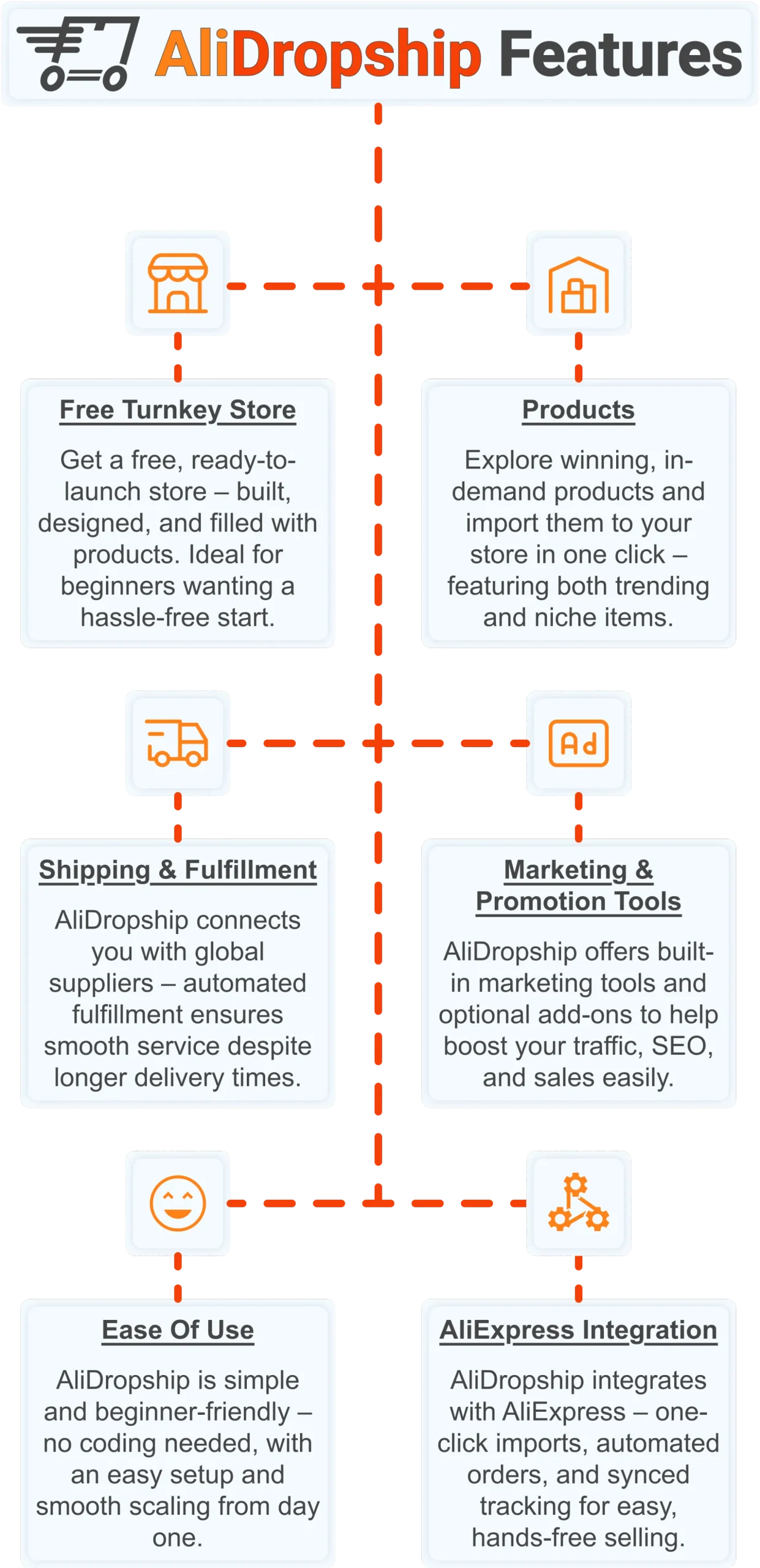
Free turnkey store 🛍️
Get a free turnkey store – built, designed, and filled with products. Ideal for beginners wanting a hassle-free start, the store comes fully optimized to attract customers right away, saving you time on setup. Plus, it includes professional design elements to give your business a polished, trustworthy look from day one. This ready-made foundation makes it easy to move seamlessly into product selection.
Products 📦
Once your store is set up, you can explore winning, in-demand products and import them in one click – featuring both trending and niche items. This wide selection lets you cater to diverse customer interests and test what works best. Regular updates ensure you always have fresh products, keeping your store competitive and relevant. With great products in place, smooth shipping becomes the next essential step.
Shipping & fulfillment 🚚
AliDropship connects you with global suppliers, and automated fulfillment ensures seamless order processing despite international delivery times. Customers receive real-time tracking updates, which builds confidence and trust in your store. Once shipping is handled reliably, you can focus on promoting your store and attracting traffic.
Marketing & promotion tools 📣
To maximize sales, AliDropship offers built-in marketing tools and optional add-ons that help boost traffic, SEO, and conversions. From email campaigns and discounts to social media integration, these tools empower you to reach and retain customers without needing prior marketing experience. With promotion strategies in place, managing your business becomes simpler and more efficient.
Ease of use 👌
AliDropship is beginner-friendly – no coding needed, with an intuitive dashboard that guides you through every step. Easy setup and smooth scaling let you expand your store without stress. As your business grows, adding new features, products, and marketing campaigns remains hassle-free, giving you more time to focus on sales.
AliExpress integration 🛒
Finally, AliDropship integrates seamlessly with AliExpress, enabling one-click imports, automated orders, and synced tracking. Your inventory stays up-to-date with the latest products and prices, while automated order processing frees you from manual tasks. Combined with the turnkey setup, reliable shipping, and built-in marketing tools, this integration ensures your dropshipping business is fully equipped for growth and success.
If a print on demand business appeals to you because of its low startup cost and product flexibility, AliDropship takes that logic even further – giving you a complete, ready-to-earn store without the design bottleneck. Get your free turnkey store and start selling today.
What is a print on demand business and how does it work?
How much can you realistically make from a print on demand business?
Most beginners earn between 200 and 800 dollars per month within their first 60 to 90 days if they publish consistently and optimise their listings. Part-time operators running their own store alongside an Etsy presence typically reach 1,000 to 3,000 dollars per month after 4 to 6 months of active effort. Full-time operators using paid ads and email marketing can reach 5,000 to 8,000 dollars per month or more, though this level requires treating the business like a real ecommerce operation.
What are the best print on demand platforms for beginners?
Etsy combined with Printify is the most recommended starting point for beginners because Etsy provides built-in search traffic and Printify offers competitive base product costs. Printful is a strong alternative with slightly higher quality control and faster US fulfillment. For sellers who want their own independent store, Shopify connected to either Printify or Printful gives full control over branding and customer data without relying on marketplace traffic. Merch by Amazon is worth pursuing once you have established designs, though it operates a tier-based invite system.
What is a good print on demand profit margin?
A realistic net print on demand profit margin after product costs, platform fees, shipping contributions, and ad spend is between 15 and 25 percent. On a 28-dollar t-shirt with a 10-dollar base cost and 6.5 percent Etsy transaction fee, the gross margin before ads is around 35 to 40 percent. Ad spend, free shipping offers, and occasional reprints reduce the net figure. At 5,000 dollars per month in revenue, a well-managed store can net between 750 and 1,250 dollars per month in profit.
How long does it take to make money with print on demand?
Most sellers see their first sale within 2 to 4 weeks on Etsy if their listings are properly keyword-optimised and priced competitively. Reaching a consistent 500-dollar monthly income typically takes 60 to 90 days with a catalogue of 30 to 50 listings in a focused niche. Scaling beyond 1,000 dollars per month generally requires 4 to 6 months of consistent effort, regular new design uploads, and at least one additional traffic channel such as Pinterest or a small paid ad budget.