Is Dropshipping Profitable In 2026? (Real Numbers, Margins & Trends)


Ecommerce has fundamentally transformed how people shop and how entrepreneurs build businesses. Among the various online business models, dropshipping continues to spark heated debates. Some claim it’s a fast track to online income, while others question whether it’s still viable in an increasingly competitive landscape. So as we navigate through 2026, it’s time to ask the critical question: is dropshipping profitable? Can it still generate substantial income, or has market saturation made it obsolete?
In this comprehensive guide, we’ll cut through the noise with real data, current market trends, and practical strategies to help you understand dropshipping profitability in 2026.
Quick answer
Is dropshipping profitable in 2026? Yes. The global dropshipping market reached $445 billion in 2025 and is projected to hit $500 billion by 2026. Typical profit margins range from 15-30%, with beginners earning $500-$2,000/month and experienced sellers making $10,000-$100,000+/month. Success depends on strategic niche selection, automation tools, and effective marketing.
While competition has increased, opportunities still exist for those who approach dropshipping as a real business with proper systems and branding.
The current state of dropshipping: 2026 market overview
Market size & growth projections
The numbers tell a compelling story. The global dropshipping industry has experienced remarkable growth, reaching $370 billion in 2024 and showing no signs of slowing down. Industry analysts project the market will surpass $500 billion by 2027, representing a steady 7-10% year-over-year growth rate.
This growth isn’t just theoretical. Real-world data shows that approximately 33% of online stores now use some form of dropshipping, and businesses with strong social media integration report up to 32% more revenue compared to those without it.

The online shopping landscape continues expanding as well. In 2026, an estimated 2.64 billion people worldwide shop online–that’s nearly one-third of the global population. The global ecommerce market has grown to approximately $6.3 trillion, creating an enormous addressable market for dropshippers who position themselves strategically.
Key trends shaping 2026 profitability
Several significant trends are reshaping the dropshipping landscape:
1. TikTok Shop Revolution
TikTok Shop has emerged as a game-changing platform with $33+ billion in annual gross merchandise value and access to 1.6 billion active users. The platform’s algorithm favors authentic, engaging content over traditional ads, creating opportunities for dropshippers who can create compelling videos. Products can go viral overnight, generating thousands of sales within days.
2. AI-powered automation
Artificial intelligence has transformed operational efficiency. Modern automation tools can reduce manual work by 60-70%, handling everything from product imports to order fulfillment and customer communications. This allows entrepreneurs to scale faster while maintaining profitability.
3. Emphasis on fast shipping
Consumer expectations have shifted dramatically. The standard 20-30 day shipping times from overseas suppliers are no longer acceptable. Successful dropshippers in 2026 prioritize US and EU-based warehouses that offer 2-5 day delivery, even if it means slightly lower margins.
4. Micro-niche dominance
Broad niches like “fitness equipment” or “phone accessories” have become oversaturated. The profitable opportunities now exist in highly specific micro-niches: biodegradable pet supplies for eco-conscious owners, ergonomic desk accessories for remote workers, or specialized equipment for niche hobbies.
5. Tariff & regulatory changes
Changes to the US de minimis rule (which previously allowed imports under $800 to enter with minimal processing) have impacted cross-border dropshipping. Successful sellers are adapting by working with domestic fulfillment partners and factoring these costs into their pricing strategies.
Understanding dropshipping profit margins in 2026
What are typical profit margins?
Let’s be transparent: dropshipping profit margins have tightened as the market has matured. While early dropshippers sometimes enjoyed margins of 40-50%, the reality in 2026 is more modest but still very profitable.
Typical profit margins now range from 15-30% after accounting for all expenses including product costs, shipping, platform fees, payment processing, and advertising. Here’s how margins typically break down by product category:
Real profit calculation examples
Let’s break down exactly what you can expect to keep from each sale with two realistic examples:
Example 1: Low-ticket product (phone case)
- Selling price: $15.99
- Supplier cost: $3.00
- Shipping cost: $2.50
- Platform fees (Shopify): $0.60
- Payment processing(2.9% + $0.30): $0.76
- Advertising cost per sale: $5.00
- TOTAL COSTS: $11.86
- NET PROFIT PER SALE: $4.13 (26% margin)
- Monthly scenario: If you sell 150 units per month, that’s $619.50 in monthly profit. Not life-changing alone, but scale this across multiple products and the numbers become significant.
Example 2: Mid-ticket product (portable blender)
- Selling price: $79.99
- Supplier cost: $22.00
- Shipping cost: $6.00
- Platform fees: $2.40
- Payment processing: $2.62
- Advertising cost per sale: $18.00
- TOTAL COSTS: $51.02
- NET PROFIT PER SALE: $28.97 (36% margin)
- Monthly scenario: Selling just 50 units monthly generates $1,448.50 in profit. With multiple winning products, this scales quickly.
Factors that affect your margins
Several key factors determine whether you’ll hit the higher or lower end of profit margin ranges:
1. Product selection
Unique, problem-solving products command better margins than commodity items. A specialized ergonomic pillow for side sleepers will always out-perform generic pillows.
2. Supplier relationships
Negotiating better wholesale prices as your volume increases can improve margins by 5-10%. Building strong supplier partnerships is crucial for long-term profitability.
3. Advertising efficiency
Your customer acquisition cost (CAC) directly impacts profitability. Successful dropshippers continuously test and optimize ads to lower CAC from $15-20 down to $8-12 per customer.
4. Platform choice
Different platforms have vastly different fee structures. Shopify charges monthly fees but lower transaction costs, while marketplaces like Amazon have higher fees but provide built-in traffic.
5. Operational automation
Manual order processing eats into profits through time costs and errors. Automation tools like AliDropship eliminate these hidden costs while improving accuracy.
How much money can you realistically make with dropshipping in 2026?
This is the question everyone wants answered. The truth is income varies dramatically based on experience, effort, and strategy, but here’s what real dropshippers earn:
Beginner phase (first 0-6 months): $500-$2,000/month
When you’re just starting, expect to spend the first few months learning, testing products, and refining your approach. Many beginners break even or operate at a small loss initially while they figure out what works.
Typical beginner profile:
- Testing 5-10 products to find winners
- Learning advertising platforms
- Small daily ad budget ($10-30)
- Building initial customer base
- Time to profitability: 3-6 months
During this phase, realistic earnings are $500-$2,000 per month once you’ve found 1-2 winning products and optimized your ad campaigns.
Intermediate phase (6-18 months): $3,000-$10,000/month
Once you’ve mastered the fundamentals, profits increase substantially. Intermediate dropshippers have dialed in their product research, advertising, and operational systems.
Typical intermediate profile:
- 3-5 proven winning products
- Optimized advertising with 2-3x ROAS
- Medium ad budget ($100-300 daily)
- Email marketing automation
- Streamlined fulfillment processes
- Monthly revenue: $15,000-$50,000
- Net profit: $3,000-$10,000 (20-30% margins)
At this stage, dropshipping becomes a legitimate income source that can replace or exceed a traditional salary.
Advanced phase (18+ months): $10,000-$100,000+/month
Experienced dropshippers who’ve scaled their operations can generate substantial income. These entrepreneurs treat dropshipping as a serious business with systems, teams, and multiple revenue streams.
Typical advanced profile:
- Portfolio of 10-20 products across multiple niches
- Multi-channel selling (Shopify + TikTok Shop + Amazon)
- Large ad budgets ($500-$2,000+ daily)
- Team members or VAs handling operations
- Strong brand presence and customer loyalty
- Monthly revenue: $100,000-$500,000+
- Net profit: $10,000-$100,000+ (15-25% margins at scale)
Important note: These high-earning dropshippers didn’t start here. They invested 1-2 years learning, testing, failing, and optimizing before reaching this level. The path requires persistence, continuous learning, and willingness to invest in growth.
Income progression chart
Profitability by selling channel: Which platform makes the most money?
Where you sell dramatically impacts your profitability. Each platform has distinct advantages, fee structures, and audience characteristics. Let’s analyze the major platforms:
Platform comparison table
Key takeaways:
- Shopify offers the most control and branding potential, ideal for building long-term businesses
- TikTok Shop has the lowest fees and highest viral potential for trending products
- Amazon provides massive traffic but charges premium fees requiring high volume
- Etsy works best for unique, customizable, and handmade-style products
- eBay and Facebook Marketplace are great for quick testing with minimal investment
Why dropshipping still works: The potential for beginners in 2026
Despite increased competition, dropshipping remains one of the most accessible business models for aspiring entrepreneurs. Here’s why it continues to attract thousands of new sellers:
Low barrier to entry
Traditional retail requires significant upfront capital for inventory, warehousing, and staffing. Dropshipping flips this model entirely. You can launch a store for under $100 and only purchase products after customers order them. This dramatically reduces financial risk and makes entrepreneurship accessible to anyone with internet access and determination.
Minimal startup costs:
- Domain name: $10-20/year
- Shopify subscription: $1 for first month trial, then $29/month
- AliDropship or automation tool: $29-299 one-time or monthly
- Initial ad testing budget: $100-500
- Total to start: $150-850
Infinite product selection
Unlike traditional retail where you’re limited by physical space and capital, dropshipping offers access to millions of products across countless niches. If a product isn’t selling, you simply remove it and test something new–no sunk costs in dead inventory.
This flexibility allows you to:
- Test multiple products simultaneously
- Pivot quickly based on market trends
- Enter seasonal niches without risk
- Adapt to changing consumer demands
- Scale winning products without inventory constraints
Location independence
Dropshipping businesses can be managed from anywhere with reliable internet. This geographical freedom attracts digital nomads, parents wanting flexible schedules, and anyone seeking to escape traditional 9-5 constraints.
Many successful dropshippers run six-figure businesses while:
- Traveling the world
- Living in lower cost-of-living areas
- Working part-time hours
- Managing multiple businesses simultaneously
Scalability without proportional costs
Traditional businesses face scaling challenges: more sales require more inventory investment, larger warehouses, additional staff. Dropshipping scales more efficiently because your supplier handles fulfillment. Going from 10 orders daily to 100 doesn’t require 10x more infrastructure on your end.
Scaling advantages:
- Supplier handles increased fulfillment
- Automation tools process more orders without proportional cost increases
- Marketing can be systematized and outsourced
- Multiple products can be managed with same infrastructure
Evolution of support tools
The dropshipping ecosystem has matured significantly. Platforms like AliDropship have emerged to solve the operational challenges that plagued early dropshippers:
- Automated order fulfillment eliminates manual processing
- Real-time inventory monitoring prevents overselling
- One-click product imports save hours of work
- Price optimization tools maintain profitability
- Customer service automation handles routine inquiries
These tools level the playing field, allowing solo entrepreneurs to compete with larger operations.
The reality check: 2026 challenges affecting profitability
While dropshipping remains profitable, success requires navigating several significant challenges:
Challenge 1: Intense competition
The problem: Low barriers to entry mean you’re competing with thousands of other dropshippers, many targeting the same profitable niches. Generic stores selling commodity products struggle to differentiate.
Impact on profitability: Increased competition drives down prices, increases advertising costs, and makes customer acquisition more expensive. Many beginners fail because they can’t compete on price with established sellers.
Solutions:
- Focus on micro-niches: Instead of “fitness equipment,” target “resistance bands for physical therapy” or “workout gear for pregnant women”
- Build a brand: Create a memorable brand identity with cohesive visuals, messaging, and customer experience
- Offer superior customer service: Respond quickly, handle issues proactively, and turn customers into advocates
- Create unique product bundles: Combine products in ways competitors don’t
- Develop proprietary products: Work with suppliers to create exclusive variations
Challenge 2: Rising advertising costs
The problem: Facebook and TikTok advertising costs have increased 30-50% since 2023. Cost per thousand impressions (CPM) that used to be $5-8 now often runs $12-20, especially in competitive niches.
Impact on profitability: Higher advertising costs directly reduce profit margins. A product that was profitable at $8 CAC may lose money at $18 CAC.
Solutions:
- Master organic marketing: Create valuable content that attracts customers without paid ads
- Build email lists: Capture visitors and market to them repeatedly for free
- Develop influencer partnerships: Micro-influencers offer more affordable reach than paid ads
- Improve conversion rates: Better landing pages and offers reduce CAC by converting more traffic
- Test multiple platforms: Don’t rely solely on Facebook; diversify across TikTok, Pinterest, Google
- Create lookalike audiences: Use existing customer data to find similar prospects more efficiently
Challenge 3: Tariffs & import regulation changes
The problem: Changes to the US de minimis rule and increased tariff scrutiny have made cross-border dropshipping more complex and expensive. Products previously exempt from duties now face additional fees and processing delays.
Impact on profitability: Unexpected customs fees, longer delivery times, and additional administrative burden reduce margins and hurt customer satisfaction.
Solutions:
- Partner with domestic suppliers: Work with US or EU-based wholesalers and fulfillment centers
- Use platforms with US warehouses: Sellvia and similar services offer US-based inventory storage
- Factor tariffs into pricing: Build these costs into your product pricing from the start
- Communicate shipping times clearly: Set accurate expectations to reduce complaints
- Offer expedited shipping options: Let customers pay extra for faster delivery from domestic warehouses
Challenge 4: Increased customer acquisition costs (CAC)
The problem: As digital advertising matures, acquiring new customers costs more across all platforms. The days of $3-5 CAC are largely gone; realistic CAC now ranges from $12-30 depending on niche and product price point.
Impact on profitability: High CAC means you need higher-priced products or excellent repeat purchase rates to maintain profitability.
Solutions:
Focus on customer lifetime value (CLV): Build systems to generate repeat purchases
Implement email marketing: Nurture customers post-purchase to encourage additional orders
Create loyalty programs: Reward repeat customers with discounts or exclusive products
Increase average order value (AOV): Use upsells, cross-sells, and bundles to sell more per transaction
Develop subscription models: For consumable products, offer subscription discounts
Improve targeting precision: Use detailed audience targeting to reach only highest-probability buyers
Challenge 5: Quality control & supplier reliability
The problem: You never physically handle products, making quality control challenging. Poor supplier performance damages your reputation, leads to returns, and creates negative reviews.
Impact on profitability: Returns cost 2-3x the original sale in processing, refunds, and lost customer trust. Bad reviews reduce conversion rates by 15-25%.
Solutions:
- Order samples before listing: Test every product yourself to verify quality
- Vet suppliers thoroughly: Check reviews, response times, and track records
- Maintain backup suppliers: Have alternative sources for your winning products
- Implement quality guarantees: Offer hassle-free returns to build customer confidence
- Communicate proactively: Set clear expectations about product specifications and shipping
- Build supplier relationships: Regular communication improves priority and service quality
Proven strategies to maximize your dropshipping profits in 2026
Success in 2026 dropshipping requires more than just listing products and running ads. Implement these strategies to maximize profitability:
Strategy 1: Master niche selection
The foundation of profitability is choosing the right niche. Follow this framework:
Step 1: Identify your criteria
Products priced $20-150 (sweet spot for margins and impulse purchases)
Lightweight for affordable shipping
Solves specific problems or fulfills strong desires
Not easily found in local retail stores
Evergreen demand or predictable seasonal patterns
Profit potential of at least $15-30 per unit
Step 2: Research demand
Use Google Trends to verify consistent or growing interest
Check Amazon bestsellers in your category
Analyze TikTok and Instagram hashtags for engagement
Search Reddit and niche forums for pain points
Review competitor reviews to identify gaps
Step 3: Assess competition
Search for products on your target platform
Analyze top sellers’ pricing, positioning, and reviews
Count number of established competitors
Identify opportunities to differentiate
Look for underserved sub-niches
Step 4: Calculate profitability
Source products from multiple suppliers
Calculate total costs including shipping, fees, and estimated ad costs
Ensure target margin of 25-35% is achievable
Verify audience can support necessary pricing
Strategy 2: Leverage automation for scale
Manual dropshipping quickly becomes overwhelming as you scale. Automation is essential for maintaining profitability while growing.
Core automation implementations:
Order fulfillment automation (AliDropship, DSers, AutoDS)
- Orders automatically forwarded to suppliers
- Tracking numbers imported to your store
- Customer notifications sent automatically
- Eliminates human error and saves 5-10 hours weekly
Inventory management automation
- Real-time stock level monitoring
- Automatic product deactivation when out of stock
- Price monitoring to maintain margins
- Prevents overselling and angry customers
Email marketing automation (Klaviyo, Omnisend)
- Welcome series for new subscribers
- Abandoned cart recovery sequences
- Post-purchase review requests
- Win-back campaigns for inactive customers
- Can generate 15-25% of revenue on autopilot
Customer service automation (Gorgias, Zendesk)
- AI-powered chatbots handle common questions
- Automatic responses to tracking inquiries
- Ticket routing to appropriate team members
- Saves hours daily on repetitive inquiries
Ad management automation (Revealbot, Smartly.io)
- Automatic budget allocation to winning ads
- Pause unprofitable campaigns based on rules
- Scale winning ads gradually
- A/B testing automation
Strategy 3: Optimize your sales funnel
Every percentage point improvement in conversion rate directly increases profitability without spending more on traffic.
Homepage optimization:
- Clear value proposition visible in 3 seconds
- High-quality lifestyle imagery
- Trust signals (reviews, guarantees, secure checkout badges)
- Prominent search and category navigation
- Mobile-first design (60% of traffic)
Product page optimization:
- Benefit-focused descriptions (not just features)
- Multiple high-resolution images from different angles
- Video demonstrations when possible
- Detailed specifications and dimensions
- Social proof (reviews, ratings, customer photos)
- Urgency elements (limited stock, countdown timers)
- Related products for cross-selling
Checkout optimization:
- Guest checkout option
- Multiple payment methods (credit cards, PayPal, Shop Pay, Apple Pay)
- Progress indicators
- Security reassurances
- Clear shipping costs early
- One-click upsells post-purchase
Follow-up optimization:
- Immediate order confirmation email
- Shipping notification with tracking
- Delivery confirmation
- Review request 7-14 days post-delivery
- Cross-sell related products 30 days post-delivery
Strategy 4: Implement strategic upselling & cross-selling
Increasing average order value (AOV) is the fastest way to boost profitability without acquiring more customers.
Pre-purchase upsells:
- Bundle related products at discount (save 15% when buying 3)
- Offer premium versions of main product
- Add protection plans or extended warranties
- Suggest frequently bought together items
At-checkout upsells:
- “Add [complementary item] for only $X more”
- Quantity discounts (buy 2, save 10%)
- Free shipping threshold prompts
Post-purchase upsells:
- One-click upsells immediately after checkout
- Email campaigns to recent customers
- “Complete your order” suggestions
- Exclusive bundle offers for existing customers
Example: Customer buys yoga mat for $39.99. Your upsell strategy:
- Pre-checkout: Suggest yoga blocks and strap bundle (+$19.99)
- At checkout: Offer express shipping upgrade (+$4.99)
- Post-purchase: One-click add yoga towel (+$14.99)
Result: AOV increases from $39.99 to $79.96 – doubling revenue per customer without additional acquisition costs.
Strategy 5: Build customer loyalty & repeat business
Acquiring a new customer costs 5-7x more than selling to an existing one. Building repeat business is crucial for long-term profitability.
Loyalty program implementation:
- Point-based rewards system
- VIP tiers with escalating benefits
- Birthday discounts and special offers
- Early access to new products
- Exclusive promotions for members
Email nurture sequences:
- Welcome series educating new customers
- Regular value-driven content (not just promotions)
- Product education and tips
- User-generated content showcasing
- Re-engagement campaigns for inactive customers
Community building:
- Private Facebook group or Discord server
- User-generated content campaigns on social media
- Customer spotlight features
- Contests and giveaways
- Referral programs with incentives
Exceptional customer service:
- Respond to inquiries within 2-4 hours
- Proactive communication about delays
- Hassle-free returns and exchanges
- Go above and beyond to resolve issues
- Follow up after resolution to ensure satisfaction
Common dropshipping mistakes that kill profitability
Avoid these critical errors that cause most dropshippers to fail:
Mistake 1: Choosing oversaturated niches
The error: Jumping into “hot niches” everyone talks about (fitness gear, phone accessories, pet supplies) without specialization.
Why it kills profits: You’re competing with thousands of established sellers on price alone. Advertising costs skyrocket while conversion rates plummet.
The fix: Go micro. Instead of “fitness equipment,” target “resistance bands for physical therapy patients over 50.” Instead of “phone cases,” focus on “eco-friendly biodegradable phone cases for iPhone users.”
Mistake 2: Neglecting product quality
The error: Choosing suppliers solely based on lowest price without testing samples or checking reviews.
Why it kills profits: Poor quality leads to returns (costing 2-3x the original sale), negative reviews (reducing conversion rates 15-25%), and chargebacks.
The fix: Always order samples before listing products. Test them yourself. Read supplier reviews. Start with smaller, reputable suppliers rather than the absolute cheapest options. Build quality into your brand promise.
Mistake 3: Amateur store design
The error: Using free themes without customization, poor product photography, generic descriptions, and cluttered layouts.
Why it kills profits: Professional consumers can spot a low-effort store instantly. Conversion rates suffer dramatically (often <1% vs. 2-4% for professional stores).
The fix: Invest in professional design. Use high-quality product images and lifestyle photography. Write compelling, benefit-focused copy. Ensure mobile optimization. Consider AliDropship’s custom store service if design isn’t your strength.
Mistake 4: Ignoring email marketing
The error: Focusing entirely on paid ads without building an email list or nurturing customer relationships.
Why it kills profits: You’re leaving 15-30% of potential revenue on the table. Email marketing generates $36-42 for every $1 spent when done correctly.
The fix: Install email capture popups from day one. Offer an incentive (10% discount, free shipping). Build automated sequences for welcome, abandoned cart, post-purchase, and re-engagement. Send 2-3 value-driven emails per week.
Mistake 5: Giving up too soon
The error: Testing 2-3 products, spending $500 on ads, not seeing immediate results, and quitting.
Why it kills profits: You never reach profitability because you quit during the learning phase. Most successful dropshippers tested 10-20 products before finding consistent winners.
The fix: Set realistic expectations. Commit to testing at least 10-15 products over 3-6 months. Track all data meticulously. Learn from failures. Most successful dropshippers failed multiple times before succeeding.
Mistake 6: Over-reliance on paid advertising
The error: Putting all marketing efforts into Facebook or TikTok ads without building organic channels.
Why it kills profits: When ad costs spike or accounts get banned, your entire business collapses. You have no fallback traffic source.
The fix: Diversify traffic sources. Build organic social media presence. Invest in SEO and content marketing. Create valuable YouTube or TikTok content. Develop partnerships and affiliates. Build an audience that you own (email list).
Mistake 7: Poor supplier management
The error: Working with unreliable suppliers who have slow shipping, frequent stockouts, or poor communication.
Why it kills profits: Customer complaints, refunds, and negative reviews damage your reputation and reduce future sales. Time spent managing supplier issues could be spent growing your business.
The fix: Thoroughly vet suppliers before committing. Maintain relationships with 2-3 backup suppliers for each product. Communicate regularly. Set clear expectations. Use platforms like AliDropship that have pre-vetted supplier networks.
Mistake 8: Ignoring data & analytics
The error: Running ads and fulfilling orders without tracking conversion rates, customer acquisition costs, or customer lifetime value.
Why it kills profits: You’re flying blind. You don’t know which products, ads, or channels are actually profitable. You might be losing money without realizing it.
The fix: Implement comprehensive tracking from day one. Monitor key metrics weekly: conversion rate, AOV, CAC, CLV, ROAS, profit margin. Use tools like Google Analytics, Facebook Pixel, and your platform’s built-in analytics. Make data-driven decisions, not emotional ones.
Step-by-step guide: Starting profitable dropshipping in 2026
Ready to build your own profitable dropshipping business? Follow this proven roadmap:
Step 1: Research & select your profitable niche
Time investment: 1-2 weeks
Goal: Identify a niche with strong demand, manageable competition, and 25-35% profit potential
Action steps:
- Brainstorm 20-30 niche ideas based on your interests, knowledge, and market observation
- Use Google Trends to verify sustained or growing interest
- Search “niche + Reddit” to find passionate communities discussing problems
- Check Amazon bestsellers and TikTok trending sounds in your categories
- Analyze competition on your target selling platform
- Calculate potential profitability for top 3-5 niches
- Select your niche based on demand, competition, and profit potential
Success criteria: You’ve identified a niche with proven demand, <50 direct competitors on your platform, and products you can profitably sell with 25%+ margins.
Step 2: Choose your selling platform
Time investment: 2-3 days
Goal: Select the platform that best aligns with your niche, technical skills, and business goals
Action steps:
- Review the platform comparison table earlier in this article
- Consider your target audience (Where do they shop? Shopify? TikTok? Etsy?)
- Assess your technical skills (Comfortable with Shopify setup? Prefer marketplace?)
- Calculate total costs including fees, apps, and tools
- Make your platform decision
Recommendations by profile:
- Complete beginners: Start with TikTok Shop or Etsy (lowest barrier)
- Serious about branding: Shopify + AliDropship
- Want fastest results: Facebook Marketplace or eBay
- Technical background: WooCommerce for maximum control
- Want massive scale: Amazon (but be prepared for competition)
Step 3: Find & vet reliable suppliers
Time investment: 1-2 weeks
Goal: Identify 2-3 reliable suppliers for your initial product lineup
Action steps:
- If using AliDropship: Access our vetted supplier network
- If sourcing independently: Search AliExpress, CJ Dropshipping, Spocket, or domestic wholesalers
- Check supplier ratings, reviews, and response times
- Order samples of your top 10 products
- Test quality, packaging, and shipping times personally
- Contact suppliers to discuss terms, shipping methods, and bulk pricing
- Select primary and backup suppliers for each product
Quality checklist:
✅ 4.7+ star rating with 1000+ reviews
✅ Responsive to messages within 24 hours
✅ Product quality meets or exceeds expectations
✅ Reasonable shipping times (ideally 7-14 days maximum)
✅ Professional packaging
✅ Willing to discuss partnership as you scale
Step 4: Build your professional store
Time investment: 1-2 weeks (or 1-2 days with AliDropship’s custom store service)
Goal: Create a professional, conversion-optimized online store
Action steps:
Option A – DIY approach:
- Sign up for Shopify trial ($1 for first month)
- Choose professional theme (free or $180-300 premium)
- Customize branding (logo, colors, fonts)
- Install essential apps (email capture, reviews, abandoned cart)
- Create homepage, product pages, about page, policies
- Set up payment processing and shipping settings
- Test checkout process thoroughly
- Optimize for mobile
Option B – AliDropship custom store service:
- Consult with AliDropship team about your niche and vision
- Provide branding preferences and examples you like
- Review and approve design mockups
- Receive completed, professional store ready for products
- Add your product selection with one-click imports
Store essentials checklist:
✅ Professional, clean design
✅ Fast loading speed (<3 seconds)
✅ Mobile-responsive (test on multiple devices)
✅ Trust signals (reviews, guarantees, secure badges)
✅ Clear navigation and search
✅ Compelling product descriptions
✅ High-quality product images
✅ Complete legal pages (Privacy Policy, Terms, Refund Policy)
✅ Email capture popup
✅ Professional logo and branding
Step 5: Implement automation systems
Time investment: 2-3 days
Goal: Automate order fulfillment, inventory management, and customer communications
Action steps:
- Install AliDropship or similar automation tool
- Connect to your supplier accounts
- Configure automatic order forwarding
- Set up inventory sync and monitoring
- Enable automated price adjustments
- Configure customer notification templates
- Set up abandoned cart recovery emails
- Test automation with small test orders
- Create standard operating procedures (SOPs) for manual tasks
Automation checklist:
✅ Orders automatically forwarded to suppliers
✅ Tracking numbers imported to store automatically
✅ Customer notifications sent at each stage
✅ Inventory levels monitored in real-time
✅ Out-of-stock products automatically hidden
✅ Abandoned cart emails scheduled
✅ Welcome email series active
✅ Review request emails scheduled 14 days post-delivery
Step 6: Launch strategic marketing campaigns
Time investment: Ongoing (2-3 hours daily initially)
Goal: Drive qualified traffic and generate your first sales
Action steps:
Week 1-2: Organic foundation
- Create social media accounts (TikTok, Instagram, Facebook)
- Post 1-2 times daily with valuable content (not just product promotion)
- Engage with niche communities and hashtags
- Build initial email list through contests or lead magnets
Week 3-4: Paid advertising launch
- Start with small daily budget ($10-20)
- Test 3-5 different products with 2-3 ad variations each
- Run ads for 3-5 days per product before making decisions
- Track key metrics: CTR, CPC, conversion rate, ROAS
- Identify winning products (2x+ ROAS)
- Pause losing products/ads
Month 2+: Scale what works
- Gradually increase budget on winning ads (20% every 3-5 days)
- Create more variations of winning ad creative
- Expand to additional platforms (if starting on Facebook, test TikTok)
- Implement retargeting campaigns for site visitors
- Build lookalike audiences from customers
- Continue testing new products regularly
Marketing budget guidelines:
- Month 1: $300-600 testing budget
- Month 2-3: $500-1,500 (scaling winners)
- Month 4+: $1,000-5,000+ (depends on profitability)
Step 7: Analyze, optimize & scale
Time investment: 3-5 hours weekly
Goal: Continuously improve profitability through data-driven optimization
Action steps:
Weekly analysis:
- Review all key metrics (traffic, conversion rate, AOV, CAC, ROAS)
- Identify best and worst performing products
- Analyze customer feedback and reviews
- Check supplier performance and shipping times
- Review email marketing performance
- Assess customer service inquiries for patterns
Monthly optimization:
- Pause products with poor performance (after sufficient testing)
- Increase investment in winning products
- Test new products based on market trends
- Optimize underperforming ad campaigns
- Improve product pages based on data
- Refine target audiences
- Update pricing based on costs and competition
- Plan next month’s product testing
Quarterly scaling:
- Analyze overall business profitability
- Consider expanding to additional platforms
- Evaluate outsourcing opportunities (VAs for customer service)
- Invest in advanced automation tools
- Build deeper supplier relationships for better terms
- Develop brand partnerships or influencer relationships
- Consider building owned inventory for bestsellers
How AliDropship maximizes your dropshipping profitability
Success in dropshipping increasingly depends on having the right tools and systems. AliDropship has emerged as a comprehensive solution designed specifically to help dropshippers maximize profitability through automation and efficiency.
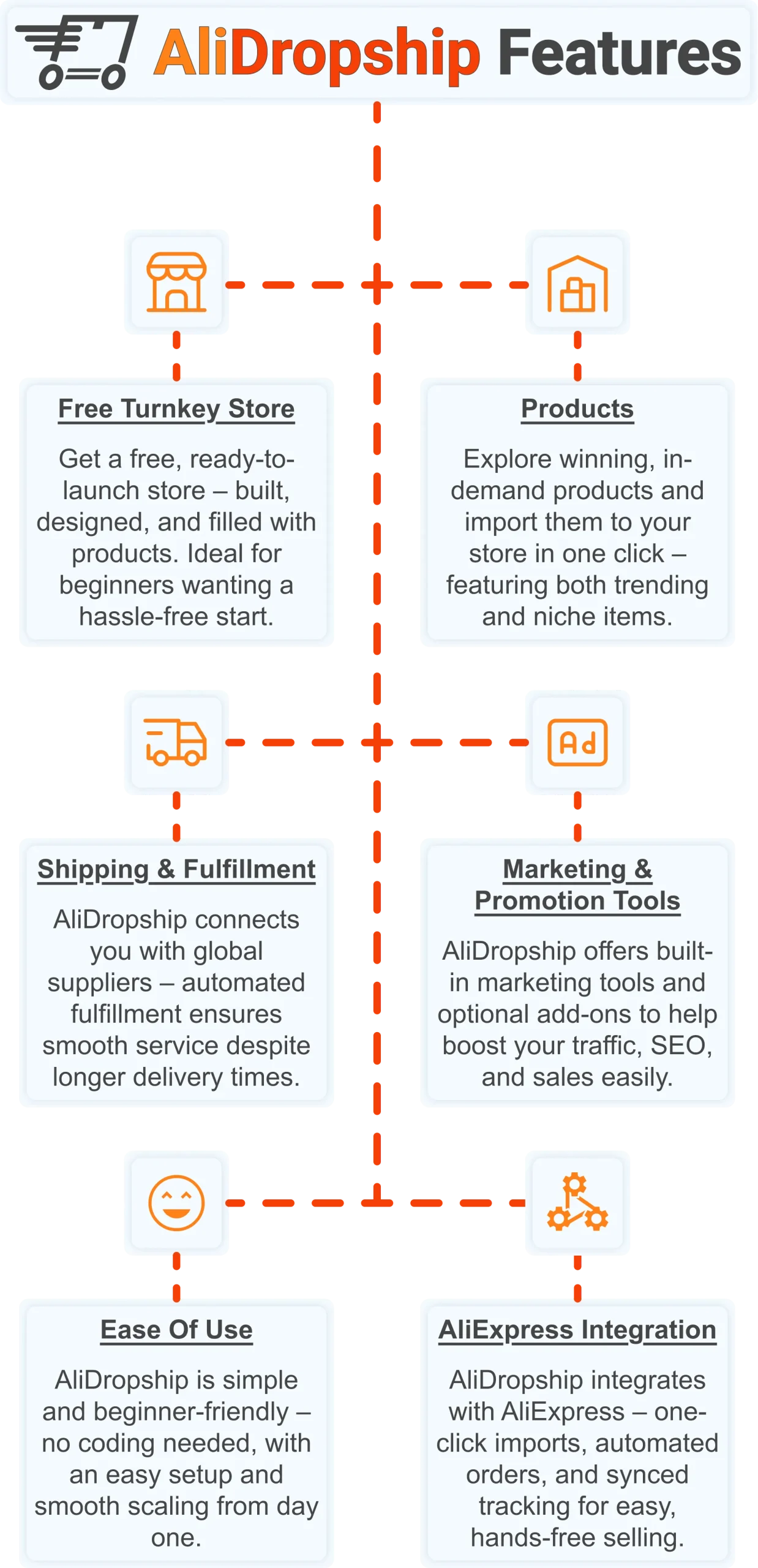
Free turnkey store 🛍️✨
Get a free turnkey store – built, designed, and filled with products. Ideal for beginners wanting a hassle-free start, the store comes fully optimized to attract customers right away, saving you time on setup. Plus, it includes professional design elements to give your business a polished, trustworthy look from day one. This ready-made foundation makes it easy to move seamlessly into product selection.
Products 📦🔥
Once your store is set up, you can explore winning, in-demand products and import them in one click – featuring both trending and niche items. This wide selection lets you cater to diverse customer interests and test what works best. Regular updates ensure you always have fresh products, keeping your store competitive and relevant. With great products in place, smooth shipping becomes the next essential step.
Shipping & fulfillment 🚚🌍
AliDropship connects you with global suppliers, and automated fulfillment ensures seamless order processing despite international delivery times. Customers receive real-time tracking updates, which builds confidence and trust in your store. Once shipping is handled reliably, you can focus on promoting your store and attracting traffic.
Marketing & promotion tools 📣📈
To maximize sales, AliDropship offers built-in marketing tools and optional add-ons that help boost traffic, SEO, and conversions. From email campaigns and discounts to social media integration, these tools empower you to reach and retain customers without needing prior marketing experience. With promotion strategies in place, managing your business becomes simpler and more efficient.
Ease of use 🧩👌
AliDropship is beginner-friendly – no coding needed, with an intuitive dashboard that guides you through every step. Easy setup and smooth scaling let you expand your store without stress. As your business grows, adding new features, products, and marketing campaigns remains hassle-free, giving you more time to focus on sales.
AliExpress integration 🔗🛒
Finally, AliDropship integrates seamlessly with AliExpress, enabling one-click imports, automated orders, and synced tracking. Your inventory stays up-to-date with the latest products and prices, while automated order processing frees you from manual tasks. Combined with the turnkey setup, reliable shipping, and built-in marketing tools, this integration ensures your dropshipping business is fully equipped for growth and success.
Conclusion: Your path to dropshipping profitability in 2026
So, is dropshipping profitable in 2026? Absolutely–but only for those who approach it strategically.
The numbers speak for themselves. With the dropshipping market reaching $445 billion in 2025 and projected to hit $500 billion by 2027, the opportunity has never been larger. More importantly, 2.64 billion online shoppers worldwide are actively seeking products, creating an enormous addressable market for smart entrepreneurs.
But here’s the reality: dropshipping has matured from a “get-rich-quick” opportunity into a legitimate business model that rewards those who treat it seriously. While profit margins have tightened to 15-30%, successful dropshippers are still generating $10,000-$100,000+ monthly by focusing on the fundamentals that actually matter.
What separates winners from quitters
The dropshippers who succeed in 2026 share common traits:
✅ They choose micro-niches over broad, oversaturated categories
✅ They build recognizable brands instead of generic stores
✅ They leverage automation tools like AliDropship to scale efficiently
✅ They prioritize customer experience over quick profits
✅ They test relentlessly and learn from failures
✅ They adapt to trends like TikTok Shop and AI tools early
Those who fail typically give up after testing 2-3 products or expect overnight success without putting in the work. Profitability comes to those who commit to the process, test 10-20+ products, optimize continuously, and treat their store as a real business.
Your next steps
If you’re serious about building a profitable dropshipping business, here’s what to do:
1. Start with research – Identify a profitable micro-niche with proven demand but manageable competition
2. Choose your platform – Shopify for brand building, TikTok Shop for viral potential, or test on eBay/Facebook first
3. Implement automation – Use AliDropship to handle fulfillment and eliminate operational headaches
4. Test strategically – Allocate $300-600 for your first month testing 5-10 products
5. Double down on winners – Scale what works, cut what doesn’t
6. Build for the long-term – Focus on customer satisfaction, email lists, and repeat business
Remember: Most successful dropshippers failed multiple times before finding their winning formula. The difference between those earning $50,000/month and those who quit? The successful ones kept testing, kept learning, and kept adapting.
The dropshipping opportunity in 2026 is real, substantial, and growing. But it’s no longer accessible to those looking for passive income without effort. It’s available to entrepreneurs willing to work smart, leverage the right tools, and commit to building something valuable.
Join thousands of successful entrepreneurs who’ve built profitable dropshipping businesses with AliDropship’s proven system. Your future of location independence and financial freedom starts now. Claim your perfect ecommerce store with hot-selling products + $100 for a business upgrade!
Is dropshipping a good way to make money?
How many dropshippers fail?
Can I make $10,000 per month dropshipping?
Can you make $2000 a month dropshipping?
How long does it take to become profitable with dropshipping?