Is DealDash Legit? 5 Red Flags And 1 Big Safety Net You Must Know

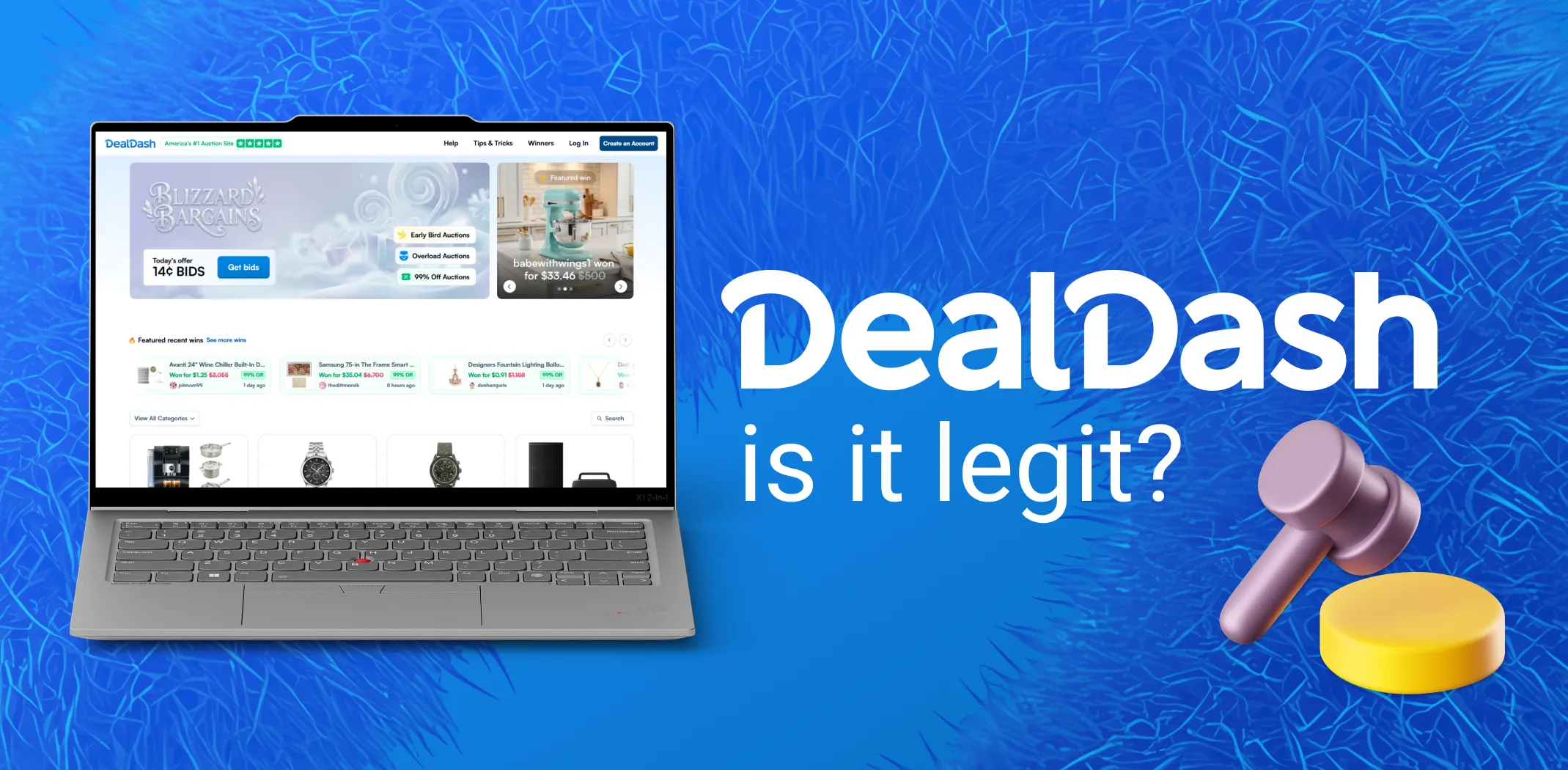
DealDash is a legitimate company – it is not a scam. It ships real products, has operated since 2009, passed a third-party audit in 2020, and maintains an A+ BBB rating through active complaint resolution. However, its penny auction model is designed to generate profit primarily from losing bidders, and research from the University of Chicago analyzing over 134,568 auctions shows that more than 55% of users consistently lose money on the platform.
The honest answer to “is DealDash legit?” is: yes operationally, but high-risk economically. Whether it is worth using depends entirely on whether you understand – and accept – the all-pay auction structure before you hand over your credit card.
This guide covers how the model works, the five specific red flags to know before signing up, the one feature that protects you if you lose, and what the data actually shows about who wins and who doesn’.

The cheat sheet: Essential alerts & your primary safeguard
If you are looking for the short answer to whether you should trust this site, here is a quick breakdown of the warning signs and the one feature that keeps the company on the right side of the law.
The 5 red flags to watch for
- The “true cost” trap: DealDash commercials often show people winning items for “pennies,” but they frequently hide the fact that the winner spent hundreds of dollars on the bids themselves to get that price.
- MSRP inflation via “house brands”: Many of the luxury brands on the site, like Bolvaint and Kamikoto, are actually owned by the founder of DealDash and have “retail prices” that are much higher than their actual market value.
- The “perpetual sale” tactic: The site almost always claims bid packs are “on sale” from a regular price of 60 cents, but they almost never actually sell them at that high rate – it is a trick to create a false sense of urgency.
- The automated “war of attrition”: Tools like BidBuddy allow users to bid automatically, which can keep an auction going for hours and drain everyone’s bid balance until the house makes a massive profit.
- Surprise sign-up charges: A major pattern of complaints at the BBB shows that new users often get charged $30 to $40 for a bid pack immediately after providing their credit card info, often without realizing they were making a purchase.
The 1 big safety net
- The “Buy It Now” (BIN) feature: This is the company’s biggest defense. If you lose an auction, you can choose to buy the item at its listed retail price, and DealDash will give you all your spent bids back to use on another auction. This turns a “gambling loss” into a regular retail purchase.
For this review, we examined DealDash’s operational history, the 2020 third-party audit findings, active BBB complaint records, the 2017 Pstikyan v. DealDash class-action lawsuit outcome, and the University of Chicago’s 2018 analysis of 174 million platform bids – all reviewed and cross-referenced as of early 2026
How DealDash works: The mechanics of the “all-pay” auction
If you want to know if DealDash is legit, you first need to realize that you aren’t actually “shopping” in the traditional sense; instead, you are participating in a bidding fee auction. In a normal auction like eBay, you only pay if you win the item. However, on DealDash, you have to pay for the right to place a bid in the first place.
You start by purchasing “bid packs,” which are bundles of credits that usually cost anywhere from 12 to 60 cents each, depending on the current sale.
Bid pack prices vary by bundle size. Smaller packs of around 100 bids typically carry a higher per-bid cost than larger packs of 1,500 bids or more. The site almost always displays bid packs as “on sale” from a higher baseline price – this is covered in red flag #3 – but the realistic per-bid cost for most users falls between 15 and 20 cents when purchasing mid-size bundles. Factor this into any win calculation: a “free” item still costs the total number of bids placed multiplied by your actual per-bid rate.
Every time you click that “bid” button, you spend one of those credits, and it is gone forever, regardless of whether you win the item or not.
Because of this structure, the site is known as an “all-pay” auction model. Each bid you place increases the price of the item by exactly one penny and resets a countdown timer, which usually lasts about nine or ten seconds.
If you are the last person to bid before that clock hits zero, you win! But here is the catch: because every bid resets the clock, auctions can go on for hours as people fight back and forth.
For example, if a PlayStation 5 “sells” for $25.00, that means 2,500 bids were placed. If each of those bids cost 15 cents, the “house” (DealDash) actually collected $375.00 in bid fees plus the $25.00 sale price.
Essentially, the company is making a profit even if the winner gets a massive discount, because the losers are the ones who effectively paid for the winner’s deal.
The “Buy It Now” (BIN) feature: Your safety net
One of the biggest reasons why people worry about the site’s legitimacy is the fear of spending $50 on bids and walking away with absolutely nothing. To solve this problem and separate itself from older, more predatory penny auctions, DealDash introduced the “Buy It Now” (BIN) feature.
This is basically a safety net that says: “If you lose the auction, you don’t have to lose your money.” If you spend 100 bids trying to win a toaster and someone else outbids you at the last second, you can choose to purchase that toaster at its listed retail price.
When you use the BIN option, DealDash will actually return all the bids you spent on that specific auction back to your account. This is a huge deal because it turns a potential total loss into a regular purchase.
However, you should be aware that the “retail prices” on the site are often higher than what you would find on Amazon or at Walmart. Furthermore, you need to have the actual cash on hand to buy the item at full price to get your bids back.
If you spent your last $30 on bids and you can’t afford the $400 retail price of the tablet you were bidding on, you are still out of luck. Because of this, many consumer advocates still compare the model to legalized gambling, even though the BIN feature technically makes it a retail transaction.
The “house brands” controversy: Bolvaint and Kamikoto
As we keep investigating to see if DealDash is legit, we have to talk about the actual products you are bidding on. While you will see big names like Apple, Sony, and Samsung, a huge portion of the items come from luxury brands you have probably never heard of, such as Bolvaint, Kamikoto, and Wilson & Miller.
Forensic research and legal filings have revealed that these are “house brands” owned by a company called Galton Voysey, which is closely tied to DealDash’s founder. The problem here is “price anchoring.”
DealDash might list a set of Kamikoto knives with a Manufacturer’s Suggested Retail Price (MSRP) of $1,200. When you see that huge number, a “win” at $100 feels like the deal of a century! But since these brands aren’t really sold in high-end department stores, that $1,200 price tag is basically made up by the company itself.
Because there is no external market for these brands, it is very hard for a regular person to know if the item is actually worth the money. Critics argue that this is a way to inflate the perceived value of the deals, making the BIN option look more attractive than it really is.
Consequently, if you are bidding on a Bolvaint house brand bag, you might be overpaying for a generic product that just has a fancy label and a high “fake” retail price.
Is DealDash rigged? Bots, BidBuddy, and the 2020 audit
A very common complaint from new users is that they feel like they are bidding against a computer. It can be incredibly frustrating to see a user name pop up and outbid you every single time the clock hits one second. You might start to think, “This has to be a bot!”
To be fair, the site does have an automated bidding tool called BidBuddy. You can tell BidBuddy how many bids you want to spend, and it will automatically place a bid for you at the last possible second. Because many people use this tool at once, auctions can stay alive for a long time, giving the illusion that a machine is controlling the outcome.
To address these concerns and prove their operational legitimacy, the company underwent a major third-party audit in 2020. An independent accounting firm looked at their systems to see if there were any “shill bots” or employees bidding to drive up prices. The audit found no evidence of bots or cheating, which is a major point in the company’s favor.
While this doesn’t mean you are guaranteed to win, it does provide some level of comfort that the person outbidding you is a real human being who is just as determined (and perhaps just as frustrated) as you are.
Legal history: Lawsuits and regulatory scrutiny
No investigation into the question ‘is DealDash legit’ would be complete without looking at their time in the courtroom. Back in 2017, a class-action lawsuit called Pstikyan v. DealDash was filed in Minnesota.
The plaintiffs claimed that the site was running an illegal lottery and that it used deceptive marketing to trick people into spending thousands of dollars on “fake” luxury brands. They pointed out that the commercials often failed to mention the cost of the bids, which meant the winners were actually paying way more than the advertised “pennies.”
Interestingly, this lawsuit was voluntarily dismissed with prejudice in 2018. In legal terms, “with prejudice” means the claims can never be filed again.
Although settlement details are private, the company updated its advertising practices afterward. Now, if you look closely at the fine print in their commercials, you will see disclosures about the total cost of winning.
For instance, if someone “wins” a mixer for $25, the tiny text might explain they actually used 700 bids to get there.
Because they survived this massive legal challenge and have continued to operate openly for years, they have managed to stay on the right side of the law, even if their business model remains controversial.
The BBB rating and customer sentiment
If you go to the Better Business Bureau website, you might be surprised to see that DealDash often maintains an A+ rating. How can a “risky” auction site get such a good grade? The answer lies in their customer service. DealDash is incredibly responsive to complaints.
Most of the negative reviews come from people who signed up and didn’t realize they were being charged $30 or $40 for an initial bid pack. When these people complain to the BBB, the company’s representatives usually respond within a few days and issue a full refund.
Because they have a 90-day money-back guarantee for your first purchase, they are able to keep their rating high by simply giving people their money back when they are unhappy. This responsiveness is a strong indicator that they aren’t a “fly-by-night” scam that is going to disappear with your money.
However, just because they have a good BBB rating doesn’t mean everyone is winning. Thousands of people still lose money on the site every day; they just do it within the rules that they agreed to when they signed up. Essentially, the company is playing fair by the rules they created, but those rules are heavily tilted in favor of the house.
Data insight: The “winner’s curse” and user success rates
To get a truly scientific view of the situation, we can look at a massive study done by researchers at the University of Chicago. They analyzed over 134,568 auctions and 174 million bids on the platform. What they found was quite revealing about who actually wins.
Research shows that 2.2% are “Power Bidders” using aggressive strategies and automated tools to win many auctions. Conversely, over 55% are “Budget Bidders” who place few bids, get outbid, and lose small amounts every time.
Ultimately, deals are real, but a small group of experts capturing most wins dominates the platform. For average users trying it occasionally, the platform usually results in a net loss of capital. Therefore, view the site as entertainment – like a casino – rather than a reliable way to save money on necessities.
Final verdict: Is DealDash legit?
So, after all that digging, what is the final answer? Is DealDash legit? Operationally, the answer is yes. They are a real company, they ship real products, they are audited by professionals, and they respond to customer complaints.
You are not going to get your identity stolen just by signing up, and if you win an item, it will actually show up at your front door. They have been in business for over fifteen years, which is almost forever in the world of the internet.
However, from an economic standpoint, the site is a high-risk environment that is designed to make the company money at the expense of the majority of its users.
It is not “shopping”; it is a competitive game where the cost of entry can quickly add up.
If you are someone who has a “fun budget” and you enjoy the thrill of the chase, you might have a great time. But if you are looking for a guaranteed way to save money because your budget is tight, you are much better off sticking to standard retailers where the price you see is the price you actually pay.
Safety checklist: 5 tips for first-time bidders
If you still feel like giving it a shot, here is a quick checklist to help you stay safe:
-
Watch the “no jumper” limit:
Many auctions won’t let new bidders join once the price hits $5.00. If you want to bid on something, make sure you jump in early so you aren’t locked out later.
-
Only bid on BIN items:
Never bid on an item unless you are willing and able to pay the full retail price to get your bids back. This is the only way to guarantee you won’t walk away with a total loss.
-
Verify the MSRP:
Before you start bidding on a brand like Bolvaint or Kamikoto, search for that item on a third-party site like Amazon. If you can buy it there for $50, don’t believe the DealDash claim that it is worth $500.
-
Set a hard limit:
Decide exactly how many bids you are willing to spend before you even start. Once you hit that number, walk away. Don’t fall for the “sunk-cost fallacy” where you keep spending just because you’ve already spent a lot.
-
Use the first-purchase guarantee:
Remember that your first bid pack is protected by a 90-day money-back guarantee. If you try it and realize it’s not for you, don’t be afraid to contact their support and ask for a refund.
DealDash is a fascinating example of how modern ecommerce can be gamified.
Because it is a “pay-to-play” system, it will always have its critics, but as long as you go in with your eyes wide open and a strict budget in mind, it can be a legitimate way to spend some time and – if you are lucky – score a deal.
Just remember that in this game, the house usually wins, and the “pennies” you see in the ads are only half the story.
What are the best alternatives to DealDash?
If DealDash’s all-pay auction model feels too risky, several alternatives offer better odds or a fundamentally different risk structure:
| Platform | Model | Risk level | Best for |
|---|---|---|---|
| Amazon | Fixed price retail | None | Guaranteed price, no bidding |
| eBay | Traditional auction | Low–Medium | Competitive pricing – pay only if you win |
| Walmart | Fixed price retail | None | Everyday low prices, no account needed |
| QuiBids | Penny auction | High | Experienced bidders only – same all-pay structure |
| Facebook Marketplace | Peer-to-peer | Low | Used items at negotiable prices, local pickup |
The critical difference between DealDash and traditional auctions like eBay: on eBay you only pay if you win. On DealDash every bid costs money regardless of outcome. For anyone uncomfortable with that structure, eBay is the closest functional alternative – competitive pricing without the all-pay risk. Amazon and Walmart are the right choice if you simply want the item at a fair, predictable price.
Moving from luck to logic: The power of dropshipping
While the thrill of an auction can be fun, many people eventually realize that they want a more reliable way to make money or build something of their own. If you are tired of the “win-some-lose-most” nature of bidding sites, you might want to look into dropshipping.
Instead of paying for a chance to get a product, dropshipping lets you build a real business where you sell products to customers without ever having to touch the inventory.
Basically, when a customer buys something from your online store, you purchase the item from a supplier at a lower price, and they ship it directly to the customer. Consequently, you keep the profit in between.
It is a more stable approach to digital commerce because you are not gambling on a timer. Instead, you provide value by finding strong products and reaching the right customers.
However, starting from scratch can be overwhelming, which is where a professional platform becomes essential.
Why AliDropship is the ultimate shortcut for serious beginners
If you want to start dropshipping without spending months building from scratch, AliDropship offers a faster, beginner-friendly solution. For $39 per month, you get a ready-made store with automation tools, eliminating the need for multiple apps or technical setup.
We’ve gathered everything you need in one place, so your turnkey dropshipping store is simple and easy to use right out of the box. Plus, there’s a 14-day free trial, which allows you to test everything out before you spend a single cent of your own money.
Here is why it is so great for beginners:
- Professional design: You get a professional free turnkey store designed for you;
- Zero experience needed: The setup is incredibly easy for beginners, and you even get access to a team that actually helps you get your business up and running;
- Marketing on autopilot: You get automated promotion tools, so you don’t need a fancy background in marketing to start making sales.
Furthermore, AliDropship is a full ecosystem. With your subscription, you get access to a huge catalog of high-quality products and product packages – these are carefully curated bundles of footwear, fashion, accessories, and tech gadgets.
Most importantly, you get partnerships with premium fashion brands like Tommy Hilfiger, Calvin Klein, Levi’s, Armani, Guess, New Balance, and even Gucci from authorized suppliers.
The entire platform is purpose-built for dropshipping, drawing on years of hands-on experience and proven results. Every store is thoughtfully designed to meet the real needs of a business owner, ensuring all the essential tools work together seamlessly.
From day one, most of the work runs on autopilot, so you can focus more on growing your brand and less on juggling the technical details. AliDropship makes launching simpler and faster, so you can start selling almost immediately.
Looking for a more predictable way to earn online instead of gambling on auctions? Start your dropshipping business today with AliDropship and launch a fully automated store.
How trustworthy is DealDash?
Are the items on DealDash new?
Yes, all products on the site are brand new. They even come with the original manufacturer warranty, so you can buy with confidence just like you would at a regular store.
What is better than DealDash?
Is shipping free on DealDash?
Yes, shipping is always free. Whether you win an auction or use the Buy It Now feature, you do not have to worry about extra shipping or handling fees.
Does it cost money to bid on DealDash?