How To Start An Ecommerce Business: A Beginner Guide

Over 2.7 billion people shopped online in 2024 – and that number is still climbing. If you have been wondering how to start an ecommerce business but kept putting it off because it felt too technical or too expensive, 2026 is genuinely the easiest year yet to get going. The barrier to entry has never been lower, the tools have never been smarter, and the market has never been bigger.
The honest answer is: you can launch a functional online store in a single day. What takes longer – 60 to 90 days of consistent effort – is building traffic, making your first sales, and finding the products that actually convert. This guide walks you through every step, from choosing your business model to making your first sale, without the fluff.
Quick Answer: To start an ecommerce business, choose a business model (dropshipping, print-on-demand, or selling your own products), set up a store on a platform like WooCommerce or Shopify, add products, and drive traffic through SEO, social media, or paid ads. Total startup cost ranges from $0 to a few hundred dollars depending on your approach.
Before diving in, it helps to understand the full picture. Starting an ecommerce business is not one decision – it is a series of smaller decisions that build on each other. The sections below cover each one in the order you will actually face them.

What is an ecommerce business?
An ecommerce business is any business that sells products or services online – through a standalone website, a marketplace like Amazon or Etsy, or both. The term covers everything from a solo dropshipper running a niche store to a large retailer with a full warehouse operation. What they share is a digital storefront and an online transaction process.
In 2026, ecommerce is not a side-of-the-desk experiment. Global ecommerce revenue is projected to exceed $6.8 trillion this year, according to Statista. More importantly for newcomers, the tools that used to require a developer and a significant budget – store builders, payment processors, inventory management – are now available to anyone with a laptop and a few hours to spare.
The three most practical models for someone starting out today are:
- Dropshipping – you sell products you never physically hold. When a customer orders, your supplier ships directly to them. Low startup cost, no inventory risk.
- Print-on-demand – you design products (t-shirts, mugs, phone cases) and a third-party prints and ships them per order. Creative-heavy, margin-light.
- Selling your own products – physical goods you make or source yourself, or digital products you create once and sell repeatedly. Higher margins, higher upfront effort.
Each model has a different effort curve, cost structure, and ceiling. The right one depends on your budget, your time, and how hands-on you want to be.
How much can you realistically earn?
The income range for ecommerce businesses is enormous – from $0 to millions per year. What matters is understanding where most beginners actually land, and what it takes to move up from there.
These figures reflect realistic monthly ranges after 60 to 90 days of active effort – not week-one results. Dropshipping tends to be the fastest path to first revenue because the setup cost is low and the product catalog is unlimited. Physical product businesses take longer to ramp but typically deliver higher margins once they find product-market fit.
One note on ceiling figures: the upper range in each row represents established stores with consistent traffic and proven products. New stores typically earn $30 to $80 per day in the early months – hitting four figures a month is a realistic 90-day target for someone working on this consistently, not a week-one guarantee. Full-time effort means daily store management, active marketing, and regular product testing.
The model with the lowest ceiling for casual effort is print-on-demand – it tends to reward creative output but offers thinner margins. Dropshipping through a platform like AliDropship gives beginners the best combination of low startup cost and genuine scalability.
How to start an ecommerce business: step by step
Here is the process broken down into the decisions you will actually face, in the order you will face them. Skip ahead if you have already completed a step – but do not skip the niche and product research phases. They are the foundation everything else rests on.
Step 1 – Choose your business model
Your first decision is how you will source and deliver products. As covered above, the main options are dropshipping, print-on-demand, and selling your own goods. For most beginners, dropshipping is the right starting point because it requires the least capital and lets you test products without buying inventory upfront.
If you already have a product idea – a skill, a craft, or a digital asset – start with what you have. The best business model is the one you will actually stick with long enough to learn from.
Step 2 – Pick a niche
A niche is a focused product category or audience. “Home decor” is a market. “Minimalist desk accessories for remote workers” is a niche. The more specific you are, the easier it is to find your first customers, rank in search, and build a recognizable brand.
Good niche selection criteria in 2026:
- Consistent search demand (use Google Trends, Ahrefs, or Semrush to verify)
- Products with a retail price of $30 to $150 – low enough to impulse-buy, high enough to leave margin
- Not dominated entirely by Amazon or big-box retailers at every price point
- A defined audience you can reach through social media or SEO
Avoid ultra-broad niches (general fashion, general electronics) and avoid niches with seasonal demand spikes if you need year-round income.
Step 3 – Find your products
Once you have a niche, you need actual products to sell. For dropshipping, AliExpress is the most widely used supplier marketplace – it covers millions of SKUs across nearly every category. For print-on-demand, Printful and Printify connect directly to your store. For own-brand physical products, Alibaba is the standard sourcing route for bulk orders.
When evaluating a product, look at three things: order volume (proof that people buy it), supplier reliability (check reviews and response rate), and shipping time (anything over 20 days will hurt your reviews). For dropshipping specifically, ePacket or AliExpress Standard Shipping to the US typically delivers in 10 to 20 days.
Why this works in 2026: Supplier networks have matured significantly. Many AliExpress sellers now ship from US or EU warehouses, cutting delivery times to 5 to 7 days for major markets – a major improvement over even two years ago.
Step 4 – Set up your online store
Your store is your primary sales channel. The two most popular platforms for independent ecommerce stores are Shopify and WooCommerce (WordPress). Shopify is faster to set up and fully hosted – no server management needed. WooCommerce gives you more flexibility and lower ongoing costs but requires more technical comfort.
For dropshipping specifically, AliDropship integrates directly with WooCommerce and handles product imports, order automation, and supplier communication in one place. It is one of the most complete solutions for someone starting an ecommerce business from zero.
Essential store setup checklist:
- Custom domain name ($10–$15/year from Namecheap or GoDaddy)
- SSL certificate (free with most hosting providers)
- Payment gateway – Stripe and PayPal are the standard starting points
- Professional theme (your platform’s free options are fine to start)
- About page, shipping policy, return policy, and contact page
Step 5 – Write product listings that convert
A product listing has one job: convert a visitor into a buyer. Most beginners copy the supplier description and wonder why their conversion rate is low. Write your own descriptions. Address the buyer’s actual concern (“will this fit my desk setup?”), highlight the benefit rather than just the feature, and include at least 3 to 5 product images.
For SEO, include the product name, key attributes, and a natural long-tail keyword phrase in the title and first paragraph of the description. A title like “Minimalist wooden pen holder – compact desk organizer for home office” performs better in search than “Pen Holder Model A.”
Step 6 – Drive traffic to your store
A store with no traffic makes no sales. Traffic is the part that takes the most consistent effort, and it is where most beginners underinvest. Your three main channels are:
- SEO (organic search) – write blog content targeting keywords your audience searches for. Slower to build (3 to 6 months to see meaningful results) but compound over time and cost nothing beyond effort.
- Social media – TikTok, Instagram, and Pinterest are the highest-leverage platforms for ecommerce in 2026. Short-form video demonstrating your product in use is the format that converts best organically.
- Paid ads – Facebook/Meta Ads and Google Shopping are the standard paid channels. Start with a small daily budget ($10 to $20) to test product-audience fit before scaling.
Most successful store owners use all three. SEO and content build long-term organic traffic. Social media builds brand recognition. Paid ads accelerate results once you know which products convert.
Earning potential: $500–$3,000/month within 90 days for a focused dropshipping store running consistent SEO and social content, based on typical beginner benchmarks across Reddit communities like r/dropship and r/ecommerce.
Ecommerce business models compared
Not sure which route to take? Here is a side-by-side view of the four main models to help you decide based on your situation.
Dropshipping and digital products are the fastest paths to a first sale because there is no inventory to purchase and no fulfillment infrastructure to build. Own physical products take longer but tend to produce stronger brand loyalty and repeat purchase rates once established.
Tips for growing your ecommerce store faster
Getting your store live is step one. Growing it to consistent monthly revenue is a different challenge – and a more interesting one. These practices separate stores that plateau at a few sales per week from those that scale to full-time income.
Focus on one traffic channel first
New store owners often spread themselves across SEO, TikTok, Instagram, Pinterest, and paid ads simultaneously. The result is mediocre effort on five channels instead of real traction on one. Pick the channel where your target audience is most active and go deep on it for at least 60 days before adding a second.
Use email from day one
Email is the highest-ROI marketing channel in ecommerce – consistently outperforming social and paid ads in revenue per contact. Set up a basic welcome sequence (3 to 5 emails introducing your store and best products) and an abandoned cart flow before you launch. Klaviyo and Mailchimp both have free tiers that cover most early-stage stores.
Test products systematically
Most products you list will not be winners. That is normal. The stores that scale are the ones that test 10 to 20 products per month, identify the 2 or 3 that convert well, and then pour marketing budget into those. Do not fall in love with a product that does not sell – cut it quickly and move on.
Optimize for mobile
Over 70% of ecommerce traffic comes from mobile devices. If your store is hard to navigate on a phone – slow load times, tiny buttons, unclear checkout flow – you are losing sales you already paid to acquire. Test your store on mobile before launch and after every major change.
Build trust signals into your store
First-time buyers from a store they have never heard of need reassurance. Add real customer reviews (even 5 to 10 genuine ones make a significant difference), a clear return policy, visible contact information, and trust badges near the checkout button. Trustpilot or Judge.me integrate cleanly with most platforms.
Legal and ethical considerations when you start an ecommerce business
Ecommerce is a real business – and that means real legal obligations. Most beginners skip this section. Do not be most beginners.
Business registration and taxes
In the US, registering an LLC costs $50 to $500 depending on the state and protects your personal assets from business liability. You will also need to understand your sales tax obligations – most states now require out-of-state sellers to collect sales tax once they exceed a certain revenue threshold (economic nexus laws). TaxJar and Avalara automate this for ecommerce stores.
Outside the US, requirements vary significantly. UK sellers need to register with HMRC once revenue exceeds £1,000 per year. EU sellers must comply with VAT rules across member states. Check your local requirements before your first sale, not after.
Product compliance and intellectual property
Do not sell counterfeit goods, do not use brand names or logos you do not own rights to, and do not source products that violate safety standards in your target market. These are not edge cases – they are common mistakes that lead to account bans, legal notices, and in some cases personal liability.
Key principle: If a supplier is selling a product at a suspiciously low price and the listing includes recognizable brand imagery, walk away. The short-term margin is not worth the long-term risk.
Consumer protection and transparency
Your store needs a privacy policy (required under GDPR for EU customers and CCPA for California), a clear shipping policy with realistic delivery timeframes, and a returns process that you will actually honor. Do not promise 3-day delivery if your supplier ships from China in 15. Customers read reviews, and one wave of “product took 3 weeks, description said 3 days” reviews can tank a store’s reputation permanently.
Important: FTC guidelines in the US require that any paid endorsement or influencer partnership be disclosed. If you send free products for reviews, that relationship must be transparent.
Which ecommerce model is right for you?
The best way to start an ecommerce business is different depending on where you are starting from. Here is a plain-English breakdown by reader profile.
Complete beginner with limited budget
Start with dropshipping. Zero inventory cost, no upfront product purchase, and platforms like AliDropship handle the supplier side for you. Your job in the first 60 days is to find a niche, test products, and build your first traffic source. Expect to invest more time than money – 1 to 2 hours per day minimum.
Intermediate – some budget, part-time focus
If you have $500 to $1,000 to invest, consider a hybrid approach: dropshipping for the core catalog with 2 to 3 branded private-label products added over time. Private label gives you better margins and a defensible brand. Use the dropshipping revenue to fund the private label development without taking on risk you cannot afford.
Advanced – full-time goal within 6 months
Treat this as a real business from day one. Register your LLC, set up proper accounting (QuickBooks or Wave), allocate a testing budget for paid ads ($20 to $50/day), and commit to publishing at least 4 SEO blog posts per month. The stores that reach full-time income within 6 months are almost always the ones with a written plan and a daily routine around the business.
The ecommerce market will not get less competitive over time – but the tools available to independent sellers will keep improving. The people who start now, learn the fundamentals, and stay consistent are the ones who will have established stores when others are still deciding whether to begin.
AliDropship: Your complete all-in-one solution for starting dropshipping in 2026
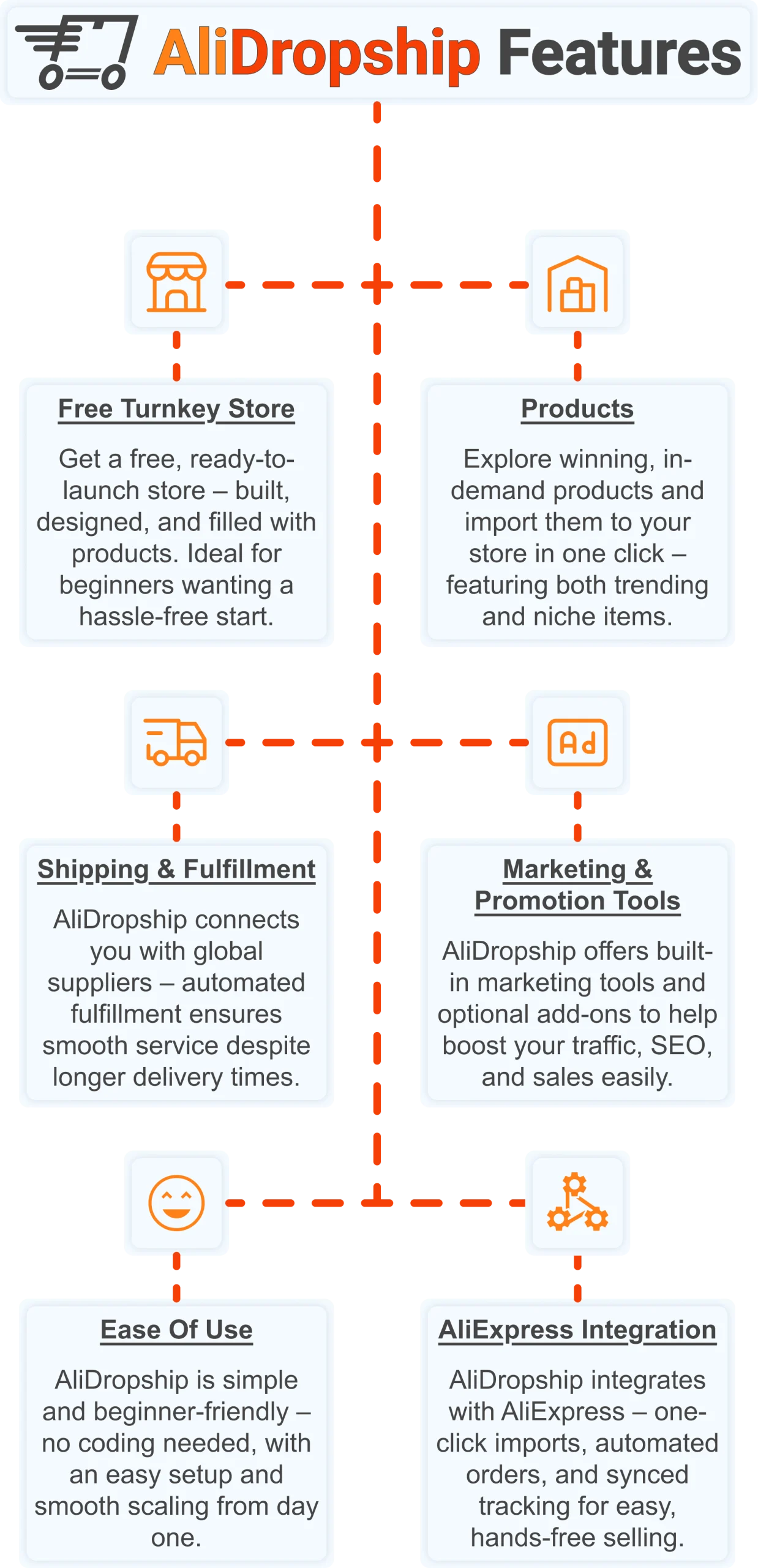
If you want the simplest possible way to start dropshipping – especially if you’re brand new – AliDropship remains one of the most beginner-friendly tools available in 2026. It brings together store creation, product imports, automation, and marketing into a single streamlined system designed to help you launch quickly and grow confidently.
Free turnkey store 🛍️
Get a free turnkey store – built, designed, and filled with products. Ideal for beginners wanting a hassle-free start, the store comes fully optimized to attract customers right away, saving you time on setup. Plus, it includes professional design elements to give your business a polished, trustworthy look from day one. This ready-made foundation makes it easy to move seamlessly into product selection.
Products 📦
Once your store is set up, you can explore winning, in-demand products and import them in one click – featuring both trending and niche items. This wide selection lets you cater to diverse customer interests and test what works best. Regular updates ensure you always have fresh products, keeping your store competitive and relevant. With great products in place, smooth shipping becomes the next essential step.
Shipping & fulfillment 🚚
AliDropship connects you with global suppliers, and automated fulfillment ensures seamless order processing despite international delivery times. Customers receive real-time tracking updates, which builds confidence and trust in your store. Once shipping is handled reliably, you can focus on promoting your store and attracting traffic.
Marketing & promotion tools 📣
To maximize sales, AliDropship offers built-in marketing tools and optional add-ons that help boost traffic, SEO, and conversions. From email campaigns and discounts to social media integration, these tools empower you to reach and retain customers without needing prior marketing experience. With promotion strategies in place, managing your business becomes simpler and more efficient.
Ease of use 👌
AliDropship is beginner-friendly – no coding needed, with an intuitive dashboard that guides you through every step. Easy setup and smooth scaling let you expand your store without stress. As your business grows, adding new features, products, and marketing campaigns remains hassle-free, giving you more time to focus on sales.
AliExpress integration 🛒
Finally, AliDropship integrates seamlessly with AliExpress, enabling one-click imports, automated orders, and synced tracking. Your inventory stays up-to-date with the latest products and prices, while automated order processing frees you from manual tasks. Combined with the turnkey setup, reliable shipping, and built-in marketing tools, this integration ensures your dropshipping business is fully equipped for growth and success.
Starting an ecommerce business does not have to mean months of setup, technical headaches, or upfront inventory costs. Get your free turnkey store from AliDropship and start selling today.
How to start an ecommerce business with no money?
What is the easiest ecommerce business to start?
How long does it take to start an ecommerce business?
How much does it cost to start an ecommerce business?
Is starting an ecommerce business worth it in 2026?