How To Start A Clothing Business In 2026

If you have been wondering how to start a clothing business, you are in good company. Fashion is one of the most searched ecommerce niches every single year – and for good reason. Global online clothing sales are projected to exceed $1.2 trillion by 2027, and a growing chunk of that is captured by small independent stores, not just the big retailers.
The barrier to entry has never been lower, and 2026 might be the most accessible year yet to get started.
Quick Answer: To start a clothing business online, you choose a niche, pick a business model (dropshipping is the lowest-cost option), set up an ecommerce store, source products, and drive traffic. Most people can launch within 30–60 days and start seeing real sales within 60–90 days of consistent effort.
This guide walks you through every step – from picking your niche and understanding your startup costs to avoiding the mistakes that kill most new clothing stores before they ever find traction.

What is a clothing business, and why start one in 2026?
A clothing business is any venture that sells apparel – whether that is t-shirts, streetwear, activewear, or niche fashion – to end customers. The business model you choose determines how much money you need upfront, how much risk you carry, and how quickly you can start earning.
The three most common models are print-on-demand, wholesale buying, and dropshipping. Each works, but they are not equal in terms of startup cost or scalability.
What makes 2026 a particularly good time to start is the maturity of the ecommerce infrastructure around you. Platforms, suppliers, fulfilment networks, and marketing tools have all converged to the point where a solo founder with no technical background can build and run a legitimate online clothing store. You do not need a warehouse. You do not need to buy inventory upfront. You do not need a developer.
Why this works in 2026: Consumer trust in independent online stores has grown significantly – 63% of shoppers now say they actively seek out smaller or niche brands over mass-market retailers, according to recent Shopify research.
How much can you realistically earn from an online clothing business?
Let us be straight with you. Most new clothing stores do not hit five figures in month one. What they can do is build a steady, growing income stream over 6–12 months with consistent effort. Here is a realistic breakdown by business model:
Dropshipping offers the most accessible entry point because you never hold stock. Print-on-demand suits creative founders who want unique designs. Wholesale carries higher potential but also the highest financial risk for beginners.
One note on the higher figures: Those $3,000–$8,000/month outcomes typically require 6–12 months of consistent work, a tested ad strategy, and a clearly defined niche. Part-time effort over 60–90 days can realistically generate $30–$80/day once your store gains traction, but treating it like a passive income stream from day one leads to disappointment.
The most important thing you can do in the early stages is focus on one model, one niche, and one traffic source. Spreading yourself across three business models at once is one of the most common reasons new clothing stores fail to gain momentum.
Step-by-step: How to start a clothing business online
The following sections break down each major step in launching your online clothing store. Whether you are starting with zero experience or have dabbled in ecommerce before, this sequence works.
Choosing your niche and business model
Pick a niche, not just “clothing”
“Clothing” is not a niche – it is a category. The stores that gain traction fastest are the ones that stand for something specific: sustainable athleisure for women over 40, streetwear for skaters, cottagecore dresses for small weddings, or oversized graphic tees for gamers.
The narrower your positioning, the easier it is to market, rank in search, and build a loyal customer base. Use Google Trends, Reddit communities, and TikTok search to validate demand before committing to a niche.
Earning potential: Niche clothing stores with a defined audience typically convert at 2–4%, compared to 0.5–1.5% for generic fashion stores.
Choose your business model early
Your business model shapes everything: how much capital you need, what your margins look like, and how fast you can scale. For most first-time clothing business owners, dropshipping is the most sensible starting point.
There is no inventory to buy, no warehouse to manage, and no minimum order quantity. When a customer places an order on your store, the supplier ships it directly to them. Your job is marketing and customer experience.
Print-on-demand works well if you have a creative angle and want fully unique products – platforms like Printful and Printify connect directly to your store. Wholesale buying (purchasing inventory in bulk) is the hardest to start but can yield the best margins long-term once you know what sells.
Setting up your online clothing store
Register your business
Before you take your first sale, set up your legal foundation. In the US, this usually means registering as an LLC (Limited Liability Company), which protects your personal assets and costs $50–$500 depending on your state.
You will also need an EIN (Employer Identification Number) from the IRS, a business bank account, and – depending on your state – a sales tax permit. This process typically takes 1–2 weeks and can largely be done online.
Important: Operating as a sole trader without any legal structure is risky – one dispute or chargeback can expose your personal finances if you have no entity separation.
Choose your ecommerce platform
The two dominant platforms for independent clothing stores are Shopify and WooCommerce. Shopify is fully hosted and beginner-friendly, starting at around $39/month. WooCommerce is a WordPress plugin that is free to install but requires hosting and more technical setup.
For dropshipping specifically, WooCommerce with a plugin like AliDropship is often the more cost-effective long-term choice because you own your site entirely and pay no ongoing platform percentage fees.
Design your store
Your store design communicates trust in the first three seconds. Use a clean, mobile-optimised theme. High-quality product photos are non-negotiable – even if you are dropshipping, you should request sample images from your supplier or invest in lifestyle photography.
Write product descriptions that speak to the customer’s identity, not just the fabric content. A black oversized hoodie is not just “100% cotton, 400gsm” – it is the piece they will grab on every cold morning.
Earning potential: Stores with professional product photography see 40% higher conversion rates on average, according to BigCommerce data.
Sourcing products for your clothing business
Finding reliable clothing suppliers
For dropshipping, AliExpress is the most widely used supplier marketplace – it has millions of clothing items across every niche, with suppliers who accept individual orders and ship worldwide.
Look for suppliers with a 4.7+ rating, 500+ orders on the specific product, and detailed product photos. Always order samples before listing a product on your store. A supplier who takes 45 days to ship will ruin your reviews no matter how good the product is.
Other sourcing options include Spocket (US and EU suppliers for faster shipping), Modalyst (higher-end fashion), and direct manufacturer outreach via Alibaba for stores at higher volume.
Pricing your clothing products
A healthy clothing dropshipping margin is typically 40–70% markup on supplier cost. If a hoodie costs $12 from your supplier, pricing it at $28–$35 gives you room to cover transaction fees (usually 2–3%), ad spend, and still net $8–$15 per sale.
Use competitor pricing as a benchmark, but do not race to the bottom – stores that win on price alone are the first ones to lose customers to the next cheaper option. Win on brand, story, and niche specificity instead.
Marketing your online clothing store
Social media marketing
Instagram and TikTok are the two most powerful free channels for clothing businesses in 2026. Instagram Reels and TikTok videos showing styling, unboxings, and behind-the-scenes content consistently outperform static posts.
Post 3–5 times per week in the early days, use niche-specific hashtags, and engage genuinely in the comments of accounts your target customer already follows. Organic growth is slower than paid, but the audience you build is more loyal.
Paid advertising
Meta (Facebook and Instagram) ads remain the most scalable paid channel for clothing ecommerce. Start with a testing budget of $10–$20/day, running 3–5 creative variations to identify your best-performing angle.
Once you have a winner, scale slowly – doubling budget every 3–4 days rather than overnight. TikTok ads are increasingly effective for fashion niches, especially those targeting under-35 audiences. Pinterest is often overlooked but converts well for home-aesthetic and lifestyle fashion niches.
Important note: Do not launch paid ads until your store is fully set up, your product pages are polished, and you have at least 3–5 genuine customer reviews. Sending cold traffic to an unfinished store burns budget and destroys data quality.
SEO for clothing stores
Search engine optimisation is a slower burn than social media, but it pays dividends long after you write the content. Optimise product pages around specific search terms like “oversized graphic tee for men” rather than just “t-shirt.”
Write a blog that targets informational searches in your niche. Build internal links between product categories and blog posts. A clothing store with 20 well-optimised product pages and 10 blog posts can generate 500–2,000 monthly organic visitors within 6 months – visitors who cost you nothing per click.
Startup costs: What does it actually cost to start a clothing business?
This is the question everyone searches for and rarely gets a straight answer on. Here is a realistic breakdown by business model:
Dropshipping is clearly the most cost-effective starting point. With a free turnkey store from AliDropship, you can get online for under $200 total – the bulk of that being your initial testing budget for ads. Wholesale requires $1,000+ before your first sale. Both can work, but the risk profile is very different.
Map your path from first sale to profit
Enter your startup investment, net profit per sale, monthly fixed costs, and expected monthly sales, and the calculator will display your monthly revenue and net contribution toward break-even, total sales needed, months to break-even, and an at-a-glance verdict on your startup’s trajectory.
| Under 3 mo | Fast — strong product economics, fast payback |
| 3–6 mo | Moderate — typical first product cycle for beginners |
| 6–12 mo | Slow — workable but little cushion for setbacks |
| 12+ mo | Concerning — reconsider price, sourcing, or audience |
| Never | Fixed costs exceed monthly profit — structural fix needed |
Tips to grow your clothing business faster
Start with 10–20 tightly curated products
New store owners often make the mistake of importing 200 products immediately, then wondering why nothing sells. A focused store with 10–20 carefully chosen products in a clear niche converts far better than a cluttered one trying to serve everyone. Curate ruthlessly. Every product on your site should fit the visual identity and the specific customer you are targeting.
Use email marketing from day one
Email is the highest-ROI marketing channel in ecommerce, returning an average of $36 for every $1 spent (Litmus, 2023). Set up an abandoned cart sequence, a welcome series, and a weekly or bi-weekly newsletter from the moment your store launches. Tools like Klaviyo integrate directly with WooCommerce and Shopify and have free plans for stores under 500 subscribers.
Leverage user-generated content
Ask every customer to share a photo wearing your product and offer a 10% discount on their next order in return. User-generated content (UGC) is more trusted than brand content – 79% of shoppers say UGC highly influences their purchase decisions (Stackla). Repost it on your social channels, embed it on your product pages, and use it in your ads. It is also free creative content you do not have to produce yourself.
Offer free shipping strategically
Free shipping on orders above a threshold (e.g. free shipping over $50) increases average order value without destroying your margins. Most customers will add an item to hit the free shipping threshold if they are close. Calculate your break-even threshold based on your average product cost and supplier shipping fees before setting the number.
Review and iterate on your data monthly
Set a recurring monthly session to review your Google Analytics and store dashboard. Which products have the highest click-through rate but low conversion? That is a pricing or product page problem. Which traffic source drives the most first-purchase revenue? Double down on that channel. Data-driven iteration is what separates stores that plateau at $500/month from stores that grow to $5,000/month.
Legal and ethical considerations for your clothing business
Starting a clothing business is exciting, but skipping the legal groundwork creates problems that can shut down your store later. Here is what you need to know.
Key principle: Operating a legitimate clothing business means being transparent with customers about shipping times, return policies, and product sourcing – especially when dropshipping from overseas suppliers.
What to avoid absolutely
Do not list counterfeit or replica branded goods. This is illegal in every major market and can result in your payment processor terminating your account, your domain being seized, and civil litigation.
Even selling “inspired by” products that closely mimic luxury brand designs falls into a grey legal area that is not worth the risk. Similarly, do not use trademarked slogans, logos, or designs on print-on-demand products without a licence – this includes popular TV show quotes, sports team names, and band artwork.
Avoid posting fake reviews or inflating your product ratings with incentivised 5-star reviews without disclosure. The FTC requires disclosure of any material connection between reviewer and brand in the US, and equivalent regulations exist in the EU and UK.
What to do instead
Source original or white-label products. Write your own product descriptions rather than copying supplier copy verbatim (duplicate content also hurts your SEO). Use a clear, honest returns policy and publish realistic shipping timeframes.
If you are dropshipping from AliExpress, do not advertise “ships in 3–5 days” if your supplier takes 2–3 weeks. Customers who receive accurate expectations are far less likely to open disputes or leave negative reviews.
For product liability, especially if you are selling children’s clothing or activewear, verify that your supplier’s products meet safety standards in your target market. In the EU, clothing must comply with REACH regulations. In the US, children’s clothing has specific CPSC safety requirements.
How to choose your approach: Recommendations by reader profile
The right way to start a clothing business depends heavily on where you are starting from. Here is a breakdown by experience level.
Complete beginner
If you have never run an online business before, start with clothing dropshipping. Zero inventory risk, no technical barriers, and you can be live within a week. Use a turnkey solution like AliDropship to skip the setup headaches entirely. Focus on one tight niche, pick 10–15 products, and spend your first 30 days learning how to drive traffic with organic social media before touching paid ads.
Intermediate / part-time
If you have some ecommerce or marketing experience, you can move faster. Consider adding print-on-demand to a dropshipping store so you have some unique branded items alongside supplier products. Start testing Meta ads in month two. Aim for your first $1,000/month by month three. At this stage, email automation and SEO should become regular activities rather than afterthoughts.
Advanced / full-time goal
If your goal is to replace a full-time income, clothing dropshipping is still a valid starting vehicle – but plan to migrate toward either private-label products or a small wholesale inventory within 12–18 months. Building a genuine brand with a clear identity is what pushes stores past $10,000/month. At this level, invest in professional photography, influencer partnerships, and potentially a virtual assistant to handle customer service.
No matter which category you fall into, the key principle is the same: start lean, test fast, and scale what works. The clothing businesses that fail are almost always the ones that over-invest in setup and under-invest in traffic.
AliDropship: Your complete all-in-one solution for starting dropshipping in 2026
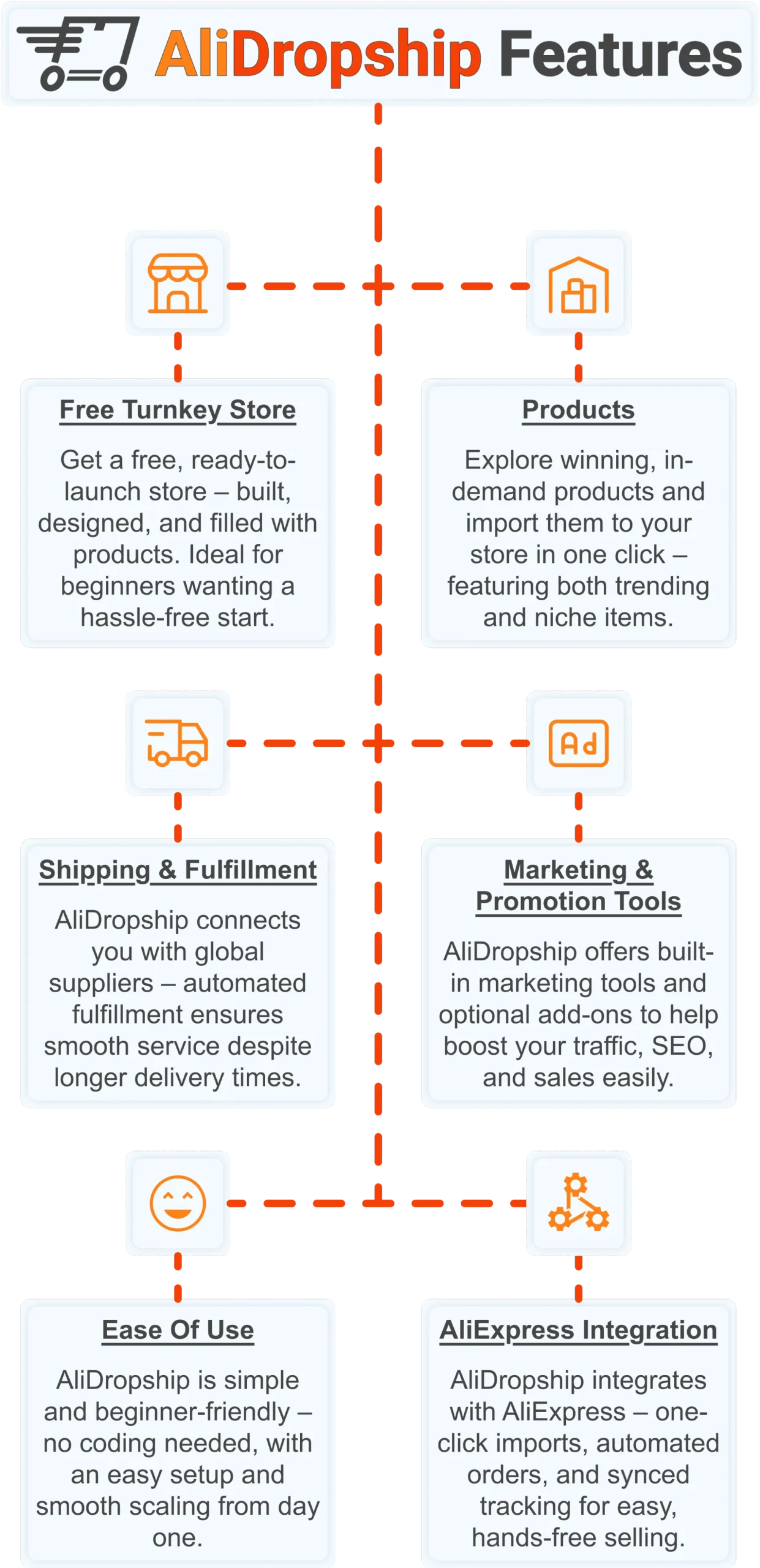
If you want the simplest possible way to start dropshipping – especially if you’re brand new – AliDropship remains one of the most beginner-friendly tools available in 2026. It brings together store creation, product imports, automation, and marketing into a single streamlined system designed to help you launch quickly and grow confidently.
Free turnkey store 🛍️
Get a free turnkey store – built, designed, and filled with products. Ideal for beginners wanting a hassle-free start, the store comes fully optimized to attract customers right away, saving you time on setup. Plus, it includes professional design elements to give your business a polished, trustworthy look from day one. This ready-made foundation makes it easy to move seamlessly into product selection.
Products 📦
Once your store is set up, you can explore winning, in-demand products and import them in one click – featuring both trending and niche items. This wide selection lets you cater to diverse customer interests and test what works best. Regular updates ensure you always have fresh products, keeping your store competitive and relevant. With great products in place, smooth shipping becomes the next essential step.
Shipping & fulfillment 🚚
AliDropship connects you with global suppliers, and automated fulfillment ensures seamless order processing despite international delivery times. Customers receive real-time tracking updates, which builds confidence and trust in your store. Once shipping is handled reliably, you can focus on promoting your store and attracting traffic.
Marketing & promotion tools 📣
To maximize sales, AliDropship offers built-in marketing tools and optional add-ons that help boost traffic, SEO, and conversions. From email campaigns and discounts to social media integration, these tools empower you to reach and retain customers without needing prior marketing experience. With promotion strategies in place, managing your business becomes simpler and more efficient.
Ease of use 👌
AliDropship is beginner-friendly – no coding needed, with an intuitive dashboard that guides you through every step. Easy setup and smooth scaling let you expand your store without stress. As your business grows, adding new features, products, and marketing campaigns remains hassle-free, giving you more time to focus on sales.
AliExpress integration 🛒
Finally, AliDropship integrates seamlessly with AliExpress, enabling one-click imports, automated orders, and synced tracking. Your inventory stays up-to-date with the latest products and prices, while automated order processing frees you from manual tasks. Combined with the turnkey setup, reliable shipping, and built-in marketing tools, this integration ensures your dropshipping business is fully equipped for growth and success.
Starting a clothing business has never been more accessible – and AliDropship gives you everything you need to do it right, without the upfront cost or complexity. Claim your free turnkey clothing store and $100 welcome gift and launch your ecommerce business today.
How to start a clothing business with no money?
How much does it cost to start an online clothing business?
The startup cost for a clothing dropshipping store can be as low as 100 to 300 dollars when using a free store builder like AliDropship. This budget covers your domain, a small product sample order, and initial ad testing. A wholesale or private-label clothing business typically requires 1,000 to 5,000 dollars in inventory alone before your first sale. For most beginners, dropshipping is the most financially accessible route into the online clothing business.
Is clothing dropshipping still profitable in 2026?
Yes, clothing dropshipping remains profitable in 2026 for stores that focus on a clear niche rather than generic apparel. The global online fashion market continues to grow, and independent niche stores are capturing more of that revenue as consumer trust in smaller brands increases. Margins of 40 to 70 percent are achievable with well-chosen products, and stores that combine dropshipping with strong branding can scale to 2,000 to 5,000 dollars per month within 6 to 12 months. Success depends on product selection, store quality, and consistent marketing effort.
What is the best platform for an online clothing store?
WooCommerce with AliDropship is a strong choice for clothing dropshipping because you own your store fully and pay no ongoing revenue percentage. Shopify is a popular alternative that is fully hosted and beginner-friendly, starting at around 39 dollars per month. Both platforms support product imports from AliExpress and integrate with major marketing and email tools. The best platform depends on your technical comfort level and how much ongoing monthly cost you are willing to absorb.
How long does it take to make money from a clothing business?
Most clothing dropshipping stores make their first sale within the first 2 to 4 weeks when using paid advertising to drive traffic. Building to a consistent 500 to 1,000 dollars per month typically takes 60 to 90 days with daily effort, a tested ad campaign, and a focused niche. Organic-only strategies using TikTok or Instagram generally take 3 to 6 months to generate meaningful recurring revenue. Treating the business as a serious venture rather than a passive side hustle significantly shortens the timeline to profitability.