How To Start A Business From Home In 2026

So you want to start a business from home. Maybe you are tired of the commute, tired of working for someone else, or you just need an extra income stream that fits around your actual life.
Whatever your reason, the timing has never been better – and the barrier to entry has never been lower. The number of people running a legitimate online business from home has grown steadily year after year, and in 2026, the tools, platforms, and global supply chains available to a solo operator are genuinely impressive.
But here is the honest part: most “start a home business” content is vague. It tells you to “follow your passion” or “find a niche” without explaining what that actually looks like on a Tuesday morning when you are trying to make your first sale.
This guide is different. It walks you through the most realistic home business ideas available right now, what each one actually requires, and how much you can expect to earn – with real numbers, not fairy tales.
Quick Answer: The most practical ways to start a business from home in 2026 include dropshipping, freelancing, digital product sales, and local service businesses. Each has a different startup cost and learning curve. Most home business owners see their first consistent income within 60–120 days of focused effort.

What does it mean to start a business from home in 2026?
A home business is any business you run primarily from your home – whether that is a spare bedroom, a kitchen table, or a dedicated home office. What has changed dramatically in recent years is the scale of what is possible from that setup.
You can manage an ecommerce store serving customers across three continents, run a content agency with clients in New York and Berlin, or build a coaching business with a global audience – all without leaving your house.
The most important shift is infrastructure. Platforms like Shopify, AliDropship, Etsy, Fiverr, and Upwork have removed the technical and logistical barriers that used to require a business address, a warehouse, or an office. Payment processors like Stripe and PayPal work globally. Shipping solutions are automated.
Customer service tools run on AI assistance. In practical terms, a solo home business operator in 2026 has access to roughly the same tools as a small company with a physical office – at a fraction of the cost.
That said, running a home business still requires real work. The freedom is genuine, but so is the responsibility. You are the marketing department, the customer service team, and the finance department until you can afford to outsource. Starting with clear expectations about that reality is what separates people who build something sustainable from those who give up after two months.
How much can you realistically earn from a home business?
This is the question everyone wants answered, and the honest answer is: it depends enormously on which model you choose, how much time you put in, and how quickly you learn from early mistakes. Here is a realistic breakdown of the most common home business models and what they typically pay.
These ranges reflect what real operators at different stages are earning – not ceiling figures for top performers. A dropshipping beginner, for example, might earn $200–$500 in their first full month and scale to $2,000–$3,000 by month four or five with consistent product testing and marketing.
Freelancers typically start lower and grow as they build a client base and raise their rates. The $5,000+ figures for ecommerce are achievable but usually require at least 6–12 months of active iteration.
One note on income timelines: Most home businesses take 60–120 days to generate consistent income. Anyone promising you will earn full-time money in your first week is not being straight with you. The models that get you to income fastest – like dropshipping with a pre-built store – still require you to drive traffic and optimize your offer.
What the table also does not show is compounding. Ecommerce and digital products scale without a proportional increase in your workload. You can go from 10 orders a day to 100 without working 10 times as hard – which is the core reason so many people who figure out how to start a business from home end up choosing an online product model over a service model.
The best home business ideas to start in 2026
Not every home business idea suits every person. Some require specific skills, others need startup capital, and some are almost entirely dependent on your ability to market yourself. Below are the most proven models available right now, grouped by type so you can find the best fit for your situation.
Ecommerce and product-based businesses
Selling physical or digital products online is consistently one of the most scalable work from home business models. You are not trading time for money – you are building an asset that can generate revenue while you sleep.
Dropshipping
Dropshipping is one of the most popular ways to start an online business from home because it removes the biggest barrier for most beginners: inventory. You list products in your store, customers buy them, and your supplier ships directly to the customer. You never handle the physical product.
The model works best when you find a niche with consistent demand and manageable competition – think pet accessories, home office gear, outdoor equipment, or hobby supplies. Platforms like AliDropship let you connect directly to AliExpress suppliers and automate the entire fulfillment process. Startup costs are low – typically $0–$300 – and you can be live with a store in a single day.
Earning potential: $500–$3,000/month within 3–6 months for a focused beginner. Full-time income ($3,000–$8,000+/month) is realistic by months 8–12 with the right niche and consistent ad or SEO traffic.
Why this works in 2026: Global ecommerce revenue continues to grow, and the tools for solo operators have never been more capable. Automated fulfillment and AI-assisted product research mean a one-person home business can compete effectively with larger operations.
Print-on-demand
Print-on-demand works similarly to dropshipping – a third-party supplier prints and ships your custom designs on products like t-shirts, mugs, phone cases, and wall art. You create the designs (or hire a designer), list them in your store, and the supplier handles everything else when an order comes in.
This model suits creative people who enjoy design and branding. Platforms like Printful, Printify, and Gelato integrate directly with Shopify and Etsy. Margins are thinner than standard dropshipping, typically 20–35%, but a well-branded print-on-demand store in a specific niche (dog breeds, specific sports, local pride designs) can build a loyal returning customer base over time.
Earning potential: $200–$1,500/month for consistent part-time effort. Scaling requires either strong organic traffic from social media or a paid advertising budget.
Selling handmade or sourced products on Etsy
If you make something by hand – jewelry, candles, ceramics, knitted goods, custom artwork – Etsy gives you immediate access to a marketplace of buyers who are specifically looking for unique, handmade items. You can also source wholesale products and sell them on Etsy with custom packaging or branding.
Etsy has over 90 million active buyers as of recent figures, and the platform handles payment processing, basic SEO, and marketplace trust. The trade-off is competition – popular categories are saturated – so differentiation through strong photography, a clear brand identity, and great customer service matters a lot.
Earning potential: $300–$2,000/month for a well-optimized shop with consistent listings and reviews. Top Etsy sellers with multiple product lines and strong repeat customers can exceed this significantly.
Service-based home businesses
Service businesses are often the fastest path to income because you are selling a skill you already have – there is no inventory, no product development, and no waiting for organic traffic to build. The trade-off is that your earning capacity is tied directly to your available hours unless you eventually hire or productize your services.
Freelance writing, copywriting, and content creation
Demand for quality written content – blog posts, product descriptions, email newsletters, social media copy, and web content – has remained strong despite the rise of AI writing tools. In fact, many businesses now use AI as a first draft and hire human writers specifically for editing, strategy, and the kind of nuanced, brand-consistent copy that AI alone does not reliably produce.
You can find your first clients on Upwork, Fiverr, LinkedIn, or through direct outreach to small businesses in your area. Rates vary widely – content mills pay as little as $0.03/word, while experienced copywriters charge $0.20–$0.50/word or flat project rates of $500–$3,000 for sales pages and email sequences.
Earning potential: $800–$2,500/month part-time. Full-time freelance writers with a solid client base typically earn $3,000–$6,000/month.
Graphic design and web design
Designers with skills in tools like Figma, Adobe Illustrator, or Canva Pro can build a strong home-based business serving small businesses, startups, and content creators. Logo design, social media templates, website redesigns, and brand identity packages are consistently in demand.
The best-paid design work tends to come through direct referrals and long-term client relationships rather than marketplace platforms, which often drive prices down. Building a portfolio site (even a simple one on Squarespace or Webflow) and being active on LinkedIn or Behance will accelerate your first client acquisition significantly.
Earning potential: $1,000–$4,000/month for a part-time freelance designer. Senior-level designers with strong portfolios and retainer clients can earn $5,000–$8,000/month working from home.
Virtual assistant (VA) services
Virtual assistants handle administrative tasks for busy entrepreneurs and small businesses – things like inbox management, scheduling, data entry, social media posting, customer support, and basic bookkeeping. It is one of the most accessible home business ideas because the barrier to entry is low and the demand is steady.
VA rates range from $15–$20/hour for general admin tasks to $40–$60/hour for specialized VAs with skills in project management, CRM systems, or paid advertising. Platforms like Belay, Time Etc, and Fancy Hands connect VAs with clients, or you can build a client base independently through LinkedIn outreach.
Earning potential: $600–$2,500/month part-time, depending on hourly rate and number of clients.
Online tutoring and coaching
If you have expertise in a subject – academic topics, a language, a musical instrument, fitness, business, or personal development – online tutoring and coaching is a natural home business option. Platforms like Wyzant, Tutor.com, and Preply connect tutors with students globally. For coaching, a direct approach through social media, a simple website, and referrals works well.
The key difference between tutoring (teaching a skill to a specific outcome) and coaching (helping someone develop mindset, strategy, or habits) is pricing. Tutors typically earn $25–$80/hour. Business or life coaches with a strong personal brand often charge $100–$300/session or $500–$2,000 for monthly packages.
Earning potential: $500–$3,500/month depending on hours worked, rate, and niche.
Content and passive income models
These models take longer to monetize but have the strongest long-term upside. They are best treated as a parallel income stream while you build income from a faster-paying model, or as a full-time pursuit if you can afford a 6–12 month runway without significant income.
Affiliate marketing
Affiliate marketing means earning a commission by recommending products or services through your content – a blog, YouTube channel, newsletter, or social media following. When someone clicks your link and makes a purchase, you earn a percentage, typically 5–30% depending on the category.
The critical factor is traffic. Without an audience, affiliate marketing earns almost nothing. Building that audience through consistent content – whether via SEO-optimized blog posts, YouTube videos, or a niche newsletter – typically takes 6–18 months before meaningful income begins. Those who stick with it and build genuine authority in a niche can eventually earn $1,000–$10,000/month from a single content site.
Earning potential: $100–$500/month in year one. $1,000–$5,000+/month by year two or three for a well-executed niche site.
Selling digital products
Digital products – e-books, online courses, templates, Notion dashboards, Lightroom presets, Canva kits – are created once and sold indefinitely. There is no inventory, no shipping, and no per-unit cost. That makes the margin on digital products genuinely exceptional: a $29 template that sells 100 times a month is $2,900 in near-pure profit.
Platforms like Gumroad, Teachable, Podia, and Etsy’s digital section make selling digital products straightforward. The challenge, as with affiliate marketing, is building or finding an audience who wants what you create. Creators who already have a social media following or email list can launch a digital product and see immediate sales. Those starting from scratch should expect 3–6 months before significant traction.
Earning potential: $200–$3,000/month once you have an audience and proven product.
Legal and practical things to get right from day one
Starting a business from home is exciting, but skipping the legal and financial basics is one of the most common – and costly – mistakes new home business owners make. None of this is complicated, but it does need to be handled properly.
Register your business
In most countries, operating a business without registering it is fine at very small scales, but as soon as you are earning consistently, you need a formal business structure. In the US, an LLC (Limited Liability Company) is the most common choice for home business owners – it separates your personal finances from the business and provides liability protection. The cost is typically $50–$500 depending on your state, and the process takes a few days online.
In the UK, registering as a sole trader with HMRC is free and takes about 10 minutes. In most EU countries, the equivalent process is similarly accessible. Check your local government’s small business registration portal for the specific requirements in your region.
Key principle: Register your business and open a separate bank account for it before you start making meaningful money – not after.
Understand your tax obligations
Home business income is taxable in every jurisdiction. As a self-employed person, you are responsible for tracking your income, deducting legitimate business expenses (home office portion of rent, internet, equipment, software subscriptions), and paying self-employment tax. In the US, this means quarterly estimated tax payments to the IRS if you expect to owe more than $1,000 in a given year.
Using accounting software like Wave (free), FreshBooks, or QuickBooks from the start will save you significant stress at tax time. If your income grows past $50,000/year, hiring a tax professional who specializes in small business or self-employed clients is worth the cost.
What to avoid
A few things that regularly get home business owners into trouble, worth naming directly:
- Misrepresenting your qualifications or experience when pitching clients – it creates legal exposure and destroys reputation when discovered
- Operating as an unregistered business past the threshold your country requires
- Using copyrighted images, copy, or assets in your store or content without licensing them
- Making income claims to customers that you cannot substantiate – this applies especially to coaching and digital products
- Mixing personal and business finances in a single bank account
Important: If you are selling internationally, check the VAT/GST rules for your key markets. The thresholds and requirements vary and can catch new ecommerce sellers off guard.
How to choose the right home business model for you
There is no single best home business – the right choice depends on what you have available right now: your time, your existing skills, your startup budget, and your tolerance for a slow start versus a fast one. Here is a practical breakdown by reader profile to help you decide.
If you are a complete beginner
If you have no specific business skills, limited technical knowledge, and want to start earning as quickly as possible with minimal upfront investment, dropshipping with a pre-built store is the most realistic option. It removes the technical setup, gives you a product catalogue from day one, and the fulfillment is automated.
Your main job is driving traffic – through organic social media, basic SEO content, or a small paid advertising budget of $5–$10/day.
Alternatively, if you are willing to trade time for money immediately, virtual assistant work or basic freelance services (writing, data entry, social media management) will get you to your first paycheck faster than any product-based business. Use that income to fund a longer-term ecommerce or digital product project in parallel.
If you have a skill and want to go part-time first
If you have a marketable skill – writing, design, development, accounting, photography, marketing – freelancing is the fastest path to replacing a portion of your employment income. Start by picking up 2–3 clients at a sustainable rate, get consistent with your delivery, and use the stability to gradually build a product-based business on the side.
Many successful ecommerce store owners started as freelancers. The freelance income funded their first ad spend, gave them time to learn the market, and the ecommerce business eventually scaled past their freelance income – at which point they shifted their focus full-time.
If you are aiming for full-time home business income
If your goal is to replace a full-time salary – typically $3,000–$6,000/month net – the models with the most realistic paths there are dropshipping/ecommerce, freelancing in a high-demand skill, or combining a content platform with an ecommerce store. None of these is a six-week project, but all three have clear, documented paths that regular people with no business background have followed successfully.
The data from communities like r/dropshipping on Reddit and ecommerce-focused forums consistently shows the same pattern: people who treat their home business like a real business from day one – with consistent hours, tracked metrics, and a willingness to iterate on what is not working – are the ones who get to full-time income. The people who give up usually do so between months two and four, right before the compounding starts to kick in.
If you want maximum flexibility with minimal ongoing management
If flexibility is your primary goal – you travel frequently, have unpredictable availability, or want something that runs largely on autopilot – an automated ecommerce store with dropshipping fulfillment is the best fit. Once your store has traffic and converting products, the day-to-day management is relatively light: monitoring orders, handling occasional customer queries, and occasionally refreshing your product selection.
This is exactly the setup that makes dropshipping attractive to parents, students, travellers, and people with other commitments. You are not clocked in to a shift. The store runs when you are not watching it.
AliDropship: Your complete all-in-one solution for starting dropshipping in 2026
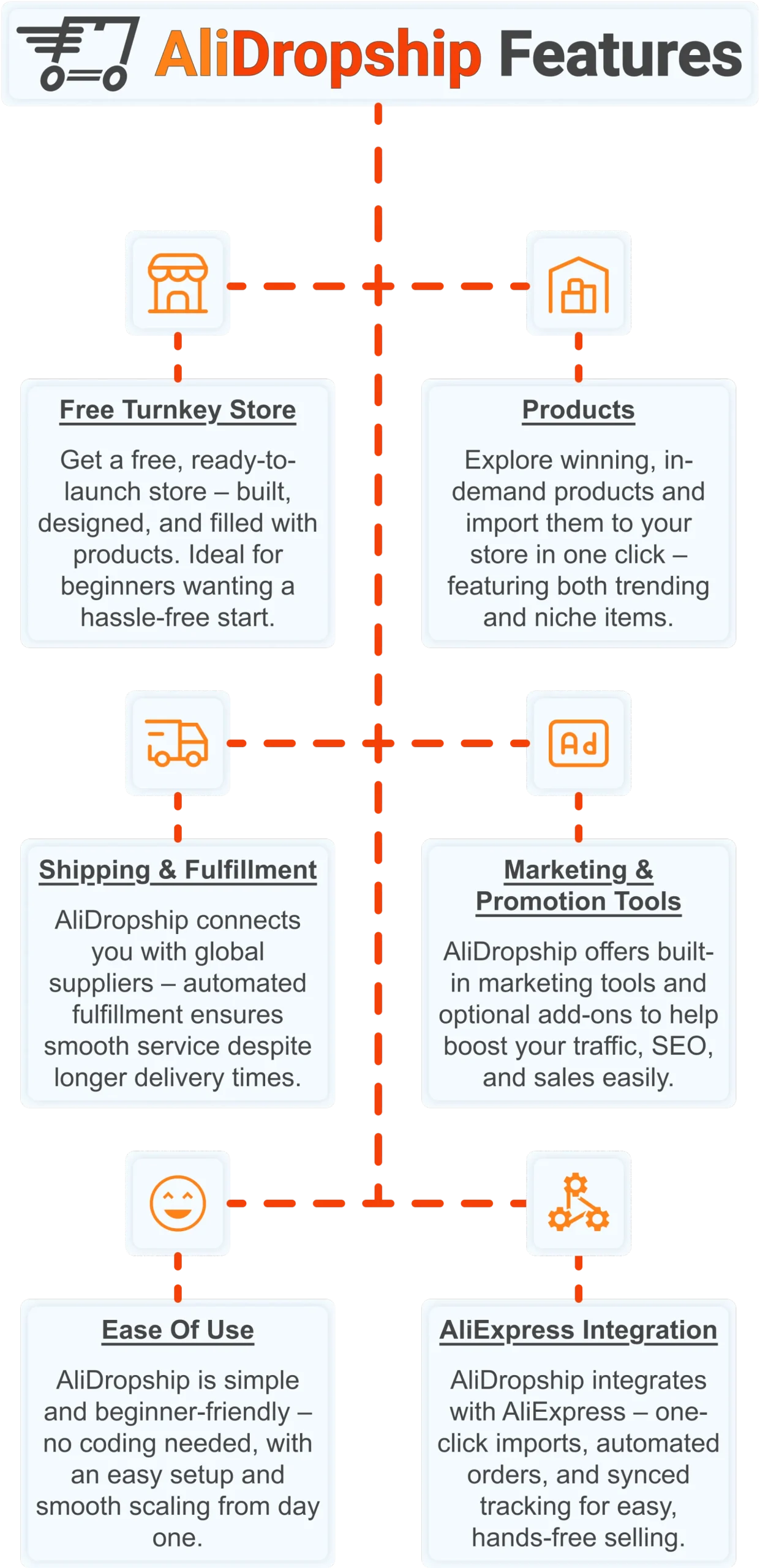
If you want the simplest possible way to start dropshipping – especially if you’re brand new – AliDropship remains one of the most beginner-friendly tools available in 2026. It brings together store creation, product imports, automation, and marketing into a single streamlined system designed to help you launch quickly and grow confidently.
Free turnkey store 🛍️
Get a free turnkey store – built, designed, and filled with products. Ideal for beginners wanting a hassle-free start, the store comes fully optimized to attract customers right away, saving you time on setup. Plus, it includes professional design elements to give your business a polished, trustworthy look from day one. This ready-made foundation makes it easy to move seamlessly into product selection.
Products 📦
Once your store is set up, you can explore winning, in-demand products and import them in one click – featuring both trending and niche items. This wide selection lets you cater to diverse customer interests and test what works best. Regular updates ensure you always have fresh products, keeping your store competitive and relevant. With great products in place, smooth shipping becomes the next essential step.
Shipping & fulfillment 🚚
AliDropship connects you with global suppliers, and automated fulfillment ensures seamless order processing despite international delivery times. Customers receive real-time tracking updates, which builds confidence and trust in your store. Once shipping is handled reliably, you can focus on promoting your store and attracting traffic.
Marketing & promotion tools 📣
To maximize sales, AliDropship offers built-in marketing tools and optional add-ons that help boost traffic, SEO, and conversions. From email campaigns and discounts to social media integration, these tools empower you to reach and retain customers without needing prior marketing experience. With promotion strategies in place, managing your business becomes simpler and more efficient.
Ease of use 👌
AliDropship is beginner-friendly – no coding needed, with an intuitive dashboard that guides you through every step. Easy setup and smooth scaling let you expand your store without stress. As your business grows, adding new features, products, and marketing campaigns remains hassle-free, giving you more time to focus on sales.
AliExpress integration 🛒
Finally, AliDropship integrates seamlessly with AliExpress, enabling one-click imports, automated orders, and synced tracking. Your inventory stays up-to-date with the latest products and prices, while automated order processing frees you from manual tasks. Combined with the turnkey setup, reliable shipping, and built-in marketing tools, this integration ensures your dropshipping business is fully equipped for growth and success.
If you are serious about how to start a business from home, an automated ecommerce store is the most scalable, flexible path available in 2026. Get your free turnkey store today and start building something that earns on your terms.
How do I start a business from home with no money?
What is the most profitable home business to start in 2026?
The most profitable home business models in 2026 are dropshipping and ecommerce, high-ticket freelancing such as web development or copywriting, and online coaching in business or personal development niches. Dropshipping with an automated store is particularly strong because it scales without a proportional increase in your workload – moving from 10 to 100 orders a day does not require you to work 10 times harder. Experienced freelancers in development or marketing can earn 4,000 to 8,000 dollars per month working from home. The best choice depends on your existing skills, available time, and how quickly you need income.
How long does it take to make money from a home business?
Most home businesses generate their first meaningful income within 30 to 90 days, depending on the model. Service-based businesses such as freelancing tend to produce income fastest, often within the first 2 to 4 weeks once you land your first client. Product-based businesses like dropshipping typically take 60 to 120 days to achieve consistent sales, with full-time income levels usually reached between months 6 and 12. Passive models like affiliate marketing or digital product sales take the longest – often 6 to 18 months before generating reliable monthly income. Setting realistic expectations about your timeline is one of the most important things you can do when starting out.
Is dropshipping still a good home business idea in 2026?
Dropshipping is still a strong home business model in 2026. Global ecommerce continues to grow, fulfillment automation has improved significantly, and tools like AliDropship make it easier than ever for a solo operator to run a professional store from home. The model is more competitive than it was in 2018 or 2019, which means product research and marketing quality matter more than they used to. Operators who choose a clear niche, test products systematically, and focus on customer experience consistently build profitable stores. Communities like the dropshipping subreddit regularly feature verified income reports from people earning 2,000 to 10,000 dollars per month from home.
What home business can I start today?
The fastest home businesses to start today are freelance services and dropshipping with a pre-built store. A freelance writing, design, or virtual assistant profile on Upwork or Fiverr can be live in under an hour. A turnkey dropshipping store through AliDropship can be ready the same day – built, stocked with products, and connected to a payment processor. Both options require real effort to generate income, but neither requires weeks of technical setup or significant upfront investment. Choosing the right model comes down to whether you want immediate service-based income or a scalable product-based business that compounds over time.