Ways To Sell Things Online And Make Money: The 2026 Guide

Millions of people search for ways to sell things online and make money every single month – and yet most of them never actually start. Not because the opportunity isn’t real, but because the options can feel overwhelming and the results aren’t always what they expect. So let’s cut through the noise.
Quick Answer: You can sell physical products, digital downloads, services, or handmade goods online through platforms like eBay, Etsy, Amazon, or your own ecommerce store. Earnings range from $200–$500/month for casual sellers to $5,000–$20,000+/month for serious ecommerce operators – depending on the method, effort, and model you choose.
This guide walks you through the most legitimate, tested ways to sell online in 2026, how much each one realistically earns, and why building your own ecommerce store remains the path with the highest ceiling. Whether you’re starting from scratch or looking to scale, there’s a place for you here.
Before diving into the methods, it’s worth understanding what “selling online” actually covers in 2026 – because the landscape has shifted quite a bit from even three years ago.

What does it mean to sell things online and make money?
Selling things online simply means exchanging goods, services, or digital products for money through an internet-based channel. That could be listing a used jacket on eBay, selling printable planners on Etsy, building a dropshipping store on WooCommerce, or offering freelance design through your own website. The delivery mechanism differs, but the core idea is the same: you find what people want, put it in front of them, and collect payment.
What makes 2026 different from earlier years is how much of the infrastructure already exists. Payment processors, logistics networks, print-on-demand suppliers, and dropshipping automation tools have matured to the point where anyone with a laptop and a few hours can have a functioning online store running within a day. The barrier to entry has never been lower – but neither has the threshold for standing out, which is why having a clear strategy matters more than ever.
There are two broad categories of online selling worth understanding: platform-dependent (you sell on someone else’s marketplace – Amazon, eBay, Etsy) and platform-independent (you own your store, your audience, your data). Both have merit. But the long-term economics strongly favor building something you control.
How much can you realistically earn selling online?
Here is an honest breakdown of earning potential across the most common methods. The numbers below reflect realistic outcomes based on consistent effort – not best-case scenarios.
The table shows a clear pattern: methods that rely on your own time (freelancing, handmade goods) hit a natural ceiling, while scalable models like ecommerce and digital products can grow beyond what your hours allow.
One note on ceiling figures: The top-end numbers above reflect sellers who have been operating consistently for 6–18 months, built repeatable traffic sources, and reinvested earnings into growth. If you are brand new, expect 60–90 days before seeing meaningful revenue from most methods – and plan your effort accordingly. “Full-time effort” here means 4–6 hours per day of focused work, not occasional browsing.
Now that you have a realistic picture of the earning landscape, let’s break down each method in detail – starting with the quickest ways to make money and building toward the most scalable.
The best ways to sell things online and make money in 2026
These methods are grouped by type – from low-barrier entry points to higher-ceiling models. Use this section to find the approach that fits your situation right now, not just the one that sounds most exciting.
Selling physical products through online marketplaces
Sell used and second-hand items
If you have stuff lying around the house – electronics, clothing, furniture, collectibles – platforms like eBay, Facebook Marketplace, and Poshmark let you turn clutter into cash with almost no upfront investment. eBay remains the strongest option for electronics and niche collectibles, while Poshmark and Depop dominate fashion. Facebook Marketplace works best for bulky items where local pickup makes sense.
The mechanics are straightforward: take clean photos, write an accurate title (include brand, model, condition), price competitively by checking recent sold listings, and ship promptly. Sellers who learn to source items cheaply – from thrift stores, estate sales, or clearance aisles – turn this into a repeatable side business known as “retail arbitrage.”
Earning potential: $100–$600/month for casual decluttering; $800–$2,500/month for consistent retail arbitrage with active sourcing.
Sell on Amazon (FBA or Merchant Fulfilled)
Amazon gives you access to one of the largest buying audiences on the planet. The two main routes are Fulfilled by Amazon (FBA), where you ship inventory to Amazon’s warehouses and they handle storage, packing, and delivery, and Merchant Fulfilled, where you store and ship products yourself. FBA generally performs better for discoverability and the Prime badge – but it comes with storage fees and requires more upfront capital for inventory.
A more capital-efficient version is Amazon dropshipping, where you list products you don’t physically hold and fulfil orders through a supplier. This is allowed within Amazon’s policies as long as you are the seller of record – meaning your name and contact, not the supplier’s, appears on all packaging and invoices.
Earning potential: $500–$5,000/month for FBA with a validated product; results vary significantly based on category and ad spend.
Sell handmade or vintage goods on Etsy
Etsy remains the go-to marketplace for handmade, vintage, and craft-adjacent products. If you make candles, jewellery, ceramics, custom embroidery, or anything in that category, Etsy gives you a built-in audience actively searching for exactly those things. The platform has over 90 million active buyers as of recent reports – a ready market you don’t have to build from scratch.
Etsy success comes down to three things: strong photography, keyword-rich product titles and tags, and consistent shop activity. New listings get a short visibility boost, so uploading regularly (even one or two new items per week) keeps your shop active in the algorithm. Top Etsy sellers often expand to their own Shopify store once they’ve validated their audience.
Earning potential: $300–$3,000/month for consistent makers; top sellers with strong SEO and multiple product lines exceed $10,000/month.
Selling digital products online
Sell digital downloads (templates, guides, presets)
Digital products are one of the most attractive online selling models because of the economics: create once, sell infinitely with zero per-unit cost. Popular digital products include Notion templates, Lightroom presets, resume templates, financial spreadsheets, printable planners, and instructional PDFs. Etsy and Gumroad are the most beginner-friendly platforms for listing digital downloads, though Payhip, Stan Store, and your own website are also viable.
The upfront work is real – producing something polished takes time – but once the product exists and the listing is live, it can generate passive income for months or years. The key is solving a specific, searchable problem. “Editable Canva invoice template for freelancers” sells better than “business template pack.”
Earning potential: $200–$2,000/month for a focused digital product shop with strong SEO; creators with large social audiences frequently exceed $5,000/month.
Sell online courses and ebooks
If you have knowledge worth sharing – whether that’s a professional skill, a niche hobby, language learning, or fitness expertise – packaging it into a course or ebook is a direct way to monetize it. Platforms like Teachable, Podia, and Thinkific handle hosting, payments, and delivery. Gumroad works well for simpler ebooks and guides.
Pricing matters a lot here. Ebooks generally sell in the $10–$30 range, while structured courses with video lessons can command $97–$497. The difference in revenue per sale is significant, which is why established creators typically use a low-cost ebook as an entry point (a “lead magnet upgrade”) and upsell to a full course.
Earning potential: $300–$5,000/month depending on audience size, pricing, and the quality of your marketing funnel.
Selling through your own ecommerce store
Dropshipping
Dropshipping is the model that makes ecommerce genuinely accessible to beginners: you sell products in your online store without holding inventory. When a customer places an order, your supplier ships directly to them. You never touch the product. Your margin is the difference between what you charge the customer and what the supplier charges you.
This model works because it removes two of the biggest barriers to ecommerce – upfront inventory investment and warehousing. Platforms like AliDropship, combined with suppliers on AliExpress, let you import products in one click and automate order fulfilment. The tradeoff is that delivery times can be longer than domestic alternatives, so product selection and setting clear expectations matter.
The most successful dropshippers pick a specific niche (pet accessories, home gym gear, outdoor gadgets), focus on one or two winning products, and build their marketing around those. Trying to sell everything to everyone is the most common early mistake.
Under 10%
Tight — hard to sustain on paid traffic
10–15%
Marginal — slim cushion for refunds and ad cost shifts
15–20%
Healthy — cohort median sits at 19.2%
20–25%
Strong — outperforming the median operator
25%+
Excellent — top-tier product economics
Earning potential: $500–$3,000/month in the first 3–6 months for focused operators; $5,000–$20,000+/month once winning products and traffic channels are established.
Print-on-demand
Print-on-demand (POD) removes inventory risk entirely: you design graphics and apply them to products (t-shirts, mugs, hoodies, phone cases, tote bags), and a supplier prints and ships each item only when someone orders. Printful and Printify are the two dominant POD suppliers, both of which integrate with Shopify, Etsy, and WooCommerce.
POD works best when the designs are tied to a specific identity – a hobby, community, profession, or inside reference – rather than generic graphics. A “nurse life” mug sold to nurses or a hiking-specific t-shirt in an outdoors niche will consistently outperform a generic motivational quote design.
Earning potential: $200–$2,500/month for consistent designers with active marketing; margins are slimmer than regular dropshipping due to higher per-unit POD costs.
Selling services online
Freelance services on Fiverr and Upwork
Freelancing lets you sell what you already know how to do – writing, graphic design, video editing, web development, translation, social media management – directly to clients through platforms like Fiverr and Upwork. Fiverr is better for standardized, productized services (e.g., “I will design a logo in 48 hours for $75”). Upwork suits longer engagements and hourly contracts.
New freelancers typically start by underpricing to collect reviews, then raise rates once their profile has social proof. On Fiverr, your gig thumbnail and first line of copy determine whether anyone clicks at all – treat them like ad creative. Specialising in one service within one industry (e.g., copywriting for SaaS companies) builds a reputation faster than being a generalist.
Earning potential: $500–$3,000/month for part-time freelancers; $4,000–$10,000/month for experienced specialists with strong profiles.
Comparing your options: which method fits you best?
Every selling method has a different profile of time, risk, upfront cost, and scalability. This comparison focuses on the factors that matter most to someone deciding where to start in 2026.
The pattern is consistent: methods with the lowest barriers tend to have the lowest ceilings. The methods with the highest ceilings – digital products, ecommerce, and dropshipping – require more intentional setup but pay off significantly over time.
Tips to make more money selling things online
Pick a niche, not a category
The biggest mistake new online sellers make is being too broad. “Clothing” is a category. “Minimalist workwear for women over 40” is a niche. Niches have more targeted buyers, less competition for attention, and stronger word-of-mouth. The tighter your focus at the start, the faster you’ll build authority and repeat customers.
Learn the basics of SEO for product listings
Whether you’re on Etsy, Amazon, or your own store, organic search traffic is the most cost-effective way to get consistent buyers. For marketplace listings, that means putting your highest-value keywords in the title (front-loaded), filling all available tags, and writing descriptions that answer real buyer questions. For your own store, it means building content around what your buyers are already searching for.
Use social proof actively
Reviews, ratings, and user-generated content are the most powerful conversion tools available to an online seller – and they are free. Actively follow up with buyers to encourage honest reviews. Respond to every review, positive or negative. Feature real customer photos where your platform allows it. Buyers trust other buyers far more than they trust any ad or product description you write.
Treat your first 90 days as market research
The products you think will sell and the products that actually sell are often different. Use your first three months to test multiple listings or product ideas at small scale, track which ones get clicks and which ones convert, and double down on what works. Successful ecommerce operators treat data as their co-founder – they let numbers guide decisions, not gut feel alone.
Reinvest early profits into paid traffic
Once you have a product converting organically – even at a small scale – that’s the signal to test paid traffic. Facebook and Instagram ads give you the most granular targeting for physical product ecommerce. Google Shopping ads work well for products with high search intent. The key is starting with a small daily budget ($10–$20/day), proving your cost-per-acquisition before scaling, and never putting significant spend behind a product that hasn’t converted organically first.
What to avoid when selling things online
Most people who fail at online selling don’t fail because the method doesn’t work – they fail because they make a handful of very predictable mistakes. Here are the ones worth knowing before you start.
Fake reviews and inflated claims
Buying reviews on Amazon or Etsy, using review-exchange groups, or writing fake testimonials for your own store might seem like a shortcut in the short term. It isn’t. Amazon permanently bans seller accounts when it detects review manipulation – and it detects it often. Etsy has become increasingly aggressive at removing listings and shops with suspicious review patterns. Beyond the platform risk, fake social proof damages your brand permanently when exposed.
Key principle: Build credibility through real product quality and genuine follow-up – it compounds in your favour over time.
Misleading product listings
Selling something that looks nothing like the photos, omitting known defects, or using misleading size or specification descriptions is a fast route to bad reviews, high return rates, and potential account suspension. Beyond the business consequences, it simply isn’t a sustainable practice. Accurate, honest listings consistently outperform deceptive ones over any meaningful time horizon.
Over-relying on a single platform
If 100% of your income runs through one marketplace, you are one policy change or account suspension away from losing everything. Diversification – even just having your own store alongside your marketplace presence – gives you a safety net. Platforms like Amazon, Etsy, and eBay change their fee structures, ranking algorithms, and policies regularly. The sellers who survive long-term are the ones who own their customer relationships, not just their listings.
How to choose the right method for where you are now
The best way to sell things online and make money isn’t a universal answer – it depends on your starting point, your available time, and what you want your business to look like in 12 months. Here’s a practical breakdown by reader profile.
Complete beginner with limited time
Start with selling used items or digital downloads – both have near-zero startup costs and don’t require building an audience from scratch. Use this phase to learn the mechanics of online selling: how to write product copy, how to price competitively, and what buyers actually respond to. Give yourself 60 days before evaluating results.
Part-time seller looking to grow
If you have 10–15 hours per week and some initial capital ($200–$500), print-on-demand and dropshipping are strong next steps. Both allow you to test products without committing to inventory. Dropshipping through your own store – rather than a marketplace – gives you more control over branding, pricing, and customer data.
Serious about building a full-time online income
If your goal is to replace a salary or build a genuine long-term business, ecommerce – specifically owning your store and customer list – is where the math works in your favour. The combination of dropshipping automation, a validated niche, and consistent marketing creates compounding returns that no marketplace-dependent model can match. Budget 90–120 days for meaningful traction, and treat marketing as a core function from day one.
Already earning but want to scale
If you’re already making $500–$2,000/month from one method, the highest-leverage next move is usually to build or expand your own store. That means more control over pricing, more margin to invest in ads, and an asset you actually own – rather than a rented shelf on someone else’s platform. This is where tools like AliDropship earn their value by combining product sourcing, store automation, and marketing in one system.
AliDropship: Your complete all-in-one solution for starting dropshipping in 2026
If you want the simplest possible way to start dropshipping – especially if you’re brand new – AliDropship remains one of the most beginner-friendly tools available in 2026. It brings together store creation, product imports, automation, and marketing into a single streamlined system designed to help you launch quickly and grow confidently.
Free turnkey store 🛍️
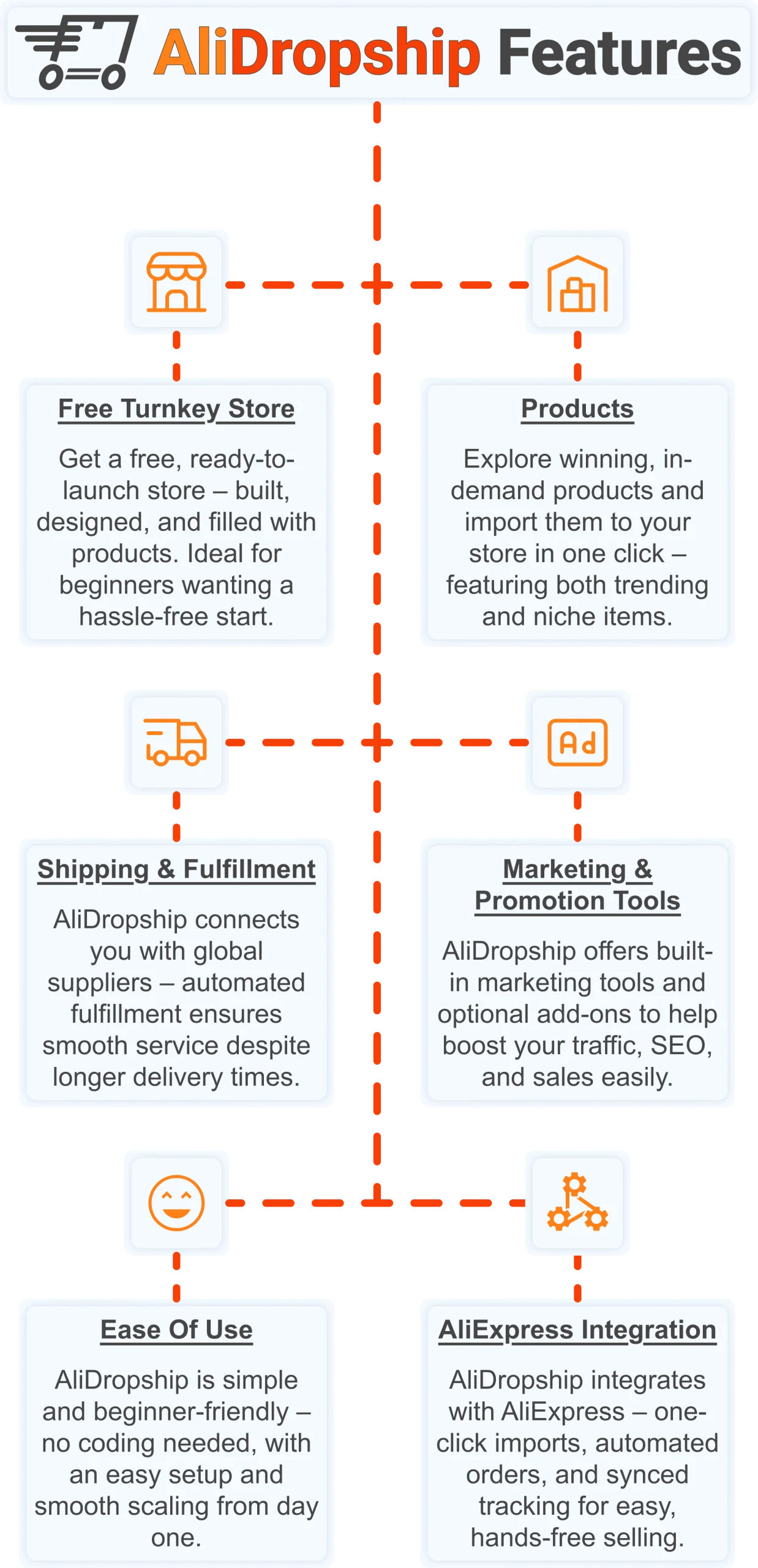
Get a free turnkey store – built, designed, and filled with products. Ideal for beginners wanting a hassle-free start, the store comes fully optimized to attract customers right away, saving you time on setup. Plus, it includes professional design elements to give your business a polished, trustworthy look from day one. This ready-made foundation makes it easy to move seamlessly into product selection.
Products 📦
Once your store is set up, you can explore winning, in-demand products and import them in one click – featuring both trending and niche items. This wide selection lets you cater to diverse customer interests and test what works best. Regular updates ensure you always have fresh products, keeping your store competitive and relevant. With great products in place, smooth shipping becomes the next essential step.
Shipping & fulfillment 🚚
AliDropship connects you with global suppliers, and automated fulfillment ensures seamless order processing despite international delivery times. Customers receive real-time tracking updates, which builds confidence and trust in your store. Once shipping is handled reliably, you can focus on promoting your store and attracting traffic.
Marketing & promotion tools 📣
To maximize sales, AliDropship offers built-in marketing tools and optional add-ons that help boost traffic, SEO, and conversions. From email campaigns and discounts to social media integration, these tools empower you to reach and retain customers without needing prior marketing experience. With promotion strategies in place, managing your business becomes simpler and more efficient.
Ease of use 👌
AliDropship is beginner-friendly – no coding needed, with an intuitive dashboard that guides you through every step. Easy setup and smooth scaling let you expand your store without stress. As your business grows, adding new features, products, and marketing campaigns remains hassle-free, giving you more time to focus on sales.
AliExpress integration 🛒
Finally, AliDropship integrates seamlessly with AliExpress, enabling one-click imports, automated orders, and synced tracking. Your inventory stays up-to-date with the latest products and prices, while automated order processing frees you from manual tasks. Combined with the turnkey setup, reliable shipping, and built-in marketing tools, this integration ensures your dropshipping business is fully equipped for growth and success.
Knowing how to sell things online and make money is the first step – having the right system to do it is the second. Claim your free turnkey store with a $100 welcome gift and start selling today.
What is the easiest thing to sell online to make money?
How much money can you make selling things online?
Do you need a business license to sell things online and make money?
What is the best platform to sell things online for beginners?
How do you start selling things online with no money?