Make Money Reselling: Best Methods And Platforms In 2026

The secondhand and reselling market is one of the fastest-growing corners of the global economy right now. According to ThredUp’s 2025 Resale Report, the US secondhand market alone is on track to hit $73 billion by 2027 – growing at roughly twice the rate of traditional retail. So if you’ve been thinking about how to make money reselling, 2026 is genuinely one of the best times to start.
The good news is you don’t need a warehouse, a big budget, or years of business experience. Reselling is accessible at almost any level – from flipping a $5 thrift find on eBay over the weekend to building a full dropshipping store that earns while you sleep. The key is understanding which method fits your situation, how much you can realistically earn, and how to scale intelligently over time.
Quick answer: You make money reselling by sourcing products at a lower price and selling them at a higher price, keeping the margin after fees and costs. Methods range from flipping physical items on platforms like eBay and Poshmark to running a dropshipping store where you never hold inventory at all – with earning potential from $100/month for casual resellers up to $3,000–$8,000/month for full-time operators.

What is reselling – and why does it work in 2026?
Reselling is the practice of buying products at one price and selling them at a higher price, pocketing the difference after fees, shipping, and any prep costs. That’s the entire model. What makes it so compelling is that the underlying logic never changes – only the tools, platforms, and categories evolve.
In 2026, the reselling landscape has expanded dramatically. Physical flipping – sourcing items from thrift stores, garage sales, and estate sales and listing them online – remains a solid income strategy. But the real growth area is digital and ecommerce-based reselling, where platforms and automation tools have removed most of the traditional barriers to entry. You no longer need a storefront, a van, or a large upfront investment to run a reselling operation.
There are two broad camps of resellers operating today. The first group focuses on physical arbitrage: finding undervalued items in the real world and selling them on marketplaces like eBay, Poshmark, Mercari, or Facebook Marketplace. The second group leans into ecommerce-first models – particularly dropshipping – where products go directly from supplier to customer without the seller ever touching inventory. Both can work well; the right choice depends on your time, budget, and goals.
Why this works in 2026: Platform infrastructure has never been better – AI-powered listing tools, crosslisting software, and automated order processing have made it possible to run a lean, profitable reselling operation from a laptop, part-time or full-time.
How much can you realistically earn reselling?
This is where a lot of beginner content falls apart – either by underselling the opportunity or by posting misleading $10,000/month claims that represent outliers, not averages. Here’s an honest breakdown of what you can expect at different levels of commitment.
The table above reflects net profit ranges, not gross revenue. Platform fees on eBay and Poshmark typically run 10–15%, and shipping eats further into margins on physical goods. Dropshipping sidesteps the physical handling cost but requires upfront marketing investment to drive traffic.
One note on the ceiling figures: Most beginners land between $100 and $400 in their first 60–90 days. Reaching the $2,000+ range requires consistent sourcing, multi-platform listings, and a sharp eye for what sells. Full-time income from reselling is achievable – but plan for a 3–6 month ramp-up before the numbers become truly reliable.
It’s also worth noting that the reselling methods with the highest ceiling – dropshipping and automated ecommerce – are the ones that scale without proportionally increasing your time. A physical reseller who earns $500/month can’t simply double their hours and double their income. A dropshipping store, by contrast, can grow revenue while the owner focuses on marketing rather than packing boxes.
Best ways to make money reselling in 2026
Not every reselling method suits every person. Below, the main approaches are broken into two groups: physical reselling (buying and selling real-world items) and online/ecommerce reselling (selling products through digital platforms and stores). Each has its own sourcing logic, platform fit, and income ceiling.
Physical reselling methods
Thrift store and garage sale flipping
This is the classic entry point for most new resellers. You visit thrift stores, estate sales, charity shops, and weekend garage sales to find items that are significantly undervalued – then list them on eBay, Mercari, or Facebook Marketplace at their true market value. Branded clothing, vintage electronics, books, and collectibles are among the most reliable categories for beginners.
The starting investment can be as low as $50–$100. The 3x rule is a useful guideline here: aim to sell every item for at least three times what you paid, to cover platform fees, shipping, and still walk away with a meaningful margin. A thrift jacket bought for $8 can list for $35–$50 on Poshmark if the brand and condition are right.
Earning potential: $200–$800/month part-time, with consistent sourcing and multi-platform listings.
Furniture and home decor flipping
Furniture flipping involves sourcing used or damaged pieces from estate sales, clearance sections, and Facebook Marketplace, then cleaning, repainting, or lightly refurbishing them before reselling locally or on platforms like Etsy and Chairish. The margins can be substantial – a $50 vintage dresser that gets a fresh coat of paint can sell for $250–$350 in the right market.
This method works best for people with some space (a garage or basement), basic DIY skills, and access to local buyers. Facebook Marketplace remains the dominant channel for large item sales in 2026 because local pickup eliminates shipping friction entirely. One honest caveat: furniture flipping is physically demanding and hard to scale without a vehicle and storage space.
Earning potential: $300–$1,200/month depending on volume, sourcing quality, and local demand.
Electronics and tech reselling
Used electronics – laptops, gaming consoles, smartphones, smart home devices – consistently rank among the most profitable categories for resellers. New tariffs on Chinese-manufactured electronics introduced in late 2025 have pushed retail prices for laptops, monitors, and gaming peripherals up by 8–15%, which has driven more buyers toward the used market and inflated resale values.
The key skill here is accurate condition assessment. A smartphone with a cracked screen bought for $60 can be resold for $120–$150 after a $15 screen repair kit. Gaming consoles that test fully functional can fetch 2–3x what thrift stores price them at. eBay and Swappa are the go-to platforms for electronics, and both have robust buyer pools. The main risk is buying items that don’t work – always test before listing.
Earning potential: $400–$2,000/month for dedicated electronics resellers with strong sourcing channels.
Clothing and fashion reselling
Clothing reselling is the most accessible entry point for beginners – it requires no technical knowledge, ships easily in poly mailers, and demand is consistent year-round. Poshmark and Depop are the dominant platforms in 2026. Poshmark attracts buyers seeking current fashion trends, while Depop skews toward vintage and Y2K-era pieces, which have been commanding strong prices for the past two years.
Branded items – Levi’s, Carhartt, Nike, and concert tees from the 1990s and 2000s – consistently outperform fast fashion finds in terms of resale value. A $3 thrift find in the right brand and condition can realistically sell for $30–$60. The main limitation of clothing reselling is that it’s a high-volume, low-per-item model – you need strong inventory turnover to generate meaningful monthly income.
Earning potential: $200–$1,000/month part-time, scaling higher with consistent listing volume and niche expertise.
Online reselling and ecommerce methods
eBay reselling
eBay remains the most versatile reselling platform available in 2026. Its auction format can push prices above market value for rare or collectible items, while fixed-price Buy It Now listings work well for common products with stable demand. The platform supports virtually every product category – electronics, clothing, collectibles, auto parts, books – which makes it the natural first platform for general resellers.
Platform fees on eBay typically run around 12–15% of the sale price depending on your category and seller status. The learning curve for new sellers is moderate – getting your first 10 feedback ratings and understanding how to write keyword-rich titles makes a significant difference in visibility and sell-through rate.
Earning potential: $300–$2,500/month depending on niche, listing volume, and sourcing consistency.
Facebook Marketplace and local reselling
Facebook Marketplace is the dominant channel for large-item and local reselling in 2026. Because transactions are local and buyers pick up in person, there are no shipping costs and no platform fees on most listings – which makes it highly profitable per transaction. Furniture, appliances, gym equipment, and power tools are among the best-performing categories here.
The trade-off is that local markets are limited in size. You can only sell to buyers within reasonable driving distance, which caps your volume. Many experienced resellers use Facebook Marketplace as a secondary channel alongside eBay or Mercari, routing large or fragile items locally while listing everything else nationwide.
Earning potential: $200–$800/month as a primary channel, higher when combined with other platforms.
Poshmark and Depop for fashion reselling
Poshmark and Depop have built highly engaged communities around fashion reselling, and both platforms offer built-in social features that boost listing visibility when you stay active. Poshmark charges a flat $2.95 fee on sales under $15 and 20% on sales over that threshold – so pricing strategy matters. Depop charges 10% on sales plus payment processing fees.
Both platforms reward consistent activity. Sellers who share their listings regularly, participate in Posh Parties on Poshmark, and maintain well-photographed listings with accurate measurements and condition notes consistently outperform casual listers. If you have a reliable source of branded or vintage clothing, either platform can generate steady part-time income within 30–60 days of getting your first handful of sales.
Earning potential: $200–$1,500/month depending on niche, inventory quality, and listing frequency.
Dropshipping – the scalable ecommerce model
Dropshipping is the reselling model with the highest income ceiling and the lowest physical overhead. Instead of buying inventory upfront and storing it yourself, you list products in your own online store and only purchase them from a supplier once a customer places an order. The supplier ships directly to your buyer, and you keep the price difference as profit.
This matters because it removes the two biggest constraints of physical reselling: the need for storage space and upfront capital tied up in inventory. A dropshipping store can list hundreds of products from day one, process orders from anywhere in the world, and scale revenue without a proportional increase in time or effort.
In 2026, dropshipping platforms and tools have matured significantly. Automated product imports, one-click order fulfillment, and AI-powered store builders have made it possible for complete beginners to launch a functional store quickly and start generating sales within their first 60–90 days. Categories like home gadgets, fashion accessories, phone cases, and pet supplies continue to perform strongly across ecommerce platforms.
Earning potential: $500–$8,000+/month depending on niche selection, marketing investment, and store optimization.
How to compare reselling methods at a glance
The table above shows the most important operational distinction between reselling models: whether you hold inventory or not. Physical resellers trade time and storage for higher per-item control; dropshippers trade that control for the ability to scale without physical constraints.
Tips for making more money reselling
Research sold prices, not listed prices
One of the most common mistakes beginners make is pricing items based on what other sellers are asking – not what buyers are actually paying. On eBay, filter your search results to show “Sold” listings to see real transaction prices. On Poshmark, check the “Sold” tab on individual items. Pricing based on completed sales gives you an accurate picture of true market demand and prevents you from sitting on inventory that’s priced too high to move.
Crosslist across multiple platforms
Listing the same item on two or three platforms simultaneously multiplies your visibility and speeds up your sell-through rate. Tools like Vendoo and List Perfectly let you create one listing and push it to eBay, Poshmark, Mercari, and Depop at once, without manually re-entering details on each platform. In 2026, crosslisting is increasingly considered standard practice rather than an advanced technique – single-platform listing leaves meaningful revenue on the table.
Focus on a niche before going broad
Resellers who specialize in a category – vintage clothing, gaming consoles, kitchen appliances – develop an intuitive sense for what’s undervalued much faster than those who buy anything and everything. Niche expertise means fewer bad purchases, more confident pricing, and a stronger seller reputation on platforms where category feedback matters. Pick one or two categories and get genuinely good at them before expanding.
Account for all costs before buying
A common profit killer for new resellers is forgetting to factor in platform fees, shipping costs, packaging materials, and the time spent photographing, listing, and packing items. On eBay, budget for 12–15% in fees. On Poshmark, budget for 20% on items over $15. On top of that, if you’re offering free shipping to attract buyers, that cost comes directly out of your margin. Run the numbers on every item before you buy it – not after.
Reinvest profits to scale
The fastest way to grow a physical reselling operation is to treat early profits as working capital rather than spending money. Resellers who consistently reinvest 50–70% of their net profit back into inventory in the first 3–6 months tend to reach sustainable part-time income levels significantly faster than those who cash out every sale. Set a reinvestment ratio early and stick to it until your monthly income is reliably where you need it to be.
Legal and ethical considerations when reselling
Reselling is entirely legal in most countries, but there are a few areas where new resellers can inadvertently cross lines – whether legal or ethical. Understanding these upfront protects your seller accounts, your reputation, and your income.
Tax obligations
In the US, income from reselling for profit is taxable as self-employment income. The IRS requires you to report earnings, and many platforms now issue 1099-K forms for sellers who exceed certain thresholds. If you’re selling personal items at a loss – a couch you bought for $800 and sold for $300 – that’s generally not taxable, but you still need to document it. Set aside 25–30% of net profits for taxes once you’re generating consistent monthly income, and keep receipts for every sourcing purchase.
Counterfeit and authenticity issues
Selling counterfeit goods – fake sneakers listed as authentic, replica designer bags, unofficial sports jerseys – is illegal in most jurisdictions and will result in permanent platform bans on eBay, Poshmark, and Mercari. Authenticity matters especially in sneakers, luxury goods, and trading cards. If you’re new to a high-value category, err on the side of caution: don’t list items you can’t authenticate, and consider using third-party authentication services like Poshmark’s built-in Posh Authenticate for luxury goods over $500.
Platform policy compliance
Each platform has rules about what can and cannot be sold, how listings must be structured, and what seller metrics you need to maintain to stay in good standing. eBay, for instance, penalizes sellers for excessive cancellations and late shipments. Poshmark has guidelines around item condition descriptions. Violating platform policies – even unintentionally – can result in listing removal, account suspension, or permanent bans.
Key principle: Build your reselling business on practices you’d be comfortable explaining out loud. Honest condition descriptions, accurate pricing, and prompt shipping build a reputation that compounds over time.
How to choose your reselling method based on your situation
Not every reselling path suits every person. Here’s how to match the right approach to where you are right now.
Complete beginner
Start with what you already have. Go through your home and list items you no longer use on eBay or Facebook Marketplace. This zero-risk starting point teaches you the mechanics – photography, pricing, listing, shipping – before you spend a dollar on sourcing. Once you’ve made your first 5–10 sales and have a feel for how platforms work, expand to thrift store sourcing in one simple category like books or branded clothing.
Intermediate / part-time
At the part-time stage, the biggest lever is crosslisting. If you’re currently listing on a single platform, adding one or two more immediately multiplies your reach. Simultaneously, consider tightening your niche – resellers who specialize tend to source faster, price more accurately, and build stronger seller reputations. A focused part-time reseller operating across 2–3 platforms in one niche can realistically earn $500–$1,500/month within 3–6 months.
Advanced / full-time goal
If your goal is to replace a full-time income, the single most important shift is moving toward a model that doesn’t trade your hours 1:1 for income. Full-time physical reselling is achievable but comes with hard ceiling – there are only so many hours to source, list, pack, and ship. Dropshipping removes that ceiling. A well-structured dropshipping store can process orders around the clock without proportionally increasing your workload, which makes it the most scalable path for resellers who are serious about building a long-term ecommerce income.
Already have an audience or social following
If you’ve built a following on Instagram, TikTok, or YouTube, reselling through your own store rather than third-party marketplaces keeps the full margin and lets you drive traffic you already have. Live selling on Whatnot or eBay Live is also worth exploring – both platforms have seen strong growth in 2026 and reward sellers who can engage an audience in real time.
AliDropship: Your complete all-in-one solution for starting dropshipping in 2026
If you want the simplest possible way to start dropshipping – especially if you’re brand new – AliDropship remains one of the most beginner-friendly tools available in 2026. It brings together store creation, product imports, automation, and marketing into a single streamlined system designed to help you launch quickly and grow confidently.
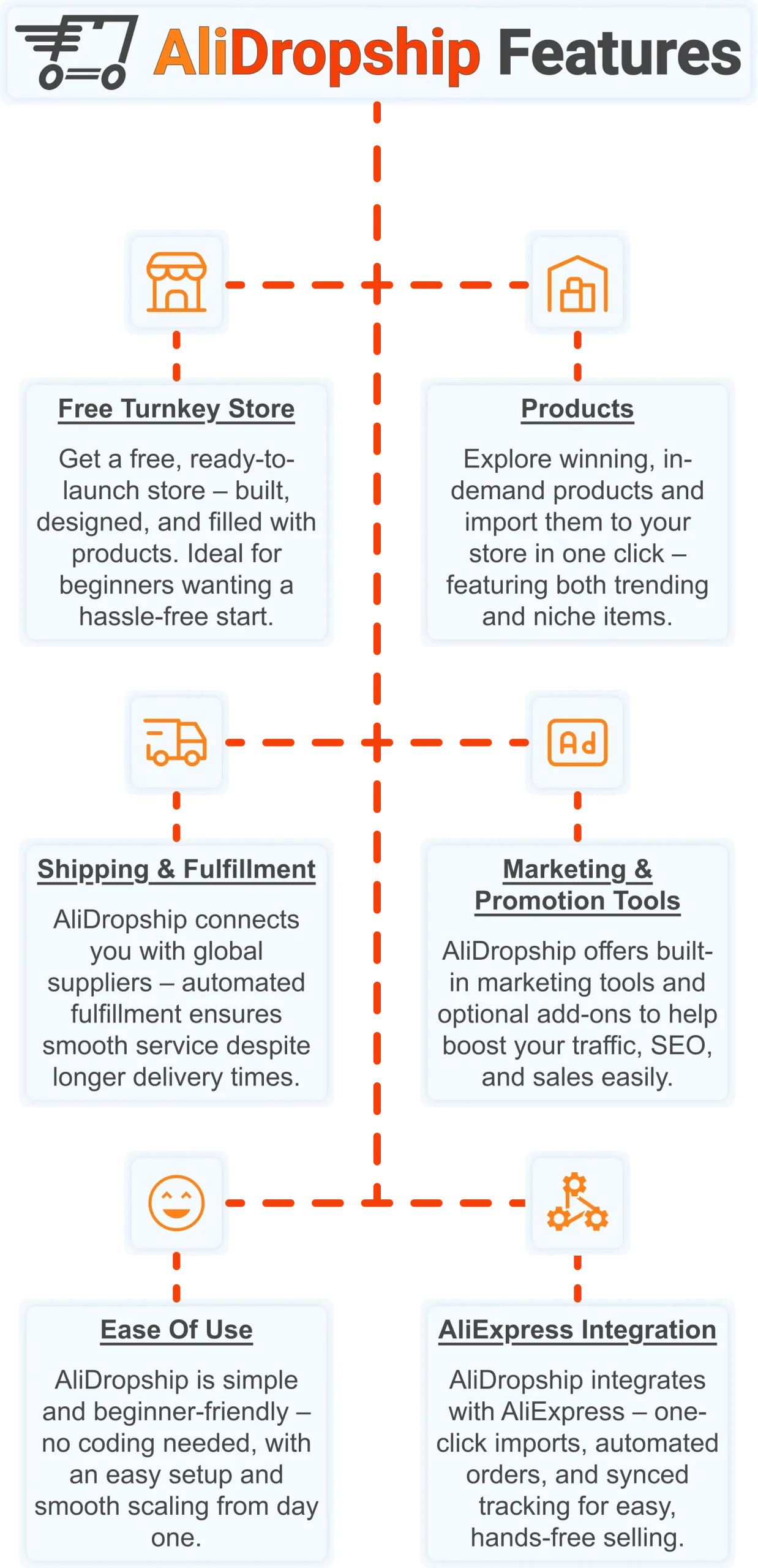
Free turnkey store 🛍️
Get a free turnkey store – built, designed, and filled with products. Ideal for beginners wanting a hassle-free start, the store comes fully optimized to attract customers right away, saving you time on setup. Plus, it includes professional design elements to give your business a polished, trustworthy look from day one. This ready-made foundation makes it easy to move seamlessly into product selection.
Products 📦
Once your store is set up, you can explore winning, in-demand products and import them in one click – featuring both trending and niche items. This wide selection lets you cater to diverse customer interests and test what works best. Regular updates ensure you always have fresh products, keeping your store competitive and relevant. With great products in place, smooth shipping becomes the next essential step.
Shipping & fulfillment 🚚
AliDropship connects you with global suppliers, and automated fulfillment ensures seamless order processing despite international delivery times. Customers receive real-time tracking updates, which builds confidence and trust in your store. Once shipping is handled reliably, you can focus on promoting your store and attracting traffic.
Marketing & promotion tools 📣
To maximize sales, AliDropship offers built-in marketing tools and optional add-ons that help boost traffic, SEO, and conversions. From email campaigns and discounts to social media integration, these tools empower you to reach and retain customers without needing prior marketing experience. With promotion strategies in place, managing your business becomes simpler and more efficient.
Ease of use 👌
AliDropship is beginner-friendly – no coding needed, with an intuitive dashboard that guides you through every step. Easy setup and smooth scaling let you expand your store without stress. As your business grows, adding new features, products, and marketing campaigns remains hassle-free, giving you more time to focus on sales.
AliExpress integration 🛒
Finally, AliDropship integrates seamlessly with AliExpress, enabling one-click imports, automated orders, and synced tracking. Your inventory stays up-to-date with the latest products and prices, while automated order processing frees you from manual tasks. Combined with the turnkey setup, reliable shipping, and built-in marketing tools, this integration ensures your dropshipping business is fully equipped for growth and success.
Making money reselling is a proven path – and dropshipping removes every barrier that holds physical resellers back. Get your free turnkey store and a $100 welcome gift and start building your ecommerce income today.
How to make money reselling for beginners?
What is the best thing to resell to make money online?
How much can you realistically make reselling?
Is reselling worth it in 2026?
How does dropshipping differ from traditional reselling?