How Much Does It Cost To Sell On Shopify In 2026?

If you are thinking about starting an online store, Shopify is probably the first name that comes to mind. But before you sign up, you want to know one thing: how much does it cost to sell on Shopify? The honest answer is that it depends on which plan you pick and how you run your store – but the total adds up faster than most beginners expect.
Quick Answer: Selling on Shopify costs between $29 and $299 per month for a standard plan, plus transaction fees of 0.5%–2% on every sale (unless you use Shopify Payments), domain costs, and optional app fees. Most new sellers spend $40–$80 per month to get started.
This article breaks down every Shopify fee you need to know in 2026 – from the basic Shopify pricing plans to the hidden costs that can quietly eat into your margins. By the end, you will know exactly what to budget and whether Shopify is the right fit for your goals.

What is Shopify and why do the costs matter?
Shopify is a hosted ecommerce platform that lets you build and run an online store without needing to code or manage your own web server. You pay a monthly subscription, and in return Shopify handles hosting, security, checkout, and payment processing. It is one of the most popular ecommerce platforms in the world, powering over 4.6 million stores as of 2026.
Understanding the full cost of selling on Shopify matters because the advertised plan price is never the whole picture. Transaction fees, payment processing rates, app subscriptions, and theme costs all stack on top of your base plan. For a beginner budgeting $29 per month and expecting to keep most of their revenue, the reality of Shopify fees can come as a surprise.
In 2026, Shopify offers four main pricing tiers: Starter, Basic, Shopify, and Advanced. Each tier comes with different transaction fee rates, staff account limits, and reporting features. Knowing which plan fits your stage of business – and what each one actually costs once you add everything up – is the first step to running a profitable store.
Shopify pricing plans: what each one costs in 2026
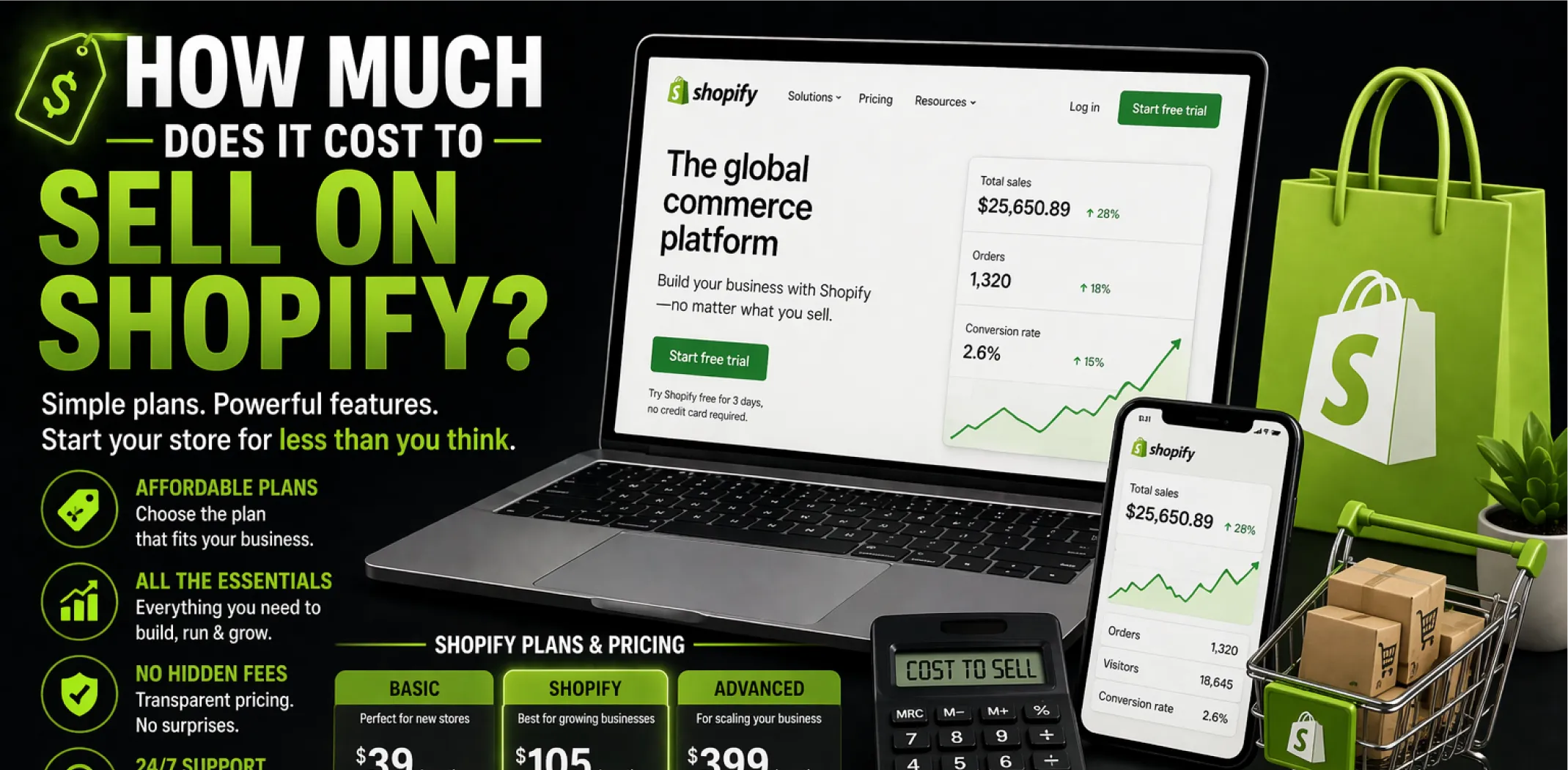
Shopify restructured its pricing in recent years, and in 2026 the lineup looks like this. All prices below are for monthly billing. Paying annually saves you around 25% on each plan.
The Starter plan is limited – you cannot build a full storefront with it. It is designed for selling via social media or existing websites using a buy button. For a proper online store, most beginners start on the Basic plan at $39 per month. The mid-tier Shopify plan at $105 per month adds better reporting and lower transaction fees, which makes sense once your monthly revenue passes around $2,000–$3,000.
One note on the advertised prices: These are the monthly rates when billed month-to-month. Annual billing brings Basic down to around $29 per month, which is the figure you often see quoted. Budget for the month-to-month rate until you are confident the platform suits you.
Transaction fees are one of the most misunderstood parts of Shopify fees. If you use a third-party payment provider like PayPal or Stripe instead of Shopify Payments, Shopify charges you an additional fee on top of whatever your payment processor charges. On the Basic plan, that is an extra 2% per sale. On 100 orders at $50 each, that is $100 straight off your revenue every month just in platform fees – before processing costs.
Using Shopify Payments (available in most countries) eliminates the transaction fee entirely. You still pay a card processing rate – typically 2.9% + $0.30 per online transaction on Basic – but the Shopify-specific fee disappears. For most new sellers, enabling Shopify Payments from day one is the smartest move to protect margins.
The full breakdown: Every Shopify fee you need to budget for
The monthly plan price is just the starting point. To get a realistic picture of how much it costs to sell on Shopify, you need to account for all the other costs that come with running a live store. Here is a category-by-category breakdown.
Domain and hosting costs
Custom domain
Shopify hosting is included in your plan – there is no separate hosting bill. However, your store will launch on a free subdomain (yourstore.myshopify.com) unless you buy a custom domain. A .com domain through Shopify costs around $14–$16 per year. You can also buy through a third-party registrar like Namecheap for $10–$12 per year and connect it manually. Either way, budget around $15 per year.
Important: A custom domain is not optional if you want customers to take your store seriously. The .myshopify.com subdomain signals that your store is in test mode to most shoppers.
Theme costs
Free themes
Shopify offers around 12 free themes in its theme store. They are clean, mobile-responsive, and good enough for most new stores. If you are just getting started and want to keep the Shopify monthly cost as low as possible, a free theme is a perfectly reasonable choice.
Premium themes
Premium Shopify themes cost between $150 and $350 as a one-time purchase. They come with more layout options, built-in conversion features, and dedicated support. Most sellers do not need a premium theme until they are generating consistent revenue – at that point, even a small improvement in conversion rate can pay for the theme quickly.
App costs
Essential apps
The Shopify App Store has over 8,000 apps. Many of the most useful ones are paid. Common essential apps include email marketing tools ($10–$30/month), review apps ($15–$30/month), upsell and cross-sell tools ($20–$50/month), and SEO apps ($10–$20/month).
It is easy to build a $60–$100 per month app stack without realising it. Be selective – add apps one at a time and cut anything that does not show a clear return.
Dropshipping-specific apps
If you are running a dropshipping store on Shopify, you will likely need a product sourcing app like DSers, AutoDS, or Zendrop. These range from free tiers to $30–$60 per month for full automation features. Add this to your baseline cost calculation from the start.
Email and marketing costs
Shopify Email
Shopify includes a basic email marketing tool called Shopify Email. The first 10,000 emails per month are free, after which you pay $1 per 1,000 emails. For a small store in its early months, this is enough. Once your list grows beyond 5,000 subscribers, dedicated tools like Klaviyo or Omnisend offer better automation but cost $20–$60 per month.
Paid advertising
Paid ads are not a Shopify fee, but they are a real cost of selling on the platform for most store owners. Facebook and Instagram ads, Google Shopping campaigns, and TikTok ads are common channels. Realistic starter budgets range from $5–$20 per day ($150–$600 per month) for testing. Organic traffic through SEO and social content takes 60–90 days to build but is free once established.
Payment processing fees
Even with Shopify Payments enabled and the transaction fee waived, you still pay a card processing rate on every order. On the Basic plan this is 2.9% + $0.30 per online transaction. On the Shopify plan it drops to 2.6% + $0.30, and on Advanced it goes to 2.4% + $0.30. These rates are competitive with industry standards, but on low-margin products – common in dropshipping – they are worth factoring carefully into your pricing.
Earning potential: A Shopify store generating $3,000 per month in revenue on a Basic plan with Shopify Payments enabled will pay roughly $87–$120 per month in card processing fees, plus the $39 plan fee. Net after platform costs: approximately $2,750–$2,874 before product and ad spend.
What does Shopify actually cost per month in total?
To give you a realistic total, here is what a typical new seller on the Basic plan actually pays in their first few months, with conservative app usage and Shopify Payments enabled.
This is the lean version. Sellers who add a premium theme, a full email platform, and paid ad spend can easily hit $250–$500 per month in total costs before making a single sale. That is not unusual – it is just the reality of running a self-managed ecommerce business, and something every newcomer should plan for.
Hidden Shopify fees beginners often miss
Beyond the obvious Shopify pricing plans and app costs, there are a few fees that catch new sellers off guard. Here is what to watch for.
Currency conversion fees
If you sell internationally and your store currency differs from your payout currency, Shopify charges a 1.5% currency conversion fee. This is easy to miss in the early setup stages and can meaningfully reduce margins on international orders. Check your payout settings early and align currencies where possible.
Chargeback fees
If a customer disputes a charge and files a chargeback through their bank, Shopify charges a $15 fee per chargeback (when using Shopify Payments). Fraud protection apps and clear product descriptions reduce the risk, but budget for occasional chargebacks as your order volume grows.
Shopify Plus upgrade costs
Shopify Plus is the enterprise tier, starting at $2,000 per month. It is aimed at high-volume brands doing $1M+ in annual revenue. For the vast majority of sellers reading this guide, Plus is not relevant – but it is worth knowing that Shopify has a very wide pricing range depending on your scale.
Refund and dispute processing
When you issue a refund, Shopify does not automatically return the card processing fee on the original transaction. On Shopify Payments, you get the 2.9% portion back but not the $0.30 flat fee. On high-volume stores with frequent returns, this adds up. Build a realistic refund rate into your margin calculations from the start.
Is Shopify worth the cost? What sellers on Reddit and Trustpilot say
Looking at genuine seller feedback on Reddit’s r/shopify and on Trustpilot, the picture is nuanced. Shopify scores around 3.5–4 out of 5 on Trustpilot, with most positive reviews praising the ease of setup and the quality of the checkout experience. The most common complaints centre on the cumulative cost of apps and the transaction fees when not using Shopify Payments.
On Reddit, experienced sellers consistently make two points. First, the platform works well once you treat it like a real business with proper cost tracking from day one. Second, sellers who underestimate app costs and ad spend are the ones who end up feeling like the platform is too expensive. The platform itself is not the problem – the lack of financial planning is.
Why this works in 2026: Shopify’s infrastructure is genuinely excellent for fast store setup and payment reliability, which is why it still dominates despite higher total costs than some competitors. For sellers who understand the fee structure upfront, it remains one of the most capable platforms available.
How to keep your Shopify costs as low as possible
Once you understand how Shopify pricing plans and fees work, there are straightforward ways to manage costs without sacrificing performance.
Use annual billing from the start
If you are confident about committing to Shopify for a full year, annual billing saves around 25% on your plan cost. Basic drops from $39 to approximately $29 per month, and the Shopify plan drops from $105 to around $79 per month. Over a year, that is a meaningful saving – especially in the early months when margins are tight.
Enable Shopify Payments immediately
This is the single most impactful cost decision you can make on the platform. Eliminating the additional transaction fee (2% on Basic) on every sale is immediate and ongoing. If Shopify Payments is available in your country, enable it during store setup, not after your first sales.
Audit your apps every 30 days
App costs are the easiest place for your monthly cost to creep up without noticing. Set a calendar reminder once a month to review every active app, check its ROI, and cancel anything that is not directly contributing to revenue or saving meaningful time. Most sellers find at least one redundant app subscription when they do this audit for the first time.
Start with organic traffic, not paid ads
Paid advertising adds $150–$600 per month to your costs immediately. While ads can accelerate growth, starting with SEO content, Pinterest, or organic social media gives you time to validate your products and pricing before spending on traffic. Most successful Shopify stores that started lean spent their first 60–90 days building organic content before turning on ad spend.
Which Shopify plan is right for you?
The right Shopify pricing plan depends entirely on where you are in your business journey. Here is how to think about it by reader profile.
Complete beginner
If you have never run an online store before, start on the Basic plan at $39 per month with annual billing if possible. Enable Shopify Payments, use a free theme, and keep your app stack to two or three tools maximum. Your total cost should land between $40 and $70 per month before ad spend. Expect to spend 60–90 days before your first consistent sales, and do not scale ad spend until your product-market fit is confirmed.
Intermediate seller
If you are already generating $2,000–$5,000 per month in revenue, the mid-tier Shopify plan at $105 per month starts to make sense. The lower transaction fee (1% vs 2%) and better analytics justify the extra cost at this revenue level. You are also likely building an email list at this stage, so a proper email platform like Klaviyo becomes worthwhile.
Advanced or full-time goal
If your goal is a full-time ecommerce income of $5,000+ per month, the Advanced plan at $399 per month can be justified by the 0.5% transaction fee alone at high volumes. At $50,000 per month in revenue, the difference between a 1% and 0.5% transaction fee saves $250 per month – more than covering the plan upgrade. Focus on conversion rate optimisation, retention, and product expansion at this stage.
Shopify continues to grow as a platform, with new features, better international support, and a maturing app ecosystem making it more capable every year. For sellers who understand and plan for the full cost structure, it remains a strong foundation for an online business in 2026.
AliDropship: Your complete all-in-one solution for starting dropshipping in 2026
If you want the simplest possible way to start dropshipping – especially if you’re brand new – AliDropship remains one of the most beginner-friendly tools available in 2026. It brings together store creation, product imports, automation, and marketing into a single streamlined system designed to help you launch quickly and grow confidently.
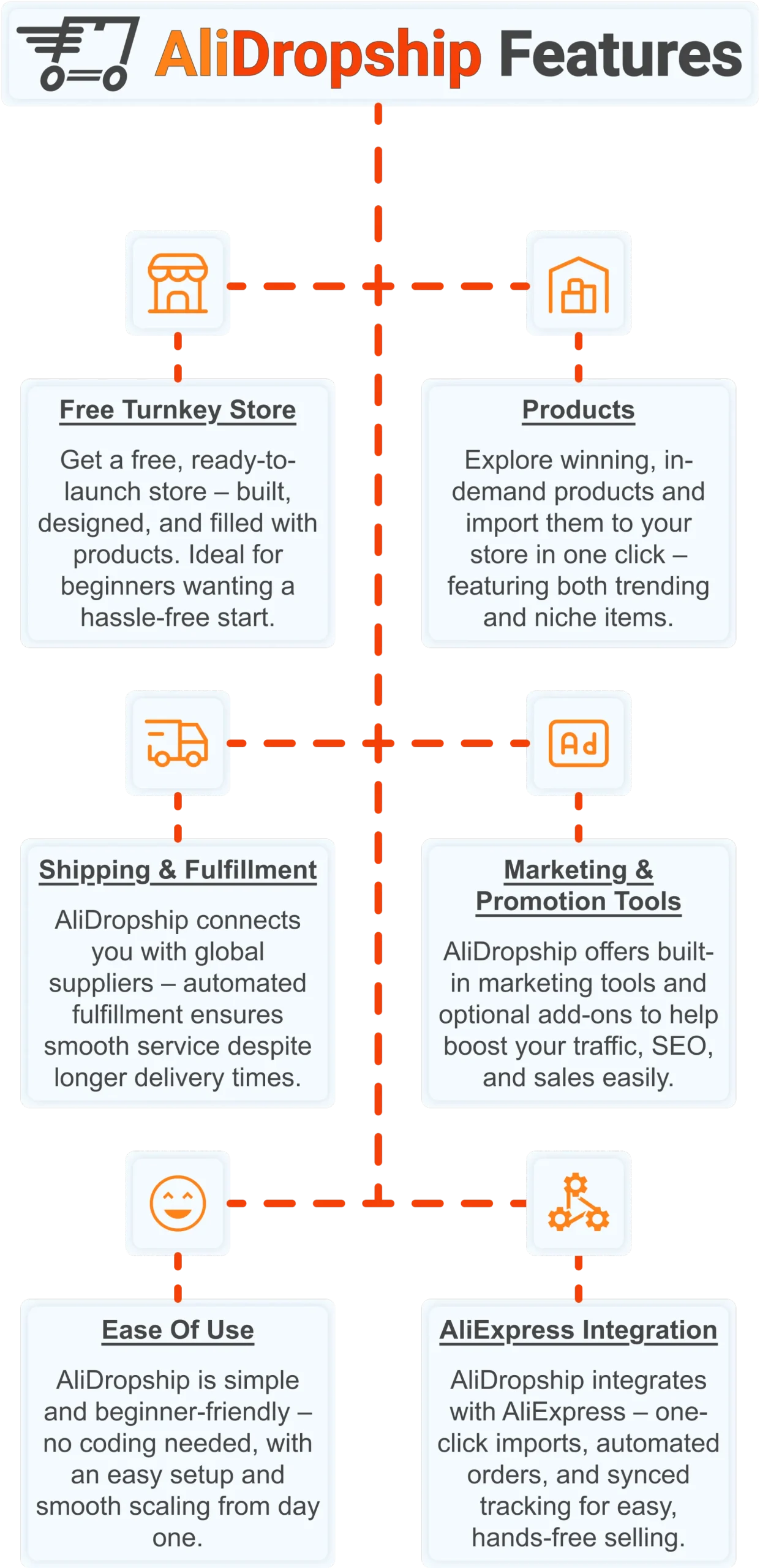
Free turnkey store 🛍️
Get a free turnkey store – built, designed, and filled with products. Ideal for beginners wanting a hassle-free start, the store comes fully optimized to attract customers right away, saving you time on setup. Plus, it includes professional design elements to give your business a polished, trustworthy look from day one. This ready-made foundation makes it easy to move seamlessly into product selection.
Products 📦
Once your store is set up, you can explore winning, in-demand products and import them in one click – featuring both trending and niche items. This wide selection lets you cater to diverse customer interests and test what works best. Regular updates ensure you always have fresh products, keeping your store competitive and relevant. With great products in place, smooth shipping becomes the next essential step.
Shipping & fulfillment 🚚
AliDropship connects you with global suppliers, and automated fulfillment ensures seamless order processing despite international delivery times. Customers receive real-time tracking updates, which builds confidence and trust in your store. Once shipping is handled reliably, you can focus on promoting your store and attracting traffic.
Marketing & promotion tools 📣
To maximize sales, AliDropship offers built-in marketing tools and optional add-ons that help boost traffic, SEO, and conversions. From email campaigns and discounts to social media integration, these tools empower you to reach and retain customers without needing prior marketing experience. With promotion strategies in place, managing your business becomes simpler and more efficient.
Ease of use 👌
AliDropship is beginner-friendly – no coding needed, with an intuitive dashboard that guides you through every step. Easy setup and smooth scaling let you expand your store without stress. As your business grows, adding new features, products, and marketing campaigns remains hassle-free, giving you more time to focus on sales.
AliExpress integration 🛒
Finally, AliDropship integrates seamlessly with AliExpress, enabling one-click imports, automated orders, and synced tracking. Your inventory stays up-to-date with the latest products and prices, while automated order processing frees you from manual tasks. Combined with the turnkey setup, reliable shipping, and built-in marketing tools, this integration ensures your dropshipping business is fully equipped for growth and success.
If the cost to sell on Shopify is giving you second thoughts, AliDropship offers a genuinely different starting point – a free, fully built store with no monthly platform fee to stress over. Claim your free turnkey store and $100 welcome gift and start selling today.
How much does it cost to sell on Shopify per month?
What are the Shopify transaction fees?
Shopify charges two types of transaction fees. The first is a platform fee that applies when you use a third-party payment provider instead of Shopify Payments. This fee is 2 percent on the Basic plan, 1 percent on the Shopify plan, and 0.5 percent on the Advanced plan. The second is a card processing fee, which applies to every sale regardless of payment method. With Shopify Payments enabled, the processing rate is 2.9 percent plus 30 cents per transaction on the Basic plan. Using Shopify Payments eliminates the platform fee entirely, which is why most sellers enable it from day one.
Which Shopify pricing plan is best for beginners?
Most beginners should start on the Basic plan, which costs 39 dollars per month on monthly billing or around 29 dollars per month with annual billing. It includes everything you need to launch a full online store, including a custom domain connection, unlimited products, and access to Shopify Payments. The mid-tier Shopify plan at 105 dollars per month becomes worth considering once your revenue consistently exceeds 2,000 to 3,000 dollars per month, as the lower transaction fee starts to offset the higher plan cost at that volume.
Are there hidden fees on Shopify?
Yes, there are several costs that beginners often miss. Currency conversion fees of 1.5 percent apply when your store currency and payout currency differ. Chargeback fees of 15 dollars per dispute apply when using Shopify Payments. App costs accumulate quickly and can add 50 to 100 dollars or more per month if you are not careful. Refund processing also does not return the 30 cent flat fee on the original transaction. Being aware of these before you launch makes budgeting much more accurate.
How do Shopify fees compare to other ecommerce platforms?
Shopify is on the higher end for total monthly cost compared to platforms like WooCommerce or Wix. WooCommerce is free as a plugin but requires paid hosting of around 10 to 20 dollars per month and more technical setup. Wix eCommerce starts at around 17 dollars per month but has fewer ecommerce features at the lower tiers. Shopify justifies its cost with a more reliable checkout, a larger app ecosystem, and better scalability. For sellers prioritising ease of use and long-term growth, the higher cost is generally considered worthwhile.