12 Best Home Business Ideas to Start in 2026

You are not alone if you have typed “home business ideas” into Google at 11pm while the rest of the house is asleep. Millions of people do it every month, and most walk away with a vague list and zero clue which option actually fits their life. This article fixes that.
Below you will find 12 home business ideas that real people are running in 2026 – with honest earning ranges, realistic timelines, and the specific skills or startup costs each one needs. No hype, no “make $10,000 in your first week” promises. Just grounded, profitable home business ideas you can actually start this month.
Quick Answer: The best home business ideas in 2026 are the ones that match your time, budget, and skills – not whatever is trending on TikTok. For most beginners, a dropshipping store, freelance service, or print-on-demand shop offers the fastest path to $30–$80 per day, usually within 60–90 days of consistent work.

What counts as a home business in 2026?
A home business is any income-generating activity you run primarily from your residence, using your own tools and time. In 2026, a home based business no longer means stuffing envelopes or assembling crafts from a catalog. It means running a real operation – often entirely online – from a laptop, a phone, or a spare room.
The line between a side hustle and a home business is thin but important. A side hustle pays the bills on the side. A home business is structured to grow. You register it, track expenses, reinvest profits, and ideally build something that keeps earning when you step away.
Three shifts have made 2026 unusually good for starting one. Remote tools are cheaper than ever, with AI assistants replacing what used to cost $500 a month. Customer acquisition no longer requires a marketing degree – short-form video and email automation handle most of the heavy lifting. And the trust barrier is lower, because buyers are used to ordering from small independent brands they found on Instagram.
How much can you realistically earn from a home business?
Honest numbers up front: most home businesses do not make you rich, but the good ones replace a paycheck faster than any job change could. Here is the realistic earning range across the main categories of home based business in 2026.
The table shows typical ranges, not ceilings. A handful of operators in every category earn far above these numbers, but they are the exception, not the rule. Expect the lower end for your first 60–90 days and the middle of the range once you have systems in place.
One note on these figures: “full-time effort” in a home business usually means 30–40 focused hours per week, not 80. The operators clearing the top of these ranges are almost always reinvesting profits into ads, tools, or help – not grinding harder alone.
12 profitable home business ideas for 2026
These are the options worth your attention right now. Each one comes with honest startup requirements, a realistic earning window, and a note on who it actually fits. Skim them all before committing – the best home business ideas are rarely the loudest ones.
Ecommerce and online selling
Dropshipping store
Dropshipping lets you sell physical products without ever touching inventory. You list items on your own store, the customer pays you, and a supplier ships the order directly. Your margin is the gap between what the customer pays and what the supplier charges.
The Wild West days of $3 products sold for $40 are gone, but the fundamentals still work when you pick the right niche and treat it like a real business.
How to get started: pick a niche you understand, set up a store on a platform that supports automation, import 15–30 well-chosen products, and start with one marketing channel – usually TikTok organic or Meta Ads. Budget around $100–$500 for your first ad tests.
Why this works in 2026: AI tools now handle product research, ad copy, and customer service at a fraction of what they used to cost, which means a solo operator can run what previously took a three-person team.
Earning potential: $30–$300 per day within 60–90 days of consistent effort.
Print on demand
Print on demand is dropshipping for designers. You upload artwork, a partner prints it on t-shirts, mugs, posters, or phone cases whenever an order comes in, and ships it for you. Zero upfront inventory, unlimited design iterations, and the ability to test a new niche in an afternoon.
How to get started: pick a specific audience – think “dog trainers in Texas” rather than “dog lovers” – create 20–30 designs using Canva or an AI image tool, and list them on Etsy, Redbubble, or your own store. The specificity is what separates the $5/day stores from the $500/day ones.
Important note: copyright rules are enforced aggressively in 2026. Stay far away from any trademarked phrases, sports team colors, or character likenesses.
Earning potential: $10–$100 per day once you have 100+ listings and a clear niche.
Handmade products on Etsy
If you actually enjoy making things – candles, soap, jewelry, printables, leather goods – Etsy remains viable in 2026, though fees have climbed. Handmade commands higher prices, builds stronger repeat customers, and has a real defensible moat that dropshipping does not.
How to get started: pick a category you can produce consistently for under 25% of the retail price, photograph everything against a clean background, and write listings that tell a story. SEO on Etsy is mostly about the first 40 characters of your title and your tags.
Service based home businesses
Freelance writing, design, or development
Selling a skill is the fastest path from zero to real income in any home based business. You do not need a store, an audience, or a product – you need one skill businesses will pay for and the discipline to keep pitching. Writing, graphic design, and web development are the three most accessible lanes in 2026.
How to find clients: Upwork and Contra are the standard starting points, but the operators making real money are on LinkedIn, pitching cold three to five times a day. Reddit communities like r/freelance are honest about what actually works – most newcomers underprice themselves by 40% for the first six months.
Earning potential: $25–$150 per hour depending on skill and niche, with experienced specialists billing $200+.
Virtual assistant
Virtual assistants handle the admin, scheduling, and inbox management that small business owners cannot afford to outsource to a full-time hire. It is one of the most beginner-friendly small home business ideas because the barrier to entry is organization, not a specific credential.
How to get started: niche down to a specific industry – real estate agents, coaches, or ecommerce founders – and list the exact three to five tasks you handle. Generic VAs compete on price. Specialized VAs charge double.
Online tutoring and coaching
If you know something well – a language, a skill, a test, a sport – someone will pay to learn it from you. Platforms like Preply and Wyzant handle the logistics for tutors, while coaches build their own book through LinkedIn, Instagram, or referrals. Flexible hours, and rates climb quickly once you have testimonials.
Earning potential: $20–$60 per hour on platforms, $75–$200+ per hour for independent coaches with a niche.
Content and digital products
YouTube or TikTok channel
Content creation is the most asymmetric home business idea on this list. Most channels earn nothing for the first six to twelve months. A small minority clear six figures. The difference is almost always consistency and niche clarity – not production quality.
Important: treat the first 100 videos as tuition, not income. You are paying in time to figure out what your audience responds to.
Earning potential: $0–$500 per day, with massive variance. Plan for an 18-month runway before this replaces a real paycheck.
Digital products and templates
Notion templates, Canva templates, spreadsheets, prompts, and ebooks are the cleanest form of online home business income. You build once, you sell forever, with no shipping to manage. The catch is distribution – the product alone is never enough.
How to get started: solve one specific problem you personally had – a budget template, a meal planner, a client onboarding system – and sell it on Gumroad, Etsy, or your own site. Then promote it on the platform where your buyers already hang out.
Online courses
Courses are a harder version of digital products – higher price point, higher expectation, more support required. But margins are excellent once you have a working funnel. A $197 course with 50 sales per month is $9,850 in mostly passive income.
Local and hybrid home businesses
Pet sitting, dog walking, or boarding
Rover and Wag handle most of the logistics, so you can start this week. Pet sitting is excellent for anyone with a stable home environment and some schedule flexibility. The work is physical but genuinely enjoyable for the right person.
Earning potential: $20–$50 per visit, $40–$90 per overnight stay, with busy sitters in major cities clearing $3,000–$5,000 per month.
Cleaning or organizing service
Residential cleaning and professional organizing are among the most underrated profitable home business ideas for anyone who prefers working with their hands over staring at a screen. Startup costs are minimal, demand is steady, and repeat clients build recurring income fast.
How to get started: pick one specific service – move-out cleans, post-renovation cleans, or pantry organizing – and market within a 15-mile radius on Nextdoor and local Facebook groups. Get insured before your first paid job.
Food business from home
Cottage food laws now allow home-baked goods, jams, and packaged snacks to be sold legally in most US states, with caps ranging from $25,000 to $250,000 in annual revenue depending on the state. Farmers markets, Instagram orders, and pickup-only models are the main distribution channels.
Important note: cottage food rules vary sharply by state. Check your state department of agriculture page before taking your first order – some products are allowed, others require a commercial kitchen.
Legal and ethical considerations for every home based business
The biggest mistakes new home business owners make are legal, not marketing. Skipping these steps will cost you far more later than the hour it takes to handle them now.
Key principle: treat your home business as a business from day one, not a hobby you occasionally invoice for.
What to handle before your first paying customer
Register your business as an LLC or sole proprietorship depending on your state and risk level. Open a separate bank account – mixing personal and business money is the single fastest way to create a tax nightmare. Check your local zoning rules if you plan to receive any foot traffic or deliveries. And get liability insurance if you handle anyone else’s property, body, or children.
What to avoid absolutely
Fake reviews are now illegal in the US under FTC rules updated in 2024, with fines of up to $51,744 per violation. Do not buy them, do not incentivize them, do not trade them. Avoid any MLM opportunity that requires you to recruit to earn, any dropshipping supplier selling counterfeit branded goods, and any course that promises specific income figures without a clear disclaimer.
Taxes you should plan for
Self-employment tax in the US is 15.3% on top of regular income tax, and you are expected to pay quarterly. Set aside 25–30% of every dollar earned until you talk to an accountant. The home office deduction is legitimate and useful, but only if you have a dedicated space used exclusively for business.
How to choose the right home business for you
The best home business ideas for you depend on three things: how much time you have, how much money you can risk, and whether you want to sell your time or build something that sells without you. Here is how the 12 options above line up by reader profile.
Complete beginner with no savings
Start with a service you can deliver immediately – virtual assistant work, freelance writing, pet sitting, or cleaning. You will have cash within 2–4 weeks, and that cash becomes the seed capital for something more scalable later. Avoid anything that requires ad spend before you have revenue.
Intermediate with some savings and 10–20 hours per week
Dropshipping, print on demand, or digital products are the sweet spot. You have enough time to run real tests and enough savings to absorb the 2–3 months of learning curve. Pick one and commit for 90 days minimum – switching models every three weeks is the most common reason people fail.
Advanced aiming for full-time replacement income
Build a real ecommerce store with email flows, paid ads, and a content pipeline, or stack a high-ticket coaching offer on top of a content channel you already have. The combined approach – store plus content plus email list – is what separates $100,000 home businesses from $10,000 ones.
The broader trend is clear: independent online businesses take a larger share of retail every year, AI tools keep lowering the operating cost of running one, and the infrastructure for solo operators has never been better. Starting something this year puts you on the right side of that shift.
AliDropship: Your complete all-in-one solution for starting dropshipping in 2026
If you want the simplest possible way to start dropshipping – especially if you’re brand new – AliDropship remains one of the most beginner-friendly tools available in 2026. It brings together store creation, product imports, automation, and marketing into a single streamlined system designed to help you launch quickly and grow confidently.
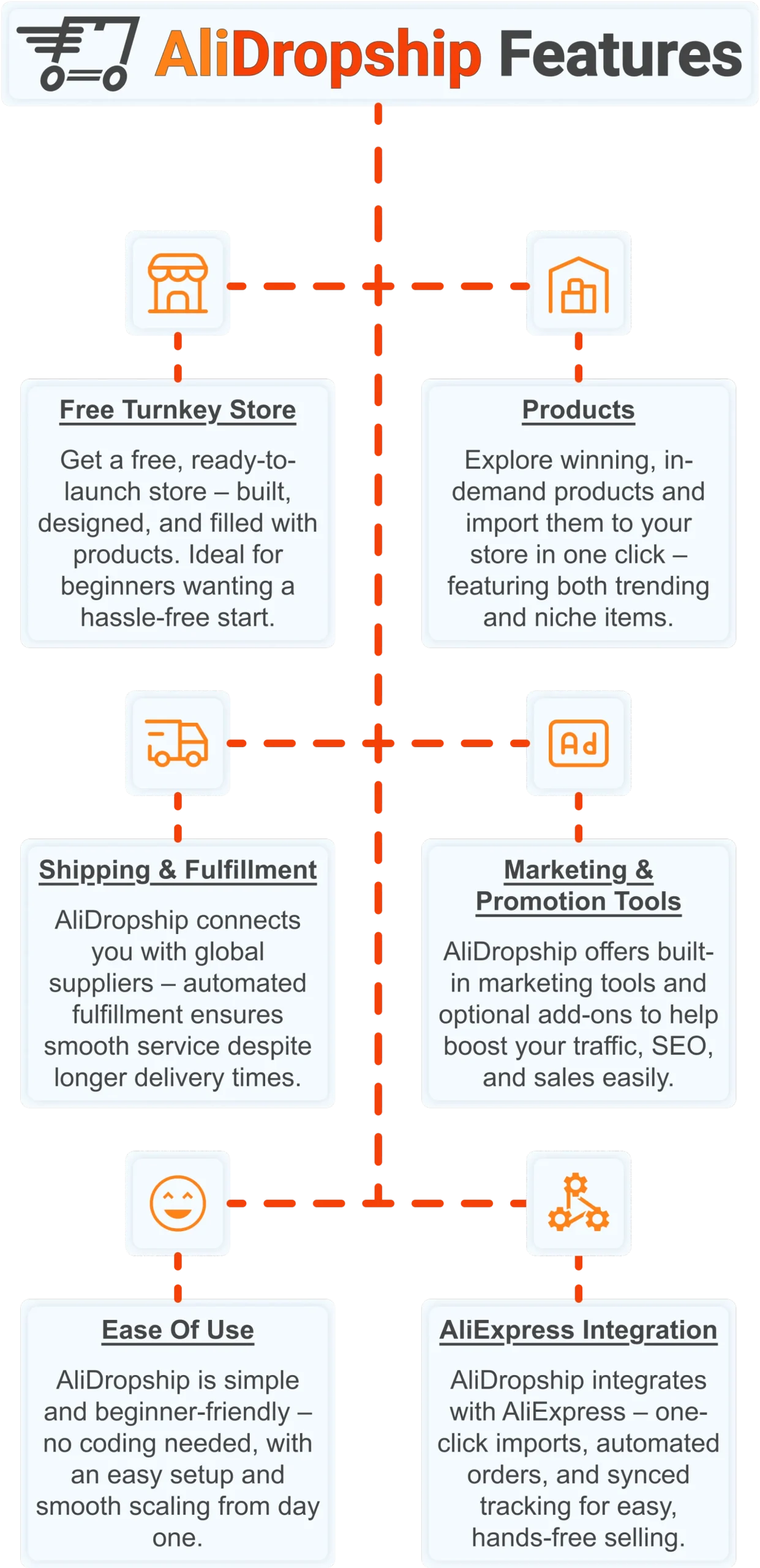
Free turnkey store 🛍️
Get a free turnkey store – built, designed, and filled with products. Ideal for beginners wanting a hassle-free start, the store comes fully optimized to attract customers right away, saving you time on setup. Plus, it includes professional design elements to give your business a polished, trustworthy look from day one. This ready-made foundation makes it easy to move seamlessly into product selection.
Products 📦
Once your store is set up, you can explore winning, in-demand products and import them in one click – featuring both trending and niche items. This wide selection lets you cater to diverse customer interests and test what works best. Regular updates ensure you always have fresh products, keeping your store competitive and relevant. With great products in place, smooth shipping becomes the next essential step.
Shipping & fulfillment 🚚
AliDropship connects you with global suppliers, and automated fulfillment ensures seamless order processing despite international delivery times. Customers receive real-time tracking updates, which builds confidence and trust in your store. Once shipping is handled reliably, you can focus on promoting your store and attracting traffic.
Marketing & promotion tools 📣
To maximize sales, AliDropship offers built-in marketing tools and optional add-ons that help boost traffic, SEO, and conversions. From email campaigns and discounts to social media integration, these tools empower you to reach and retain customers without needing prior marketing experience. With promotion strategies in place, managing your business becomes simpler and more efficient.
Ease of use 👌
AliDropship is beginner-friendly – no coding needed, with an intuitive dashboard that guides you through every step. Easy setup and smooth scaling let you expand your store without stress. As your business grows, adding new features, products, and marketing campaigns remains hassle-free, giving you more time to focus on sales.
AliExpress integration 🛒
Finally, AliDropship integrates seamlessly with AliExpress, enabling one-click imports, automated orders, and synced tracking. Your inventory stays up-to-date with the latest products and prices, while automated order processing frees you from manual tasks. Combined with the turnkey setup, reliable shipping, and built-in marketing tools, this integration ensures your dropshipping business is fully equipped for growth and success.
Of all the home business ideas you could start this year, ecommerce offers the rare combination of low startup cost, global reach, and real scale potential. Claim your free turnkey store and start selling this week.
What is the most profitable home business to start in 2026?
How much money do you need to start a home business?
Most home businesses can launch for under 500 dollars in 2026. Dropshipping stores usually need 100 to 500 dollars for domain, apps, and initial ad tests. Freelance and virtual assistant businesses can start with essentially zero cost beyond a laptop and internet. Print on demand stores often launch for under 50 dollars since there is no inventory to buy. Local services like pet sitting or cleaning may require 200 to 400 dollars for insurance and basic supplies.
What home business ideas work with no experience?
Virtual assistant work, pet sitting, cleaning, print on demand, and basic freelance services are the most beginner friendly options. Each one relies on organization, reliability, or creativity rather than specialized credentials. Most platforms provide training materials, and communities on Reddit and YouTube offer detailed guides for every path. Expect a learning curve of 30 to 60 days before you feel confident, but you can start earning within the first two weeks for most service based options.
Can you run a home business while working full time?
Yes, and many successful home business owners start exactly this way. A realistic schedule is 10 to 15 hours per week in evenings and weekends, focused on one business model rather than juggling three. Automated options like dropshipping and digital products fit best around a day job because customer interactions can be batched. The key constraint is energy, not time, so protect two to three focused evenings per week.
How long does it take for a home business to become profitable?
Most home businesses reach meaningful profit between 60 and 180 days, depending on the model. Service based businesses can hit 1,000 dollars per month within 30 to 60 days if you pitch consistently. Ecommerce stores typically need 60 to 90 days to find a winning product and audience. Content based businesses like YouTube or blogging generally take 12 to 18 months to replace a part time income. The number one factor in getting there faster is daily consistency rather than weekly sprints.