Ecommerce Growth in 2026: Proven Strategies That Work

Ecommerce growth in 2026 is no longer about dumping ad budget into Facebook and hoping the algorithm behaves. The playing field changed. Global online retail sales are expected to cross $8 trillion this year, and the stores winning that pie are the ones treating growth as a system – not a lucky launch. If you are trying to grow an online store from scratch, or scale one that has plateaued, you are in the right place.
This guide walks through what ecommerce growth actually means in 2026, how much you can realistically earn, which levers move the needle, and how to pick the right strategy based on where you are today. Expect specific numbers, honest timelines, and zero fluff.
Quick Answer: Ecommerce growth in 2026 comes from compounding small wins – better traffic sources, higher conversion rates, repeat customer revenue, and smarter product selection. Most stores that stick with it hit $1,000–$5,000/month within 90 days and scale from there.

What is ecommerce growth, really?
Ecommerce growth is the measurable increase in revenue, customers, and profitability of an online store over time. It is not just more traffic or more sales in isolation – it is the compounding effect of traffic, conversion, average order value, and customer retention all moving in the right direction together.
In 2026, ecommerce growth has shifted. The easy-money years of cheap Facebook ads and viral TikTok drops are over. What works now is a mix of owned traffic (SEO, email, community), paid acquisition with tighter margins, and repeat purchase systems that turn one-time buyers into regulars.
According to Shopify and Statista data, the average ecommerce store that survives past year one does so by hitting a repeat purchase rate above 20% – a number most new stores completely ignore.
Why does this matter to you? Because the difference between a store that earns $30/day and a store that earns $300/day is rarely the product. It is the growth system behind it. You do not need a unicorn idea. You need a store that converts, a traffic source that keeps bringing people in, and a reason for them to come back.
Why this works in 2026: Consumer spending is shifting toward stores that feel personal and trustworthy. Small, focused online stores are outperforming generic mega-retailers in specific niches because buyers want curation, not clutter.
How much can you realistically earn from an ecommerce store?
Let us get specific. Here is what actual ecommerce revenue looks like across different growth stages, based on Shopify merchant data, Reddit r/ecommerce threads, and publicly shared income reports.
These ranges reflect real stores, not cherry-picked unicorns. Most beginners earn closer to the low end of the first row for 60–90 days before anything resembling consistent growth kicks in. The stores that scale to the top row put in full-time hours for months before crossing that threshold.
One note on the ceiling figures: Hitting $3,000/day is real but rare, and it usually involves paid ads at scale, a refined supply chain, and a team. If you are solo and starting now, aim for the middle row within your first year – that is where most sustainable ecommerce businesses live.
The core levers that drive ecommerce growth
Every growing ecommerce store – without exception – pulls on four levers. Understanding them is the difference between spinning your wheels and actually moving forward.
Traffic: Getting the right people to your store
Traffic is the oxygen of ecommerce growth. But not all traffic is equal – 10,000 random visitors convert worse than 500 targeted ones. In 2026, the winning traffic mix usually combines one paid channel, one organic channel, and one owned channel.
Paid ads
Meta Ads, TikTok Ads, and Google Shopping remain the big three for ecommerce sales growth. Costs are higher than five years ago – expect a $15–$40 cost per acquisition for most niches – but the targeting is more precise. Start with a $20–$50/day budget, test five to ten creatives, and kill losers ruthlessly.
SEO and content
Organic search is slower but compounds. Stores that publish buyer-intent content (comparison posts, how-to guides, category pages) see traffic build over 3–6 months and then grow without paying per click. Tools like Ahrefs and free alternatives like Google Search Console make this approachable.
Social and community
TikTok, Instagram Reels, and niche communities on Reddit or Discord bring traffic that is already warm. The key is posting consistently – 4–7 times a week on at least one platform – and engaging with comments rather than broadcasting at people.
Earning potential: A balanced traffic mix typically drives $50–$300/day within 60–90 days for a well-built store.
Conversion: Turning visitors into buyers
The average ecommerce conversion rate in 2026 sits between 2% and 3%. Pushing yours from 1.5% to 3% effectively doubles your revenue without adding a single visitor. This is usually the fastest ecommerce growth lever you can pull.
Page speed and mobile experience
Over 70% of ecommerce traffic is mobile. A store that loads in under 3 seconds converts roughly 2x better than one that takes 5+ seconds. Compress images, limit apps, and use a light theme.
Trust signals
Real reviews, clear shipping times, a visible return policy, and a working contact page matter more than any fancy design trick. Buyers check these before pulling out their wallet.
Checkout simplicity
Every additional checkout field drops conversion by around 5%. Guest checkout, Apple Pay, Google Pay, and Shop Pay should all be enabled. Do not force account creation before payment.
Earning potential: A conversion rate bump from 1.5% to 3% on $5,000/month in traffic value adds roughly $2,500 in monthly revenue with zero extra ad spend.
Average order value: Earning more per buyer
If your average order value (AOV) is $40 and you can push it to $60, you just grew revenue by 50% without adding customers. Three tactics reliably move AOV in 2026.
Bundles and kits
Grouping related products at a 10–15% discount versus buying them separately lifts AOV by 20–30% in most niches. Skincare, pet supplies, and home goods respond especially well.
Free shipping thresholds
Setting free shipping at 1.3x your current AOV pushes buyers to add one more item. If your AOV is $35, set the threshold at $45.
Post-purchase upsells
One-click upsells shown right after checkout convert at 8–15% and add pure margin. Apps like ReConvert make this a 10-minute setup.
Retention: Turning buyers into repeat customers
This is the lever most beginners ignore – and it is arguably the most important for long-term ecommerce business growth. Acquiring a new customer costs 5–7x more than selling to an existing one.
Email and SMS flows
A welcome series, abandoned cart flow, and post-purchase sequence set up in Klaviyo or Omnisend typically drives 20–30% of total store revenue once it matures. Set these up once and they earn on autopilot.
Loyalty programs
Simple points-based systems (spend $1, earn 1 point) raise repeat purchase rates by 15–25% in niches where buyers naturally come back – beauty, consumables, hobby supplies.
Subscription options
If your product is consumable, a 10–15% discount for subscribe-and-save turns one-time buyers into predictable monthly revenue.
Earning potential: A 20% repeat purchase rate on a $1,500/month store adds $300+/month in near-automatic revenue.
Ecommerce growth trends shaping 2026
Knowing which direction the market is heading helps you pick strategies that will still work in 12 months – not ones that are already dying.
AI-assisted everything
AI tools now handle product descriptions, customer support chat, ad creative generation, and personalized email copy at a fraction of what it used to cost. Stores using AI for these tasks report 30–50% time savings on operations.
Shorter, faster shipping expectations
Buyers expect 5–10 day delivery as the new normal, even from small stores. Suppliers with US or EU warehouses – or fulfillment partners that use them – have a clear edge over 20+ day shipping from overseas.
Niche over mass-market
Stores targeting a specific audience (left-handed gardeners, minimalist pet owners, van-life cooks) convert at 2–3x the rate of generic stores. Narrow beats broad, consistently.
First-party data and email
With cookie-based tracking eroding, email lists are more valuable than ever. Stores building 500+ engaged subscribers in their first 6 months are positioned far better for long-term growth.
Social commerce maturity
TikTok Shop, Instagram Shopping, and YouTube Shopping are now real sales channels rather than experiments. Early adopters in niches like beauty, fashion, and home decor are reporting 20–40% of their revenue from these platforms.
Tips to maximize your ecommerce growth this year
Pick one traffic channel and master it first
Trying to be everywhere at once is how new stores burn out. Pick one – TikTok, SEO, or Meta Ads – and go deep for 90 days before adding a second. Depth beats breadth in the early stages.
Track the three numbers that matter
Conversion rate, AOV, and repeat purchase rate. Everything else is vanity. Check them weekly in Shopify analytics or Google Analytics 4 and make one change at a time so you can tell what moved the needle.
Reinvest profit for the first 6 months
This is the hardest advice to follow but the most reliable. Founders who reinvest 70–80% of early profit back into ads, content, and inventory grow 3–4x faster than those who pull money out early.
Build your email list from day one
A pop-up offering 10–15% off the first order converts 3–5% of visitors into subscribers. Over a year, that list becomes your most valuable asset – one you actually own, unlike followers on any platform.
Test products ruthlessly
Not every product will work. Test new items with a small ad budget ($50–$100), kill what does not convert after 3–5 days, and double down on winners. Emotional attachment to products is one of the top reasons stores fail.
Legal and ethical considerations for ecommerce growth
Rapid growth is exciting, but shortcuts that damage trust or skirt regulations usually kill a store faster than slow starts ever do. A few things are worth being explicit about.
Important: Fake reviews, misleading before/after images, and invented scarcity timers violate FTC guidelines in the US and equivalent consumer protection laws in the EU and UK. Penalties range from listing removal to five-figure fines.
What to avoid
Fake reviews and paid review manipulation. Hidden subscription traps where buyers are auto-enrolled without clear consent. Misleading health, weight loss, or income claims. Copying another brand’s product photos or copy without permission. Ignoring GDPR, CCPA, or other data privacy rules on your signup forms.
What to do instead
Request honest reviews through post-purchase emails – apps like Judge.me or Loox do this within platform rules. Make subscription terms obvious at checkout. Stick to claims you can back up with documentation. Use original photos or properly licensed stock. Add a clear privacy policy, cookie banner, and unsubscribe links to every email.
Key principle: Treat every customer the way you would want a store to treat you – the long-term revenue from this approach beats any short-term trick.
Choosing the right ecommerce growth path for you
The best strategy depends on where you are starting. Here is how to think about it by reader profile.
Complete beginner
Start with a turnkey store or pre-built solution. Focus on learning the basics – product pages, Shopify or WordPress basics, running your first $20/day ad campaign. Aim for $30–$80/day in the first 90 days. Do not try to master every channel at once.
Intermediate / part-time
You have launched, made some sales, and now need to scale. Prioritize conversion optimization and email flows – they give the biggest return for the least work. Target $100–$400/day over the next 6 months.
Advanced / full-time goal
You are past $300/day and aiming for real scale. Diversify traffic across 3+ channels, build a brand rather than a generic store, and start systemizing – SOPs, a virtual assistant, and proper bookkeeping. The top of the range ($500–$3,000+/day) is within reach here.
Whichever stage you are in, the fundamentals do not change. Build a store buyers trust, bring them the right traffic, convert them efficiently, and give them a reason to come back. The ecommerce growth curve in 2026 rewards consistency over cleverness – and the platform is only getting bigger from here.
AliDropship: Your complete all-in-one solution for starting dropshipping in 2026
If you want the simplest possible way to start dropshipping – especially if you’re brand new – AliDropship remains one of the most beginner-friendly tools available in 2026. It brings together store creation, product imports, automation, and marketing into a single streamlined system designed to help you launch quickly and grow confidently.
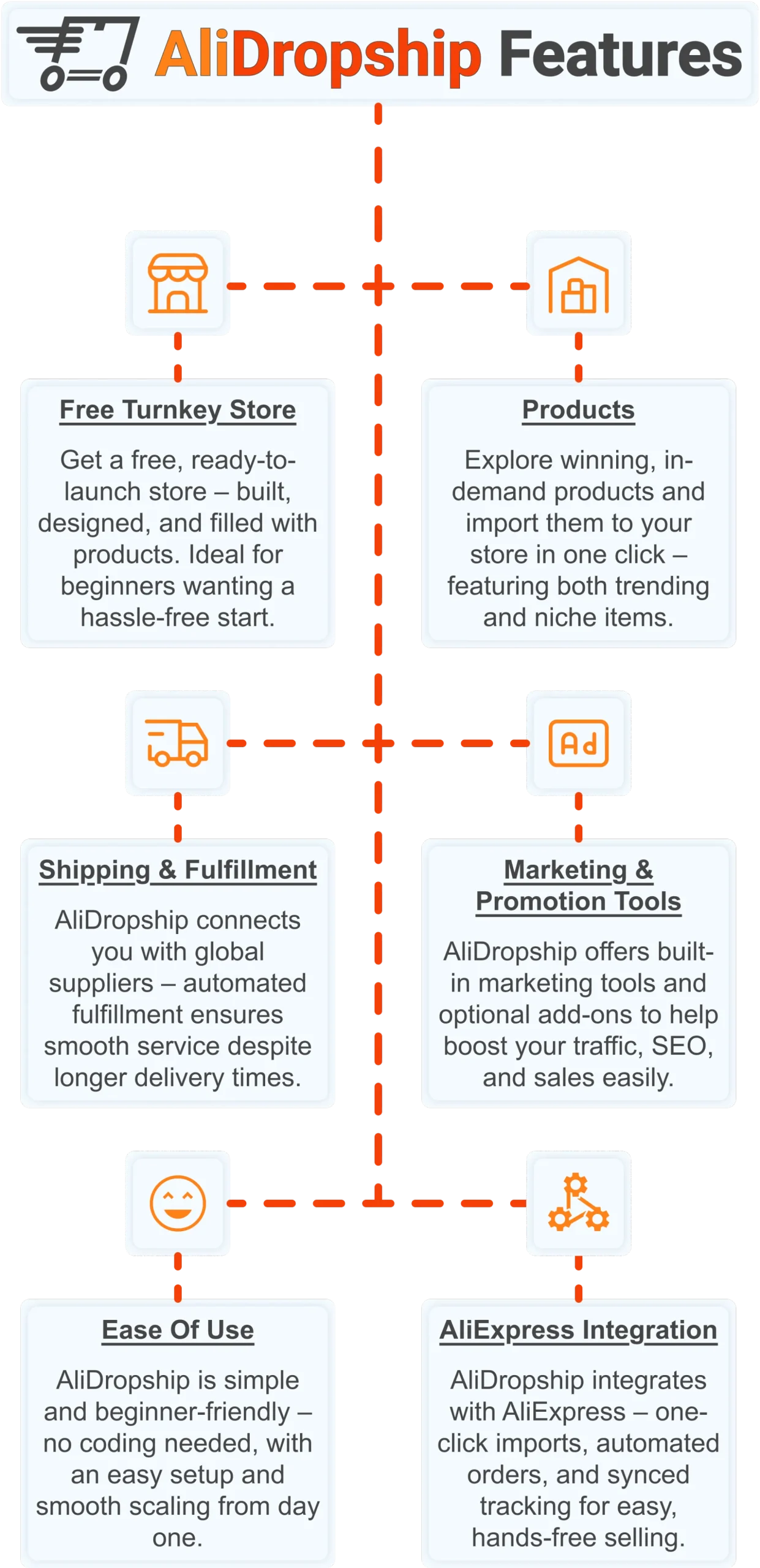
Free turnkey store 🛍️
Get a free turnkey store – built, designed, and filled with products. Ideal for beginners wanting a hassle-free start, the store comes fully optimized to attract customers right away, saving you time on setup. Plus, it includes professional design elements to give your business a polished, trustworthy look from day one. This ready-made foundation makes it easy to move seamlessly into product selection.
Products 📦
Once your store is set up, you can explore winning, in-demand products and import them in one click – featuring both trending and niche items. This wide selection lets you cater to diverse customer interests and test what works best. Regular updates ensure you always have fresh products, keeping your store competitive and relevant. With great products in place, smooth shipping becomes the next essential step.
Shipping & fulfillment 🚚
AliDropship connects you with global suppliers, and automated fulfillment ensures seamless order processing despite international delivery times. Customers receive real-time tracking updates, which builds confidence and trust in your store. Once shipping is handled reliably, you can focus on promoting your store and attracting traffic.
Marketing & promotion tools 📣
To maximize sales, AliDropship offers built-in marketing tools and optional add-ons that help boost traffic, SEO, and conversions. From email campaigns and discounts to social media integration, these tools empower you to reach and retain customers without needing prior marketing experience. With promotion strategies in place, managing your business becomes simpler and more efficient.
Ease of use 👌
AliDropship is beginner-friendly – no coding needed, with an intuitive dashboard that guides you through every step. Easy setup and smooth scaling let you expand your store without stress. As your business grows, adding new features, products, and marketing campaigns remains hassle-free, giving you more time to focus on sales.
AliExpress integration 🛒
Finally, AliDropship integrates seamlessly with AliExpress, enabling one-click imports, automated orders, and synced tracking. Your inventory stays up-to-date with the latest products and prices, while automated order processing frees you from manual tasks. Combined with the turnkey setup, reliable shipping, and built-in marketing tools, this integration ensures your dropshipping business is fully equipped for growth and success.
Ecommerce growth in 2026 rewards builders who launch fast and iterate faster. Claim your free turnkey store and start compounding your growth today.
What is ecommerce growth in simple terms?
How long does it take to grow an ecommerce store?
Most ecommerce stores need 60 to 90 days to see consistent daily sales and 6 to 12 months to reach stable part-time income. Stores that reinvest early profit into ads, content, and inventory tend to grow 3 to 4 times faster than those that pull money out right away. Full-time level earnings, meaning 500 dollars a day or more, typically take 9 to 18 months of focused work. Timeline depends heavily on niche, traffic mix, and how quickly the owner learns from early data.
What is the fastest way to grow ecommerce sales?
The fastest way to grow ecommerce sales in 2026 is to raise the conversion rate of your existing traffic before trying to get more visitors. Fixing page speed, adding clear trust signals, simplifying checkout, and turning on post purchase upsells can double revenue without any extra ad spend. After conversion is solid, setting up email and SMS flows usually adds another 20 to 30 percent in monthly revenue on autopilot. Only after those two steps does chasing more traffic make sense.
How much money do you need to start growing an ecommerce business?
You can start growing an ecommerce business with as little as 300 to 500 dollars for a basic store, starter ad budget, and a few product tests. Serious growth typically calls for 1000 to 3000 dollars over the first 90 days to cover ads, apps, and inventory testing. Dropshipping and turnkey store models lower the upfront cost because there is no bulk inventory to buy. The real investment is time and consistency, not just money.
Is ecommerce still profitable in 2026?
Yes, ecommerce remains highly profitable in 2026, with global online retail sales expected to pass 8 trillion dollars this year. What has changed is that easy wins are gone and margins are tighter, so stores need real strategy instead of luck. Niche stores with strong branding and repeat customer systems are outperforming generic mega stores in many categories. The owners who treat it as a real business, not a side hustle gamble, continue to build six and seven figure online stores.