What Ecommerce Business Ideas Actually Work In 2026?

Most people who want to start an online business already know ecommerce is the right direction – but they get stuck on the same question: which idea is actually worth pursuing? Global ecommerce is on track to surpass $6 trillion in total sales in 2026, which means the market is large enough for new entrants at every level, whether you have $500 to invest or practically nothing at all.
Quick answer: The best ecommerce business ideas in 2026 include dropshipping in high-demand niches, digital product stores, and subscription-based models. Dropshipping is the most beginner-friendly option because you sell without holding inventory, while digital products offer the highest margins. Your actual earnings depend on your niche, effort, and how consistently you market.
This guide breaks down 15 real ecommerce business ideas, explains what each one involves, and gives you a clear picture of the effort required and the income potential behind each model. Whether you are completely new to ecommerce or looking to scale a part-time store into a full operation, you will find an honest, practical path forward here.

What are ecommerce business ideas?
An ecommerce business idea is any model where you sell products or services through an online store. That covers a wider range than most people initially think – from physical goods shipped from overseas suppliers, to digital downloads delivered instantly, to subscription boxes curated around a specific lifestyle. What all ecommerce business ideas have in common is that they run online, which means lower overhead, global reach, and the ability to operate from anywhere with a laptop and an internet connection.
The key distinction to make early on is between product-based models – where you sell physical or digital goods – and service-based models – where your store acts as a storefront for a skill or ongoing service. Both can work, but product-based ecommerce, particularly dropshipping, is easier to start and scale because you are not trading time for money in the same way. In 2026, the most popular and profitable ecommerce models are dropshipping, digital products, and niche physical goods stores – all of which are covered in detail below.
How much can you realistically earn from ecommerce?
Earnings in ecommerce vary considerably depending on your niche, marketing approach, and how consistently you work on growing the store. That said, there are realistic benchmarks worth understanding before you commit to a model.
Dropshipping consistently delivers the widest earning range – from a few hundred dollars for beginners in their first 60–90 days, up to five figures monthly for sellers running optimized stores with targeted ad campaigns. Digital products offer higher margins but require upfront effort to build or source the product. Subscription boxes carry strong long-term customer value but take longer to build a reliable base.
One note on ceiling figures: The top-end numbers in the table above reflect experienced sellers who treat their store like a real business – running paid ads, testing products, and reinvesting profits. A realistic first-year target for a part-time beginner is $500–$2,000 per month, reachable within 60–90 days of consistent effort. Full-time income levels typically require 6–12 months of focused work to reach.
Best ecommerce business ideas in 2026
Below you will find 15 proven ecommerce business ideas organized into four categories. Each entry covers what the model involves, why it works right now, and a realistic earning range so you can compare options with actual data rather than vague promises.
Physical product dropshipping
Dropshipping is the most accessible ecommerce model for beginners because you never hold inventory. When a customer places an order, your supplier ships the product directly to them. Your job is to run the store, select the right products, and drive traffic. Within physical dropshipping, certain niches consistently outperform the rest in 2026.
Home decor & living accessories
Home decor is one of the most stable ecommerce niches year after year. Products like wall art, decorative lighting, minimalist shelving, and aesthetic organizers sell consistently across demographics. The target customer – someone redecorating, moving, or looking for a gift – often makes multiple purchases in a single session. Average order values in this category tend to be higher than fast-fashion items, which improves your margin per sale without requiring higher traffic volume.
Earning potential: $600–$4,000/month with a focused store running consistent social media or paid traffic.
Why this works in 2026: Pinterest and TikTok continue to drive massive discovery traffic to home aesthetic content, making organic reach genuinely viable alongside paid ads.
Fitness & wellness gear
The fitness and wellness niche has shown no signs of slowing down. Resistance bands, yoga mats, portable gym equipment, massage tools, and recovery accessories all carry steady, evergreen demand. The market skews toward repeat buyers – someone who purchases a set of resistance bands will often return for heavier ones, additional accessories, or related wellness products. This makes email marketing particularly effective in this niche for driving ongoing revenue beyond the first purchase.
Earning potential: $500–$3,500/month with strong product selection and an active social media presence.
Pet supplies & accessories
Pet owners are among the most loyal and highest-spending customer segments in all of ecommerce. Pet supplies – harnesses, grooming tools, toys, travel accessories, and organic treats – carry a high repeat purchase rate and strong emotional motivation behind every buy. Niche pet stores targeting a specific animal type or breed tend to outperform general pet stores because they build tighter community connections and more precise ad audiences that convert at a lower cost per acquisition.
Earning potential: $700–$5,000/month for stores with a focused pet niche and consistent content marketing.
Eco-friendly & sustainable products
Consumer demand for sustainable alternatives is growing steadily, driven by environmental awareness and shifting purchasing habits across younger demographics. Reusable bags, bamboo kitchenware, zero-waste personal care products, and plastic-free home goods all perform well in this space. The niche commands premium pricing – customers here are willing to pay more for products aligned with their values – which improves your margin per order without requiring high order volume to turn a profit.
Earning potential: $400–$3,000/month, with strong growth potential as sustainable shopping continues to go mainstream.
Baby & kids products
Parents are consistently among the highest-spending ecommerce customers, and baby and kids products come with one of the strongest emotional purchase motivators in any category. Developmental toys, baby care accessories, personalized children’s items, and safe-material clothing are all high-converting product types. The niche also benefits from gifting traffic – grandparents, aunts, and uncles regularly shop in this space – which adds a meaningful customer segment on top of the core parent audience.
Earning potential: $600–$4,500/month for stores with strong product curation and gift-focused marketing.
Digital product stores
Digital products carry one significant advantage over physical goods: zero fulfillment cost. Once a product is created or sourced, it can be sold an unlimited number of times with no additional expense. This makes digital product stores some of the highest-margin ecommerce businesses available to independent sellers in 2026.
Online courses & educational content
Selling online courses through an ecommerce store remains one of the highest-income digital product models available. Courses covering practical skills – video editing, language learning, financial literacy, fitness programming, and coding – consistently command prices between $30 and $300 per unit. The key is choosing a topic where demand is clearly proven and the course delivers a measurable outcome for the buyer. Your own WooCommerce store or a hosted platform like Teachable can handle delivery seamlessly alongside your product catalog.
Earning potential: $500–$6,000/month depending on course price, audience size, and marketing consistency.
Printables & digital downloads
Printable products – planners, budget trackers, wall art, wedding templates, educational worksheets, and business toolkits – have very low creation costs and sell instantly with no shipping required. A single printable pack created once can generate income for years. Many sellers run their own ecommerce store for this instead of relying on Etsy, which gives them full control over pricing, branding, and customer data. Stores with a library of 20–50 well-optimized products regularly earn $1,000–$3,000 per month.
Earning potential: $200–$3,000/month with a quality product catalog and consistent SEO-driven traffic.
Stock photography & creative assets
If you have an eye for photography or design, selling stock photos, illustrations, icon packs, fonts, or Lightroom presets through your own store is a legitimate ecommerce business idea with real passive income upside. Each asset can be downloaded many times with no additional effort on your part. The main challenge is building a catalog large enough to generate consistent monthly traffic. Creators with libraries of 200 or more well-tagged assets typically see the most stable returns.
Earning potential: $100–$2,500/month for established creators with a large, organized asset library.
Niche dropshipping stores
Beyond broad physical product categories, several niche dropshipping verticals consistently outperform general stores in 2026 – typically because buyers in these spaces are more engaged, more willing to spend, or underserved by existing ecommerce options.
Fashion & accessories
Fashion is one of the largest ecommerce categories globally, but profitability here comes from going narrow rather than broad. Stores focused on a specific style tribe – streetwear, cottagecore, minimalist workwear, or sustainable fashion – convert far better than generic clothing stores. Accessories in particular (jewelry, bags, belts, hats, and sunglasses) have lower price points that reduce purchase hesitation, and trending styles can generate sharp short-term sales spikes when combined with TikTok or Instagram content.
Earning potential: $400–$5,000/month for niche-focused fashion stores with strong visual branding and an active social presence.
Tech gadgets & accessories
Tech accessories are a perennially strong ecommerce category – phone cases, charging cables, wireless earbuds, smart home gadgets, and productivity tools maintain consistent demand driven by device upgrade cycles and gift-giving occasions. The key advantage of this niche is that products are often impulse purchases at accessible price points, which shortens the decision-to-checkout cycle considerably. Stores here tend to perform particularly well with Google Shopping ads and comparison content.
Earning potential: $500–$4,000/month with well-optimized product pages and targeted ad campaigns.
Beauty & skincare products
Beauty and skincare is one of the highest-repeat-purchase niches in ecommerce. Customers who find a product they trust return consistently, which pushes lifetime customer value well above the category average. Trending subcategories in 2026 include glass skin routines, minimalist skincare, SPF-focused products, and scalp care tools. The niche also has strong organic marketing potential – real before-and-after content and authentic user reviews drive significant discovery traffic without requiring large ad budgets.
Earning potential: $600–$6,000/month for stores with strong product-market fit and an active content strategy.
Outdoor & hobby gear
Outdoor and hobby enthusiasts spend significantly on their interests – hiking gear, camping equipment, fishing accessories, craft supplies, and tabletop gaming products all sit in categories where buyers are highly engaged and price-tolerant. These customers also research thoroughly before buying, which makes informational content (buying guides, comparison posts, and YouTube reviews) a powerful long-term traffic driver for stores in this space. Building a community around the hobby adds another layer of customer retention beyond repeat purchases alone.
Earning potential: $400–$4,000/month for stores that combine product sales with a consistent content strategy.
Subscription & specialty models
Subscription and specialty ecommerce models offer something standard one-time-purchase stores cannot match: predictable, recurring revenue. Once a customer subscribes or commits to a specialty purchase cycle, their lifetime value increases substantially compared to one-off buyers.
Subscription box business
Subscription boxes – where customers receive a curated package of products every month – have a documented track record in niches like beauty samples, snack discovery, book clubs, gaming accessories, and self-care products. The model requires more operational complexity than standard dropshipping, but the recurring revenue structure gives you a stable income floor that grows with each new subscriber added. Many subscription businesses in focused niches reach $3,000–$8,000 per month within their first 12 months of consistent marketing.
Earning potential: $1,000–$8,000/month once a reliable subscriber base is established.
Customized & personalized products
Personalization is one of the strongest differentiators in modern ecommerce. Customers willingly pay a premium for products that feel made specifically for them – engraved jewelry, monogrammed bags, custom portraits, personalized home decor, and name-printed apparel all convert well at higher price points. Combining print-on-demand services with a well-branded ecommerce store is the most common low-overhead approach to this model. Gift occasions (birthdays, weddings, and holidays) drive strong seasonal spikes in traffic and conversion.
Earning potential: $500–$4,000/month with strong seasonal peaks around major gift-giving periods.
Health supplements & wellness products
Health supplements – protein powders, vitamins, collagen, adaptogens, sleep aids, and functional gummies – represent one of the fastest-growing ecommerce categories in 2026. The repeat purchase rate is high because consumers take supplements daily, and brand loyalty develops quickly when a product works well for someone. Important: This niche carries regulatory requirements depending on your market – always verify supplement marketing guidelines and labeling rules before launching in this category to avoid compliance issues.
Earning potential: $800–$7,000/month for stores with a focused product line and strong customer trust signals.
These 15 ecommerce business ideas represent a range of commitment levels, startup costs, and income ceilings. The common thread across all of them is that success comes from focus – choosing one model, committing to a niche, and marketing consistently rather than spreading attention across too many ideas at once.
Tips for making your ecommerce business idea actually work
Choosing the right idea is only step one. What separates stores that generate consistent income from those that stall after a few weeks usually comes down to a small number of execution habits done consistently well.
Start narrow, then expand
Generalist stores are harder to market and harder to rank in search. A store that sells everything competes with Amazon and wins almost never. A store that sells specifically for corgi owners, remote workers, or minimalist home enthusiasts can build a distinct brand, a loyal audience, and real SEO traction much more efficiently. Pick one niche, go deep rather than wide, and expand only once you have proof of consistent sales.
Build trust before you scale ad spend
Social proof is the single biggest conversion driver in ecommerce. Before spending heavily on paid ads, make sure your store has customer reviews, a clear return policy, professional product photography, and a credible about page. Sending paid traffic to an untrustworthy-looking store wastes your budget and inflates your cost per acquisition unnecessarily. A well-built store with 20 authentic reviews will outperform a weak store with 10x the ad budget.
Prioritize repeat customers
Acquiring a new customer costs 5–7x more than retaining an existing one. Building an email list from day one and running post-purchase follow-up sequences is one of the highest-ROI activities available in ecommerce. Loyalty discounts, product bundles, and exclusive offers for returning customers all increase average order value and lifetime customer value without requiring additional ad spend to generate that incremental revenue.
Cut losing products fast
Most successful dropshipping stores launch with 10–30 products and find that 2–5 of them generate the majority of revenue. Checking your analytics weekly and removing underperforming products early frees up your marketing focus and ad budget for what actually converts. Resist the urge to keep products listed that have not generated a sale after 30 days of genuine traffic – the data is telling you something worth listening to.
Automate your operations early
Automation is what turns an ecommerce side project into a scalable business. Tools that handle order processing, email sequences, inventory updates, and customer service responses let you focus on growth rather than daily admin. AliDropship, for example, automates product imports, order fulfillment, and tracking updates – removing the manual bottlenecks that bog down most beginners and making it possible to scale without adding headcount.
Which ecommerce idea is right for you?
The best ecommerce business idea for you depends on your starting budget, available time, and long-term goals. Here is a straightforward breakdown by reader profile to help you cut through the options and land on a clear starting point.
Complete beginner
If you are brand new to ecommerce and working with a limited budget, dropshipping is your best starting point. It requires no upfront inventory investment, minimal technical knowledge, and platforms like AliDropship provide a turnkey store so you are not building from scratch. Start with a niche you personally understand – pet products, home decor, or fitness gear are all solid entry points – and focus your first 30 days on driving traffic rather than perfecting your product catalog. Your first milestone should be your first 5 sales, not your first $10,000 month.
Intermediate / part-time seller
If you already have some experience with online selling and want to grow a part-time store into something more serious, consider layering a digital product line on top of your existing physical goods store, or moving into a higher-margin niche like beauty or health supplements. At this stage, paid advertising on Facebook, Google Shopping, or TikTok is worth testing with a daily budget of $10–$30. Building your email list in parallel is equally important – it remains the most cost-effective long-term growth channel in ecommerce.
Advanced / full-time goal
If your goal is to replace a full-time income within 12 months, treat your ecommerce business like a business from day one – not a side project you check on occasionally. That means a defined niche, a documented marketing plan, a weekly content schedule, and a reinvestment strategy for early profits. The models with the highest full-time income ceiling in 2026 are niche dropshipping stores with strong brand identity, subscription box businesses once the subscriber base is established, and digital product stores with 50 or more products generating compounding search traffic.
Whatever stage you are at, the principle is the same: start with the model that fits your current resources, execute it consistently for 60–90 days, and use your results to decide where to invest next. Most stores that fail do so because the owner switched models too early – not because the original idea was wrong.
AliDropship: Your complete all-in-one solution for starting dropshipping in 2026
If you want the simplest possible way to start dropshipping – especially if you are brand new – AliDropship remains one of the most beginner-friendly tools available in 2026. It brings together store creation, product imports, automation, and marketing into a single streamlined system designed to help you launch quickly and grow confidently.
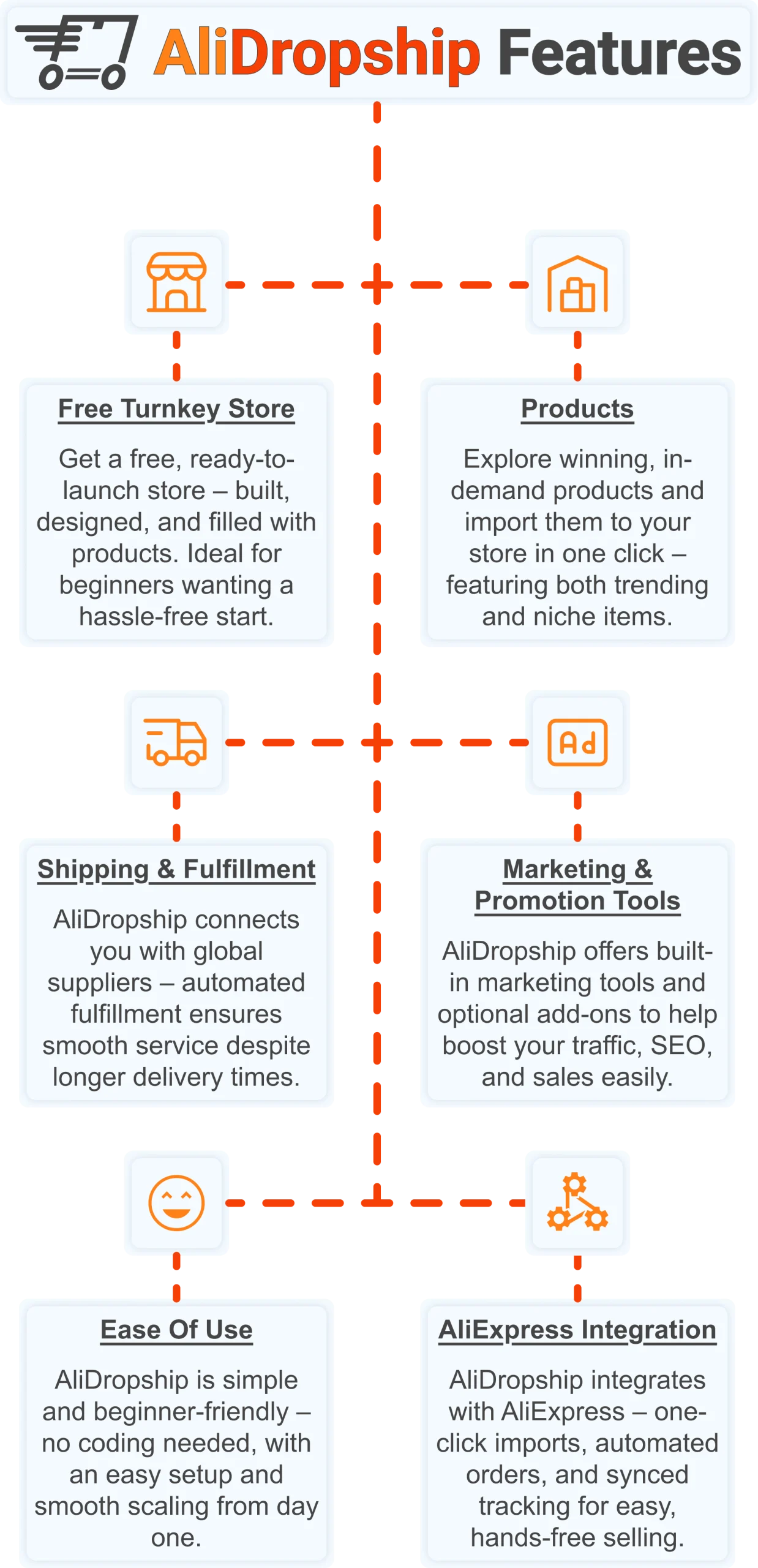
Free turnkey store 🛍️
Get a free turnkey store – built, designed, and filled with products. Ideal for beginners wanting a hassle-free start, the store comes fully optimized to attract customers right away, saving you time on setup. Plus, it includes professional design elements to give your business a polished, trustworthy look from day one. This ready-made foundation makes it easy to move seamlessly into product selection.
Products 📦
Once your store is set up, you can explore winning, in-demand products and import them in one click – featuring both trending and niche items. This wide selection lets you cater to diverse customer interests and test what works best. Regular updates ensure you always have fresh products, keeping your store competitive and relevant. With great products in place, smooth shipping becomes the next essential step.
Shipping & fulfillment 🚚
AliDropship connects you with global suppliers, and automated fulfillment ensures seamless order processing despite international delivery times. Customers receive real-time tracking updates, which builds confidence and trust in your store. Once shipping is handled reliably, you can focus on promoting your store and attracting traffic.
Marketing & promotion tools 📣
To maximize sales, AliDropship offers built-in marketing tools and optional add-ons that help boost traffic, SEO, and conversions. From email campaigns and discounts to social media integration, these tools empower you to reach and retain customers without needing prior marketing experience. With promotion strategies in place, managing your business becomes simpler and more efficient.
Ease of use 👌
AliDropship is beginner-friendly – no coding needed, with an intuitive dashboard that guides you through every step. Easy setup and smooth scaling let you expand your store without stress. As your business grows, adding new features, products, and marketing campaigns remains hassle-free, giving you more time to focus on sales.
AliExpress integration 🛒
Finally, AliDropship integrates seamlessly with AliExpress, enabling one-click imports, automated orders, and synced tracking. Your inventory stays up-to-date with the latest products and prices, while automated order processing frees you from manual tasks. Combined with the turnkey setup, reliable shipping, and built-in marketing tools, this integration ensures your dropshipping business is fully equipped for growth and success.
Whatever ecommerce business idea you choose – dropshipping, digital products, or subscription boxes – having the right platform underneath you is what separates a store that struggles from one that scales. Get your free turnkey store with AliDropship and start building your ecommerce income today.
What are the most profitable ecommerce business ideas in 2026?
How much does it cost to start an ecommerce business?
What is the easiest ecommerce business idea for beginners?
How long does it take to make money with an ecommerce business?
What are the best low cost ecommerce ideas to start with little money?