

Self-Service

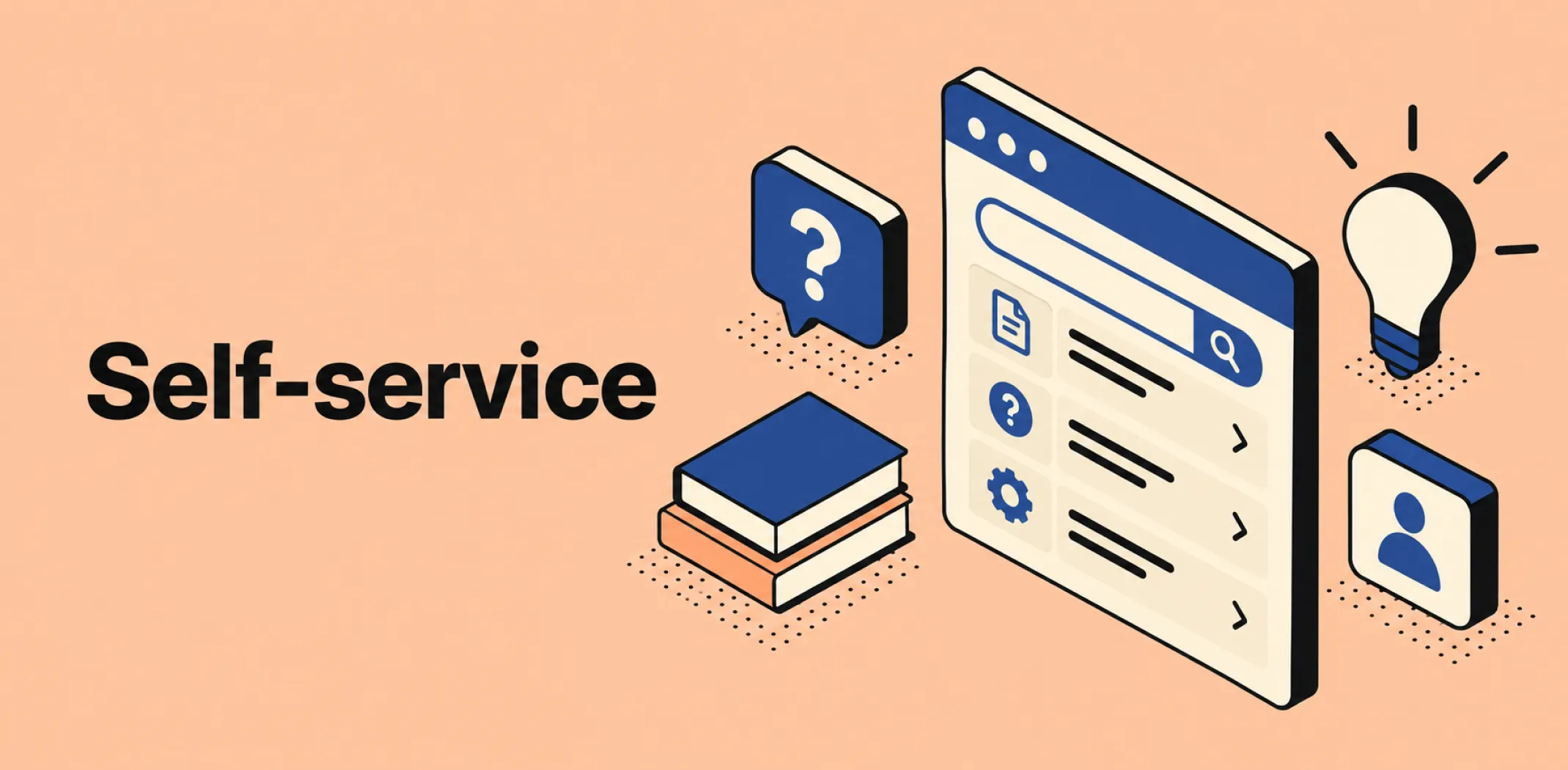
Self-service is a support model that lets customers find answers or resolve issues on their own, using tools such as a FAQ, a knowledge base, or an automated chatbot, without contacting a support agent directly.
Self-service sits at the opposite end of the support spectrum from an assisted channel like live chat, where a human or bot actively responds to the customer in real time. With self-service, the customer initiates and completes the interaction independently, whether that means reading a FAQ entry, searching a knowledge base article, or checking an order status page.
Because it does not require an agent’s direct involvement, self-service scales without adding headcount, which is why it is often the first line of customer support a well-run store puts in place before building out assisted channels for the questions self-service cannot answer.
The sophistication of self-service varies widely, ranging from a simple static FAQ page to an AI-driven chatbot capable of handling multi-step account or order issues on its own.
Example
A store adds a self-service order tracking page where customers can enter their order number to see real-time shipping status. Within a month, the volume of “where is my order” messages reaching live chat drops by roughly a third, since most customers find their answer on the tracking page before ever needing to reach out.
Key characteristics
- Customer-initiated: The customer starts and completes the interaction on their own, without an agent responding in real time.
- Available around the clock: A FAQ, knowledge base, or automated tool works at any hour, unlike support that depends on staffed availability.
- Scales without added headcount: The same self-service resource can serve one customer or thousands without requiring more agents.
- Measured by deflection: Its success is commonly tracked by how much support volume it prevents from reaching a human agent at all.
Related terms
- FAQ – a curated list of common questions and answers, one of the most common self-service formats.
- Help desk – the broader support platform that often houses self-service resources alongside assisted, agent-handled tickets.
- Live chat – an assisted, real-time channel that self-service tools are commonly used to reduce demand for.
- Customer support – the broader technical assistance function that self-service handles the simplest portion of.
Frequently asked questions
Is self-service the same as a chatbot?
Not exactly. A chatbot is one form of self-service, but the category also includes static resources like a FAQ page or a searchable knowledge base.
Does self-service replace human support agents?
No. It handles simple, common questions on its own, but customers with unique or complex issues still need an assisted channel like live chat or email.
How do stores measure whether self-service is working?
A common metric is deflection rate, meaning the percentage of potential support requests resolved through self-service instead of reaching a human agent.
AliDropship: An all-in-one platform for starting an online business in 2026
AliDropship is an online business platform that gives customers a ready-made store, a digital products catalogue, and built-in, one-click advertising within a single system. Founded in 2015 and based in Irvine, California, it has helped launch more than 1,500,000 stores and holds a 4.7-star rating on Trustpilot. It is built for people with no prior experience and no technical skills.
🆓 Free 14-day trial
New users get full platform access for 14 days, including a ready-made store, hosting, a domain, an SSL certificate, and access to the digital products catalogue. The trial also includes a $40 ad coupon to test the advertising system. Order fees apply only when a sale is made.
📦 Digital products
Customers choose from AliDropship’s catalogue of digital products – guides, courses, checklists, tools, and AI-powered toolkits – and keep up to 70% of every sale. Delivery is instant and automated, so there is no inventory, shipping, or manual fulfillment involved.
📣 One-click advertising
AliDropship includes built-in advertising that customers can turn on for as little as $10 a day. The system handles targeting, creatives, and optimization, and many customers see their first orders the same day they launch ads.
👌 Ease of use
AliDropship requires no coding or marketing experience. The store, products, and ads are managed from a single dashboard that works on a phone as well as a desktop, and a personal growth manager is available to help by chat.
💳 Monthly plan
After the trial, continued access is $39 a month, covering the store, the digital products catalogue, and ongoing support. There is no long-term contract, and the plan can be cancelled at any time.
Is self-service the same thing as a chatbot?
Does self-service mean a store no longer needs human agents?
How do stores measure whether self-service is working?
How much self-service is considered a good sign?
Is self-service actually cheaper than hiring more agents?
Are you ready to become an owner
of a profitable online business?
Free Dropshipping Guide