

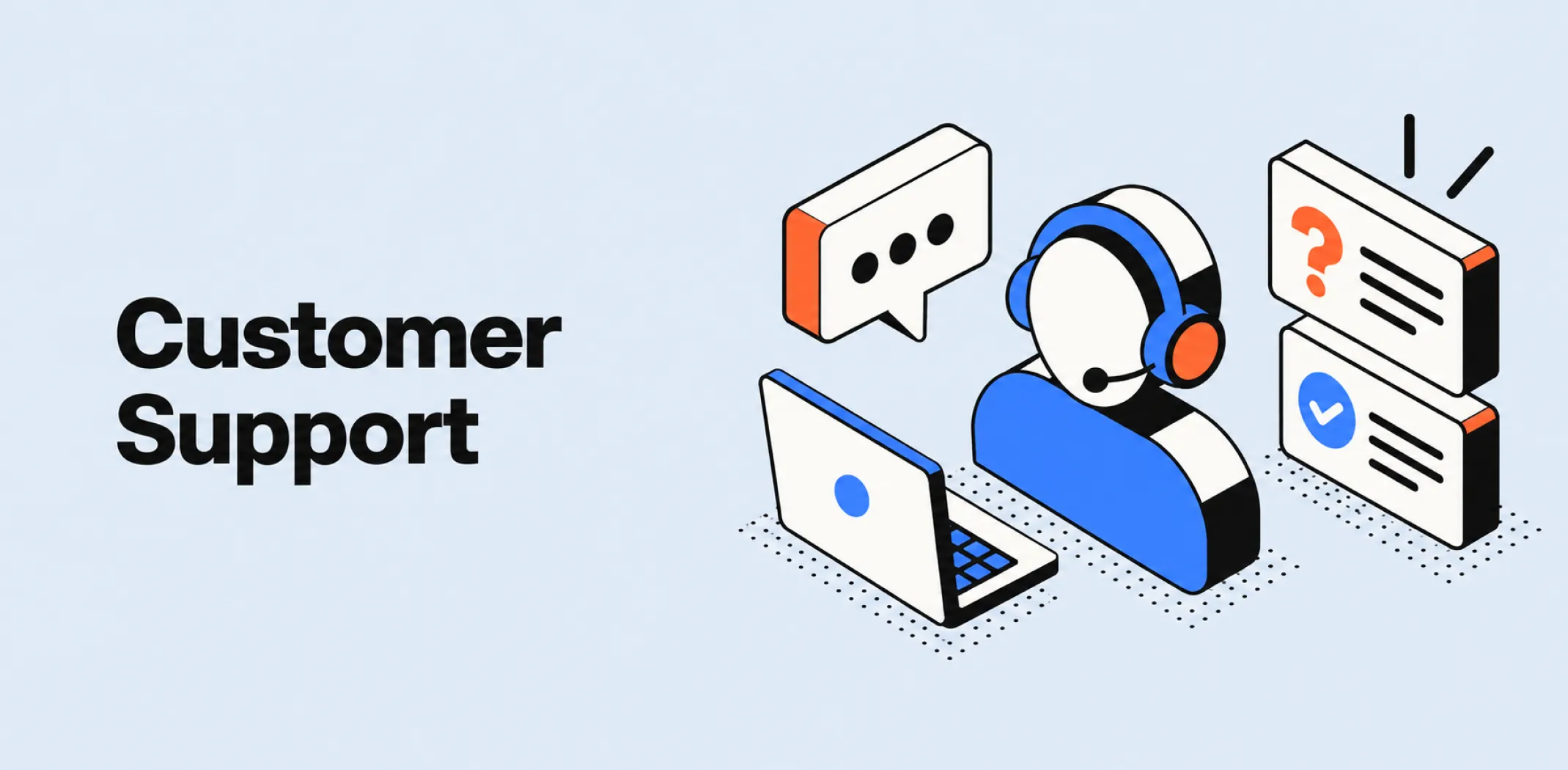
Customer Support

Customer support is post-purchase technical assistance that helps customers troubleshoot or resolve a specific problem with a product they have already bought, typically delivered through help desks, live chat, email, or a knowledge base.
The term is often used interchangeably with customer service in everyday conversation, but the two have a narrower distinction in practice: customer service covers a broader range of interactions, including pre-sale questions and general inquiries, while customer support skews specifically toward diagnosing and fixing a problem with a product the customer already owns.
Support teams often use a tiered structure, where a first-line agent handles common issues and escalates more complex technical problems to a specialist. Consistently effective support contributes to customer experience, since a frustrating troubleshooting process can undo the goodwill built by an otherwise smooth purchase, even if the underlying product defect was minor and easily fixed once identified.
Example
A customer contacts support because a smart plug they purchased will not connect to their home network. A first-line agent walks them through a reset and reconnection process; when that does not resolve it, the ticket is escalated to a technical specialist who identifies a firmware issue and sends an updated app link. The customer’s product works within the day, and the ticket is logged as resolved on escalation.
Key characteristics
- Problem-focused: Support addresses a specific issue with a product already purchased, rather than general or pre-sale questions.
- Often tiered: Simple issues are handled by first-line agents, with complex technical problems escalated to specialists.
- Product- and troubleshooting-oriented: Common tasks include diagnosing defects, walking through setup steps, and processing warranty or return claims.
- Measured by resolution outcomes: Ticket volume, resolution rate, and escalation rate are common indicators of how well support is functioning.
Related terms
- Customer service – the broader category of customer-facing support, of which technical support is a specific type.
- Customer experience – the cumulative impression a customer forms across every touchpoint, including how support issues are resolved.
- Customer lifetime value – the total revenue a business expects from a customer, which effective support can help protect.
- Customer segmentation – dividing customers into groups, sometimes used to prioritize support resources for higher-value segments.
Frequently asked questions
Is customer support the same as customer service?
Not exactly. Customer service is the broader category covering all customer-facing interactions, while customer support specifically focuses on resolving technical problems with a purchased product.
What does tiered customer support mean?
It means simple issues are handled by first-line agents, while more complex technical problems get escalated to specialists with deeper product knowledge.
How do stores measure customer support performance?
Common indicators include resolution rate, average time to resolve a ticket, and escalation rate, which shows how often issues need a specialist.
AliDropship: An all-in-one platform for starting an online business in 2026
AliDropship is an online business platform that gives customers a ready-made store, a digital products catalogue, and built-in, one-click advertising within a single system. Founded in 2015 and based in Irvine, California, it has helped launch more than 1,500,000 stores and holds a 4.7-star rating on Trustpilot. It is built for people with no prior experience and no technical skills.
🆓 Free 14-day trial
New users get full platform access for 14 days, including a ready-made store, hosting, a domain, an SSL certificate, and access to the digital products catalogue. The trial also includes a $40 ad coupon to test the advertising system. Order fees apply only when a sale is made.
📦 Digital products
Customers choose from AliDropship’s catalogue of digital products – guides, courses, checklists, tools, and AI-powered toolkits – and keep up to 70% of every sale. Delivery is instant and automated, so there is no inventory, shipping, or manual fulfillment involved.
📣 One-click advertising
AliDropship includes built-in advertising that customers can turn on for as little as $10 a day. The system handles targeting, creatives, and optimization, and many customers see their first orders the same day they launch ads.
👌 Ease of use
AliDropship requires no coding or marketing experience. The store, products, and ads are managed from a single dashboard that works on a phone as well as a desktop, and a personal growth manager is available to help by chat.
💳 Monthly plan
After the trial, continued access is $39 a month, covering the store, the digital products catalogue, and ongoing support. There is no long-term contract, and the plan can be cancelled at any time.
Is customer support the same thing as customer service?
What does tiered customer support mean?
How do stores measure customer support performance?
Does resolving a support issue quickly improve customer loyalty?
Should stores handle customer support in house or outsource it?
Are you ready to become an owner
of a profitable online business?
Free Dropshipping Guide