

Perplexity AI
What is Perplexity AI?
Perplexity AI is a modern artificial intelligence platform designed to answer questions, summarize information, and provide explanations in a conversational way.
Unlike traditional search engines that return long lists of links, Perplexity AI generates concise answers supported by citations from reliable sources. It combines advanced language models with real‑time web retrieval to deliver summaries that are both informative and verifiable.
The platform appeals to learners, researchers, professionals, and curious users who want clear explanations without having to sift through numerous web pages. Its hybrid design – between a search engine and conversational AI – allows it to interpret complex queries, generate structured responses, and cite sources for transparency.
While it resembles other AI assistants, Perplexity AI focuses heavily on source attribution to help users verify information and explore deeper. Its growing popularity reflects increasing demand for tools that combine accuracy, clarity, and ease of use in one interface.

History & founding
Perplexity AI was founded in August 2022 in San Francisco, California, USA. The founding team includes Aravind Srinivas (CEO), Denis Yarats (CTO), Johnny Ho (Chief Strategy Officer), and Andy Konwinski (President). The company launched with the goal of creating an AI that could deliver factual answers with transparent citations – aiming to reduce the “black box” nature of many generative AI tools.
Early development focused on building a platform that could interpret natural language questions, retrieve relevant supporting documents from the web, and synthesize concise explanations. Initial testing was done with a small community of early adopters, whose feedback helped refine query processing and source attribution.
Perplexity’s early funding included seed rounds and angel investments. According to the company’s own blog, the platform raised a $25.6 million Series A, with investors including well‑known figures from the technology sector.
Over time, additional investment rounds and venture capital support pushed its valuation higher, with reports suggesting that by 2025 it reached unicorn status – a valuation exceeding $1 billion – fueled by strong user growth and strategic investments from notable backers. Investors have included figures like Nat Friedman, Susan Wojcicki, and organizations tied to Jeff Bezos and Nvidia partners.
Headquartered in San Francisco, Perplexity AI quickly drew attention for its novel approach to information retrieval. The founders emphasized a commitment to source transparency, believing that AI should not just generate text but also show where the underlying facts came from. This foundation shaped the product’s identity and distinguished it from many contemporaries.
What Perplexity AI does
Perplexity AI is an intelligent question-answering platform designed to provide concise, verifiable responses to user queries. Users type a question – for example, “How does photosynthesis work?” – and receive a structured answer with source citations, allowing them to check accuracy and explore further.
The platform supports multi-turn conversational queries, enabling follow-up questions to build on previous ones. For instance, a student could ask, “What happens when light intensity increases?” after an initial question about photosynthesis, and Perplexity will provide a detailed response that maintains context.
Answers are drawn from a combination of the LLM’s pre-trained knowledge and up-to-date information from the web, ensuring responses reflect both general understanding and recent developments. Users can refine queries, request additional examples, or ask for simplified explanations, making the platform useful for both casual learning and professional research.
While highly accurate, Perplexity may face challenges with very recent events, highly specialized professional domains, or obscure topics, which may require external verification. The platform’s source cards and reference links help users evaluate the quality and relevance of the information provided.

Founders, funding & company growth
Perplexity AI’s growth has been rapid since its 2022 launch. Founders brought complementary expertise in AI research, product strategy, and enterprise systems. The company’s early focus on citations and transparency resonated with users tired of opaque generative AI outputs that couldn’t be traced to specific sources.
The Series A funding round, reported on the official Perplexity AI blog, was a major milestone. Investors – including tech veterans and venture capital firms – provided capital that allowed the company to scale infrastructure and expand development teams. Shortly after, Perplexity began releasing public mobile apps and bolstering API access for developers.
By early 2023, Perplexity reported millions of monthly active users. According to the company’s announcements, the number of queries processed per month quickly climbed into the hundreds of millions, indicating strong adoption across academic, professional, and personal use cases.
Third‑party estimates suggest the platform now processes over 700 million queries monthly, with user traffic exceeding 100 million visits per month, making it one of the faster‑growing AI platforms globally.
Strategic partnerships have also contributed to growth. Media collaborations – such as content agreements with established publications – help blend authoritative journalism with AI‑driven answers. This extends the platform’s value beyond simple Q&A to a richer ecosystem of information exploration.
How Perplexity AI works – technical architecture
Perplexity AI is built on a hybrid architecture that combines online large language models (LLMs) with retrieval-augmented generation (RAG). This design allows the platform to generate fluent, human-like responses while grounding them in up-to-date information from the web.
At the core of the system are Perplexity’s PPLX online models: pplx-7b-online and pplx-70b-online. These models are based on open-source foundations – Mistral-7B and LLaMA2-70B – and enhanced to work with live data.
Unlike offline LLMs, which rely solely on pre-trained knowledge, these online models can access and integrate real-time web knowledge, enabling them to answer questions about very recent events, financial data, or other time-sensitive topics.
This allows queries like “What was the Warriors game score last night?” to be answered accurately, even if the event occurred after the model’s original training.
1. In-house search & snippet retrieval
A critical component of Perplexity’s architecture is its proprietary search and indexing infrastructure. The system crawls, indexes, and ranks web content regularly, ensuring access to high-quality, reliable, and non-SEO-biased sources.
From this index, snippets – carefully selected excerpts of web content – are provided to the LLMs to inform their responses. These snippets serve as real-time context that augments the model’s base knowledge, enhancing factuality and relevance.
2. Fine-tuning & model optimization
The PPLX models undergo extensive fine-tuning to effectively utilize retrieved snippets. This process involves:
- Curating large, diverse datasets to cover a broad range of topics and domains;
- Using human-in-the-loop data contractors to evaluate and guide the models for factuality, helpfulness, and readability;
- Continuous updates to improve performance on both general knowledge and time-sensitive queries.
Fine-tuning ensures that the LLMs integrate snippet information accurately, maintain coherent conversational flow, and provide responses that align with user intent.
3. Retrieval-augmented generation (RAG)
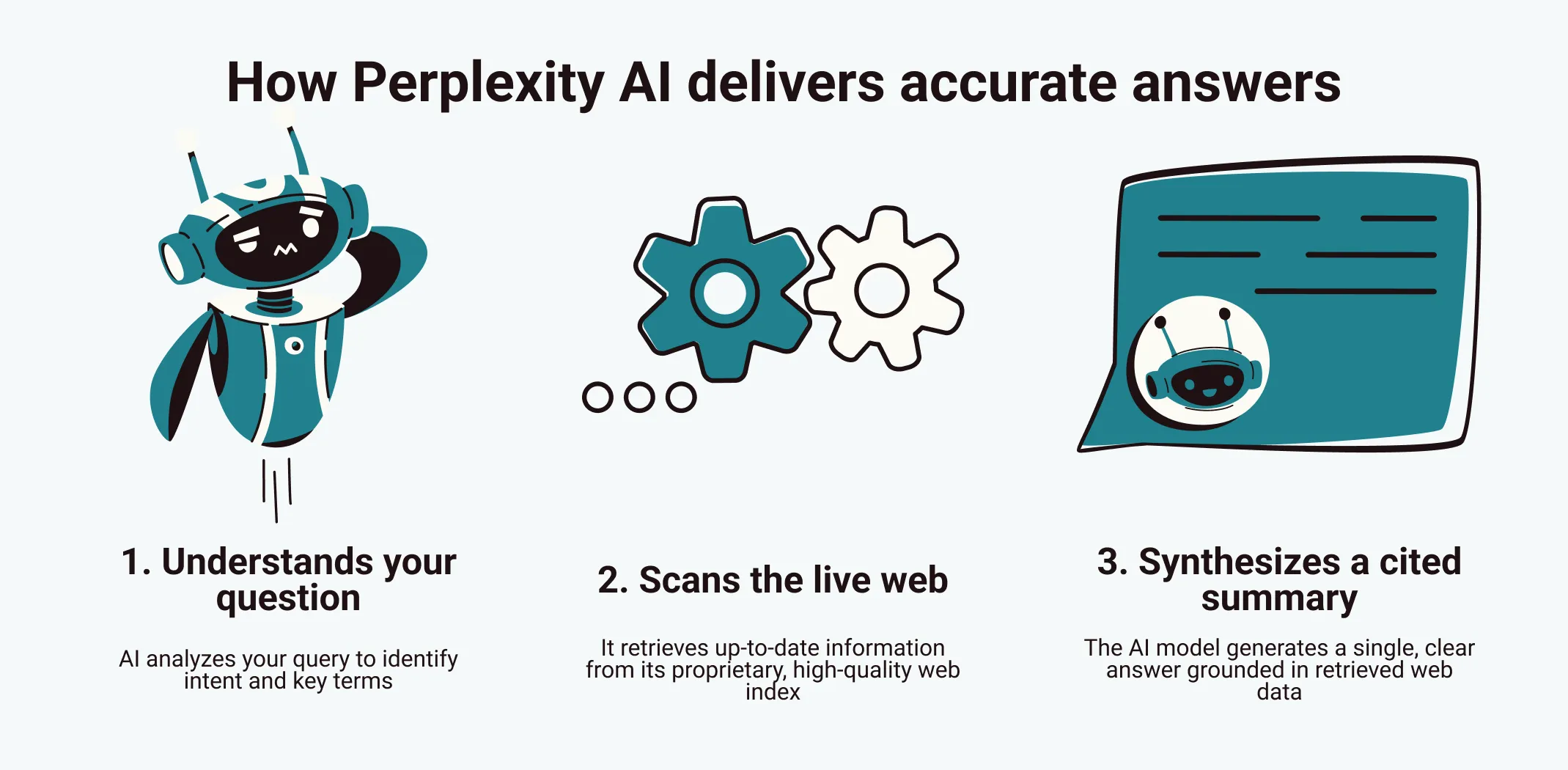
Perplexity’s architecture leverages RAG techniques, combining the LLM’s generative capabilities with retrieved web knowledge. When a query is submitted, the system performs three primary steps:
- Query understanding: Semantic parsing identifies intent, key terms, and context;
- Web retrieval: Relevant snippets are pulled from the in-house index using ranking algorithms that prioritize quality and relevance;
- Synthesis: The LLM generates a response, integrating retrieved snippets with pre-trained knowledge to produce a readable, factual, and context-aware answer.
This approach balances the model’s internal knowledge with up-to-date, real-world information, reducing hallucinations common in pure generative models.
4. Multi-turn context & conversational flow
Perplexity AI supports multi-turn conversations, maintaining context across follow-up questions. The combination of the online LLMs and RAG allows the system to interpret follow-ups in light of prior queries, generating coherent, continuous responses. This is particularly useful in research or learning scenarios, where a user may progressively refine questions.
5. Limitations and edge cases
Despite its advanced design, Perplexity’s architecture has some limitations:
- Highly technical or proprietary topics may not have sufficient snippet coverage, requiring external verification;
- Extremely new or obscure web content may take time to be indexed, creating minor lag in real-time accuracy;
- As with all LLMs, the system may occasionally misinterpret ambiguous queries or generate overly generalized responses.
Overall, the architecture – combining online LLMs, sophisticated search infrastructure, RAG synthesis, and fine-tuning – allows Perplexity AI to provide accurate, timely, and contextually relevant answers, distinguishing it from both offline AI models and traditional search engines.
User base & adoption metrics
Perplexity AI’s adoption trajectory has been steep. According to the company’s official announcements, within the first year after its launch the platform achieved millions of monthly active users. By 2025, public estimates from independent analytics groups suggest tens of millions of active users worldwide, with hundreds of millions of monthly queries.
This growth reflects interest across demographics:
- Students and educators use the platform to clarify concepts and prepare explanations;
- Professionals – from marketing analysts to legal researchers – rely on Perplexity to gather briefings or summaries;
- Casual users enjoy quick access to explanations about hobbies, health basics, or current events.
The platform’s wide geographic reach spans over 200 countries and is especially popular where traditional search may be slow or less explanatory. Traffic data suggests strong penetration in North America, Europe, and increasingly Asia and Africa.
Adoption metrics serve as an informal indicator of Perplexity’s impact compared to other AI assistants. While not as large as Google Search’s user base, Perplexity’s rapid growth illustrates demand for AI tools that prioritize clarity and source transparency.
Platform availability & interfaces
Perplexity AI is designed to be widely accessible across multiple platforms. The primary interface is a web application, which works on all major browsers, including Chrome, Firefox, Edge, and Safari. This ensures that users can access the service without installing any software.
In addition, the platform has mobile applications for both iOS and Android, offering a responsive interface optimized for smaller screens. Users can ask questions, receive answers with citations, and interact with follow-up queries seamlessly on mobile. Mobile notifications can alert users to new features or updates, enhancing engagement.
Perplexity AI also supports browser extensions that integrate its capabilities into other workflows. For instance, a student browsing Wikipedia or reading news articles can highlight a paragraph and ask Perplexity for a concise summary or explanation.
For developers and enterprises, the platform offers API access, allowing third-party applications to integrate Perplexity’s question-answering and summarization features. Examples include educational platforms using the API to assist students or research tools automating literature review summaries. This extensibility increases Perplexity AI’s ecosystem value beyond individual users.
Monetization & business model
Perplexity AI operates on a subscription-driven model, focusing on providing a professional, distraction-free experience rather than relying on advertising revenue. The platform offers multiple tiers, each designed to meet the needs of different types of users, from individual professionals and power users to enterprise teams.
Individual plans
For individual users, plans such as Pro and Max provide several key benefits over the free tier:
- Access to premium LLMs: Subscribers can use advanced models comparable to GPT-4, Claude-class models, and other frontier architectures, offering enhanced reasoning, accuracy, and contextual understanding.
- Higher usage limits: Paid users can submit more queries per month and handle more complex interactions without hitting system limits.
- Faster and prioritized responses: During peak times, paying users benefit from priority processing, reducing wait times and improving reliability.
- Enhanced research tools: Subscribers can access features designed to support research and content creation, including improved file handling, multi-turn workflows, and more advanced querying capabilities.
Pricing for individual plans is structured to be accessible to professionals and power users, making it attractive for students, researchers, and knowledge workers who need more robust AI capabilities than the free tier provides.
Enterprise plans
Perplexity’s enterprise offerings focus on team collaboration, security, and scalable workflows:
- Team collaboration and admin controls: Enterprise accounts allow organizations to manage multiple users, monitor usage, and configure permissions.
- Internal knowledge integration: Enterprises can integrate proprietary documents or internal knowledge bases, enabling the AI to work with private datasets securely.
- Higher file and query limits: Designed for professional use at scale, enterprise plans support more simultaneous queries and larger file handling.
- Security and compliance features: Enterprise plans prioritize data privacy, compliance, and robust administrative oversight, ensuring safe usage across sensitive corporate environments.
- Access to premium models: Like individual plans, enterprise subscriptions provide access to top-tier LLMs with high reasoning and retrieval capabilities, optimized for business workflows.
Unlike some AI providers, API call credits are not the central focus of Perplexity’s monetization; rather, the platform emphasizes research, collaboration, and access to high-performance models.
The result is a professional-grade environment suitable for individuals and organizations who rely on accurate, efficient, and reliable AI assistance for knowledge work.
Comparisons with other platforms
Perplexity AI occupies a distinct space between traditional search engines and generative AI assistants, offering concise, cited answers for users who need verifiable information quickly. Comparing it to other popular platforms highlights its specific advantages and trade-offs.
- Google Search: Known for its vast coverage and speed, Google Search excels at delivering raw information and indexing content in real time. However, users must manually sift through multiple links to extract relevant knowledge. Perplexity AI differs by producing direct, summarized answers with source citations, reducing the effort required for research. Multi-turn queries also allow follow-up questions to be understood in context, something Google Search does not support.
- ChatGPT: ChatGPT excels at conversational engagement, creativity, and open-ended exploration. Its major limitation is lack of reliable citations, which makes it less suitable for academic or professional research. Perplexity AI prioritizes source transparency, giving users confidence in the verifiability of the answers.
- Google Gemini: Gemini combines conversational AI with real-time search and multi-modal capabilities. While it provides interactive and dynamic responses, Perplexity AI differentiates itself by focusing on concise, verifiable summaries drawn from multiple sources, which many users find more trustworthy for research or fact-checking tasks.
How Perplexity AI differs from other platforms
Implications for users:
Perplexity AI is ideal for research-focused users who value accuracy, verifiable sources, and concise summaries. ChatGPT is better suited for creative exploration or brainstorming, Google Search excels in breadth and real-time indexing, and Google Gemini combines conversational interactivity with dynamic search, appealing to users who want mixed capabilities.
Choosing the right platform depends on the user’s priorities: whether trustworthy citations, creative freedom, or real-time multi-modal information is most important.
Interface & user experience
Perplexity AI’s interface emphasizes clarity, readability, and user control. The central query box allows users to type natural language questions, and responses are presented with clearly marked citations.
Desktop users benefit from side-by-side “source cards,” while mobile users experience scrollable, touch-friendly designs. Follow-up questions are supported, maintaining conversational context for multi-turn interactions.
The platform also offers feature flexibility: users can request simplified explanations, extended answers, or examples. This supports both casual learners and professional users seeking detailed information.
Challenges remain. Some users report that multi-turn context is occasionally imperfect, and switching between models (e.g., proprietary LLM vs GPT variants) can be confusing. Features like document uploads or more advanced tools may have inconsistencies, creating minor friction for power users. Nevertheless, the interface balances ease of use with depth, making Perplexity AI accessible while retaining professional utility.
Criticisms & controversies
Perplexity AI’s key controversies focus on accuracy, source interpretation, and legal disputes. Even with citations, the AI may misinterpret content or occasionally produce incomplete or inaccurate summaries. For example, users have reported instances where medical or technical references were summarized incorrectly, emphasizing the need for verification before applying information.
Source bias is another concern. Since the platform draws from web content, answers may reflect regional or ideological biases. Users are encouraged to cross-check responses for controversial or sensitive topics.
Legally, Perplexity AI has faced challenges regarding content usage. Lawsuits from publishers such as The New York Times allege unauthorized scraping and reproduction of proprietary material. Perplexity argues that its use is transformative, generating summaries rather than reproducing content verbatim. These disputes illustrate the evolving legal landscape around AI and intellectual property.
Finally, some users have expressed frustration with interface consistency and engagement, noting that while the platform excels at sourcing, it can feel less conversational or interactive than other AI assistants. These criticisms highlight areas for ongoing refinement without diminishing the platform’s core strengths.
Recent developments
In 2025, Perplexity AI expanded both consumer and enterprise offerings. Strategic partnerships with publishers, such as Wiley, integrated authoritative content into the AI for educational and research purposes. Collaborations with corporations like SoftBank facilitated enterprise deployment, expanding usage in finance, healthcare, and technology sectors.
Consumer adoption grew through promotional campaigns, including Perplexity Pro giveaways via PayPal, Venmo, and student programs. Financial data integration, for example with Benzinga, strengthened the platform’s value for market analysis. A high-profile $400M partnership with Snapchat aims to embed Perplexity AI into chat interfaces, potentially reaching nearly a billion users.
These developments highlight Perplexity AI’s strategy of ecosystem expansion, cross-platform accessibility, and enterprise integration, enhancing utility while broadening its user base.
What the future holds for Perplexity AI
Perplexity AI is poised to continue expanding through integration, multilingual support, and technical refinement. Consumer device partnerships, such as potential preloading on Samsung Galaxy devices, could make AI-assisted search a default interface for everyday tasks. The Comet browser, with built-in AI capabilities, represents a vision of AI as a central interaction layer, not just a query tool.
Technically, ongoing improvements aim to reduce hallucinations, improve context retention, and integrate real-time data, enhancing reliability in professional and research contexts. Multilingual expansion will broaden global reach, particularly in emerging markets like India, where strategic campaigns have already boosted adoption.
Regulatory and ethical considerations will influence future growth. Copyright challenges, content licensing, and bias mitigation remain key focus areas. By balancing technical innovation with legal compliance and ethical responsibility, Perplexity AI is positioned to remain a leading AI-assisted knowledge platform globally.
Are you ready to become an owner
of a profitable online business?
Free Dropshipping Guide