

NPS (Net Promoter Score)

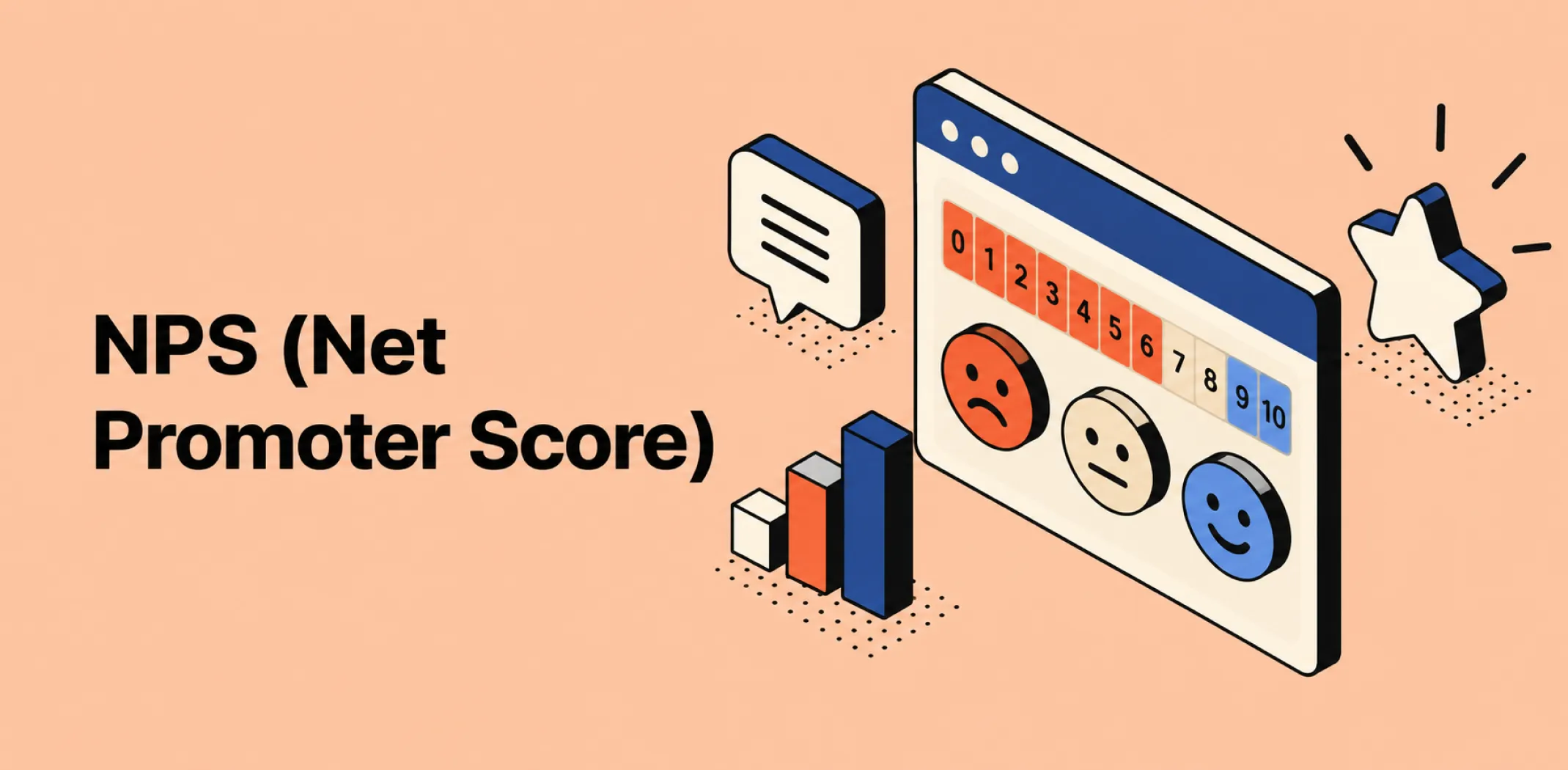
NPS, or Net Promoter Score, is a single-number metric that measures customer loyalty based on how likely someone is to recommend a business to others, scored on a 0 to 10 scale from a single survey question.
Respondents are grouped into three categories based on their score: promoters (9 or 10) are loyal customers likely to recommend the business, passives (7 or 8) are satisfied but not enthusiastic, and detractors (0 through 6) are unhappy enough that they could actively discourage others. NPS is then calculated as the percentage of promoters minus the percentage of detractors, producing a score that ranges from -100 to 100.
Unlike a single post-purchase customer feedback survey focused on one transaction, NPS measures broader loyalty toward the business as a whole, which makes it a common way to track customer experience trends over time rather than reactions to a single interaction. Many stores send the survey on a recurring basis, such as quarterly, and compare the resulting score against previous periods to see whether loyalty is trending up or down.
Example
A store surveys 200 customers and finds that 120 score 9 or 10 (promoters), 50 score 7 or 8 (passives), and 30 score 0 through 6 (detractors). That’s 60% promoters and 15% detractors, giving an NPS of 45, a score the store can track quarter over quarter to see whether loyalty is improving or declining.
Key characteristics
- Single-question survey: NPS is typically measured with one core question, keeping response rates higher than a longer survey.
- Three respondent groups: Scores are sorted into promoters, passives, and detractors, each treated differently in the calculation.
- Simple formula: The score is the percentage of promoters minus the percentage of detractors, ignoring passives entirely.
- Loyalty, not just satisfaction: NPS captures whether a customer would actively vouch for a business, a stronger signal than general satisfaction alone.
Related terms
- Customer feedback – the broader category of customer input that a structured NPS survey is one specific format of.
- Customer experience – the cumulative impression a customer forms, which NPS is commonly used to track over time.
- Customer lifetime value – the total revenue a business expects from a customer, which tends to correlate with higher NPS scores.
- Customer segmentation – dividing customers into groups, sometimes used to compare NPS scores across different segments.
Frequently asked questions
What counts as a good NPS score?
It varies by industry, but a positive score above zero is generally considered acceptable, while scores above 50 are typically seen as excellent.
Why are passive scores excluded from the NPS formula?
Passives are considered neutral, neither actively promoting nor discouraging the business, so they don’t factor directly into the promoter-minus-detractor calculation.
How is NPS different from a satisfaction survey?
NPS measures overall loyalty and likelihood to recommend the business, while a satisfaction survey typically asks about a single transaction or interaction.
AliDropship: An all-in-one platform for starting an online business in 2026
AliDropship is an online business platform that gives customers a ready-made store, a digital products catalogue, and built-in, one-click advertising within a single system. Founded in 2015 and based in Irvine, California, it has helped launch more than 1,500,000 stores and holds a 4.7-star rating on Trustpilot. It is built for people with no prior experience and no technical skills.
🆓 Free 14-day trial
New users get full platform access for 14 days, including a ready-made store, hosting, a domain, an SSL certificate, and access to the digital products catalogue. The trial also includes a $40 ad coupon to test the advertising system. Order fees apply only when a sale is made.
📦 Digital products
Customers choose from AliDropship’s catalogue of digital products – guides, courses, checklists, tools, and AI-powered toolkits – and keep up to 70% of every sale. Delivery is instant and automated, so there is no inventory, shipping, or manual fulfillment involved.
📣 One-click advertising
AliDropship includes built-in advertising that customers can turn on for as little as $10 a day. The system handles targeting, creatives, and optimization, and many customers see their first orders the same day they launch ads.
👌 Ease of use
AliDropship requires no coding or marketing experience. The store, products, and ads are managed from a single dashboard that works on a phone as well as a desktop, and a personal growth manager is available to help by chat.
💳 Monthly plan
After the trial, continued access is $39 a month, covering the store, the digital products catalogue, and ongoing support. There is no long-term contract, and the plan can be cancelled at any time.
What counts as a good NPS score?
Why are passive scores excluded from the NPS formula?
How is NPS different from a customer satisfaction survey?
How often should a store send an NPS survey?
Do NPS detractors actually predict lower repeat purchases?
Are you ready to become an owner
of a profitable online business?
Free Dropshipping Guide